

Case Background
The Bihar Police Subordinate Service Commission issued Advertisement No. 01/2019 on 21.08.2019. The notification was for four posts: Police Sub-Inspector, Sergeant, Assistant Superintendent Jail (Direct Recruitment) and Assistant Superintendent Jail (Ex-Servicemen).
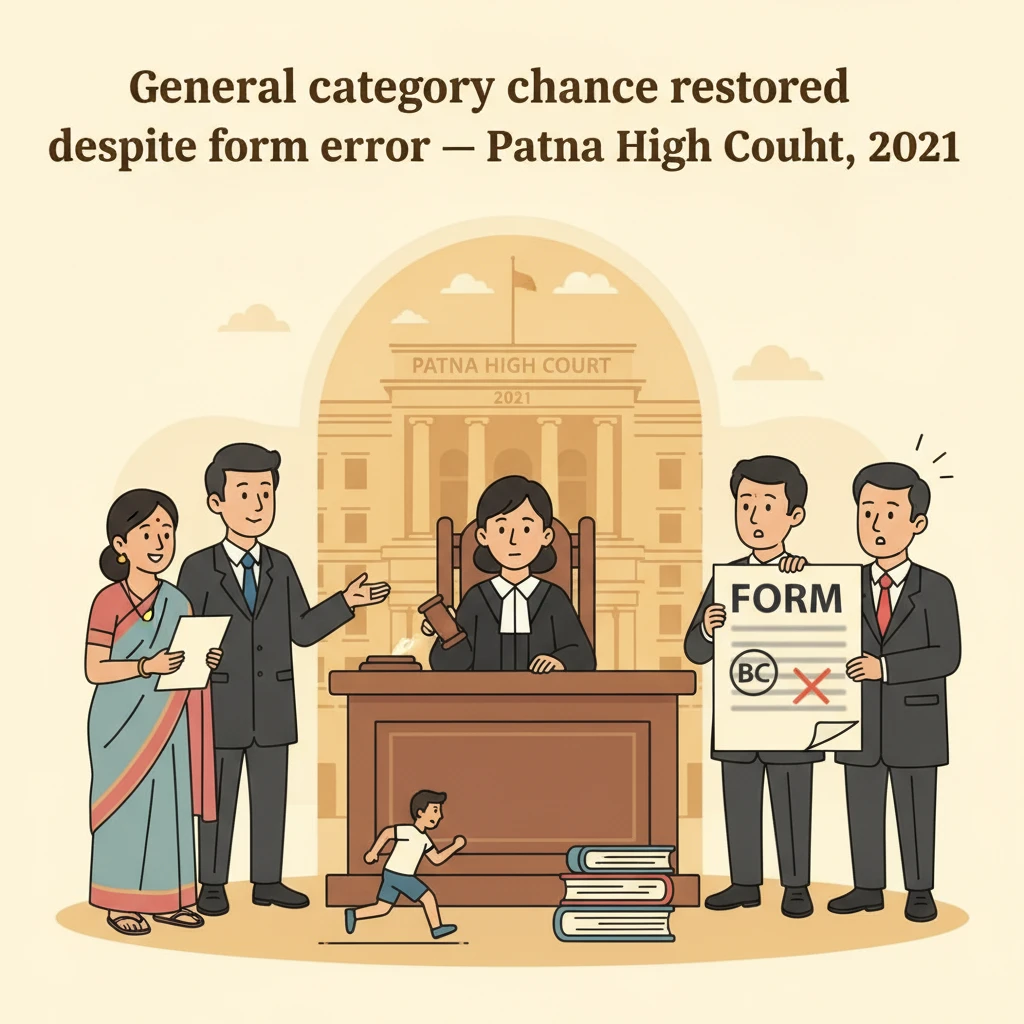
The petitioner, a woman candidate from Nalanda district, applied online for the post of Police Sub-Inspector. In the reservation category section of the application form, she mistakenly selected “BC” (Backward Classes) instead of “EBC” (Extremely Backward Classes).
Despite this error, the Commission allowed her to sit for the selection process. She appeared in the written examination and qualified. She then took part in the physical efficiency test held on 06.04.2021 and cleared it as well.
However, at the stage of further processing of the result and selection, the authorities noticed the mismatch between the category mentioned in the form and the reservation she was actually entitled to claim. Relying on conditions contained in paragraph numbers 2, 3 and 6 of the advertisement, they treated the error as fatal and cancelled her candidature altogether.
Feeling aggrieved, she filed Civil Writ Jurisdiction Case No. 10583 of 2021 before the Patna High Court. She sought directions to correct the category in her application from BC to EBC, to publish her result, to consider her under EBC quota, and to permit her to commence training for the post of Sub-Inspector.
What the Court Examined and Decided
The writ petition was heard by Hon’ble Mr. Justice P. B. Bajanthri on 08.12.2021. The core dispute revolved around two connected questions:
First, could the recruitment authorities treat the petitioner as an EBC candidate despite her having written BC in the online application? Second, even if she could not be treated as EBC, was it lawful to cancel her candidature entirely, despite her eligibility and performance in all stages of the examination?
Counsel for the petitioner argued that the wrong entry of “BC” instead of “EBC” was a simple, curable clerical mistake. According to him, this did not amount to any attempt at fraud or misrepresentation. He submitted that the authorities should have allowed correction and considered her as an EBC candidate, especially because she had already passed the written and physical tests.
He therefore requested the Court to direct the respondents to correct the category in her application form, treat her under EBC reservation, publish her result accordingly and allow her to join the further stages, including training.
On the other hand, counsel for the State and the Commission defended the cancellation. They relied on the explicit conditions mentioned in the advertisement, particularly paragraphs 2, 3 and 6. These clauses, though not reproduced in the judgment, were treated as binding terms that required cancellation of applications having incorrect particulars.
The respondents submitted that since the petitioner herself had indicated BC category in the online form, she could not later turn around to claim EBC benefits. They argued that permitting such corrections after the examination would be contrary to the recruitment rules and unfair to other candidates who had strictly complied with the advertisement.
To support this view, the respondents relied on a previous decision of the Patna High Court in Jyoti Jaiswal vs. The State of Bihar & Others in CWJC No. 6632 of 2019. Paragraph 12 of that judgment, cited in detail, had discussed how mentioning a wrong class or caste category in the application form amounted to “suppressio veri and suggestio falsi” (suppression of truth and suggestion of falsehood).
In that earlier case, the Court had noted that a candidate who knowingly claimed a reservation category different from her actual category did not deserve sympathy, especially when she failed to correct it at any stage of the process. The Court there had relied on Supreme Court precedents including Central Selection Board of Constable vs. Raj Kumar, Anil Kumar, Bedanga Talukdar, and A.P. Public Service Commission.
After hearing both sides, the Patna High Court identified the “crux of the matter” as twofold. One, whether the petitioner’s candidature could be considered under EBC as claimed. Two, whether the selecting authority was justified in cancelling her application for the post of Police Sub-Inspector entirely.
As to the first question, the Court followed the earlier decision in Jyoti Jaiswal. It held that in view of that ruling and the binding conditions of the 21.08.2019 advertisement, the petitioner could not be treated as an EBC candidate. Since she had written “BC” instead of “EBC” in her application, her claim under the EBC category could not be accepted.
Thus, her plea to correct the reservation category and to be treated as an EBC candidate was rejected.
However, the Court took a different view on the second question. It examined whether cancelling her entire candidature was justified, given that she met the basic eligibility criteria for the post even without any reservation benefit.
The judgment noted that for women in the General Merit (GM) category, the permissible age range was 20 to 40 years. The petitioner was 29 years old and therefore fully eligible to compete as a general category candidate. The Court emphasised that a candidate is normally entitled to compete both under the general category and, if applicable, additionally under a reservation category.
If a candidate makes an error or fails to meet the conditions for claiming reservation under a specific category such as BC, EBC or SC/ST, the consequence, according to the Court, should be limited. Only the claim to reservation ought to be cancelled, not the entire candidature, provided that the candidate remains otherwise eligible to compete in the General Merit category.
In the present case, the petitioner’s candidature had been cancelled solely because she had indicated BC instead of EBC. The Court held that in such circumstances the selecting authority should have considered her under the General Merit category, because she fully met the eligibility conditions for that category.
The Court went on to clarify principles relating to general and reserved category posts. It pointed out that there is no reservation for posts in the general category. All candidates, whether they belong to backward classes or not, are entitled to compete for general category posts purely on the basis of merit.
The general category seats are open to all candidates except those specifically reserved for Scheduled Castes, Scheduled Tribes and Other Backward Classes. Thus, for open category seats, caste status is irrelevant; merit alone decides selection.
To buttress this reasoning, the Court relied on the Supreme Court judgment in Saurav Yadav and Others vs. State of Uttar Pradesh, reported in (2021) 4 SCC 542. The Supreme Court had held that allowing meritorious candidates belonging to reserved categories to be selected in the general category does not amount to “communal reservation”. Instead, it is a settled principle that open or general category seats are available to all candidates, regardless of their reservation status, so long as they are selected on merit.
The Supreme Court also made clear that when candidates from reserved categories secure selection on their own merit in the general category, their appointments cannot be counted against the reservation quota of their respective reserved categories. The Patna High Court quoted the observation that “the open category is open to all, and the only condition for candidate to be shown in it is merit, regardless of whether reservation benefit either type is available to her or him.”
Applying these principles, the Patna High Court concluded that the recruitment authorities had erred in cancelling the petitioner’s entire application. Instead, they were required to consider her as a candidate under the General Merit category, given her eligibility and performance.
Accordingly, the Court directed the concerned respondent and selecting authority to consider the petitioner’s candidature under the General Merit quota/category and to permit her to participate in the further process for the post of Police Sub-Inspector.
The writ petition was thus allowed in part. The relief of correction from BC to EBC and EBC-based selection was denied, but the right to be considered in the general category was protected.
After the Court dictated this order, counsel for the State/Service Commission submitted that the selection process had already been completed and that the petitioner should have impleaded the last selected candidate as a necessary and proper party. A similar point had been mentioned in the counter affidavit, but detailed arguments were not addressed when the case was actually heard.
The Court noted that this objection was raised only after pronouncement of the operative order. To safeguard third-party rights, the Court therefore clarified that if, during implementation of the order, the Commission finds any hurdle or potential impact on rights of any third party, such person should be given notice. After giving such notice, the Commission may proceed in accordance with law.
Why This Judgment Matters
This decision is important for candidates in government recruitment examinations, especially in Bihar. It shows that a genuine mistake in claiming the wrong reservation category can cost a candidate the quota benefit, but should not automatically prevent them from competing in the general category if they otherwise meet the eligibility conditions.
For aspirants to posts like Police Sub-Inspector, the judgment clarifies that the open category is truly open to all. Even if there is a problem with a reservation claim, authorities should still consider whether the candidate can be accommodated purely on merit in the general category.
The ruling also reminds recruitment bodies to apply advertisement conditions reasonably. While they can strictly enforce rules about reservation categories, they cannot use such errors as a ground to completely oust eligible and meritorious candidates from the selection process.
At the same time, the judgment reaffirms earlier decisions that candidates must be careful and truthful while filling out application forms. Wrongly indicating caste or class category will not be easily excused when it comes to claiming reservation benefits.
Legal Issues and Answers
- Issue: Can a candidate who mistakenly mentioned “BC” instead of “EBC” in the online application later demand correction and consideration under the EBC reservation category?
Answer: No. In view of the advertisement conditions and earlier judgment in Jyoti Jaiswal, the petitioner could not be treated under EBC after having written BC in the form. - Issue: Is it lawful to cancel a candidate’s entire candidature only because of such an error in the reservation category, when the candidate is otherwise eligible for the general category?
Answer: No. The Court held that only the reservation claim can be rejected; the candidate must still be considered under the General Merit category if she satisfies that category’s eligibility criteria. - Issue: Are general category seats in such recruitments reserved for any particular caste or class?
Answer: No. Relying on Saurav Yadav, the Court reiterated that the open or general category is open to all candidates purely on merit, regardless of caste or reservation status.
Cases Cited by the Court
- Jyoti Jaiswal vs. The State of Bihar & Others, CWJC No. 6632 of 2019 (Patna High Court).
- Central Selection Board of Constable vs. Raj Kumar (cited within Jyoti Jaiswal, relied upon by the Court).
- Anil Kumar (cited within Jyoti Jaiswal, relied upon by the Court).
- Bedanga Talukdar (Supreme Court, cited within Jyoti Jaiswal, relied upon by the Court).
- A.P. Public Service Commission (Supreme Court, cited within Jyoti Jaiswal, relied upon by the Court).
- Saurav Yadav and Others vs. State of Uttar Pradesh, (2021) 4 SCC 542.
Case Details
Case Number: Civil Writ Jurisdiction Case No. 10583 of 2021
Case Title: Dolly Kumari vs. The State of Bihar & Others
Coram: Hon’ble Mr. Justice P. B. Bajanthri
Citation: 2022 (1) PLJR 881
Advocates:
- For the petitioner: Dr. Anjani Pd. Singh, Advocate
- For the State/Respondents: Mr. Ajay Kumar, AC to GP 4
- For the Bihar Police Subordinate Service Commission: Mr. Sanjay Pandey, Advocate; Mr. Nishant Kumar Jha, Advocate
Nature of the case: Writ petition under Article 226 challenging cancellation of candidature in recruitment to the post of Police Sub-Inspector and seeking correction of reservation category.
Link to full judgment: Patna High Court Judgment in CWJC No. 10583 of 2021
If you found this explanation helpful and wish to stay informed about how legal developments may affect your rights in Bihar, you may consider following Samvida Law Associates for more updates.







