

Case Background
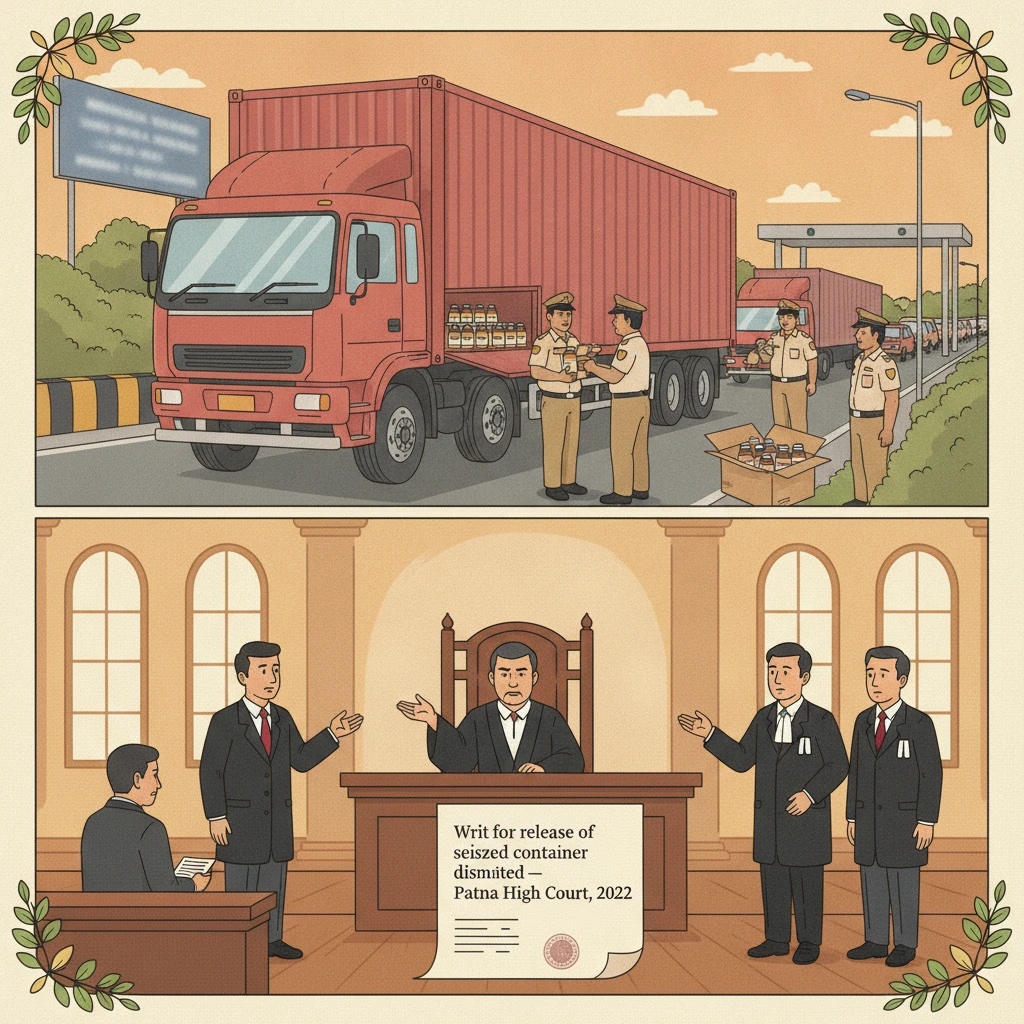
This case arose from a seizure made by Customs officials at the Land Customs Station, Raxaul, in East Champaran district, Bihar. On 05.06.2021 at about 6:00 p.m., the Inspector (Prevention), Land Customs Station, Raxaul, received information that manufactured psychotropic drugs were being moved in a trailer bearing registration number NL01AB3612.
The trailer was carrying a Customs Transit Declaration (CTD) consignment meant to go from India to Nepal through the Laxmipur, Integrated Check Post, Raxaul road. Acting on the information, the Deputy Commissioner, Land Customs Station, formed a preventive team.
The team went to the Indo–Nepal border and found the trailer standing in a queue with other vehicles. A forty-foot sealed container was loaded on the trailer. No one was found inside the trailer cabin. On inquiry, the team was informed that the driver had been there shortly before.
The officials took the help of another driver, brought the trailer inside the Integrated Check Post, and searched it in the presence of witnesses. In the cabin they found a bunch of keys and a folder containing vehicle documents such as the registration certificate. They also found two cartons containing bottles of ONEXREX cough syrup, packed in 100 ml bottles.
On further inspection, the team noticed a suspicious cavity underneath the chassis of the trailer, which was locked. Using one of the keys from the cabin, they opened this cavity and recovered more bottles of the same ONEXREX cough syrup, stacked in tray-type packets. In total, 1170 bottles were recovered and a seizure list was prepared.
Treating ONEXREX cough syrup as a psychotropic substance, the authorities seized the vehicle under Section 60(3) of the Narcotic Drugs and Psychotropic Substances Act, 1985 (NDPS Act), alleging violation of Sections 8 and 21 of that Act, read with Sections 7, 11, 50 and 51 of the Customs Act, 1962. This seizure led to registration of NDPS Case No. 52 of 2021.
The present writ petitioner is a transport company. It had hired the trailer from another transport firm, M/s Rai Paribahan, Kolkata. According to the Union of India, the trailer had been hired to transport a Rice Mill Machine Set from Kolkata to a purchaser in Nepal, M/s Mamta Traders. The rice mill machine had arrived in India from China in the same container, which was sealed by Customs at Kolkata. The CTD route for the sealed container to reach Nepal passed through Bihar under the Treaty of Transit between India and Nepal.
On 12.07.2021, the petitioner moved an application before the Special Judge, East Champaran, Motihari, seeking release of the sealed container that was loaded on the seized trailer. The Special Judge rejected this application on the same date. The petitioner then approached the Patna High Court under Articles 226 and 227 of the Constitution, challenging the seizure memo and the Special Judge’s order and seeking release of the container.
What the Court Examined and Decided
The core dispute before the Patna High Court was not about whether ONEXREX cough syrup is a psychotropic substance or whether any person was guilty under the NDPS Act. Instead, the Court focused on a threshold question: could this particular transport company maintain a writ petition to seek release of the seized container?
The writ petition sought several reliefs. The petitioner asked for quashing of Seizure Memo No. 01 of 2021 dated 06.06.2021, prepared by the Inspector (Prevention)-cum-Seizure Officer, Raxaul, to the extent it included the container along with the trailer. The petitioner also sought a direction for release of the 40-foot container bearing number OOCU6959842, described as containing CTD goods, namely a rice mill machine set. It was stressed that the container carried Customs seals, bearing numbers OOLGQ86490 and WINT00017202, and that these seals were intact.
Further, the petitioner challenged the order dated 12.07.2021 of the Sessions Judge/Special Judge, East Champaran, rejecting its application for release of the container in NDPS Case No. 52 of 2021. The petitioner also sought a declaration that the container was neither a narcotic substance nor a “conveyance” used to transport the alleged narcotic, but instead was itself an article under conveyance on the trailer.
On behalf of the Union of India and Customs, the Additional Solicitor General first raised a preliminary objection regarding maintainability. He argued that the petitioner was not the owner of the container or of the goods inside it. The owner of the goods was stated to be M/s Mamta Traders (Nepal), and the owner of the trailer was M/s Rai Paribahan (Kolkata). The petitioner was only a transporter, engaged in arranging carriage of goods.
According to the respondents, because the petitioner neither owned the container nor the rice mill machine, it had no locus standi to seek release of the container in the trial court or in the High Court. The ASG also contended that any challenge to the Special Judge’s order should have been through revision under Sections 397 and 401 of the Code of Criminal Procedure, 1973, not through a writ petition.
On the merits, the ASG argued that the trailer, though carrying a duly sealed container, was used as a smoke-screen for smuggling psychotropic substances to Nepal. ONEXREX cough syrup was allegedly recovered from the cabin and the hidden cavity beneath the trailer, not from the sealed container. The ASG accepted that the Customs seal on the container remained intact and that there was no allegation against the rice mill machine inside the container.
For the petitioner, Senior Counsel argued that the company had been authorized by the purchaser in Nepal, M/s Mamta Traders, to seek release of the goods. He referred to an authorization letter dated 01.10.2021 (Annexure 15 to the second supplementary affidavit) to show that the owner of the rice mill machine had empowered the petitioner to obtain delivery of the machine from any department, authority or court.
Counsel for the petitioner stressed that, even according to the authorities, no narcotic or psychotropic substance had been recovered from inside the sealed container. All the alleged contraband was found only in the cabin and the under-chassis cavity of the trailer. Since the container itself contained only lawful goods under Customs seal, and since Section 60 of the NDPS Act allows confiscation of an “animal or conveyance” used for carrying narcotic drugs or psychotropic substances, the petitioner argued that the container was not liable to seizure at all.
The Court carefully examined these rival positions. It began by noting some undisputed facts. The petitioner had provided transportation for the goods sealed in the container. It had hired the trailer but did not own it. It was also not the owner of the rice mill machine set inside the container. The container had been sealed at Kolkata based on a Customs Transit Declaration made by the purchaser, M/s Mamta Traders, Nepal.
Importantly, the High Court scrutinized the exact reliefs claimed in the writ petition. It noted that the petitioner had prayed only for release of the container and for quashing of the seizure to that extent. There was no prayer for release of the rice mill machine inside the container, even though the disputed authorization letter related to the machine.
The Court observed that, as per the writ petition, the petitioner had hired the trailer and had loaded the sealed container onto it. The psychotropic substance, ONEXREX cough syrup, had been recovered from the trailer, not from the container. The petitioner clearly admitted it was not the owner of the trailer. It was also not the owner of the container whose release was sought.
The Court then turned to the authorization documents. It recorded that no authorization from the owner of the container or from the owner of the trailer had been produced. The authorization dated 01.10.2021 was, at best, in respect of the rice mill machine loaded in the container under Customs seal. But, as the Court highlighted, there was no prayer anywhere for release of the machine itself, either before the Special Court or in the High Court.
In these circumstances, the Court held that the petitioner was neither the owner of the container nor an authorized representative of the container’s owner. Without such locus standi, the petitioner could not maintain a prayer for release of the container.
The High Court also noted that the Special Judge’s order of 12.07.2021 had refused release of the container on the petitioner’s application, and that the same relief was now being pursued through the writ petition. But since the petitioner had no legal standing to seek release of the container at all, no case was made out to grant relief.
Significantly, while dismissing the writ petition, the Court made it clear that its observations were confined to the question of locus and maintainability. It expressly stated that nothing recorded in the judgment should be treated as an opinion on the merits of NDPS Case No. 52 of 2021 pending before the Special Judge, East Champaran, Motihari.
Ultimately, the Court concluded that the writ petition was devoid of merit and dismissed it.
Why This Judgment Matters
This decision is important for transporters, logistics companies and agents involved in cross-border trade through Bihar. The Patna High Court has clarified that a transporter cannot automatically claim release of seized property just because it arranged the carriage.
To challenge a seizure or seek release of a vehicle, container or goods, the person must either be the owner or have a clear, valid authorization from the owner of that very property. Even a document from the owner of the goods is not enough if the relief sought is for some other property, like a container, and no authorization for that property is produced.
The judgment also shows that when criminal proceedings under the NDPS Act are pending, the High Court will be cautious in using its writ powers to interfere with seizures and orders of the Special Court, especially at the instance of someone who lacks legal standing. This reinforces the need to follow proper procedural routes, such as revisions under the Code of Criminal Procedure where applicable.
For traders and transporters dealing with CTD consignments and sealed containers moving through India to neighbouring countries, the case underlines the importance of clear documentation of ownership and authority. If a seizure occurs, the real owners or properly authorized representatives should come forward promptly to assert their rights.
Legal Issues and Answers
Issue: Can a transport company that is neither the owner of a seized container nor authorized by its owner maintain a writ petition to seek release of that container?
Answer: No. The Patna High Court held that since the petitioner was not the owner of the container and had produced no authorization from the container’s owner, it had no locus standi to seek release, making the writ petition unsustainable.
Issue: Did the High Court decide whether the seizure of the container and trailer under the NDPS Act and Customs Act was valid on merits?
Answer: No. The Court confined itself to the petitioner’s lack of locus and explicitly stated that its observations should not be treated as any opinion on the merits of NDPS Case No. 52 of 2021 pending before the Special Judge.
Cases Cited by the Court
- The judgment records reliance by the respondents on Supreme Court decisions in Girish Kumar Suneja v. Central Bureau of Investigation, (2017) 14 SCC 809, and Pepsi Foods Ltd. v. Special Judicial Magistrate, (1998) 5 SCC 749, to argue about maintainability and alternate remedy. The Patna High Court’s reasoning, however, turns primarily on the petitioner’s lack of locus standi.
Case Details
Case Number: Criminal Writ Jurisdiction Case No. 904 of 2021
Case Title: M/s Road Star Logistics Pvt Ltd v. Union of India & Ors.
Citation: 2022 (1) PLJR 797
Coram: Hon’ble Mr. Justice Madhuresh Prasad
Advocates:
- For the petitioner: Mr. S.D. Sanjay, Senior Advocate with Mr. Mohit Agarwal, Advocate
- For the Union of India: Dr. K.N. Singh, Senior Advocate (Additional Solicitor General of India) with Ms. Sriram Krishna and Ms. Prakritika Sharma, A.C. to ASGI
- For the Customs: Mr. Anshuman Singh, Senior Standing Counsel, Customs
- For the NCB: Mr. Manoj Kumar Singh, Central Government Counsel
Nature of the Case: Criminal writ petition under Articles 226 and 227 of the Constitution of India, seeking quashing of seizure memo and release of a container seized in an NDPS case, and challenging an order of the Special Judge refusing such release.
Link to Judgment: Patna High Court Judgment in CR WJC No. 904 of 2021
If you found this explanation helpful and wish to stay informed about
how legal developments may affect your rights in Bihar,
you may consider following Samvida Law Associates for more updates.







