

Case Background
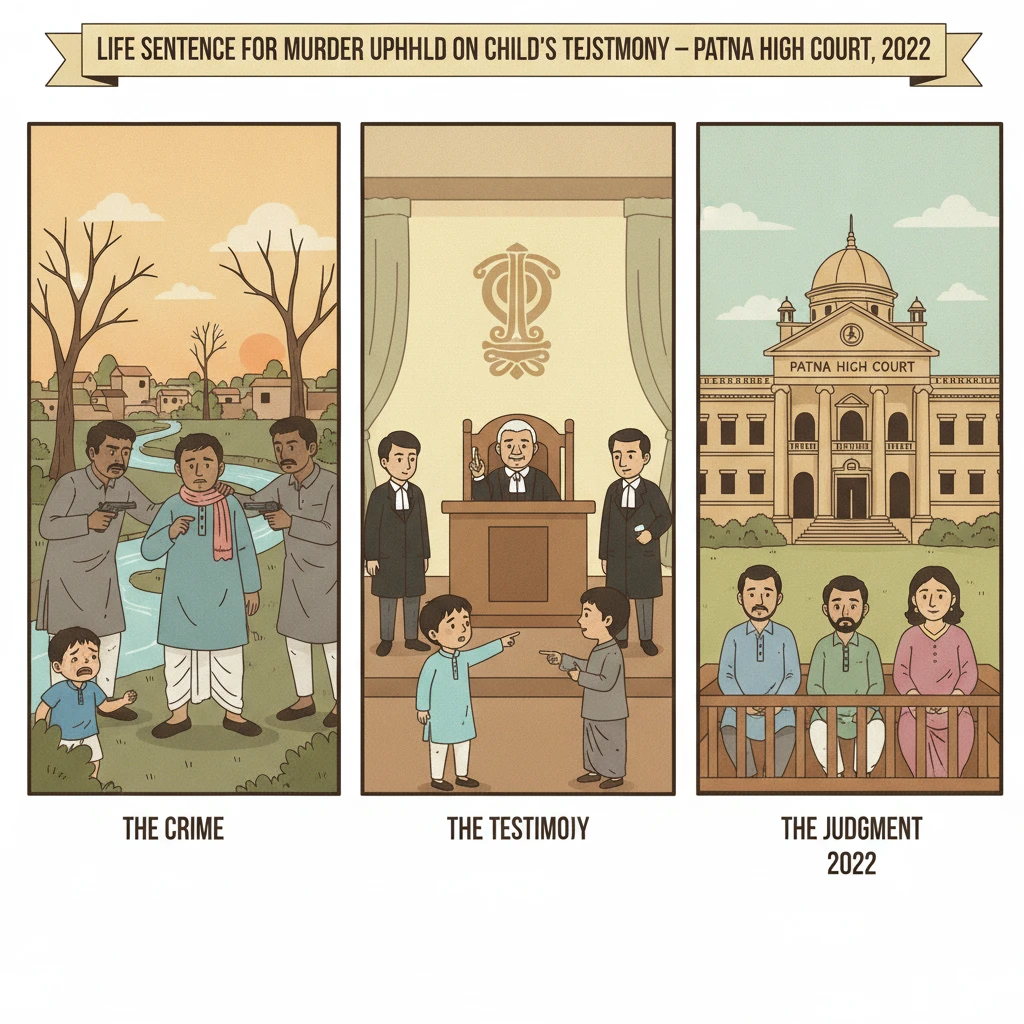
The case arises from Karpi P.S. Case No. 54 of 1994, relating to the killing of Krishna Singh near village Radhenagar under Karpi Police Station. The occurrence took place on 04.06.1994 in the evening, when Krishna Singh was travelling with his young son to attend a tilak ceremony at village Bhimali Chak.
The son, Sunil Kumar, later examined as PW-11, gave his fardbeyan the same night at about 21:00 hours at village Bhimali Chak. His statement was recorded by Sub-Inspector Mahadeo Chaudhary of Deo Kund Police Station, District Aurangabad. As the place of occurrence fell within Karpi Police Station, the fardbeyan was handed over to S.I. Yamuna Singh (PW-13) of Karpi P.S., who sent it to Karpi P.S. for registration and himself took up investigation. Karpi P.S. Case No. 54 of 1994 was instituted on 05.06.1994.
After investigation, the Investigating Officer submitted charge-sheet. Cognizance was taken and the matter was committed to the Court of Sessions, Jehanabad, for trial.
Sessions Trial No. 216 of 1994 ended in a judgment dated 30.09.1996 by the Ist Additional District & Sessions Judge, Jehanabad. In that trial, two accused, Chandra Shekhar Singh and Satendra Singh, were convicted under Section 302/34 of the Indian Penal Code and sentenced to rigorous imprisonment for life. Satendra Singh was also sentenced to two years’ imprisonment under Section 27 of the Arms Act. A third accused in that trial, Indra Deep Singh, was acquitted.
Another accused, Butan Singh, absconded at the stage of his examination under Section 313 of the Code of Criminal Procedure. His trial was separated and later conducted as Sessions Trial No. 211 of 1996/44 of 2002. By judgment dated 27.04.2009, the Additional Sessions Judge (Fast Track Court No.1), Jehanabad, convicted him under Section 302/34 of the Indian Penal Code and Section 27(1) of the Arms Act, sentencing him to life imprisonment for murder and three years’ rigorous imprisonment for the Arms Act offence.
The three criminal appeals before the Patna High Court—Criminal Appeal (DB) No. 513 of 1996, Criminal Appeal (DB) No. 550 of 1996, and Criminal Appeal (DB) No. 638 of 2009—arise from these two trial judgments. As they all related to Karpi P.S. Case No. 54 of 1994, the High Court decided them together.
What the Court Examined and Decided
The key question before the Patna High Court was whether the convictions could safely rest on the testimony of a single eye-witness, Sunil Kumar (PW-11), who was a minor at the time of the occurrence and a child witness at the time of deposition.
According to the prosecution case set out in the fardbeyan, on 04.06.1994 at about 1:45 P.M., Sunil Kumar and his father Krishna Singh left their village Ramlagan Bigha on a bicycle for Bhimali Chak to attend a tilak ceremony at the house of one Shivdhari Mahto. Around 5:30 P.M., when they reached near village Radhenagar, near a cremation ground (Shamshan Ghat, Chirari), they were allegedly intercepted.
PW-11 stated that he saw four accused: Indra Deep Singh with pistol, Chandra Shekhar Singh with dagger, Satendra Singh with pistol, and Butan Singh, resident of Mahadeo Bigha, with pistol. They surrounded his father, caught hold of him, tied his neck with a gamcha, dragged him up to Radhanagar Badhar, and repeatedly fired upon him. Krishna Singh fell down after sustaining firearm injuries and then the accused allegedly inflicted dagger blows. The father managed to get up and run a short distance but fell again.
On Sunil Kumar’s hue and cry, an unknown passerby arrived. PW-11 claimed he narrated the incident to this person, who took him to Bhimali Chak to the house of Shivdhari Mahto. Villagers from Bhimali Chak then rushed to the place of occurrence, picked up the injured Krishna Singh, and tried to take him to hospital. Krishna Singh, however, died on the way. The fardbeyan also mentioned a longstanding enmity between the deceased and the accused persons.
At the trial, thirteen prosecution witnesses were examined. Some, including PW-1 Bhagwan Singh (who had carried PW-11 to Bhimali Chak) and PW-3 and PW-4, turned hostile. PW-5 and PW-6 deposed about their presence at the place of occurrence after the incident. PW-9 and PW-10 were formal witnesses proving documents like the seizure list and the fardbeyan. PW-12, Dr. Mithilesh Kumar, conducted the postmortem. PW-13, S.I. Yamuna Singh, was the Investigating Officer.
PW-11 was both the informant and the only eye-witness. At the time of the occurrence he was about ten years old; while deposing he was about twelve. He supported, in substance, his earlier fardbeyan (Exhibit 4). He stated that he and his father were going to Bhimali Chak when near Radhenagar he saw the accused. In his deposition, he said that Satendra Singh and Butan Singh were armed with pistols, while Indra Deep Singh and Chandra Shekhar Singh were armed with daggers. He deposed that his father was caught, tied with a gamcha, fired upon by Satendra and Butan, and stabbed by Indra Deep and Chandra Shekhar. His father ran some distance and fell. An unknown person came, lifted him, and he later died on the way to hospital.
The defence, represented by the learned Amicus Curiae, attacked the prosecution case primarily on two grounds. First, it was argued that PW-11, being a child and son of the deceased, was a tutored witness, allegedly set up by his uncle, PW-2 Ram Pravesh Singh, who was said to be on inimical terms with the appellants and others due to previous murder litigation. It was claimed that the fardbeyan was dictated by PW-2 and that PW-11’s evidence contained major contradictions with his earlier version. Secondly, defence pointed out that PW-1, who had taken PW-11 from the place of occurrence to Bhimali Chak, did not support the prosecution story.
On the other hand, the State submitted that the evidence of PW-11 was reliable and was substantially corroborated by the medical evidence of PW-12. It was argued that the injuries found on the body of the deceased matched the manner of assault described by PW-11.
The High Court closely examined the medical evidence. PW-12, Dr. Mithilesh Kumar, conducted the postmortem on 05.06.1994 at 12:30 P.M. He described multiple ante-mortem injuries, including two incised wounds on the scalp, lacerated wounds on the cheek and arm with blackened and inverted margins, and a lacerated wound on the chest. Bullets or bullet-like foreign bodies were found lodged in the body, along with fracture of the right maxillary bone and rupture of the diaphragm and adjacent gut. He opined that injury no. 1 was caused by a sharp cutting weapon, injuries 3, 4 and 5 were caused by firearms, and that death was due to haemorrhage and shock from firearm injuries. In cross-examination, he stated that the injuries could have been caused by firing twice or thrice.
The Court noted that the core of the prosecution case rested on PW-11. It accepted that there was a minor variation between the fardbeyan and his deposition regarding which accused carried pistols or daggers. However, the Court treated this as a natural variation. It found that the essential parts of his story remained consistent: that he was travelling with his father, that four accused intercepted them, that firearms and daggers were used, that shots were fired from close range, and that his father died of these injuries.
The High Court highlighted that on 04.06.1996 (the date mentioned in paragraph 27), a “pall of gloom” descended upon PW-11 due to the brutal killing of his father in his presence. The Court reasoned that a child in such shock could not be expected to narrate every detail with mechanical precision. Minor contradictions, especially about which accused carried which specific weapon, did not in the Court’s view go to the root of the case.
To address the challenge to child-witness testimony, the High Court relied on the Supreme Court judgment in Dattu Ramrao Sakhare and others v. State of Maharashtra, (1997) 5 SCC 341. Quoting paragraph 5, the Court reiterated that evidence of a child witness can form the basis of conviction if the child is found competent and reliable, and if there is no likelihood of tutoring. Corroboration is a matter of prudence, not an invariable legal requirement.
The Court observed that the trial court had already tested PW-11’s competence and found his evidence “unblemished”. After independently reading his deposition, the High Court agreed. It found that PW-11 clearly spoke about the place of occurrence, the manner of assault, and the weapons used. His statement that his father was shot from about two feet away was corroborated by PW-12’s finding of charring and blackening around the wound, which is typical of close-range firing. The presence of both incised wounds and firearm injuries in the postmortem matched PW-11’s narrative of both gunshots and dagger blows.
The argument that PW-11 was tutored at the instance of his uncle PW-2 was rejected as unsupported by circumstances. The Court noted that PW-2, who was said to have influenced the child, in fact did not fully support the prosecution during trial. This, according to the Court, belied the claim that the fardbeyan and testimony were prepared at his instance.
PW-1’s limited support—that he heard two gunshots near the time of occurrence and was present at the spot immediately thereafter—was taken as further circumstantial support, even though he turned hostile on other aspects.
On a cumulative assessment, the High Court held that the prosecution had established its case beyond reasonable doubt against the appellants for the murder of Krishna Singh. It held that there was no reason to discard the testimony of PW-11, particularly in light of corroborating medical evidence.
Accordingly, the Court dismissed all three appeals. The judgments of conviction and sentences dated 30.09.1996 and 27.04.2009 passed by the respective Sessions Courts were affirmed. The life sentences and the sentences under Section 27/27(1) of the Arms Act thus stand confirmed.
Why This Judgment Matters
This judgment shows how the Patna High Court approaches cases where the main evidence comes from a child who has lost a parent in a violent crime. The Court makes it clear that such testimony is not automatically rejected just because the witness is young or related to the victim.
For families of murder victims, especially in rural areas where few independent witnesses come forward, this decision indicates that a truthful account from a child can be enough for conviction if it is consistent and supported by medical proof.
The ruling also underlines that small differences in statements—such as confusion about which accused had which weapon—do not by themselves destroy a genuine eye-witness account. Courts will focus on the main story: who attacked, how the attack happened, and whether injuries match that version.
Finally, the case reaffirms that long delays and separate trials, as happened with the absconding accused, do not automatically benefit the convict if evidence clearly points to guilt. Life sentences once properly awarded will be upheld.
Legal Issues and Answers
- Issue: Can convictions for murder under Section 302/34 IPC and under Section 27 of the Arms Act be sustained mainly on the testimony of a single child witness who is the victim’s son?
- Answer: Yes. The Patna High Court held that PW-11 was a competent and reliable witness, not shown to be tutored, and his evidence was strongly corroborated by medical findings. Minor inconsistencies did not undermine the core of his account. The convictions and life sentences were therefore upheld.
Cases Cited by the Court
- Dattu Ramrao Sakhare and others v. State of Maharashtra, (1997) 5 Supreme Court Cases 341 – cited on the principles governing reliance on child witness testimony.
Case Details
Case Numbers: Criminal Appeal (DB) No. 513 of 1996; Criminal Appeal (DB) No. 550 of 1996; Criminal Appeal (DB) No. 638 of 2009; arising out of Karpi P.S. Case No. 54 of 1994.
Case Title: Chandra Shekhar Singh v. State of Bihar; Satendra Singh v. State of Bihar; Butan Singh v. State of Bihar.
Coram: Hon’ble Mr. Justice A. M. Badar and Hon’ble Mr. Justice Sunil Kumar Panwar (CAV Judgment, per Hon’ble Mr. Justice Sunil Kumar Panwar).
Citation: 2022(2) PLJR 26.
Advocates: For the appellants in all three appeals – Mr. Prince Kumar Mishra, Amicus Curiae; For the State in Criminal Appeal (DB) Nos. 513 of 1996 and 550 of 1996 – Dr. Mayanand Jha, Senior Advocate; For the State in Criminal Appeal (DB) No. 638 of 2009 – Mr. Dilip Kumar Sinha, APP.
Nature of Case: Criminal appeals (Division Bench) against judgments of conviction and sentence passed by the Sessions Courts for offences under Section 302/34 of the Indian Penal Code and Section 27/27(1) of the Arms Act.
Link to Judgment: Click here to read the full Patna High Court judgment.
If you found this explanation helpful and wish to stay informed about
how legal developments may affect your rights in Bihar,
you may consider following Samvida Law Associates for more updates.







