

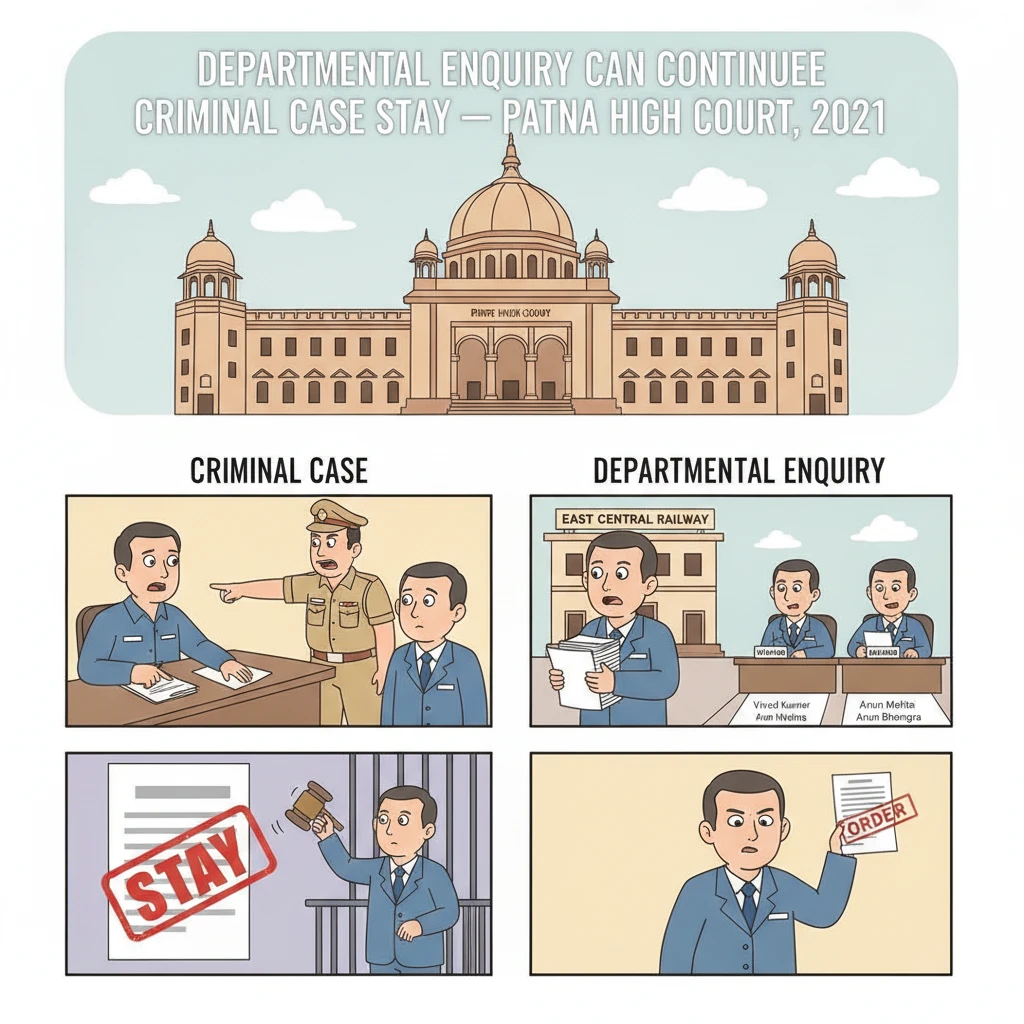
Case Background
The case concerns a senior Mechanical Engineer of East Central Railway, who had joined the Indian Railway Service after clearing the Indian Engineering Services examination. He was posted in East Central Railway on 13.06.2005.
While working there, he claims to have detected an erroneous agreement in favour of a vehicle contractor, one Sri Anand Raj. According to the petitioner, due to his intervention and note for recovery, about Rs. 34 lakhs were recovered from the contractor after earlier excess payment of around Rs. 16 lakhs.
The petitioner alleges that, annoyed with this recovery, the contractor, in connivance with the CBI, filed a complaint on 15.05.2007 accusing him of demanding a bribe. An Inspector of CBI, Sri Praveen Kumar, was assigned to verify the complaint. On the basis of that verification, an FIR was registered and the petitioner was arrested and sent to judicial custody. He later obtained bail from the Patna High Court in Cr. Misc. No. 27616 of 2007.
A charge-sheet was filed in the CBI court on 30.07.2008. The Special Court initially refused to take cognizance on 09.08.2008 due to absence of pre-trap and post-trap memoranda. Later, on 11.09.2008, the CBI court took cognizance. The petitioner challenged that order in Cr. Misc. No. 8861 of 2009, which was dismissed with liberty to seek discharge. His discharge petition was then rejected on 20.02.2013. He subsequently filed Cr. Misc. No. 14016 of 2013 seeking quashing of the FIR, in which the High Court stayed further proceedings in Special Case No. 08 of 2007 (R.C. No. 12(A) of 2007) by order dated 23.06.2016.
Meanwhile, on 19.12.2008, the General Manager of East Central Railway (respondent no. 2) issued a major penalty charge-sheet to the petitioner on the same set of allegations. The petitioner repeatedly sought certain documents: the CBI verification report regarding the alleged bribe demand and the mobile or phone numbers said to have been used. His representations dated 06.08.2009, 29.10.2009 and 25.01.2010 were either rejected or not complied with.
Several Inquiry Officers were appointed and replaced between 2010 and 2017: Sri Vinod Kumar (appointed 15.05.2010), Sri Arun Mehta (appointed 11.07.2011), Sri Arun Bhangra (appointed 02.12.2015), Sri B.P. Gupta (appointed 04.08.2016), Sri Kameshwar Choudhary (appointed 19.10.2016) and Sri P.K. Rai (who held preliminary enquiry on 07.12.2017). The petitioner alleges that despite his repeated demand for the verification report and phone details, the documents were not supplied, and the enquiry dates were fixed without compliance.
Feeling aggrieved, he approached the Central Administrative Tribunal, Patna Bench, in O.A. No. 050/77/2018, praying for a stay of the departmental enquiry on the ground that the High Court had already stayed the criminal proceedings in Cr. Misc. No. 14016 of 2013. On 18.01.2018, the Tribunal directed him to file a representation before the Disciplinary Authority for staying the enquiry in light of the High Court’s order.
The petitioner filed a detailed representation on 25.01.2018. On 15.02.2018, the Tribunal asked the Railway’s counsel to take instructions on this representation. Eventually, on 27.03.2018, the Disciplinary Authority (respondent no. 2) stayed the departmental enquiry till the outcome of the criminal case. Based on this order, the petitioner withdrew O.A. No. 050/77/2018.
More than a year later, on 16.05.2019, the Disciplinary Authority issued another order directing the Inquiry Officer to proceed with the departmental enquiry. The petitioner again approached the Tribunal in O.A. No. 00595 of 2019. The Tribunal granted an interim stay on 07.06.2019 but finally, by order dated 16.02.2021, dismissed the O.A., rejecting the petitioner’s challenge. The present writ petition (C.W.J.C. No. 9204 of 2021) before the Patna High Court assailed both the Tribunal’s order dated 16.02.2021 and the Disciplinary Authority’s order dated 16.05.2019, along with related reliefs.
What the Court Examined and Decided
The main plank of the petitioner’s case was that the Disciplinary Authority’s decision dated 27.03.2018, staying the departmental enquiry, was a quasi-judicial order. According to him, such an order could not be withdrawn or modified by the same authority in the absence of a statutory power of review. He argued that once the Disciplinary Authority passed that order, it became functus officio and could not later resume the enquiry by the order dated 16.05.2019.
The petitioner also complained of long delay in the enquiry from 2008 to 2016, frequent changes of Inquiry Officers and non-supply of CBI verification material and phone records. He claimed that because of this delay he was being denied due promotions. He further argued that the departmental proceedings were being resumed solely because of Central Vigilance Commission (CVC) advice, showing that the Disciplinary Authority had not applied its independent mind.
To support his contentions, he cited three decisions:
First, a Patna High Court judgment in Union of India v. Smt. Pushpa Rani, 2017 (4) PLJR 739. There, it was held that where punishment had already been fixed or at least advised to the disciplinary authority, there was no occasion for independent application of mind. He tried to extend this principle to argue that the Disciplinary Authority had mechanically followed CVC advice while revoking the stay.
Second, the Supreme Court judgment in SBI v. S.N. Goyal, (2008) 2 SCC (L & S) 678, on when an authority becomes functus officio and cannot review or revise its earlier quasi-judicial order.
Third, a Full Bench decision of the Patna High Court in Nand Kumar Thakur v. State of Bihar, 2014 (4) PLJR 210 (FB), which held that a quasi-judicial authority has no inherent power of review, unless conferred by statute, except for correcting clerical or accidental errors.
On the other side, the Railway authorities argued that the orders dated 27.03.2018 (staying the enquiry) and 16.05.2019 (resuming it) were not final quasi-judicial decisions but interim administrative steps in the course of a departmental enquiry. Therefore, the principle of functus officio and restrictions on review did not apply.
The Railway pointed out that the charge against the petitioner was grave and could lead to a major penalty. They accused the petitioner of trying to stall the enquiry indefinitely. They relied on several Supreme Court rulings to show that departmental proceedings and criminal trials can go on simultaneously, and that there is no legal bar even if the criminal proceedings are stayed or pending.
They also clarified that Rule 25 and 25A of the Railway Servants (Discipline & Appeal) Rules, 1968, dealing with revision and review, become relevant only after a final penalty order is passed and affirmed in appeal. In this case, no final order had been made; the departmental proceeding was still in progress. Hence, those rules were not attracted.
The respondents emphasised that the stay-and-resume decisions were communicated through the Dy. CPO/Gaz, GM(P) Office, East Central Railway, in a format showing their administrative nature. The Tribunal, in paragraph 14 of its order dated 16.02.2021, had also held these orders to be administrative rather than quasi-judicial.
The High Court then examined the case law on simultaneous criminal and departmental proceedings. It referred to the Supreme Court’s decisions in A.P. SRTC v. Mohd. Yousuf Miya, (1997) 2 SCC 699; Karnataka SRTC v. M.G. Vittal Rao, (2012) 1 SCC 442; and Capt. M. Paul Anthony v. Bharat Gold Mines Ltd., (1999) 3 SCC 679.
From these cases, the Court extracted the settled principles:
There is no legal bar on simultaneously conducting departmental and criminal proceedings. The only valid ground to seek a stay of departmental proceedings is if continuation of the enquiry will seriously prejudice the defence in the criminal trial, and even then, generally only where complicated questions of fact and law are involved. Departmental proceedings should not be unduly delayed, as both employer and employee have an interest in early conclusion.
The Supreme Court in Capt. M. Paul Anthony had summarised that departmental and criminal processes operate in different fields with different standards of proof. Even if an enquiry is stayed initially, it can be resumed if the criminal trial is not progressing or is unduly delayed.
Applying these principles, the Patna High Court noted that in the present case the criminal proceedings in Special Case No. 08 of 2007 had been stayed by the High Court since 23.06.2016, and the criminal trial was not moving forward. In such a situation, there was clear justification to proceed with the departmental enquiry so that the matter could be concluded one way or the other.
The Court then focused on the nature of the Disciplinary Authority’s orders. It held that a departmental enquiry begins with the charge memorandum and ends either with the imposition of punishment or with exoneration/dropping of charges. During this journey, the Disciplinary Authority has to take several decisions: appointing or changing Inquiry Officers or Presenting Officers, ordering de novo enquiries, and deciding whether to temporarily stay or resume proceedings.
These interim decisions, the Court held, do not make the authority functus officio. If every such order were treated as final quasi-judicial and incapable of being revisited, then any later change of Inquiry Officer or direction for de novo enquiry would become illegal, which is not the law. Only the final decision imposing penalty or exonerating the employee would give the Disciplinary Authority a final, non-reviewable character, unless a statutory review power exists.
In the present case, the Court found that the 27.03.2018 order merely stayed the enquiry and did not decide the petitioner’s guilt or innocence. It neither imposed any penalty nor dropped the charges. Thus, it was an administrative, interim order. Likewise, the later order dated 16.05.2019, resuming the enquiry, was another administrative step. The Court agreed with the Tribunal’s view that these orders were not quasi-judicial and therefore could be modified by the Disciplinary Authority in view of changing circumstances and CVC guidelines.
The Court also underlined the conceptual difference between criminal trials and departmental enquiries. It reiterated that the purpose of the former is to punish an offender for a crime against society, with a standard of proof “beyond reasonable doubt” applied under strict rules of evidence. Departmental enquiries, on the other hand, aim to maintain service discipline and efficiency, where findings can be based on “preponderance of probability”.
Importantly, the Court recorded that in this case the charges in the departmental proceedings are different from those in the criminal case. It further observed that even an acquittal in criminal proceedings on the same set of charges does not automatically protect a delinquent employee from departmental action.
After carefully evaluating the facts, the procedural history, and the legal principles, the Bench concluded that the order dated 16.05.2019 directing the Inquiry Officer to proceed with the enquiry was lawful. Consequently, it upheld the Central Administrative Tribunal’s order dated 16.02.2021, which had dismissed the petitioner’s challenge.
The writ petition was therefore dismissed, and the departmental enquiry against the petitioner is now free to proceed in accordance with law.
Why This Judgment Matters
This judgment is significant for government and public sector employees facing both criminal investigation and departmental action on related allegations.
It clarifies that simply because a criminal case has been stayed by a High Court, a departmental enquiry does not automatically stop forever. If the criminal case is not moving or is delayed, the employer can restart the departmental process.
The decision also stresses that orders temporarily staying or resuming an enquiry are administrative steps, not final judicial decisions. Employees cannot use such interim orders to argue that the authority has lost power to continue the matter later.
For employees, the ruling signals that delaying tactics based on pending criminal cases may not succeed. For departments, it confirms that they can proceed with disciplinary cases to protect administrative discipline, even during long criminal proceedings.
Legal Issues and Answers
Issue: Could the Disciplinary Authority, after once staying the departmental enquiry till conclusion of the criminal case, later revoke that stay and direct the enquiry to continue?
Answer: Yes. The High Court held that the stay and resumption orders were administrative and interim, not quasi-judicial final orders. Therefore, the Disciplinary Authority was not functus officio and was legally competent to resume the enquiry.
Issue: Must departmental proceedings be halted because a related criminal case has been stayed by the High Court?
Answer: No. Relying on Supreme Court precedents, the Court held that there is no legal bar on simultaneous proceedings. Departmental enquiries may continue, especially where the criminal case is delayed and where no serious prejudice to the employee’s defence is shown.
Issue: Did the Central Administrative Tribunal err in dismissing the employee’s challenge to the resumption of the departmental enquiry?
Answer: No. The Patna High Court found the Tribunal’s reasoning correct and upheld its order dated 16.02.2021, thereby dismissing the writ petition.
Cases Cited by the Court
- A.P. SRTC v. Mohd. Yousuf Miya, (1997) 2 SCC 699 : 1997 SCC (L & S) 548
- Karnataka SRTC v. M.G. Vittal Rao, (2012) 1 SCC 442 : (2012) 1 SCC (L & S) 171
- Capt. M. Paul Anthony v. Bharat Gold Mines Ltd., (1999) 3 SCC 679 : 1999 SCC (L & S) 810
- Union of India v. Smt. Pushpa Rani, 2017 (4) PLJR 739 (distinguished)
- SBI v. S.N. Goyal, (2008) 2 SCC (L & S) 678 (distinguished)
- Nand Kumar Thakur v. State of Bihar, 2014 (4) PLJR 210 (FB) (distinguished)
- State of Rajasthan v. B.K. Meena, (1996) 6 SCC 417 (relied upon by respondents)
- State Bank of India and others v. Neelam Nag and another, (2016) 9 SCC 491 (relied upon by respondents)
- Stanzen Toyotetsu India (P) Ltd. v. Girish, (2014) 1 SCC (L & S) 641 (relied upon by respondents)
Case Details
Case Number: Civil Writ Jurisdiction Case No. 9204 of 2021
Case Title: Ugrasen v. The Union of India & Anr.
Citation: 2022 (1) PLJR 19
Court: High Court of Judicature at Patna
Coram: Hon’ble Mr. Justice Vikash Jain and Hon’ble Mr. Justice Anjani Kumar Sharan
Date of Judgment: 02.12.2021
Advocates for Petitioner: Mr. M.P. Dixit, Advocate; Mr. S.K. Dixit, Advocate; Mr. Sanjay Kumar Choubey, Advocate; Ms. Swastika, Advocate
Advocate for Respondents: Dr. Anand Kumar, Advocate
Respondents: Union of India through Secretary, Railway Board, Ministry of Railways; General Manager, East Central Railway
Nature of Case: Writ petition under Article 226 challenging order of Central Administrative Tribunal and resumption of departmental enquiry.
Link to Judgment (official): Patna High Court Judgment in C.W.J.C. No. 9204 of 2021
If you found this explanation helpful and wish to stay informed about
how legal developments may affect your rights in Bihar,
you may consider following Samvida Law Associates for more updates.







