

Case Background
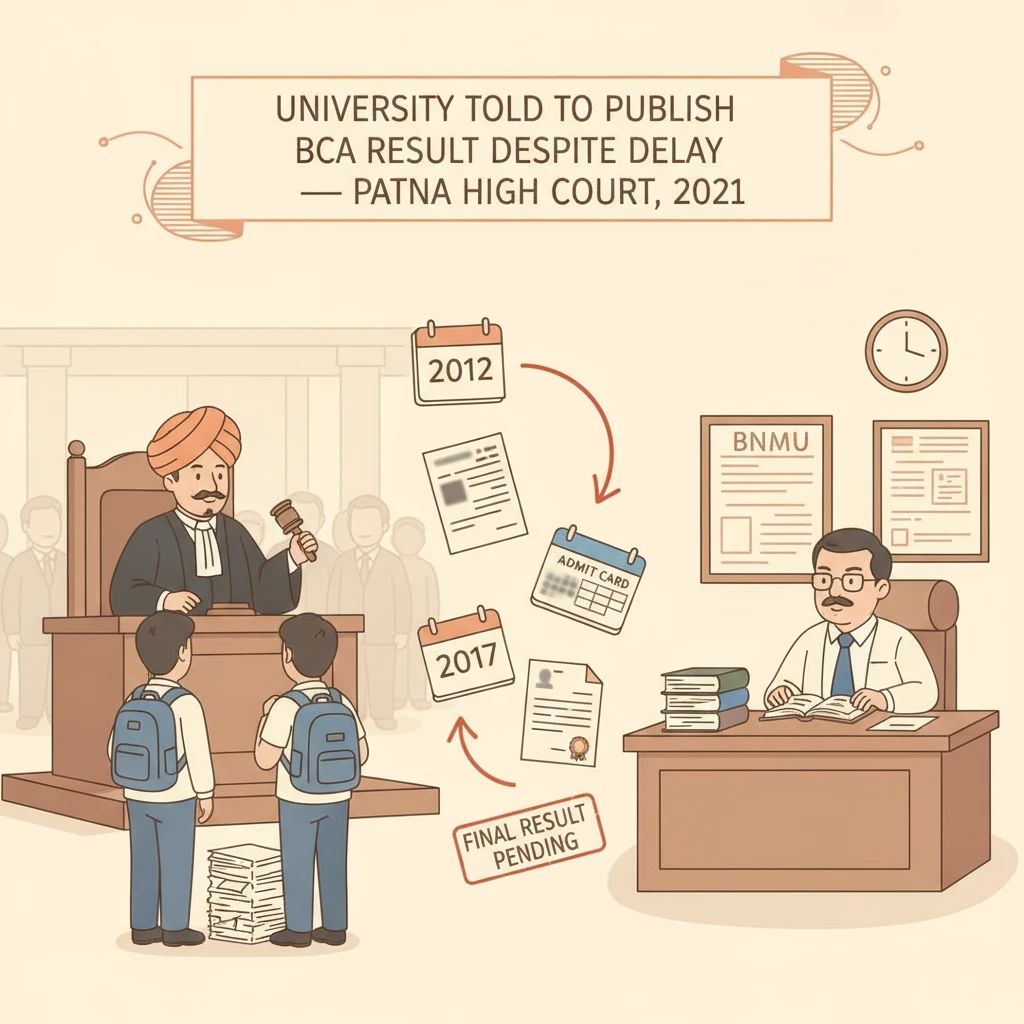
The petitioner was a Bachelor of Computer Application (BCA) student of Bhupendra Narayan Mandal University (BNMU) for the academic session 2011–2014. He was studying in Purnea College, Purnea under the university, with Roll No. 4129 and Registration No. 34850/2012.
He appeared in the second semester examination held in October 2012. When the result came, he found that he had failed in one subject but had passed in the remaining subjects.
The petitioner continued his studies and passed the fourth semester examination. After clearing the fourth semester, he filled the examination form again for that one failed subject of the second semester. The university accepted his form and issued an admit card in June 2016.
On the strength of this admit card, the petitioner appeared in the examination for the said paper held in 2017. He passed that examination as well.
According to the petitioner, he subsequently appeared in all the six semester examinations of the BCA course and passed each of them. However, his final result was not published. The university’s records showed his result as “pending” because the marks of the second semester were “awaited”.
The petitioner repeatedly approached the university authorities, requesting publication of his result and issuance of his mark-sheet, but nothing was done.
He therefore filed CWJC No. 1533 of 2020 before the Patna High Court. A coordinate Bench, by order dated 23.01.2020, granted him liberty to file a detailed representation before the Controller of Examination of BNMU, and directed the Controller to dispose of that representation.
The petitioner then submitted his representation on 04.02.2020. By order/letter dated 17.02.2020, the Controller of Examination rejected his request. The rejection was on the ground that his appearance in the second semester paper was beyond the time allowed under Regulation IX(b) of the BCA Regulations, and hence was “beyond the regulations”.
Aggrieved by this rejection, he filed the present writ petition, CWJC No. 3176 of 2021, before the Patna High Court.
What the Court Examined and Decided
The core dispute before the Patna High Court was whether the university could refuse to publish the petitioner’s BCA result on the ground that he had taken the second semester backlog examination after the time limit fixed under Regulation IX(b), even though the university had itself accepted his form, issued an admit card, allowed him to sit in the examination and declared his result for that paper.
The petitioner’s counsel argued that his case was directly covered by the Supreme Court decision in Shri Krishnan v. Kurukshetra University, Kurukshetra, (1976) 1 SCC 311. He specifically relied on paragraph 7 of that judgment. The essence of that paragraph is that when a university, after having full time and opportunity, accepts a student’s examination form, issues an admission card, and allows him to appear in the examination without raising any objection, it cannot later cancel his candidature on the ground of non-fulfilment of some requirement that could have been checked earlier.
In Shri Krishnan, the Supreme Court held that if the authorities had enough time to scrutinise the admission form and discover any defect but failed to do so, they could not afterwards treat the student as having committed fraud. Once they allowed him to appear, they had no power to withdraw that permission and withhold his result. The Court also approved a Madhya Pradesh High Court decision which said that, under the relevant university ordinance, after issuance of the admission card there was no provision allowing withdrawal of permission to sit for the examination.
The petitioner’s counsel also relied on the earlier order in CWJC No. 1533 of 2020 (between the same parties), by which he had been allowed to approach the Controller of Examination by representation. That context showed that the only real issue now was the legality of the Controller’s order dated 17.02.2020.
On the other hand, counsel for the respondent university placed heavy reliance on Regulation IX(b) of the BCA Regulations. That provision states that a candidate who has completed the course but either does not appear in the examination, fails to pass it, or does not clear any paper, can be allowed to appear in subsequent examinations only in those parts and papers in which he or she failed or was absent, on payment of the prescribed fee and without undergoing the course again.
The Regulation further states that this opportunity will be given in only two more examinations, within a period not exceeding three years, excluding the main examination held at the end of the session.
Based on this, the university submitted that the petitioner had first appeared in the BCA second semester examination in June 2012 and had failed in one paper (Mathematics-1: Advance Calculus & Matrices Numerical Method). He was promoted, but Regulation IX(b) allowed him to clear the backlog only within two additional examinations and within three years. Since he re-appeared in the second semester examination only in 2016, the university argued that this was beyond the permissible period. Therefore, according to them, his appearance in that exam was against the Regulations, and they could not publish his final BCA result.
The university also relied upon certain Patna High Court decisions: CWJC No. 6114 of 2018 (Ruchi Rachna v. The State of Bihar & Ors.), CWJC No. 17195 of 2018 (Aman Kumar Tiwari v. The Vice-Chancellor, B.N. Mandal University, Madhepura), and the Division Bench judgment in Sunil Kumar v. B.N. Mandal University & Ors., 2020 (4) PLJR 129.
In Sunil Kumar, the Division Bench had held that where a Regulation clearly provided that failure to complete sessional work requires re-admission, a student could not rely on equity and similar Supreme Court precedents to compel declaration of his result if the university itself was not at fault. The Bench had distinguished the Supreme Court decision in Guru Nanak Dev University v. Sanjay Kumar Katwal, (2009) 1 SCC 610, on the facts, noting that in that case, the university itself had made the mistake and allowed the student to complete his course over four years before raising objections. However, in Sunil Kumar, the lapse was attributed to the private engineering college, not the university.
After hearing both sides and examining the record, the Patna High Court noted an important factual aspect: even though the petitioner’s re-appearance in the second semester paper occurred after three years from the original exam, the university had not rejected his form at that time. Instead, the university had:
- accepted his examination form for the second semester backlog paper,
- issued him an admit card for the 2016 examination,
- permitted him to sit in the second semester examination, 2016, and
- published his result for that paper, showing that he had passed.
In other words, the university had fully acted upon his application and treated him as a valid candidate for the examination. By doing so, the Court observed, the university authorities had “acquiesced the infirmities” in the petitioner’s examination form. They had waived any objection based on Regulation IX(b) by their conduct of accepting and processing his candidature.
In such circumstances, the Court considered the principle laid down in Shri Krishnan and also referred to Guru Nanak Dev University v. Sanjay Kumar Katwal. In the latter case, the Supreme Court had held that where a student is admitted through the regular process, permitted to take the examinations, allowed to complete the course, and is not guilty of suppression or misrepresentation, the university cannot, after many years, suddenly declare him ineligible and destroy his career.
The Supreme Court in Guru Nanak Dev University had relied on Shri Krishnan and Sanatan Gauda v. Berhampur University and held that the university and college were estopped from withholding the candidate’s result on the ground that he was ineligible to take admission, because they themselves had admitted him and allowed him to sit for examinations.
Applying these principles, the Patna High Court held that once the respondent university had, by its positive conduct, accepted the petitioner’s form, issued the admit card, allowed him to write the exam and declared his result, it could not later turn around and say that his appearance had been “beyond the regulation” and thereby refuse to publish his final BCA result.
The Court distinguished the Division Bench judgment in Sunil Kumar on the facts. In that case, the lapse was on the part of a private engineering college, and the university had no role in allowing the ineligible student to appear in the examinations. In contrast, in the present case, BNMU itself had processed the petitioner’s backlog exam and had even published his result.
Further, the Court observed that the law laid down by the Supreme Court in Shri Krishnan is binding on all courts by virtue of Article 141 of the Constitution of India. The Court cited South Central Railway Employees Coop. Credit Society Employees Union v. B. Yashodabai & Others, (2015) 2 SCC 727, and A.S. Gauraya v. S.N. Thakur, (1986) 2 SCC 709, to underline that subordinate courts and authorities cannot ignore or bypass binding Supreme Court precedent.
Ultimately, having regard to all these aspects, the Patna High Court allowed the writ petition. It quashed the Controller of Examination’s order dated 17.02.2020, and directed the respondent university to forthwith publish the petitioner’s result for the BCA course for the session 2011–2014.
Why This Judgment Matters
This judgment is important for students whose results are held up for technical or regulatory reasons even after the university has allowed them to sit in examinations.
The Patna High Court made it clear that once a university accepts a student’s examination form, issues an admit card, permits him or her to appear, and even publishes the result of that paper, it cannot later use its own Regulations to deny publication of the final result on that same ground.
This protects students from suffering for mistakes or oversights committed by university authorities. Especially in cases where students have not hidden anything or told any lies, this judgment shows that courts will step in to prevent universities from changing their stand after exams are over.
For students in Bihar and elsewhere, it reinforces that if a university has acted in a way that shows acceptance of their candidature, it cannot later disown that conduct and destroy their academic careers by withholding results.
Legal Issues and Answers
-
Issue: Can a university refuse to publish a student’s final BCA result on the ground that he took a backlog examination beyond the time limit in its Regulations, when the university itself had accepted his form, issued an admit card, allowed him to sit in the exam and declared his result?
Answer: No. The Patna High Court held that after accepting the form, issuing the admit card, permitting the student to appear, and publishing his result, the university is bound by its own conduct and cannot withhold the final result on that ground. -
Issue: Whether the Patna High Court was bound to follow the Supreme Court’s decision in Shri Krishnan v. Kurukshetra University despite earlier High Court decisions that seemed to take a different view?
Answer: Yes. The Court held that under Article 141 of the Constitution, the law declared by the Supreme Court is binding on all courts. It relied on South Central Railway Employees Coop. Credit Society Employees Union v. B. Yashodabai & Others and A.S. Gauraya v. S.N. Thakur to emphasise that High Courts must follow Supreme Court precedent unless distinguished or overruled.
Cases Cited by the Court
- Shri Krishnan v. Kurukshetra University, Kurukshetra, (1976) 1 SCC 311.
- Guru Nanak Dev University v. Sanjay Kumar Katwal, (2009) 1 SCC 610.
- Sunil Kumar v. B.N. Mandal University & Ors., 2020 (4) PLJR 129 (distinguished).
- South Central Railway Employees Coop. Credit Society Employees Union v. B. Yashodabai & Others, (2015) 2 SCC 727.
- A.S. Gauraya v. S.N. Thakur, (1986) 2 SCC 709.
- Order dated 23.01.2020 in CWJC No. 1533 of 2020 (coordinate Bench of Patna High Court).
Case Details
Case Number: Civil Writ Jurisdiction Case No. 3176 of 2021
Case Title: Prabhansh Kumar Bharti v. The Vice Chancellor, Bhupendra Narayan Mandal University, Laloo Nagar, Madhepura & Ors.
Coram: Hon’ble Mr. Justice Mohit Kumar Shah
Citation: 2022 (1) PLJR 512
Advocates:
- For the petitioner: Mr. Prahalad Kumar Bhagat, Advocate
- For Bhupendra Narayan Mandal University: Mr. Ritesh Kumar, Advocate
Nature of the Case: Writ petition (civil) challenging the order of the Controller of Examination refusing publication of BCA examination result.
Date of Judgment: 24.12.2021
Impugned Order: Order/letter dated 17.02.2020 issued by the Controller of Examination, Bhupendra Narayan Mandal University, Madhepura.
Link to Judgment: Click here to read the full Patna High Court judgment
If you found this explanation helpful and wish to stay informed about
how legal developments may affect your rights in Bihar,
you may consider following Samvida Law Associates for more updates.







