

Case Background
The case began with a raid conducted by officers of the Narcotics Control Bureau (NCB), Patna Zonal Unit, on 26.02.2013 near Mithapur Bus Stand, Patna.
According to NCB, they had received specific information that a person would carry a commercial quantity of charas/hashish from Raxaul (Indo–Nepal border area) to Mithapur Bus Stand between 06:00 PM and 08:00 PM on that date.
On the basis of this information, a team of NCB officers went to Mithapur Bus Stand in an official vehicle, allegedly accompanied by an informer. Two men present near the bus stand, Nagendra Kumar and Harishankar, were requested to act as independent seizure witnesses.
At about 06:30 PM, the team claimed to have intercepted the appellant, who was said to be carrying a black-coloured bag. NCB officers stated that, after being informed of his rights under Section 50 of the Narcotic Drugs and Psychotropic Substances Act, 1985 (NDPS Act), he declined to be searched before a Magistrate or Gazetted Officer and offered to be searched by the team itself.
NCB alleged that 50 slabs of dark brown semi-solid resinous substance were recovered from the bag, weighing 25.450 kg, believed to be charas/hashish. Two samples of 25 grams each (S-1 and S-2) were said to have been drawn, sealed and one sample sent later to CRCL, Kolkata for chemical examination.
The appellant’s statement was recorded on 26.02.2013 under Section 67 of the NDPS Act by NCB, in which he allegedly confessed to trafficking of the contraband and named one Raj Kumar as the supplier.
He was arrested the same night at 10:50 PM and produced before the Sessions Judge-cum-Special Judge, NDPS Act, Patna on 27.02.2013, along with the seized material and samples. On the same day, permission was sought and granted to keep the seized contraband in the NCB Malkhana and to send sample S-1 to CRCL, Kolkata.
A complaint was later filed on 24.07.2013 by another Intelligence Officer (P.W.7), and Special Case No. 09 of 2013/N.C.B. No. 53 of 2013 was registered. Cognizance was taken under Section 20(b)(ii)(C) of the NDPS Act and the case was transferred to the Court of Additional Sessions Judge-VII, Patna.
On 17.09.2013, a charge under Section 20(b)(ii)(C) NDPS Act (possession of commercial quantity of charas/hashish) was framed against the appellant. He pleaded not guilty, leading to trial.
The trial court convicted him on 02.07.2016 and sentenced him on 15.07.2016 to rigorous imprisonment for thirteen years and a fine of Rs.1 lakh, with default imprisonment of two and a half years. Against this conviction and sentence, the appellant filed Criminal Appeal (DB) No. 775 of 2016 before the Patna High Court.
What the Court Examined and Decided
The Patna High Court, through a Division Bench, closely examined both the prosecution evidence and the defence version, as well as the legal requirements under the NDPS Act and the Code of Criminal Procedure.
The prosecution examined seven NCB officials as witnesses, including all members of the raiding team and the subsequent Investigating Officer. No independent civilian witness was examined, even though it was admitted that many people were present at the bus stand.
The officers gave a broadly consistent story: receipt of secret information, formation of a team, interception of the appellant, service of Section 50 notice, search of the black bag, recovery of 50 slabs weighing 25.450 kg, field testing as charas/hashish, drawing of two samples, sealing, preparation of search-cum-seizure list and test memo, and later chemical confirmation from CRCL, Kolkata.
However, during cross-examination, serious weaknesses emerged:
None of the officers could say from which bus the appellant had arrived, or exactly where he had come from. There was no bus ticket with him, and no inquiry was made about his origin or the bus he travelled in. One witness admitted that he had no proof that the appellant came from Raxaul.
Officers accepted that the bus stand was crowded but no statement of any public person was recorded, and apart from the two alleged independent witnesses (who were never produced in court), no member of the public was made a witness to any stage of search, sealing, or sampling.
The first Investigating Officer, Abhijit Prakash, who had conducted major parts of the investigation, was not examined at all. The second Investigating Officer (P.W.7) admitted that he had not witnessed the seizure, had not arrested the appellant, had not seen the seized substance, had not recorded statements of any witness, and filed the complaint only on the basis of papers already on file and legal advice.
On the other hand, the defence examined four witnesses, including the appellant’s wife (D.W.1) and three co-villagers. They deposed that the appellant had gone out of his house at about 7:00 AM on 26.02.2013 to attend the call of nature, did not return, and was taken away by some persons in a jeep. D.W.1 stated she lodged a missing report at Harsidhi Police Station the same morning and produced a xerox copy of her application with a station diary endorsement (marked for identification).
The High Court did not base its final verdict solely on this defence narrative, but it recognised that it added weight to the claim of false implication when seen along with major prosecution lapses.
On the legal side, the Court considered several important issues:
1. Non-examination of independent witnesses and first Investigating Officer
The Court noted that the search and seizure allegedly took place between 06:30 PM and 08:45 PM at a busy bus stand where many people were present, as admitted by prosecution witnesses. Despite this, except for the two named seizure witnesses (Nagendra Kumar and Harishankar), who were not produced at trial, no independent person was associated with any stage of investigation.
The Court observed that non-examination of the first Investigating Officer, Abhijit Prakash, prevented the defence and the court from verifying the truth about the alleged raid and later steps. The second Investigating Officer had limited knowledge and did nothing substantial himself. This led the Bench to infer that either the incident did not happen in the manner alleged or there were serious doubts about it.
2. Admissibility of confessional statement under Section 67 NDPS Act
The prosecution relied heavily on the appellant’s “confessional” statement recorded by NCB under Section 67 of the NDPS Act.
Referring to the three-judge bench decision of the Supreme Court in Tofan Singh v. State of Tamil Nadu [(2021) 4 SCC 1], the Patna High Court held that officers invested with powers under Section 53 of the NDPS Act are “police officers” within the meaning of Section 25 of the Indian Evidence Act.
Therefore, any confessional statement made before such officers is hit by Section 25 of the Evidence Act and cannot be used to convict an accused. On this basis, the High Court ruled that the Section 67 statement of the appellant recorded by P.W.4 could not be taken into account against him.
3. Illegalities in sampling and Standing Instructions
The Court next examined how samples from the alleged 50 slabs of charas were drawn. As per the evidence, two samples of 25 grams each (S-1 and S-2) were drawn “randomly” from the total bulk of 25.450 kg and only S-1 was sent for chemical analysis.
The Bench referred to Standing Instruction No. 1/88 dated 15.03.1988 issued by the NCB, which lays down the proper method for drawing samples from seized narcotic drugs and psychotropic substances, especially where multiple packets or slabs are involved.
These Instructions require, among other things, drawing samples on the spot in duplicate, mixing contents properly to make them homogeneous, and, in case of multiple packets, either drawing samples from each packet or forming proper lots and drawing representative samples in a structured way. They do not permit vague “random” sampling.
In this case, the Court found that:
- There was no evidence that each of the 50 slabs was separately numbered or weighed.
- There was no evidence that each slab was tested with the field test kit.
- There was no evidence that the slabs were bunched in proper lots or that their contents were mixed to create a homogeneous mass before sampling.
- It was not clear from which slab(s) the so-called “random” samples were drawn.
Thus, there was total non-compliance with Standing Instruction No. 1/88. Relying on Supreme Court decisions such as Khet Singh v. Union of India, Noor Aga v. State of Punjab, and Union of India v. Bal Mukund, the High Court held that, although such standing instructions are directory, blatant or total non-compliance creates grave doubt about the integrity of seized material and the prosecution case.
4. Non-production of seized contraband and failure of chain of custody
The Court found there was no evidence that the seized narcotic substance had been disposed of under Section 52A of the NDPS Act. Therefore, the prosecution was duty-bound to produce the seized material before the trial court.
No such production was made during trial. Furthermore, the Malkhana in-charge was not examined, nor was the Malkhana register produced. There was no reliable proof that the seized material was ever properly deposited or remained intact.
In these circumstances, relying on Supreme Court rulings in Jitendra v. State of M.P., Ashok alias Dangra Jaiswal v. State of Madhya Pradesh, and Gorakh Nath Prasad v. State of Bihar, the High Court held that mere oral evidence and seizure list, without production of the contraband or proof of its safe custody, is insufficient in NDPS cases carrying severe punishments.
5. Lapses under Sections 52 and 57 NDPS Act
Section 52(3) of the NDPS Act requires that seized articles and arrested persons be forwarded promptly to the appropriate officer, and the seized articles be kept safely and deposited with proper documentation.
The Court noted that there was no evidence of the seizing officer depositing the contraband in the Malkhana within 48 hours with a forwarding memo, nor any acknowledgment from the Malkhana in-charge. Similarly, there was no proof that a full report of arrest and seizure was sent to the superior officer as required by Section 57.
While these provisions are directory, the Court emphasised that complete ignorance of them affects the credibility of the prosecution’s story and the fairness of the investigation.
6. Serious defects in Section 313 Cr.P.C. examination
The Court carefully scrutinised the questions put to the appellant under Section 313 Cr.P.C., which is meant to give an accused a fair opportunity to explain incriminating circumstances.
It found that many key circumstances relied upon by the prosecution were never put to the appellant, such as: details of service of Section 50 notice, field test of the substance, weighing process, manner of drawing and sealing samples, alleged voluntary nature of his Section 67 statement, deposit of seized material in Malkhana, and chemical test report confirming charas.
On the other hand, a question was put to him about transporting narcotics from the Indo–Nepal border financed by Raj Kumar, although there was no evidence to support this allegation.
Referring to Supreme Court decisions in State of U.P. v. Mohd. Iqram and Naval Kishore v. State of Bihar, the Bench held that circumstances not put to the accused under Section 313 cannot be used against him. The slipshod framing of questions therefore further weakened the prosecution case.
Final Conclusion
After weighing all these factors together—non-examination of independent and key official witnesses, inadmissibility of the Section 67 confession, illegal sampling, non-production and doubtful custody of seized material, non-compliance with Sections 52 and 57 NDPS Act, and serious flaws in Section 313 questioning—the Patna High Court held that there were “serious infirmities in the prosecution evidence.”
The Court therefore held that the conviction and sentence could not be sustained and that the appellant was entitled to benefit of doubt.
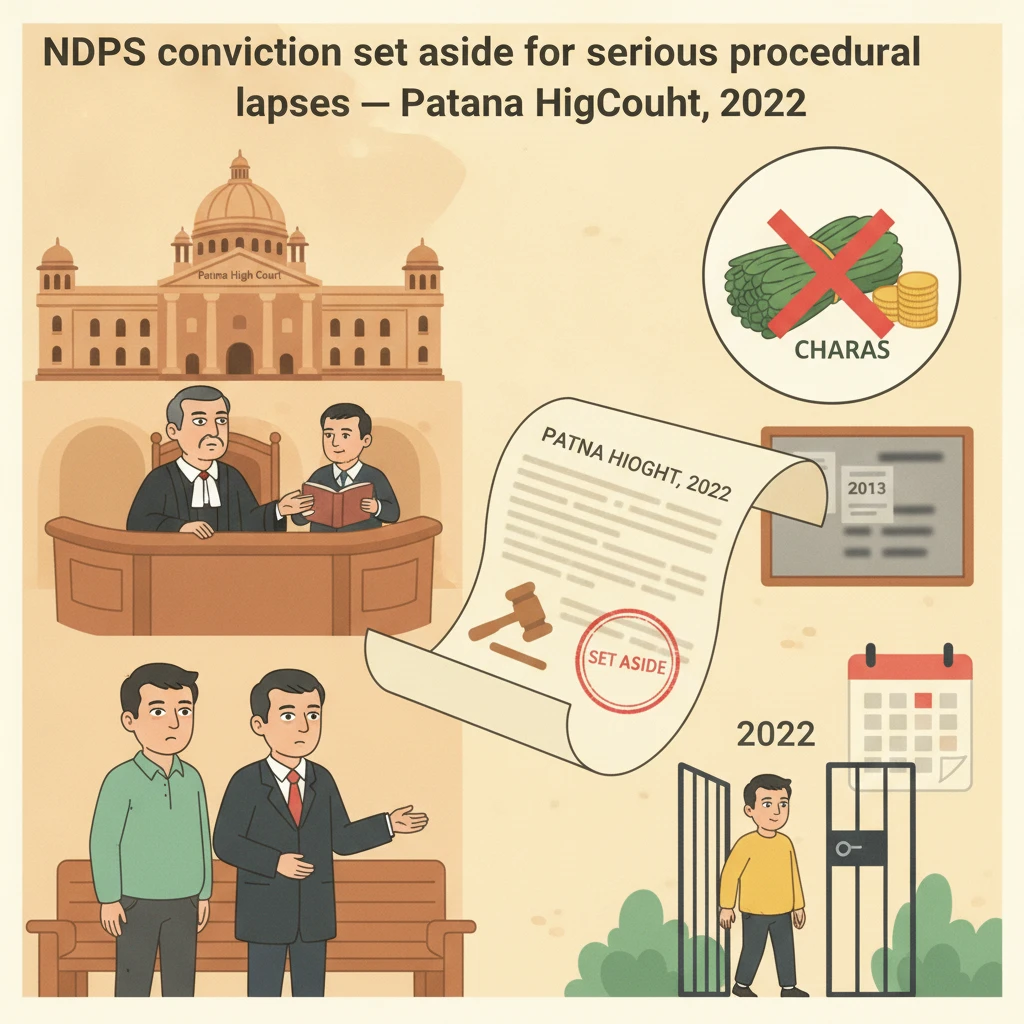
The appeal was allowed, the judgment of conviction dated 02.07.2016 and sentence dated 15.07.2016 in Special Case No. 09 of 2013/N.C.B. No. 53 of 2013 were set aside, and the appellant was acquitted of the charge under Section 20(b)(ii)(C) NDPS Act, with a direction to release him forthwith unless required in any other case.
Why This Judgment Matters
This Patna High Court decision is important for anyone facing prosecution under the NDPS Act, especially for serious charges involving commercial quantities.
First, it shows that even where very large quantities of drugs are alleged, courts will not uphold convictions if basic legal safeguards are ignored. The prosecution must strictly follow procedures for sampling, sealing, storage, production of seized material, and recording statements.
Second, it reinforces that confessional statements recorded by NCB or similar officers under Section 67 of the NDPS Act cannot, after the Supreme Court’s ruling in Tofan Singh, be used as the sole or main basis of conviction.
Third, the judgment underlines that an accused has a right to be fairly questioned under Section 313 Cr.P.C. If crucial facts are not put to him directly, those facts cannot later be used to hold him guilty.
Fourth, it sends a clear message to investigating agencies that Standing Instructions on how to draw and handle samples, even if technically directory, must be substantially followed. Ignoring them can result in acquittal.
For ordinary people, especially those who may be wrongly picked up in narcotics cases, this decision shows that higher courts will look very closely at the fairness and thoroughness of investigation, and will give the benefit of doubt where serious procedural defects exist.
Legal Issues and Answers
Issue: Can a conviction under Section 20(b)(ii)(C) NDPS Act stand when the alleged confessional statement is recorded under Section 67 by an NCB officer?
Answer: No. Following Tofan Singh, NCB officers empowered under Section 53 are “police officers”, so confessions before them are barred by Section 25 Evidence Act and cannot be used to convict.
Issue: Does serious non-compliance with Standing Instruction No. 1/88 on sampling and failure to produce seized contraband vitiate the prosecution case?
Answer: Yes. Total non-compliance with sampling guidelines and non-production of seized material, without proof of its proper custody or disposal, creates grave doubt, and conviction cannot be sustained.
Issue: Can the court rely on circumstances not put to the accused in his examination under Section 313 Cr.P.C.?
Answer: No. Circumstances not specifically put to the accused cannot be used against him. Improper Section 313 questioning in this case further weakened the prosecution and contributed to acquittal.
Cases Cited by the Court
- Tofan Singh v. State of Tamil Nadu, (2021) 4 SCC 1
- Khet Singh v. Union of India, AIR 2002 SC 1450
- Noor Aga v. State of Punjab, (2008) 16 SCC 417
- Union of India v. Bal Mukund & Ors., (2009) 12 SCC 161
- Jitendra & Another v. State of M.P., (2004) 10 SCC 562
- Ashok alias Dangra Jaiswal v. State of Madhya Pradesh, (2011) 5 SCC 123
- Gorakh Nath Prasad v. State of Bihar, (2018) 2 SCC 305
- State of Kerala & Ors. v. Kurian Abraham (P) Ltd. & Anr., (2008) 3 SCC 582
- Union of India v. Azadi Bachao Andolan, (2004) 10 SCC 1
- State of U.P. v. Mohd. Iqram & Anr., AIR 2011 SC 2296
- Naval Kishore v. State of Bihar, (2004) 7 SCC 502
Case Details
Case Number: Criminal Appeal (DB) No. 775 of 2016
Case Title: Jagat Prasad v. The State of Bihar & The Union of India
Court: High Court of Judicature at Patna
Coram: Hon’ble Mr. Justice Ashwani Kumar Singh and Hon’ble Mr. Justice Arvind Srivastava
Date of Judgment: 19.01.2022
Trial Court Case: Special Case No. 09 of 2013 / N.C.B. No. 53 of 2013, Court of Additional Sessions Judge-VII, Patna
Provision Involved: Section 20(b)(ii)(C) of the NDPS Act, 1985; Sections 8, 42, 50, 52, 52A, 53, 57, 67 of the NDPS Act; Section 313 of the Code of Criminal Procedure, 1973; Section 25 of the Indian Evidence Act, 1872
Citation: 2022 (1) PLJR 568
Advocates:
- For the Appellant: Mr. Nafisuzzoha, Advocate
- For the Respondent-State of Bihar: Dr. Mayanand Jha, APP
- For the Union of India: Mr. Manoj Kumar Singh, CGC
Nature of the Case: Criminal appeal (Division Bench) against conviction and sentence in an NDPS Special Case.
Outcome: Appeal allowed; conviction and sentence set aside; appellant acquitted and directed to be released unless required in any other case.
Link to Judgment: Click here to read the full judgment of the Patna High Court
If you found this explanation helpful and wish to stay informed about
how legal developments may affect your rights in Bihar,
you may consider following Samvida Law Associates for more updates.







