

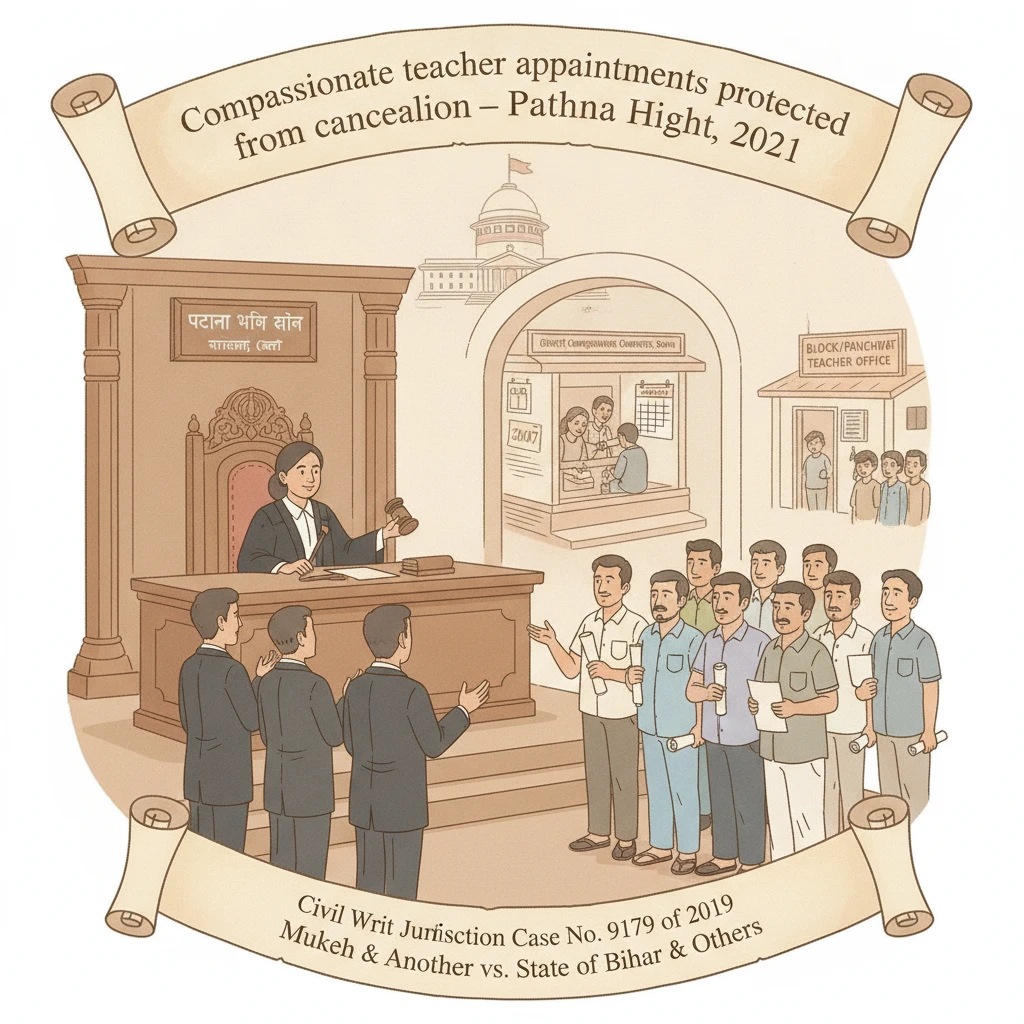
Case Background
The petitioners are sons of government school teachers who died in harness before 01.07.2006. At the time of their fathers’ deaths, no family member was employed.
In 2006, the petitioners, who were at least intermediate pass, applied for compassionate appointment. The District Compassionate Committee, Saran, recommended them for appointment on regular vacant posts of Teacher. Petitioners 1 to 8 were recommended on 15.01.2007, and petitioner 9 was recommended on 19.11.2007.
Instead of being appointed to regular government posts, they were engaged as contractual Panchayat/Block Teachers under the Bihar Panchayat Primary Teacher/Municipal Teacher (Appointment & Service Conditions) Rules, 2006. Petitioners 1 to 8 joined in 2007 and petitioner 9 in 2008.
Later, by letter dated 17.10.2008, the Department of Labour & Administrative Reforms clarified that Panchayat/Block/Town Teacher posts are not posts under the Government of Bihar. Therefore, compassionate appointments could not be made against such posts. In fact, the petitioners had originally been recommended for regular government posts.
Petitioners 1 to 6 and 9 then filed separate writ petitions before the Patna High Court. By order dated 08.01.2010, a coordinate Bench allowed those petitions and directed the State to appoint them on government posts as per the recommendations of the District Compassionate Appointment Committee and to grant them regular pay scales of Assistant Teacher.
Meanwhile, similar matters reached the Supreme Court, including the lead case Mukesh & Another vs. State of Bihar & Others. The petitioners also filed special leave petitions, which were heard together and finally decided on 03.04.2017. The Supreme Court issued directions regarding compassionate appointments of dependents of deceased teachers before and after 01.07.2006.
Acting on the liberty given by the Supreme Court, the petitioners filed representations before the State Government. On 12.01.2018, the Principal Secretary, Education Department, issued a memo stating that heirs/dependents of all employees who died in harness prior to 01.07.2006 would be entitled to regular appointment on regular pay scale. Relying on this, the District Education Officer (DEO), Saran, and the District Programme Officer (DPO), Saran, appointed the petitioners as regular Teachers on 24.02.2018.
Subsequently, those appointments were cancelled by memo dated 12.03.2018. The petitioners challenged the cancellation in CWJC No. 8843 of 2018. On 08.01.2019, the High Court disposed of that writ petition directing the District Programme Officer (Establishment), Saran at Chhapra, to decide their cases in light of the judgment dated 11.05.2018 in CWJC No. 8963 of 2018 (Chandra Shekhar Azad & Anr. vs. State of Bihar & Ors.).
Following this direction, the DEO and DPO, Saran, again appointed the petitioners on regular posts of Teacher by memo dated 21.02.2019.
Soon thereafter, on 07.03.2019, the State issued a fresh memo withdrawing the earlier Education Department memo dated 12.01.2018 and laying down new conditions regarding compassionate appointments prior to 01.07.2006. The petitioners feared that, based on this new memo, their regular appointments could once again be cancelled. They therefore filed the present writ petition seeking to quash the memo dated 07.03.2019.
What the Court Examined and Decided
The core dispute before the Patna High Court was whether the State could rely on the new memo dated 07.03.2019 to unsettle the petitioners’ established right to serve as regular Assistant Teachers on compassionate grounds.
The impugned memo was issued by the Principal Secretary, Education Department, under the signature of the Joint Secretary. It claimed to implement the Supreme Court judgment in Mukesh & Another vs. State of Bihar & Others, Civil Appeal Nos. 4776-4777 of 2017, decided on 03.04.2017. The memo stated, among other things, that:
(i) If the competent Compassionate Appointment Committee had recommended, before 01.07.2006, the case of a dependent of a deceased government teacher for appointment on Class III or Class IV posts or on the post of teacher on compassionate ground, such appointment should be made on the recommended post in the regular pay scale.
(ii) Appointments on compassionate ground would be on regular teacher posts and in regular pay scale only against available vacancies.
(iii) The order would apply only to the parties of the case referred and enclosed.
(iv) The earlier Education Department letter dated 12.01.2018 stood superseded.
(v) The order would take effect from 12.01.2018.
According to the petitioners, though their fathers died before 01.07.2006, the Committee’s recommendations in their favour were made in 2007. The State could therefore interpret the memo to say that they were not covered and could cancel their regular appointments again.
The learned Senior Counsel for the petitioners drew the Court’s attention to the reference made in CWJC No. 15626 of 2019 (Chandra Shekhar Azad & Ors. vs. State of Bihar & Ors.) to a Larger Bench on several questions, including whether compassionate appointment in a “dying cadre” like Assistant Teacher is permissible. The Division Bench, by judgment dated 13.02.2020, had already answered these questions.
The Division Bench held that, after the Supreme Court’s judgment in Mukesh & Anr., compassionate appointments in the dying cadre of Assistant Teacher were permissible where recommendations had been made before 01.07.2006. However, in view of the liberty given by the Supreme Court, the State could also take a policy decision, as it did by Memo No. 38 dated 12.01.2018, to appoint dependents of government teachers who had died before 01.07.2006, even if recommendations came later. Once appointments were made pursuant to that policy, they could not be treated as a misunderstanding of the Supreme Court’s judgment.
The Division Bench further held that the Supreme Court’s decision in State of Bihar & Ors. vs. Bihar Secondary Teachers Struggle Committee and others, which accepted that the Assistant Teacher cadre is a dying cadre, did not apply to such compassionate appointees whose appointments had attained finality by virtue of High Court directions. The issue of dying cadre in that case had arisen only as a defence to an equal-pay claim of Niyojit Shikshaks.
Most importantly, the Division Bench analysed Annexure-16 in that case, which was an internal Education Department communication issued in light of Mukesh & Anr. It noted that Mukesh & Anr. directed that dependents whose cases were recommended prior to 01.07.2006 be appointed on regular posts with regular pay. Other appellants, whose appointments were after 01.07.2006, were given liberty to approach the State Government for suitable relief on the model of Rajeev Ranvijay Kumar’s case. In that earlier matter, the State had itself promised to consider individual cases if the Supreme Court appeal was withdrawn, and thereafter had appointed the petitioners as Assistant Teachers in the cadre.
The Division Bench concluded that the liberty granted by the Supreme Court in Mukesh & Anr. placed similarly situated petitioners in the same position as Rajeev Ranvijay Kumar. The State Government was free to consider their cases, and if it did so and granted them compassionate appointment as Assistant Teachers, it could not later claim that this was a misunderstanding of the Supreme Court ruling and oust them from the cadre.
In the present writ petition, the State counsel could not show how the facts of the petitioners’ case differed from Mukesh & Anr., Rhituraj Saraubh & Anr., or Chandra Shekhar Azad & Ors.
The Single Judge (Hon’ble Mr. Justice Mohit Kumar Shah) therefore examined the sequence of events:
First, the District Compassionate Committee had recommended the petitioners for regular Class III or Class IV posts because their fathers, government teachers, had died prior to 01.07.2006.
Second, when the State later asserted that Panchayat/Block/Town Teachers were not government posts and could not be used for compassionate appointment, the High Court in 2010 directed that the petitioners be appointed on government posts as per the Committee’s recommendations.
Third, the Supreme Court in Mukesh & Anr. gave liberty to certain appellants, including the present petitioners, to approach the State Government for suitable relief. Acting on this, the State issued the circular dated 12.01.2018 under which the petitioners were appointed as regular Teachers on 24.02.2018. Though that appointment was once cancelled, the High Court in CWJC No. 8843 of 2018 again directed reconsideration in the light of Chandra Shekhar Azad & Anr., leading to fresh regular appointments by memo dated 21.02.2019.
On these facts, the Court held that once the respondents had complied with the High Court’s judgment dated 08.01.2019 in CWJC No. 8843 of 2018 and appointed the petitioners on regular teacher posts by memo dated 21.02.2019, their service conditions could not be disturbed by a later executive circular dated 07.03.2019. The circular was a subsequent event and, in any case, was held inapplicable to the petitioners’ situation.
The Court also relied on the reasoning of the Division Bench in Rhituraj Saraubh & Anr. and Chandra Shekhar Azad & Ors., which had held that once compassionate appointees are appointed in accordance with court directions and Government decisions taking note of Mukesh & Anr., they cannot be removed from the cadre on the ground of alleged misunderstanding of the Supreme Court’s judgment.
Accordingly, the High Court allowed the writ petition. It declared that the respondents shall not interfere with the petitioners’ appointments on the regular vacant posts of Teacher/Assistant Teacher in the regular pay scale made by memo no. 412 dated 21.02.2019 issued by the District Education Officer, Saran, and the District Programme Officer (Establishment), Saran.
Why This Judgment Matters
This judgment is important for families of deceased government teachers in Bihar whose dependents were appointed as regular teachers on compassionate grounds after complex rounds of litigation.
It makes clear that once such dependents are appointed on regular posts under valid government decisions and in compliance with court directions, their jobs cannot be taken away simply because the Government later changes its policy or issues a clarificatory circular.
For low-income families who lost their breadwinner and struggled for years for compassionate appointment, the decision provides security. It confirms that their regular appointments, particularly those made after the Supreme Court’s decision in Mukesh & Anr. and subsequent High Court judgments, enjoy legal protection.
The judgment also reinforces that executive circulars cannot override final court orders. Where the High Court has specifically directed appointment, and the authorities have acted on that direction, later departmental memos cannot be used to unsettle those appointments.
Legal Issues and Answers
- Issue: Can the State Government rely on memo dated 07.03.2019, issued after earlier court directions and appointments, to cancel or disturb the petitioners’ regular compassionate appointments as Teachers/Assistant Teachers?
Answer: No. The Patna High Court held that once the petitioners had been appointed on regular teacher posts in compliance with prior court judgments, their service could not be interfered with by the subsequent circular dated 07.03.2019, which was inapplicable to their case. - Issue: Do the judgments in Mukesh & Anr., Rhituraj Saraubh & Anr., and Chandra Shekhar Azad & Ors. protect the petitioners’ appointments?
Answer: Yes. The Court found the present case squarely covered by these decisions and held that, in view of the liberty granted by the Supreme Court and the State’s subsequent action, the petitioners, once appointed as Teachers in the cadre, cannot be ousted.
Cases Cited by the Court
- Mukesh & Another vs. State of Bihar & Others, Civil Appeal Nos. 4776-4777 of 2017, reported in (2017) 5 SCC 383.
- Rajiv Ranvijay Kumar v. State of Bihar, reported in 2012 SCC OnLine SC 1104.
- The State of Bihar & Ors. vs. Rhituraj Saraubh & Anr., reported in 2019 (1) PLJR 444.
- Chandra Shekhar Azad & Anr. vs. The State of Bihar & Ors., judgment dated 11.05.2018 in CWJC No. 8963 of 2018.
- Chandra Shekhar Azad & Ors. vs. The State of Bihar & Ors., CWJC No. 15626 of 2019, judgment dated 13.02.2020 (reference answered by Division Bench).
- State of Bihar & Ors. vs. Bihar Secondary Teachers Struggle Committee and others (cited and discussed in the reference judgment).
Case Details
Case Number: Civil Writ Jurisdiction Case No. 9179 of 2019
Case Title: Arbind Kumar Chaudhary & Ors. vs. The State of Bihar & Ors.
Citation: 2022 (1) PLJR 609
Coram: Hon’ble Mr. Justice Mohit Kumar Shah
Advocates:
For the petitioners: Mr. Y.V. Giri, Senior Advocate; Mr. Sumit Kumar Jha, Advocate.
For the respondents: Mr. Mrigendra Kumar, AC to GP-20.
Nature of the case: Writ petition (civil) challenging a departmental memo affecting compassionate appointments and seeking protection of regular appointments as Teachers/Assistant Teachers.
Link to the judgment: Patna High Court Judgment – CWJC No. 9179 of 2019
If you found this explanation helpful and wish to stay informed about
how legal developments may affect your rights in Bihar,
you may consider following Samvida Law Associates for more updates.







