

Case Background
This group of cases arises from the Secondary / Senior Secondary Teachers Eligibility Test, known as BSITET 2011, conducted by the Bihar School Examination Board.
Under the original 2011 guidelines, a candidate needed 50% marks in graduation (with some relaxations for reserved categories) and then had to obtain a one-year B.Ed. degree within five years of publication of the BSITET 2011 result. Only such candidates were to be considered for appointment as secondary and senior secondary school teachers in Bihar.
The results of BSITET 2011 were published for most districts on 14.06.2012. In Saharsa district, due to re-examination, results were declared later on 28.06.2013. Initially the BSITET certificate was valid for seven years, then extended by two years, and later, by Memo No. 893 dated 22.06.2021, the validity was made “for life”.
On 01.07.2019, the Education Department issued Memo No. 1142 starting the 6th phase of appointment of government teachers and directed all employment units to fill vacant posts in secondary and senior secondary schools using BSITET 2011 qualified candidates.
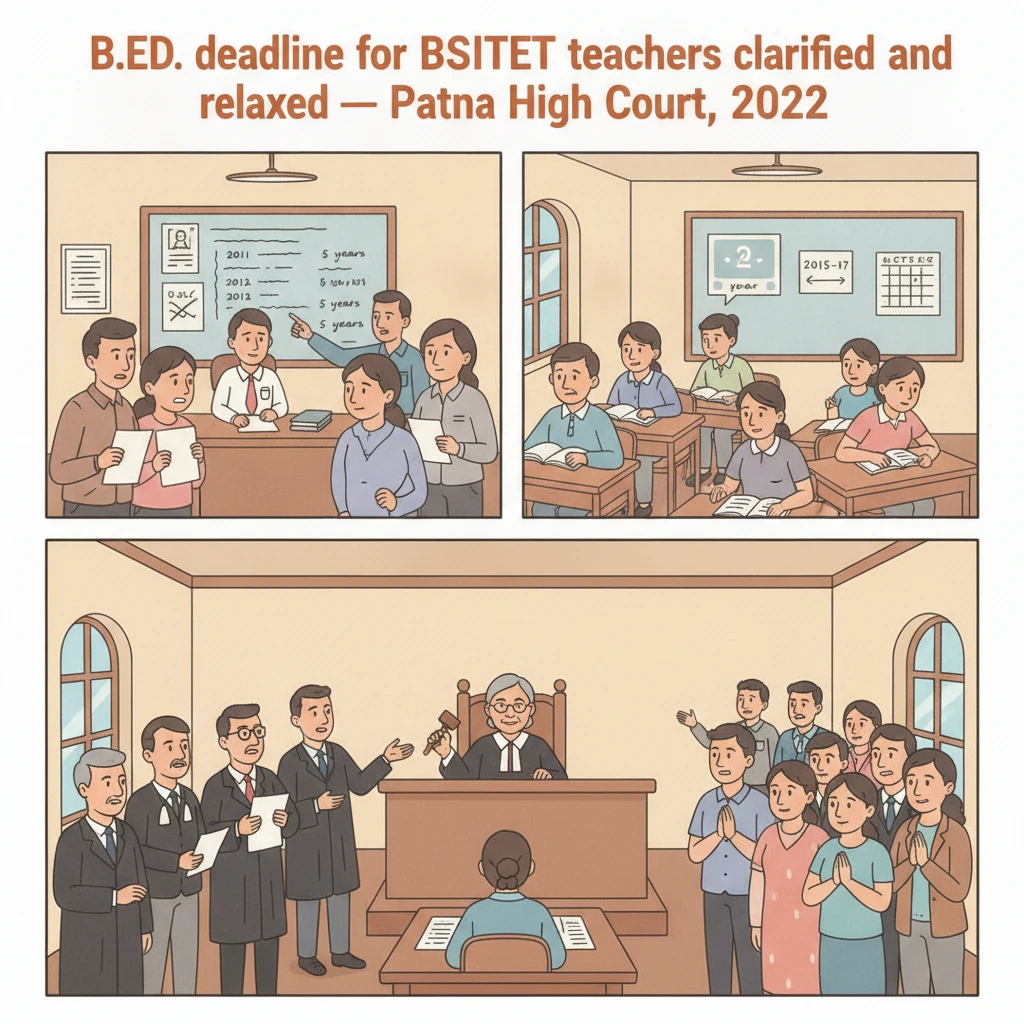
Many candidates applied. However, some had not completed their B.Ed. within five years of the BSITET result. One major reason was that the National Council for Teacher Education (NCTE) had changed the B.Ed. course from one year to two years from the 2015–17 session onwards, which disrupted earlier plans of candidates.
Complaints were received that selection lists included candidates who had not completed B.Ed. within the five-year window. On 27.12.2019, by Memo No. 2381, the Director, Secondary Education, directed all authorities not to consider any candidate who had not obtained B.Ed. within five years of publication of the BSITET 2011 result.
Preeti Priya and 120 others filed CWJC No. 1987 of 2020 to challenge this letter. Similar writ petitions (CWJC Nos. 2133, 5569, 5995, 6760, 7645, and 8108 of 2020) were filed by other candidates. During the case, a government circular gave relief to some candidates admitted in B.Ed. in the 2016–18 session; 77 petitioners in CWJC 1987/2020 withdrew as their grievances were redressed.
Meanwhile, the Education Department issued further circulars dated 13.01.2020 and 31.01.2020, relaxing and clarifying how the five-year B.Ed. completion condition should be applied in view of the two-year B.Ed. course. These circulars became the central point of dispute before the Patna High Court.
What the Court Examined and Decided
The core problem was simple to understand: BSITET 2011 said, “Get your B.Ed. within five years of the result.” But in between, the B.Ed. course changed from one year to two years, and there was confusion on from which date to count five years, and which B.Ed. sessions would qualify.
Many candidates had taken admission in B.Ed. a bit later but still finished their degree before applying in the 6th phase. They feared being disqualified only because they joined B.Ed. in a particular session (like 2017–19) instead of an earlier one. On the other side, some candidates and intervenors insisted that the rule must be read strictly and only those who complied with the original five-year one-year-B.Ed. condition should be considered.
The State responded by explaining its circulars.
First, on 13.01.2020 (Memo No. 43), the Education Department accepted that there was confusion whether the five-year period was to be counted from the date of the exam or from the date of publication of the result. It decided the period would run from the date of publication of the result.
This circular also said:
- Candidates whose BSITET results were published in 2012, who got admitted to B.Ed. in session 2015–17, and whose B.Ed. results came in 2018, would be considered in the 6th phase.
- Candidates whose BSITET results were published in 2013, who took B.Ed. admission in 2016–18, and whose B.Ed. result was published on or before 01.08.2019, would also be considered.
Second, on 31.01.2020, the Department issued another circular further clarifying the position. It noted that because BSITET results came in June 2012, candidates could not realistically secure admission in B.Ed. in the 2012–13 session. So for 2012 pass-outs, the “base year” was treated as 2013. With that adjustment, it decided:
- BSITET 2012 pass-outs who enrolled in the two-year B.Ed. course in session 2016–18 and obtained their B.Ed. before the last date for submission of forms for the 6th phase would be eligible.
- Similar concession would apply to 2013 pass-outs, though the circular did not spell out their B.Ed. session in equally clear words, which later became a point of ambiguity.
The effect of these clarifications was that some candidates gained eligibility (those in 2015–17 or 2016–18 B.Ed. sessions), while others, especially those who joined B.Ed. in 2017–19, remained in a grey area.
The petitioners argued that when BSITET 2011 originally gave a five-year window for B.Ed., they should be allowed the full five years, and the mandatory change from one-year to two-year B.Ed. should not work against them. According to them, if the result was in 2012, the five-year period ended in 2017; for 2013 results, it ended in 2018. They said that a candidate who joined B.Ed. in session 2017–19 had still started within the five-year period and should not be rejected if he or she finished B.Ed. before the cut-off date of the 6th phase applications.
The intervenors and some other petitioners took the opposite stand. They asked for a strict reading of the BSITET 2011 rules. They contended that:
- Rules of BSITET 2011 could not be changed “midway” for selection.
- Any relaxation would enlarge the pool of candidates and unfairly reward those who were “slow and lethargic” in obtaining B.Ed. over those who complied in time.
- The five-year period should be counted strictly, and the government’s 2020 circulars were contrary to the BSITET advertisement.
They relied on Supreme Court decisions in P. Mahendran v. State of Karnataka, A.A. Calton v. Director of Education, and Bedanga Talukdar v. Saifudaullah Khan, which warn against changing recruitment rules or relaxing conditions after the process starts.
The Patna High Court, per Hon’ble Mr. Justice Ashutosh Kumar, examined these arguments carefully.
First, the Court clarified that BSITET 2011 is an eligibility test, not in itself a recruitment advertisement. The appointment processes are carried out in different phases, each phase being a separate process. The rules of the “game” regarding appointment were not being changed; only the manner of calculating the five-year period for obtaining B.Ed. was being clarified in light of the NCTE’s later change to a two-year course.
Second, the Court held that the basic qualification itself was unchanged: everyone still needed graduation and B.Ed. The government had merely recognized new base years (2013 for 2012 pass-outs, and by necessary implication 2014 for 2013 pass-outs) and identified which B.Ed. sessions would count, in order to ease genuine hardship caused by the structural change in the B.Ed. programme.
Third, the Court considered an earlier decision of a Coordinate Bench in CWJC No. 7446 of 2020 (Manoj Kumar and others). That judgment had strictly applied Clause 8(k)(iii) of the BSITET 2011 guidelines and held that candidates must obtain B.Ed. not later than June 2017 (for 2012 result) or June 2018 (for 2013 result). However, the present Court noted that the government’s circulars of 13.01.2020 and 31.01.2020, which reshaped the interpretation, were either not brought to the attention of the earlier Bench or not considered. Relying on the principle of “sub silentio”, the Court held that the earlier decision could not be treated as binding precedent on these specific issues.
Fourth, the Court accepted that the government’s clarificatory circulars did not offend the Supreme Court rulings cited by the intervenors. In this case, there was no retrospective change in basic eligibility, only clarification of the timeframe to avoid hardship. The Court also noted that sufficient publicity had been given to the relaxation through the circulars.
After discussing the legal position, the Court then laid down a clear, three-part scheme for the 6th phase of appointment based on BSITET 2011:
First category: clear eligibility.
Candidates whose BSITET result was published in 2012, who enrolled in B.Ed. course latest by 2016–18 session, and who obtained their B.Ed. degree before the last date for submitting applications for the 6th phase, are eligible.
For candidates whose BSITET results were published in 2013, those who enrolled in B.Ed. latest by 2017–19 session and obtained B.Ed. before the same cut-off date are also eligible on the same principle.
Second category: not automatically eligible, but can seek relaxation.
Candidates who are 2012 BSITET pass-outs but enrolled in B.Ed. in the 2017–19 session, even if they finished B.Ed. before the last date, are not automatically eligible under the circulars. However, the Court gave them liberty to approach the concerned authorities with a representation seeking relaxation and consideration for selection/appointment.
The Court directed that such representations must be considered before conclusion of the selection process, and decisions (accepting or rejecting) should be communicated without delay. While deciding, the authorities must also bear in mind that no teacher eligibility test has been conducted after 2011, and the BSITET 2011 result has been made valid for life for that reason. The Court also “expected” that any request for age relaxation from such candidates would be considered favourably.
Third category: pass-outs of 2013 with late enrollment.
For candidates whose BSITET results were published in 2013 and who enrolled in B.Ed. in session 2017–19 and obtained B.Ed. before the cut-off date, the Court explicitly held that they are eligible, applying the same principle of base year and five-year window.
Finally, the Court rejected the plea of intervenors and some petitioners who wanted to strike down the liberalising circulars. It held that these circulars only clarified how to count the five-year period and did not amount to an unlawful change in recruitment rules or confer arbitrary advantage.
With these directions and clarifications, the batch of writ petitions was disposed of.
Why This Judgment Matters
This decision is important for thousands of BSITET 2011 qualified candidates in Bihar who are waiting for government teacher jobs.
First, the Patna High Court has settled who is clearly eligible in the 6th phase on the basis of B.Ed. session and date of result. This removes much of the confusion that earlier circulars and strict readings had created.
Second, it gives a lifeline to 2012 pass-outs who joined B.Ed. in 2017–19: while they are not automatically in, they have a recognised right to apply for relaxation, and authorities must decide their cases before the selection ends.
Third, the Court confirmed that BSITET 2011 is only an eligibility test; the government can logically clarify rules for counting the B.Ed. period in later appointment phases, especially when course duration changes by an external body like NCTE.
For teacher aspirants in Bihar, this judgment explains how long after BSITET they can finish B.Ed. and still be considered, and what steps they can take if they fall just outside the fixed sessions but hold the degree within time.
Legal Issues and Answers
Issue: Can the Government of Bihar relax and clarify the five-year period for obtaining B.Ed. under BSITET 2011 guidelines through circulars dated 13.01.2020 and 31.01.2020, or is this an impermissible change of rules “midway”?
Answer: The Court held that these circulars are valid clarifications. BSITET 2011 only determines eligibility; each appointment phase is separate. The basic qualifications remain unchanged, and only the reckoning of the five-year window is adjusted to address hardship from the NCTE’s shift to a two-year B.Ed. course.
Issue: Who among BSITET 2011 pass-outs are eligible for consideration in the 6th phase of teacher appointments in Bihar?
Answer: (a) 2012 BSITET pass-outs who enrolled in B.Ed. by 2016–18 session and obtained B.Ed. before the last application date are eligible; (b) 2013 BSITET pass-outs who enrolled by 2017–19 and obtained B.Ed. before the cut-off date are eligible; (c) 2012 pass-outs enrolling in 2017–19 are not automatically eligible but may seek relaxation through representation.
Issue: Is the earlier judgment in Manoj Kumar (CWJC 7446/2020) binding precedent on this issue despite the later government circulars?
Answer: The Court held that Manoj Kumar is not binding here because the circulars dated 13.01.2020 and 31.01.2020 were not considered. To that extent, the earlier decision is sub silentio and not an authority on the effect of those circulars.
Cases Cited by the Court
- P. Mahendran v. State of Karnataka, AIR 1990 SC 405.
- A.A. Calton v. Director of Education and Others, AIR 1983 SC 1143.
- Bedanga Talukdar v. Saifudaullah Khan and Others, (2011) 12 SCC 85.
- Municipal Corporation of Delhi v. Gurnam Kaur, 1989 SCC (1) 101.
- Lancaster Motor Company (London) Ltd. v. Bremith Ltd., (1941) 1 KB 675 (as discussed).
Case Details
Case Numbers:
- Civil Writ Jurisdiction Case No. 1987 of 2020
- Civil Writ Jurisdiction Case No. 2133 of 2020
- Civil Writ Jurisdiction Case No. 5569 of 2020
- Civil Writ Jurisdiction Case No. 5995 of 2020
- Civil Writ Jurisdiction Case No. 6760 of 2020
- Civil Writ Jurisdiction Case No. 7645 of 2020
- Civil Writ Jurisdiction Case No. 8108 of 2020
Case Title (lead matter): Preeti Priya and 120 others v. The State of Bihar and others
Coram: Hon’ble Mr. Justice Ashutosh Kumar
Citation: 2022 (1) PLJR 720
Nature of the Case: Batch of writ petitions (civil writ jurisdiction) concerning eligibility for appointment as secondary and senior secondary school teachers in the 6th phase recruitment on the basis of BSITET 2011.
Advocates:
- For petitioners in CWJC No. 1987 of 2020: Mr. Sanjeev Kumar Mishra
- For respondents in CWJC No. 1987 of 2020: Mr. Hitesh Suman
- For intervenors: Ms. Ritika Rani
- For NCTE: Mr. Sunil Kumar Singh
- For petitioner in CWJC No. 2133 of 2020: Mr. Shashank Chandra
- For respondents in CWJC No. 2133 of 2020: Ms. Shilpa Singh (GA 12)
- For petitioners in CWJC No. 5569 of 2020: Mr. Shashi Shekhar Tiwary
- For respondents in CWJC No. 5569 of 2020: Mr. Subhash Chandra Mishra (SC 16)
- For petitioners in CWJC No. 5995 of 2020: Mr. Shashank Chandra
- For respondents in CWJC No. 5995 of 2020: Mr. Ashutosh Ranjan Pandey (AAG 15)
- For petitioners in CWJC No. 6760 of 2020: Ms. Ritika Rani
- For respondents in CWJC No. 6760 of 2020: Mr. Subhash Chandra Mishra (SC 16)
- For BSEB in CWJC No. 6760 of 2020: Mr. Sunil Kumar Mandal
- For petitioners in CWJC No. 7645 of 2020: Mr. Nagendra Kumar Singh
- For respondents in CWJC No. 7645 of 2020: Mr. Umesh Narayan Dubey, AC to GP 27
- For BSEB in CWJC No. 7645 of 2020: Mr. Gyan Shankar
- For petitioners in CWJC No. 8108 of 2020: Ms. Ritika Rani
- For respondents in CWJC No. 8108 of 2020: Mr. Umesh Narayan Dubey, AC to GP 27
- For BSEB in CWJC No. 8108 of 2020: Mr. Gyan Shankar
Link to Judgment: Click here to access the full judgment of the Patna High Court
If you found this explanation helpful and wish to stay informed about
how legal developments may affect your rights in Bihar,
you may consider following Samvida Law Associates for more updates.







