

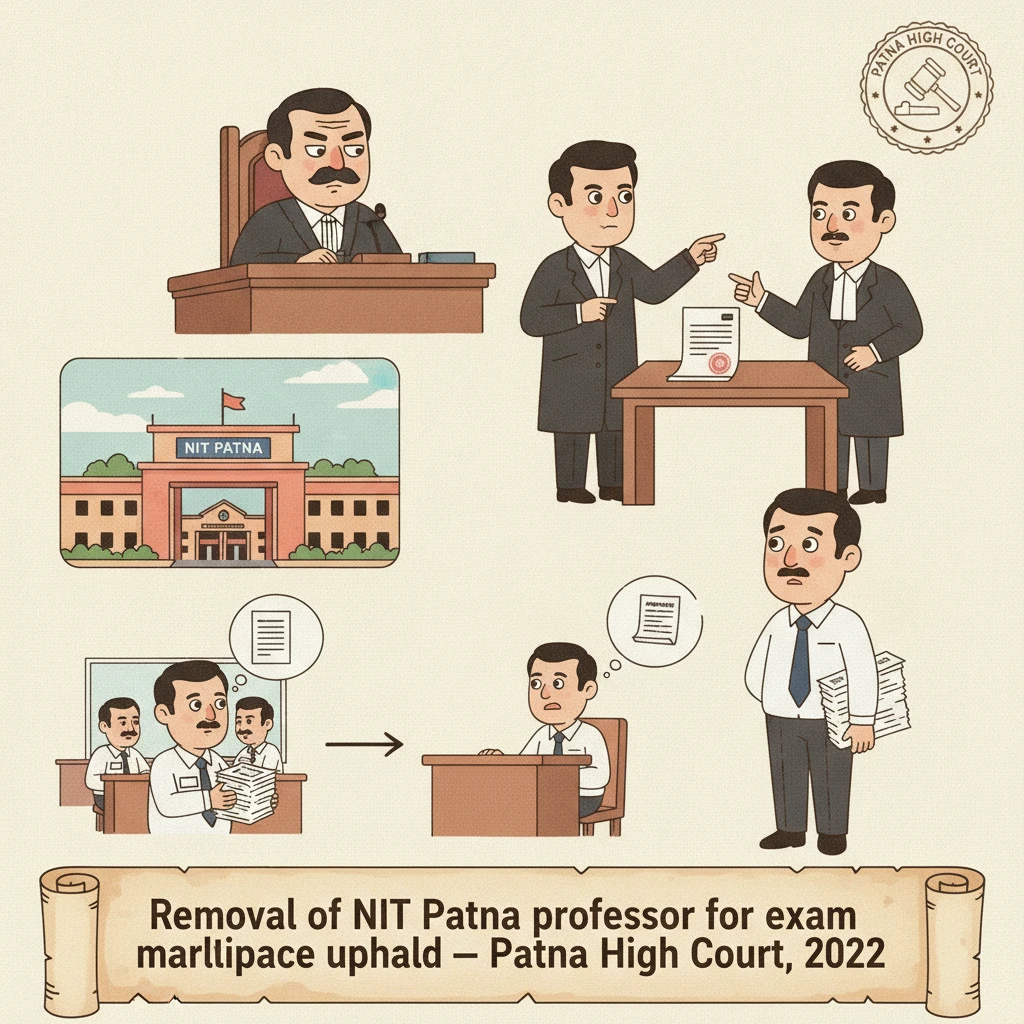
Case Background
The petitioner was working as an Assistant Professor in the Electrical Engineering Department of the National Institute of Technology, Patna (NIT Patna). While in service, he enrolled himself in the Ph.D. programme in the same department.
In March 2014 he appeared in the Mid-Semester Examination of the Ph.D. course. During evaluation, an invigilator noticed a serious discrepancy in his answer book. The code printed on the answer book submitted by the petitioner did not match the code of answer books that had been supplied in that examination hall.
Because of this, a notice was issued to the petitioner alleging that he had used unfair means in the examination. The petitioner replied on 29.04.2014. He stated that he could not verify whether the code on his answer book matched the code on other answer books in the hall and, therefore, the allegation of malpractice was uncalled for.
The matter was referred to the Unfair Means Committee of NIT Patna. The Committee examined the records of the examinations conducted on 13.03.2014. It found that in the forenoon session of that day the petitioner had been an invigilator in another room. In that session, 48 answer books with a particular code were issued, but only 47 candidates appeared and 47 answer books were returned. One unused answer book was missing.
The code of the missing answer book was different from the code used in the afternoon session, when the petitioner himself appeared as a candidate in the Ph.D. paper “Power System Protection” on 13.03.2014. The answer book he submitted in the afternoon session carried the code of the missing unused answer book from the forenoon session.
On this basis, the Committee concluded that the petitioner had pilfered the unused answer book in the forenoon while acting as invigilator, filled it with answers, and later submitted it as his own answer book in the afternoon examination. Considering that he was also a faculty member, such conduct was held to be grossly unfair.
Because he was found using unfair means, NIT Patna cancelled his admission to the Ph.D. course and debarred him forever from applying for the Ph.D. course in the Institute. The petitioner, in his reply, mentioned that this action had already caused him mental stress and requested that no further departmental proceedings be initiated for imposing punishment.
What the Court Examined and Decided
Despite his explanation, the authorities were not satisfied. A show cause notice dated 20.03.2015 was issued asking why disciplinary proceedings should not be initiated for misconduct. The petitioner replied on 31.03.2015, again claiming innocence and stating that he had no idea how he got an answer book with a different code.
Subsequently, a formal departmental proceeding was initiated. A memorandum of charges dated 21.09.2015 was served on the petitioner. Two main charges were framed:
First, that while working as an invigilator in the Mid-Semester Examination in 2014, he took away one blank answer book from the forenoon session.
Second, that he used this same answer book in the afternoon session for his own Ph.D. examination in “Power System Protection” on 13.03.2014. He was alleged to have brought the answer book with pre-written answers and to have submitted it as a bona fide examinee.
Along with the charge memo, the petitioner was supplied a list of documents and list of witnesses by which the charges were to be proved. He was directed to submit his reply within ten days of receiving the memo.
The petitioner then wrote to the Director of NIT Patna on 28.09.2015, requesting copies of the documents mentioned in the list so that he could prepare his defence. On 07.10.2015 he further requested the schedule of the Mid-Semester Examination and the Invigilators’ Duty Chart of teachers.
According to the petitioner, these documents were not provided. He alleged that the enquiry was concluded in haste without giving him adequate opportunity to defend himself. The Enquiry Officer submitted his report on 10.02.2016 holding the petitioner guilty of both charges.
The enquiry report was communicated to the petitioner on 28.02.2016, asking him to submit a representation on the proposed quantum of punishment. The communication is recorded to have been received by him on 17.04.2017.
The respondents stated before the Court that after the enquiry was completed, the petitioner absented himself from duty. Because he was not available, the Board of Governors of NIT Patna, in its meeting dated 12.12.2016, resolved to publish a notice in a daily newspaper for his information.
The Enquiry Officer’s report recorded that all formalities of a domestic enquiry had been followed and that the Board of Governors had approved the outcome. The report found that the petitioner had deliberately taken one blank answer book from the forenoon session for unauthorised and dishonest use in the afternoon session.
The case was then referred to the Central Vigilance Commission (C.V.C.) by letter dated 15.02.2017 for second-stage advice. The C.V.C. confirmed that the charges had been proved and advised imposition of a suitable major penalty. The petitioner was invited to submit his representation against the C.V.C. advice, but no such representation was ever filed.
Considering his defence as unworthy of acceptance, the disciplinary authority decided to impose the penalty of removal from service. By order dated 05.10.2019, the petitioner was removed from the post of Assistant Professor in the Electrical Engineering Department with effect from 15.10.2019.
In the Patna High Court, the petitioner challenged (i) the punishment order dated 05.10.2019, (ii) the memorandum of charges dated 21.09.2015, and (iii) all consequential proceedings. He raised several grounds.
He alleged that the documents he had asked for were not supplied, that the disciplinary proceeding was concluded in hot haste, that the Enquiry Officer (respondent no. 4) was personally biased because he was also a Member of the Board of Governors and had suggested the punishment in his report, and that the enquiry had been conducted under Rule 14 of the Central Civil Services (Classification, Control and Appeal) Rules, 1965, which according to him was not applicable when the proceeding was initiated.
He also argued that an answer book cannot be pre-written as no examinee knows in advance what questions will be asked. Lastly, he claimed that the penalty of removal from service was excessively harsh when compared with the alleged misconduct.
The Court first examined the factual findings regarding unfair means. It noted that the petitioner worked as invigilator in the forenoon session and as examinee in the afternoon session on 13.03.2014. One unused answer book from the forenoon session was missing. The code of that missing book differed from the code used in the afternoon session. The answer book submitted by the petitioner in the afternoon carried this different code. These findings came from the Unfair Means Committee’s report.
The Committee had also noted that the petitioner answered a question which was never asked in the afternoon question paper, and that he tried to deposit his answer book only within thirty minutes of the exam’s commencement. For the Court, this strongly supported the conclusion that he had pre-written answers on the pilfered answer book and brought it into the afternoon exam.
On the question of documents, the Court observed that the petitioner had been given the list of documents proposed to be used, including his answer book, the invigilators’ reports, and the Unfair Means Committee findings. The petitioner mainly wanted the invigilators’ duty chart and some other related records. Even assuming that those were not provided, the Court held that no prejudice was caused to him because the crucial documents for proving misconduct had been shared and he was aware of the case he had to meet.
Regarding the allegation of bias, the Court rejected the plea. It found that being both Enquiry Officer and member of the Board of Governors did not, by itself, prove personal bias. The Board of Governors consists of members from academic faculties and its decisions are unanimous. The suggestion of punishment by respondent no. 4 in his report merely showed concern about the seriousness of the proved misconduct and did not establish bias.
The Court also held that the enquiry had not been concluded in haste. In fact, the report could not be served earlier because the petitioner had been absent from duty, making it necessary to issue a public notice in the newspaper.
On applicability of the Central Civil Services (Classification, Control and Appeal) Rules, 1965, the Court examined the Statutes governing NITs. Section 24 of the first Statutes of National Institutes of Technology, dated 23.04.2019, stated that employees of the Institute would be governed by the Central Civil Services (Conduct) Rules, 1964. An amendment to Section 25, made on 21.07.2017, clarified that until each Institute framed its own code of conduct, it would follow the Central Civil Services (Classification, Control and Appeal) Rules, 1965.
The Court termed this amendment as clarificatory. It noted that the petitioner’s appointment as Assistant Professor was under recruitment rules issued by the Ministry of Human Resource Development on 15.01.2014, which provided that for matters not covered by the Statutes, corresponding Central Rules would apply. Section 24(5) of the first Statutes covered conduct, but not the procedure for disciplinary proceedings or imposition of penalties. Clause 26 also did not prescribe any procedure.
Therefore, the procedure and penalties in the Central Civil Services (Classification, Control and Appeal) Rules, 1965 had been applied to the petitioner as to other NIT employees. The Court stressed that these rules are procedural in nature, designed to ensure fairness and natural justice, and actually impose obligations on disciplinary authorities. It found that no prejudice was caused to the petitioner; rather, he benefited from the safeguards in those rules.
The Court also recorded that the petitioner never objected to the applicability of these rules at the time of receiving the charge memo or during the enquiry. Objections were raised only on 29.08.2019, long after the Statute had been amended on 21.07.2017. This delay further weakened his challenge.
The Court was aware that the petitioner had earlier challenged the cancellation of his Ph.D. admission and permanent debarment through C.W.J.C. No. 19403 of 2016, which had been dismissed on 23.11.2017. Even so, the Court independently considered whether the penalty of removal from service was disproportionate.
Applying the settled law on judicial review of administrative punishment, the Court referred to the Wednesbury test. It held that its role was limited to checking whether the decision was illegal, procedurally improper, or so unreasonable that no sensible decision-maker could have imposed such punishment on the available material.
The Court concluded that all relevant materials had been considered and the decision was bona fide. Many alternative punishments were open to the disciplinary authority, but it was not for the Court to substitute its own choice of penalty.
Given that the petitioner, a faculty member, had misused his position as invigilator to take away an unused answer book and submit it as his own in a Ph.D. examination, the Court held that removal from service did not shock its conscience and could not be termed perverse. Hence, there was no ground to interfere.
Accordingly, the Patna High Court dismissed the writ petition, without any order as to costs.
Why This Judgment Matters
This judgment shows that courts take examination malpractice by teachers very seriously, especially when it involves abuse of official duty like invigilation. For faculty members and staff in universities and institutes, it is a warning that misuse of examination material can lead to the extreme penalty of removal from service.
It also clarifies that where national institutions like NITs do not have their own detailed disciplinary procedures, they can validly use the Central Civil Services (Classification, Control and Appeal) Rules, 1965. Employees cannot later claim that such rules were inapplicable if they never objected during the enquiry and suffered no real prejudice.
For students and staff, the decision explains that courts will not lightly interfere with disciplinary findings when due process has been followed, especially when evidence like answer book codes, duty charts and committee reports clearly indicate manipulation.
Legal Issues and Answers
- Issue: Whether the departmental enquiry against the Assistant Professor of NIT Patna for using unfair means in a Ph.D. examination suffered from procedural defects, bias, or non-supply of documents.
Answer: The Patna High Court held that the enquiry complied with the requirements of a domestic enquiry, no personal bias was established, and any non-supply of certain documents caused no prejudice to the petitioner. - Issue: Whether the Central Civil Services (Classification, Control and Appeal) Rules, 1965 could validly be applied to NIT employees in disciplinary proceedings.
Answer: The Court held that these rules were rightly applied, as the NIT Statutes and recruitment rules permitted use of corresponding Central Rules for service conditions, and the later amendment to the Statute was only clarificatory. - Issue: Whether the punishment of removal from service was disproportionate to the misconduct proved against the petitioner.
Answer: The Court held that, applying the Wednesbury standard, the punishment did not shock the conscience, was not perverse, and could not be interfered with in judicial review.
Cases Cited by the Court
- The judgment does not expressly mention or rely on any specific earlier case law by name or citation.
Case Details
Case Number: Civil Writ Jurisdiction Case No. 119 of 2020
Case Title: Alok Ranjan v. The National Institute of Technology Patna & Ors.
Coram: Hon’ble Mr. Justice Ashutosh Kumar
Date of Judgment: 07.02.2022
Citation: 2022(1) PLJR 731
Advocates: For the petitioner – Mr. Shekhar Singh, Advocate; Mr. Manish Kumar No. 2, Advocate. For the respondents – Mr. Sanjay Kumar Giri, Advocate.
Nature of the Case: Writ petition under civil writ jurisdiction challenging departmental proceedings and order of removal from service.
Link to Judgment: https://patnahighcourt.gov.in/viewjudgment/MTUjMTE5IzIwMjAjMSNO-WQkLdj22Txc=
If you found this explanation helpful and wish to stay informed about how legal developments may affect your rights in Bihar, you may consider following Samvida Law Associates for more updates.







