

Case Background
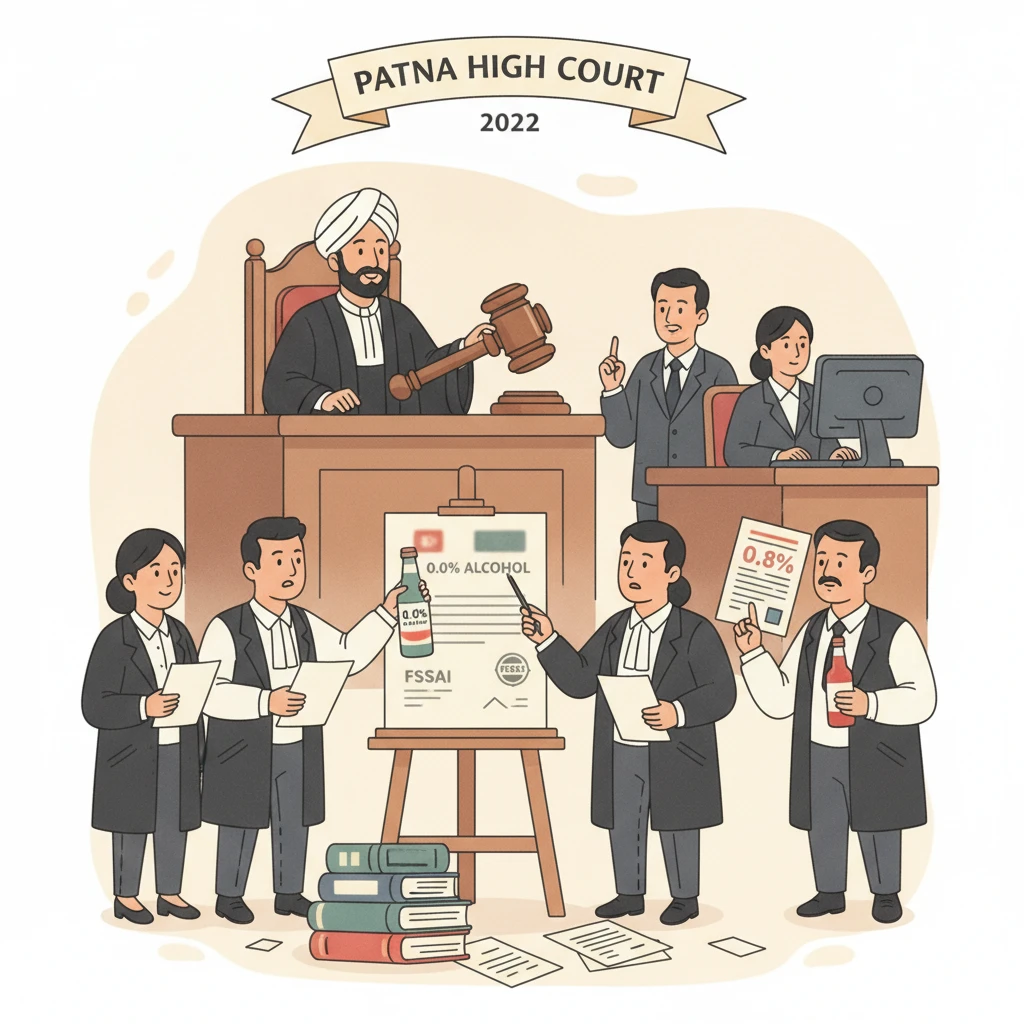
A criminal case, Pandaul P.S. Case No. 270 of 2020, was registered in Madhubani district. It alleged that products of a brewery unit of a company manufacturing malt-based non-alcoholic beverages contained alcohol in violation of the Bihar Prohibition and Excise Act, 2016 and also attracted several provisions of the Indian Penal Code.
The company, a registered entity under the Companies Act, 1956, runs a manufacturing unit at Naubatpur in Patna district. It produces malt-based non-alcoholic beverages under brand names including Kingfisher Radler and Kingfisher Ultra. The unit was represented before the Court through its General Works Manager.
After the State of Bihar imposed prohibition on 5 April 2016 on sale and consumption of foreign liquor and beer, the company approached the Excise and Prohibition Department for permission to manufacture malt-based non-alcoholic drinks. The Excise Commissioner, Bihar, granted a licence for such manufacture on 13 December 2016. A further notification dated 24 January 2017 allowed the company to engage in manufacture of non-alcoholic beverages.
The company also held a licence from the Food Safety and Standards Authority of India (FSSAI) for manufacture and sale of non-alcoholic beverages and claimed to follow the standards prescribed by the Bureau of Indian Standards (BIS), which define a non-alcoholic beverage as one containing less than 0.5% ethyl alcohol by volume.
Despite this regulatory framework, an Excise Department Chemical Examiner at Patna reported that a seized sample of the company’s drink was “fermented liquor” with 0.8% v/v ethyl alcohol. Relying on this report, the police registered the criminal case for offences under Sections 30(a) and 35(e) of the Bihar Prohibition and Excise Act, 2016 and under Sections 272, 273, 465 and 420 of the Indian Penal Code.
The company approached the Patna High Court in Criminal Writ Jurisdiction Case No. 366 of 2021, seeking quashing of the entire prosecution and a direction that no coercive steps be taken against it.
What the Court Examined and Decided
Hon’ble Mr. Justice Ashutosh Kumar heard the matter. The core question was whether the criminal prosecution could continue when the beverages were licensed, labelled and tested as non-alcoholic, and there was serious doubt about whether they were “intoxicants” or “liquor” under the Bihar Prohibition and Excise Act, 2016.
The company argued that none of the offences under the Penal Code or the Prohibition Act were made out. It stressed that it had never manufactured or sold any intoxicant or liquor as defined in the Excise Act. The beverages were non-alcoholic drinks, manufactured as per BIS specifications and under proper FSSAI licence.
On the technical side, the company pointed out that BIS standards for carbonated beverages declare that a non-alcoholic drink should contain less than 0.5% ethyl alcohol by volume. It stated that its product had been tested by the CSIR–Central Food Technological Research Institute, Mysore, a Government laboratory, which reported that the drink had zero percent alcohol. The label on the product also clearly declared it to be a non-alcoholic drink.
In spite of these test reports, the Excise Department’s Chemical Examiner reported that a sample had 0.8% v/v alcohol, treating it as fermented liquor. The company said it did not know how this higher figure was arrived at. It argued that even if a small percentage of ethyl alcohol is present in a non-alcoholic drink, without any accusation or evidence that the drink is used or sold for intoxication, prosecution under the Prohibition Act is not justified.
Learned counsel referred to the statutory definitions under the Bihar Prohibition and Excise Act, 2016. “Intoxicant” and “liquor” are defined in Sections 2(40) and 2(44) respectively, while “Alcoholic Beverage or Portable liquor” and “BIS Standards” are defined in Sections 2(4) and 2(6). Reading these provisions together, the defence submitted that an “intoxicant” must be liquor that is served as, or as a substitute for, alcohol and is consumed for the purpose of intoxication.
The company’s position was that a drink which is not consumed for intoxication and is within BIS standards cannot be treated as prohibited liquor. Counsel stressed that there could be many reasons why a single sample might show higher alcohol content, including natural fermentation in the bottle over time, yet the authorities went ahead with a “mindless prosecution” based on one report.
The Court was informed of an earlier decision of the Patna High Court in M/s Smart India Marketing v. State of Bihar (Cr. WJC No. 627 of 2017, decided on 5 November 2017). In that case, an FIR was quashed on the reasoning that the Prohibition Act does not bar sale of non-alcoholic substances conforming to BIS standards as defined in the Act. That judgment held that, to attract penal provisions of Sections 30(a) and 30(g) of the Prohibition Act, the substance must be an intoxicant or liquor capable of being used or consumed for getting intoxicated.
The company further attacked the reliability of the Excise Department’s Chemical Examiner’s report. It said that the FSSAI has laid down standard guidelines for detecting ethyl alcohol content in beverages, but those were not followed. Therefore, the report was a hasty conclusion and should not be treated as sacrosanct.
To reinforce this, the company pointed out that samples from the same batch had been tested at two National Accreditation Board approved testing and calibration laboratories, Intertek India Private Limited and Vimta, both of which reported zero percent alcohol. It also produced yet another lab report from the same Excise Department Chemical Examiner, concerning the same product, where alcohol content was found to be only 0.4% v/v. This inconsistency deepened the doubt.
On learning of the prosecution, the company had requested the Excise Commissioner to have samples tested at another NABL accredited laboratory with proper infrastructure for testing alcoholic beverages as per FSSAI guidelines, but this request was ignored.
The Court noted that the BIS has issued a second revision of methods of test for alcoholic drinks, prescribing three methods to determine ethyl alcohol content: a routine method for apparent strength, a referee method for real strength, and a method for alcoholic drinks producing volatile oil on distillation. The BIS standards mention the required apparatus, testing procedure and calculation method.
Justice Ashutosh Kumar observed that there was nothing on record to show that the Excise Department’s Chemical Examiner followed the BIS-prescribed process. Without such compliance, his report could not safely be treated as final for launching prosecution.
The Court then turned to the principles governing quashing of FIRs. It referred to the Supreme Court decision in State of Haryana and Others v. Bhajan Lal and Others, Supp (1) SCC 335, where the Court laid down illustrative situations in which High Courts may exercise powers under Article 226 of the Constitution or Section 482 of the Code of Criminal Procedure to quash an FIR. One such ground is where the allegations in the FIR, taken at face value and in their entirety, do not prima facie constitute any offence or make out any case against the accused.
The Patna High Court also cited the more recent Supreme Court judgment in Neeharika Infrastructure Pvt. Ltd. v. State of Maharashtra and Others, (2021) SCC OnLine SC 315, where the Supreme Court reiterated those principles but cautioned that investigation must not generally be thwarted and quashing powers should be used sparingly and with care.
Applying these principles to the facts, the Court emphasised that the prosecution of the company was based on a finding that some seized samples contained ethyl alcohol beyond tolerance limit. However, if the seized articles were not sold as intoxicants or capable of being consumed as intoxicants, they would not fall within the category of liquor prohibited under the Prohibition Act. The Court recognised that a “margin of error is inherent in such strict legislation.”
In the circumstances, Justice Ashutosh Kumar concluded that the facts of the case did not justify prosecution of the petitioner company. Since the substances were marketed and licensed as non-alcoholic beverages, backed by multiple lab reports showing zero alcohol and serious doubts about testing methodology, the basic ingredients of the offences under the Prohibition Act and the Penal Code were not made out.
Consequently, the Court held that the case squarely fell within the Bhajan Lal category where allegations in the FIR, even if accepted as true, did not disclose the commission of any cognizable offence.
On this reasoning, the Patna High Court quashed Pandaul P.S. Case No. 270 of 2020 and all prosecutions arising from it. The criminal writ petition was allowed and the company stood discharged from the criminal proceedings.
Why This Judgment Matters
This decision is important for manufacturers and traders of non-alcoholic beverages in Bihar operating under the strict prohibition regime. It clarifies that not every trace of alcohol in a drink turns it into prohibited liquor.
The judgment stresses that, to attract the Bihar Prohibition and Excise Act, the product must be an intoxicant or liquor meant to be used or consumed for intoxication. Drinks conforming to BIS standards and marketed as non-alcoholic, backed by reliable testing, cannot be casually treated as illicit liquor.
The Court also highlighted that prosecution should not be launched solely on the basis of a doubtful or incomplete laboratory report. Authorities must follow prescribed testing standards and consider all available evidence, including other accredited lab reports and the purpose for which the drink is consumed.
For ordinary businesses and consumers, this ruling provides assurance that non-alcoholic drinks, properly tested and labelled, are not automatically criminalised under Bihar’s prohibition law.
Legal Issues and Answers
-
Issue: Can a criminal prosecution under the Bihar Prohibition and Excise Act, 2016 and the Indian Penal Code be sustained against a company manufacturing non-alcoholic beverages, on the basis of a single Excise laboratory report showing slightly higher alcohol content?
Answer: No. The Patna High Court held that where the product is not an intoxicant or liquor meant for intoxication, and there are serious doubts regarding testing and multiple reports indicating zero alcohol, the FIR and prosecution proceedings are liable to be quashed. -
Issue: When can the High Court quash an FIR in exercise of its writ and inherent powers in such matters?
Answer: Relying on Bhajan Lal and Neeharika Infrastructure, the Court held that if, even taking the FIR allegations at face value, no offence is made out, and continuing the prosecution would amount to abuse of process, the FIR can be quashed.
Cases Cited by the Court
- M/s Smart India Marketing v. State of Bihar, Cr. WJC No. 627 of 2017, Patna High Court, judgment dated 05.11.2017 (quashing of FIR relating to non-alcoholic substances conforming to BIS standards).
- State of Haryana and Others v. Bhajan Lal and Others, Supp (1) SCC 335 (guidelines for quashing FIRs under Article 226 and Section 482 CrPC).
- Neeharika Infrastructure Pvt. Ltd. v. State of Maharashtra and Others, (2021) SCC OnLine SC 315 (reaffirming principles on quashing FIRs and cautioning against premature interference with investigation).
Case Details
Case Number: Criminal Writ Jurisdiction Case No. 366 of 2021; arising out of Pandaul P.S. Case No. 270 of 2020, District Madhubani.
Case Title: United Breweries Limited v. The State of Bihar & Ors.
Coram: Hon’ble Mr. Justice Ashutosh Kumar.
Date of Judgment: 09.02.2022 (Uploading Date: 26.02.2022).
Citation: 2022(1) PLJR 709.
Advocates: For the petitioner – Mr. Satyabir Bharti, Advocate; Mr. Avinash Shekhar, Advocate. For the State – Mr. P.K. Verma, AAG.
Nature of the Case: Criminal writ petition seeking quashing of FIR and entire prosecution.
Statutes Involved: Bihar Prohibition and Excise Act, 2016 (Sections 30(a), 35(e); definitions under Sections 2(4), 2(6), 2(40), 2(44)); Indian Penal Code (Sections 272, 273, 465, 420); Article 226 of the Constitution of India; Section 482 of the Code of Criminal Procedure (by reference in precedents).
Link to Full Judgment: Patna High Court Judgment – Criminal WJC No. 366 of 2021
If you found this explanation helpful and wish to stay informed about
how legal developments may affect your rights in Bihar,
you may consider following Samvida Law Associates for more updates.







