

Case Background
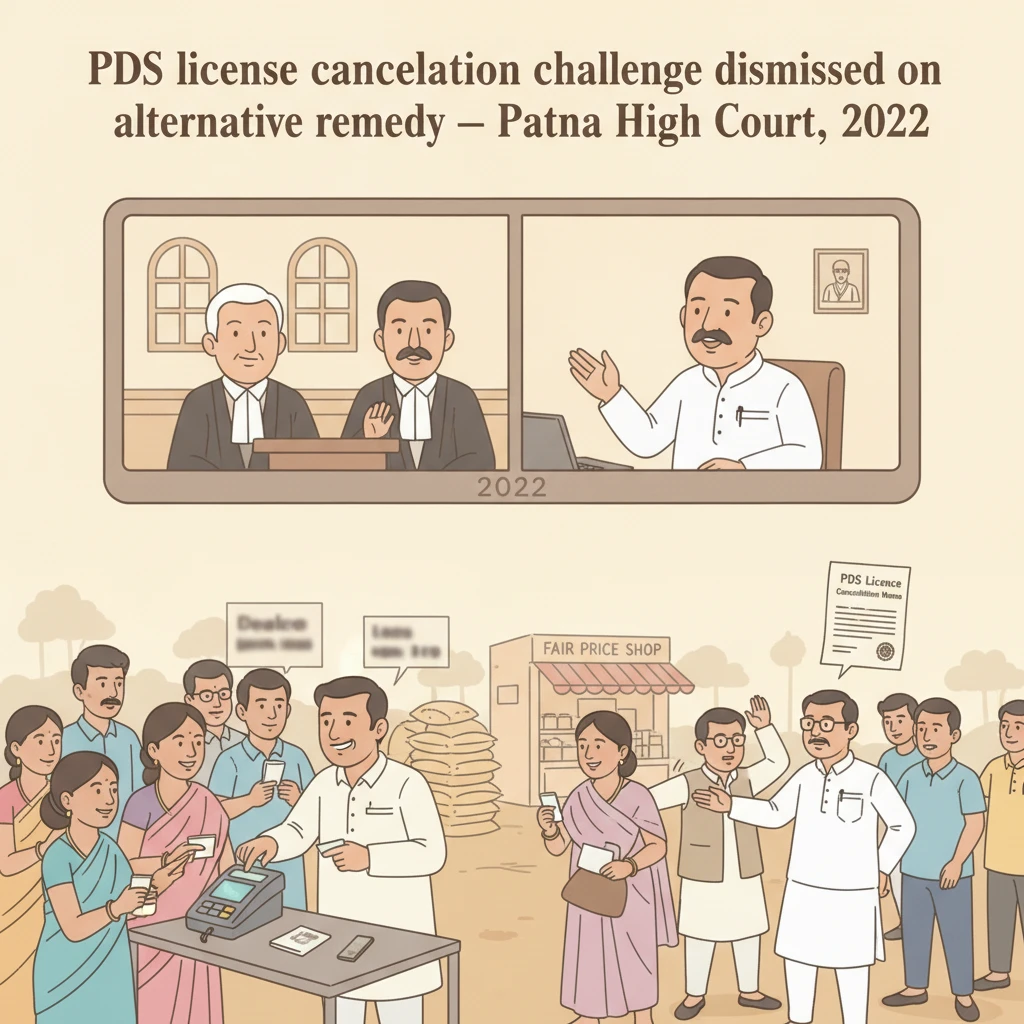
The case arose from cancellation of a Public Distribution System (PDS) licence bearing No. 48 of 2016. The licence holder ran a fair price shop in Garkha block, Saran (Chapra), Bihar.
On 01.06.2021, the Sub-Divisional Officer, Sadar, Chapra (SDO) issued Memo No. 301 cancelling this PDS licence. This order was passed after complaints were received from ration card beneficiaries attached to the shop.
Instead of first filing an appeal against the cancellation order, the dealer (petitioner) approached the Patna High Court under Article 226 of the Constitution by filing Civil Writ Jurisdiction Case No. 16184 of 2021. He asked the Court to quash the SDO’s order.
A counter affidavit was filed by the State. The petitioner did not file any rejoinder to reply to the stand taken by the State in its counter affidavit.
What the Court Examined and Decided
The Division Bench of the Patna High Court (Hon’ble Mr. Justice Chakradhari Sharan Singh and Hon’ble Mr. Justice Madhuresh Prasad) heard the matter online on 03.02.2022 because of COVID-19 restrictions. The oral judgment was delivered by Hon’ble Mr. Justice Madhuresh Prasad.
The core dispute related to serious allegations made by ration beneficiaries and the process by which the SDO cancelled the PDS licence. The Court first traced how the complaints were dealt with at the administrative level.
A communication was sent by the SDO to the Block Supply Officer, Garkha, Saran (BSO). It enclosed a complaint signed by 27 beneficiaries of the petitioner’s PDS dealership. These beneficiaries levelled multiple allegations regarding functioning of the shop.
According to the complaint, the beneficiaries alleged that the dealer was going to their homes, taking their fingerprints on the Point of Sale (POS) machine and telling them that if they did not give fingerprints, their ration quota would lapse. They said he was not providing vouchers for the supply made.
The beneficiaries further stated that when they went to the shop, they were told that allocation per unit had been reduced. In reality, according to them, less than the due ration was being supplied. Even this reduced ration was allegedly given only every alternate month and not monthly. They also complained that they were charged prices higher than the prescribed rates.
There were additional allegations. It was said that Antyodaya card holders were not being supplied foodgrains. Beneficiaries also claimed that ever since they had been tagged with this dealership they were not being supplied non-NFSC kerosene oil.
The SDO directed the BSO to enquire into these complaints. The BSO wrote back on 24.03.2021, stating that the petitioner enjoyed political patronage. He requested that an additional enquiry officer be deputed with him so that a proper enquiry could be conducted and a report submitted.
In these circumstances, an enquiry team inspected the petitioner’s PDS dealership on 08.04.2021. After inspection, a report was submitted. On the basis of statements made by certain beneficiaries during this inspection, two main illegalities were alleged:
First, that some beneficiaries were supplied ration less than their allotted quota. Second, that they were charged more than the specified price of ration.
On the basis of this inspection report, the SDO issued a show cause notice to the petitioner on 24.09.2021. The petitioner was required to explain why action should not be taken against him.
The petitioner submitted a written reply, which was placed before the High Court as Annexure-3 to the writ petition. In his reply, he sought to answer both the main charges and the allegations made by the beneficiaries.
He stated that the beneficiaries who had complained had subsequently sworn affidavits denying the allegations. Copies of these affidavits were enclosed with his reply. He also relied on certificates allegedly issued by the Vigilance Committee, according to which supplies from his dealership were being made properly and in accordance with law. Clause 23 of the Bihar Targeted Public Distribution System (Control) Order, 2016 was referred to in this context.
The SDO, however, disbelieved the affidavits filed by the beneficiaries. The reason given was that the signatures on the affidavits did not tally with the signatures made by those persons on their statements recorded during inspection. On this basis, the SDO treated the affidavits as not genuine and rejected the petitioner’s defence.
Relying on the inspection report and the statements of beneficiaries recorded at that time, the SDO proceeded to cancel the licence by the impugned order dated 01.06.2021.
In the High Court, the petitioner argued that he had not been given sufficient opportunity and that the SDO’s order showed non-consideration of his stand. It was contended that this defect could not be cured in appeal, and therefore the writ court should interfere.
The petitioner’s counsel also argued that, because of the Vigilance Committee certificates, there was evidence of proper functioning of the shop under Clause 23 of the Control Order, 2016. A long list of judgments was cited in support of general principles about fair hearing and natural justice, including decisions of the Supreme Court and previous decisions of the Patna High Court.
On the other side, counsel for the State submitted that the petitioner had a statutory remedy of appeal against the licence cancellation order. Since disputed questions of fact were involved, particularly regarding genuineness of affidavits and correctness of signatures, the writ jurisdiction should not be invoked. It was further argued that the authority had considered the petitioner’s reply and had given reasons for rejecting his defence.
The Patna High Court carefully considered the rival submissions and pleadings. It noted that the judgments relied upon by the petitioner related to settled propositions of law, which were not in doubt. However, such decisions would apply only in the particular facts of the cases in which they were delivered.
In the present case, the Court observed that the petitioner had indeed attempted to answer both the charges in his reply. Importantly, it was not his case that he was unaware of any complaint from beneficiaries. His main defence was based on the affidavits allegedly given by those beneficiaries denying earlier allegations.
The authority had disbelieved these affidavits because of mismatch in signatures. This created a clear factual dispute regarding the truthfulness and authenticity of the affidavits. The Court emphasised that in writ jurisdiction under Article 226, it would refrain from going into such factual disputes, especially when they turn on evidence and credibility of documents.
The Division Bench also made it clear that, in view of the nature of the order proposed to be passed, it would not express any opinion on the merits of the petitioner’s claims. If his claims were valid, they could be considered by the appellate authority.
The Court accepted the State’s submission that the petitioner had an effective remedy of appeal. Having regard to the disputed issues arising from the SDO’s order, the Court held that the proper course was for the petitioner to approach the appellate authority, rather than seek a writ directly.
Accordingly, the Patna High Court disposed of the writ application, observing that the petitioner, if so advised, may approach the appellate authority. It did not quash the cancellation order, nor did it grant any interim protection.
Why This Judgment Matters
This decision is important for PDS dealers and other licence holders in Bihar. It shows that when an administrative order is challenged mainly on disputed facts—such as whether complaints are genuine or whether affidavits are true—the Patna High Court is reluctant to interfere directly under writ jurisdiction.
If there is a statutory appeal provided, affected persons are expected to use that route first. The appellate authority is better placed to examine evidence, cross-check signatures, and evaluate the truth of rival versions.
The judgment also underlines that even when a dealer cites Vigilance Committee certificates or affidavits from beneficiaries, the licensing authority can reject them with reasons, and such factual appreciation will normally not be revisited in a writ petition.
For beneficiaries, the case indicates that their complaints can lead to serious consequences for a dealer, including cancellation, but the final decision can be tested in appeal. For dealers, the message is clear: after an adverse order, the first step should usually be an appeal, not a writ petition.
Legal Issues and Answers
-
Issue: Can the Patna High Court, in writ jurisdiction, re-examine factual disputes about beneficiary complaints and affidavits in a PDS licence cancellation case when an appellate remedy is available?
Answer: No. The Court declined to go into disputed facts about the veracity of affidavits and held that the proper course for the dealer was to approach the appellate authority. -
Issue: Did the case law cited by the petitioner on natural justice and fair hearing require the Court to set aside the cancellation order?
Answer: No. The Court held that those judgments lay down settled law but apply only on their own facts, and did not justify interference in the present factual and procedural setting.
Cases Cited by the Court
- 1995 Supp (1) SCC 21 : 1995 SCC (L&S) 251 (Tilak Chand Magatram Obhan v. Kamala Prasad Shukla and others)
- Oryx Fisheries (P) Ltd. v. Union of India, (2010) 13 SCC 427 : 2010 SCC Online SC 1236
- Chartered Accountants of India v. L.K. Ratna, (1986) 4 SCC 537 : (1986) 1 ATC 714
- State of U.P. v. Mohd. Nooh, 1958 SCR 595 : AIR 1958 SC 86
- Ram Bachan Ram v. State of Bihar, 2018 (4) PLJR 516
- Birendra Paswan @ Virendra Paswan v. State of Bihar, 2021 (2) PLJR 466
- CWJC No. 12426 of 2020 (Prabhavati Devi v. State of Bihar)
- CWJC No. 9649 of 2020 (Indra Kumar Mahto v. State of Bihar)
- CWJC No. 9649 of 2020 (Parewa Primary Agriculture Co-operative Society (PACS) v. State of Bihar)
- CWJC No. 4793 of 2021 (Suresh Kumar v. State of Bihar)
- CWJC No. 3721 of 2021 (Durgawati Kunwar v. State of Bihar)
Case Details
Case Number: Civil Writ Jurisdiction Case No. 16184 of 2021
Case Title: Tarkeshwar Ray v. The State of Bihar & Ors.
Coram: Hon’ble Mr. Justice Chakradhari Sharan Singh and Hon’ble Mr. Justice Madhuresh Prasad
Date of Judgment: 03-02-2022
Citation: 2022(1) PLJR 707
Advocates: For the petitioner: Mr. Aanand Kumar Ojha with Mr. Ram Kishore Singh, Advocates. For the respondents (State): Mr. Alok Ranjan, AC to AAG-5.
Nature of the Case: Writ petition under Article 226 of the Constitution challenging cancellation of PDS licence.
Link to Judgment: Click here to access the official Patna High Court judgment
If you found this explanation helpful and wish to stay informed about
how legal developments may affect your rights in Bihar,
you may consider following Samvida Law Associates for more updates.







