

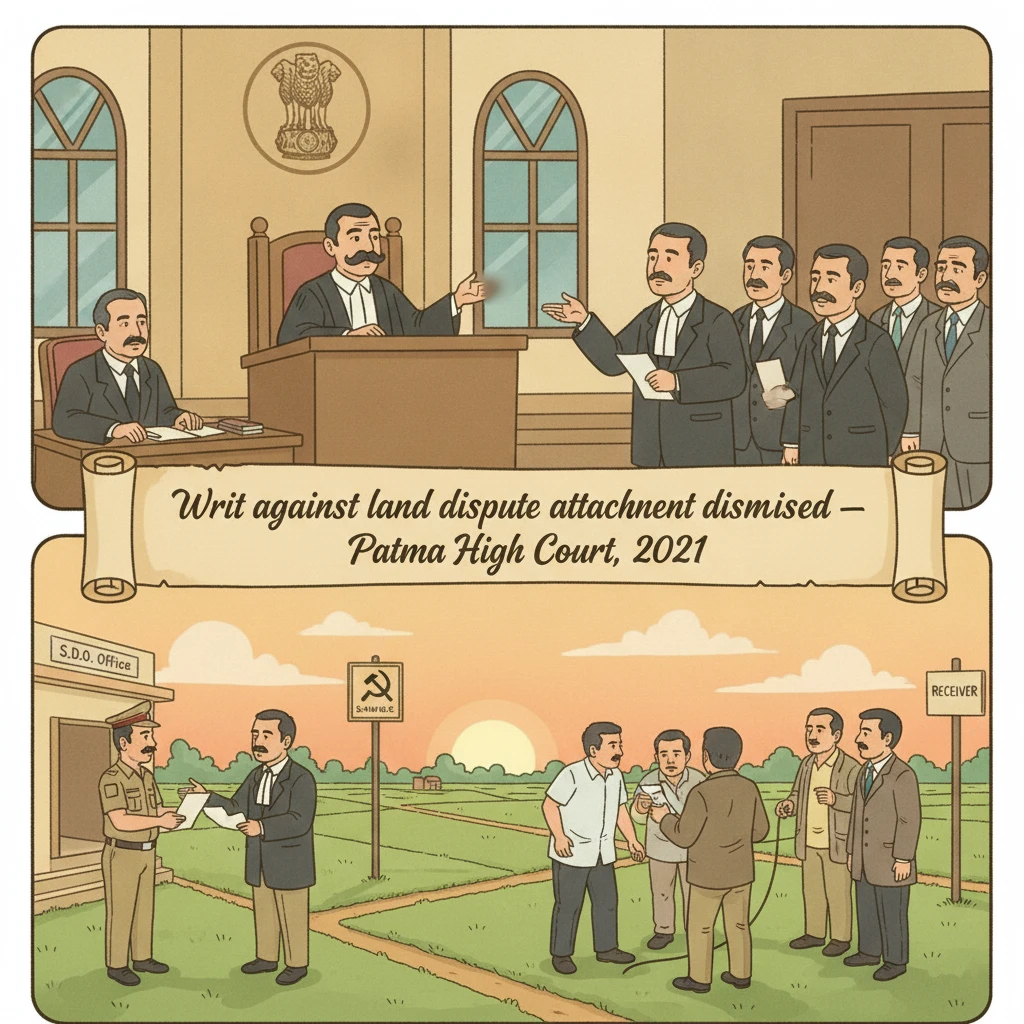
Case Background
The case arose out of a long-running land dispute within one extended family in Village Karath, Tarari, District Bhojpur.
The petitioner is one of the sons of Late Shivnarayan Singh. Private respondents are sons of Late Tejnarayan Singh. According to the petitioner, all brothers in the earlier generation had purchased agricultural lands from joint family income and were cultivating them separately by mutual understanding, without a formal partition by metes and bounds.
A dispute over these lands led private respondent no. 7 to approach the Sub-Divisional Officer, Piro, under Section 144 of the Code of Criminal Procedure. This gave rise to Case No. 107/2019 and concerned several plots mentioned by Chak Khesra and Chak Khata numbers, measuring about 86 decimals in total.
While that proceeding was pending, on 25.11.2019 the Sub-Divisional Officer, Piro, exercised powers under Section 146(1) Cr.P.C. He passed an order appointing a receiver over the disputed land and directed the Circle Officer, Tarari, Bhojpur, to act accordingly.
Feeling aggrieved, the petitioner approached the Patna High Court in Criminal Writ Jurisdiction Case No. 8 of 2020. He sought quashing of the S.D.O.’s order dated 25.11.2019.
What the Court Examined and Decided
The writ petition was heard by Hon’ble Mr. Justice Rajeev Ranjan Prasad through video application from official chambers. The core question was whether the High Court should use its writ jurisdiction to interfere with the S.D.O.’s attachment and receiver order passed under Section 146(1) Cr.P.C.
The petitioner’s counsel argued that private respondent no. 7 had filed a fraudulent petition under Section 144 Cr.P.C. It was alleged that the private respondent had suppressed material facts regarding the writ petitioner’s rights in the disputed plots. The plots were described in detail by their Chak Khesra and Chak Khata numbers, with a total area of 86 decimals.
On the petitioner’s version, respondents no. 7 and 8, being sons of Late Tejnarayan Singh, were only joint family members like himself. It was submitted that all properties listed in Annexure 2 to the writ petition were bought out of the income of all the brothers. As the elder brother, the father of respondents 7 and 8 had been the karta of the joint family.
The petitioner further submitted that by “khangi batwara” (informal family arrangement), the brothers had been cultivating separate portions of land and maintaining separate kitchens. However, there had been no formal partition on the basis of specific measurement or boundaries. According to him, the S.D.O. passed the order under Section 146(1) Cr.P.C. without sufficient material and before determining the respective rights of the parties.
On an earlier date, 13.09.2021, the Court had recorded the submissions of Mr. Sumit Kumar Jha, counsel for respondents no. 7 and 8. Those submissions were treated as important and were reproduced in the final judgment.
First, the private respondents objected to the maintainability of the writ petition itself. Counsel pointed out that the present petitioner was not even a party in the Section 145 Cr.P.C. proceeding before the Sub-Divisional Magistrate, Piro. On that basis, they argued that he had no right to challenge the order under Section 146(1) Cr.P.C. through a writ petition before the High Court.
Second, the private respondents highlighted the civil litigation history between the same branches of the family. Earlier, the brothers of the present petitioner had filed Title Suit No. 558/2008 before the Civil Court, Ara, seeking partition of the land in question. That suit was dismissed for default on 15.05.2012. Neither the petitioner nor his brothers took any steps to restore it.
The respondents contended that, by filing the criminal writ case after the dismissal of that civil suit, the petitioner was trying to create a fresh cause of action indirectly, which was not permissible.
Third, the Court was informed that during the pendency of the Section 144 Cr.P.C. proceeding, a fresh civil partition suit had been filed. This was Title Suit No. 136/2019, filed by the heirs of Late Shivnarayan Singh before the Sub-Judge, Mokam Piro, Bhojpur, for partition of the disputed land. The respondents had already appeared in that suit.
Fourth, counsel for respondents 7 and 8 submitted that, with the intervention of their mother and well-wishers, the dispute had been mutually settled between them. A compromise petition had been filed in the Section 145 Cr.P.C. proceeding, and a certified copy of the order-sheet (Annexure-R/3A) was placed on record with the counter affidavit.
In the course of arguments, the High Court posed a direct question to the petitioner’s counsel. The Court asked whether, before filing the writ petition, the petitioner had ever approached the Sub-Divisional Officer, Piro, to be added as a party in the proceeding pending before him under Sections 144/145/146 Cr.P.C.
Initially, the petitioner’s side submitted orally that an application had been made to the S.D.O. but not entertained. However, the Court carefully examined the writ petition and found that there was no such statement in the pleadings. There was no assertion in the affidavit that any application was filed before the S.D.O. to be impleaded as a party.
This absence of pleading was treated as significant. The Court refused to rely on bare oral submissions that were not supported by the verified pleadings.
The Court also examined the copy of the plaint of Title Partition Suit No. 136/2019, which the petitioner himself had filed on record. This showed that the petitioner was plaintiff no. 1 in that civil suit. His brother was plaintiff no. 2, his mother was plaintiff no. 3, and his two sisters were plaintiff nos. 4 and 5. Respondents no. 7 and 8 in the writ case were defendants in that partition suit.
The Court recorded that the defendants (respondents 7 and 8) had already appeared in the civil suit.
Further, in paragraph 9 of the plaint of Title Suit No. 136/2019, it was admitted that the petitioner’s father had earlier filed a partition suit in the court of Sub-Judge-1st, Ara, numbered as Title Suit No. 558/2008, which had been dismissed in default. This admission confirmed the earlier litigation history mentioned by the private respondents.
After hearing counsel for the petitioner, counsel for the private respondents, and counsel for the State, the Court formed its conclusion. Two factors weighed heavily with the Court.
First, the petitioner was not a party to the pending criminal proceeding before the Sub-Divisional Officer, Piro, in which the order under Section 146(1) Cr.P.C. had been passed. He had not made any application before the S.D.O. for being added as a party. Without participating in that proceeding or even attempting to become a party, he was now asking the High Court to quash the S.D.O.’s order.
Second, a comprehensive civil partition suit, Title Suit No. 136/2019, filed by the petitioner and his close family members, was already pending before the competent civil court since 29.08.2019. That suit directly concerned the same disputed lands and the rights of the same family branches. The defendants had already entered appearance in that suit.
In this situation, the High Court considered it inappropriate to examine the merits of the land dispute or the allegations of fraud and suppression made against the private respondents. Questions of title, partition, and shares in joint family property were already before the civil court, and it was for that court to decide them.
Therefore, the Patna High Court held that the writ application at the instance of the petitioner could not be entertained as a challenge to the S.D.O.’s order under Section 146(1) Cr.P.C.
The Court clearly stated that, “under such circumstances, it would not be appropriate for this court to go into the merit of the contentions raised before this court.” It finally held that the writ application had no merit and dismissed it.
Why This Judgment Matters
This judgment is important for people involved in family land disputes who may be tempted to use criminal proceedings or writ petitions to fight over property.
The Patna High Court has signalled that if someone is not a party before the local magistrate and does not even try to become a party there, they cannot easily bypass that forum and directly approach the High Court to challenge orders like attachment or appointment of a receiver.
It also underlines that when a proper civil partition suit is already pending about the same land, the High Court will usually avoid deciding the underlying property rights in a criminal writ case. The correct forum to decide shares in joint family property is the civil court.
For villagers and families in Bihar facing similar disputes, the message is that long-term solutions lie in properly filed civil suits and participation in the correct legal proceedings, not in parallel or shortcut methods.
Legal Issues and Answers
-
Issue: Can a person who was not a party before the Sub-Divisional Officer challenge an order under Section 146(1) Cr.P.C. through a writ petition when a civil partition suit over the same land is already pending?
Answer: No. The Patna High Court refused to entertain the writ petition, noting that the petitioner was not a party before the S.D.O., had not applied to be impleaded there, and had already filed a title partition suit regarding the same property.
Cases Cited by the Court
- No prior judgments or case law were cited or relied upon in the text of this decision.
Case Details
Case Number: Criminal Writ Jurisdiction Case No. 8 of 2020 (arising out of P.S. Case No.- Year-0, District Bhojpur)
Case Title: Shailendra Pratap Singh v. The State of Bihar & Ors.
Citation: 2022(1) PLJR 220
Court: High Court of Judicature at Patna
Coram: Hon’ble Mr. Justice Rajeev Ranjan Prasad
Date of Judgment: 14.09.2021
Advocates:
- For the petitioner: Mr. Rajendra Nath Sinha, Advocate
- For the State: Ms. Divya Verma, AC to AAG-III
- For private respondents: Mr. Sumit Kumar Jha, Advocate
Nature of the Case: Criminal writ petition seeking quashing of an order passed by the Sub-Divisional Officer, Piro, under Section 146(1) Cr.P.C. in connection with land dispute proceedings under Sections 144/145 Cr.P.C.
Impugned Order: Order dated 25.11.2019 passed by the Sub-Divisional Officer, Piro, Bhojpur, appointing a receiver and directing the Circle Officer, Tarari, Bhojpur, in exercise of powers under Section 146(1) Cr.P.C.
Link to Full Judgment: Click here to read the judgment on the Patna High Court website
If you found this explanation helpful and wish to stay informed about
how legal developments may affect your rights in Bihar,
you may consider following Samvida Law Associates for more updates.







