

Case Background
This criminal appeal arose from Jaynagar P.S. Case No.168 of 2016, District Madhubani. The appellant had been tried by the Special Judge, Madhubani, for offences under Sections 366A and 376 of the Indian Penal Code and Section 4 of the Protection of Children from Sexual Offences (POCSO) Act.
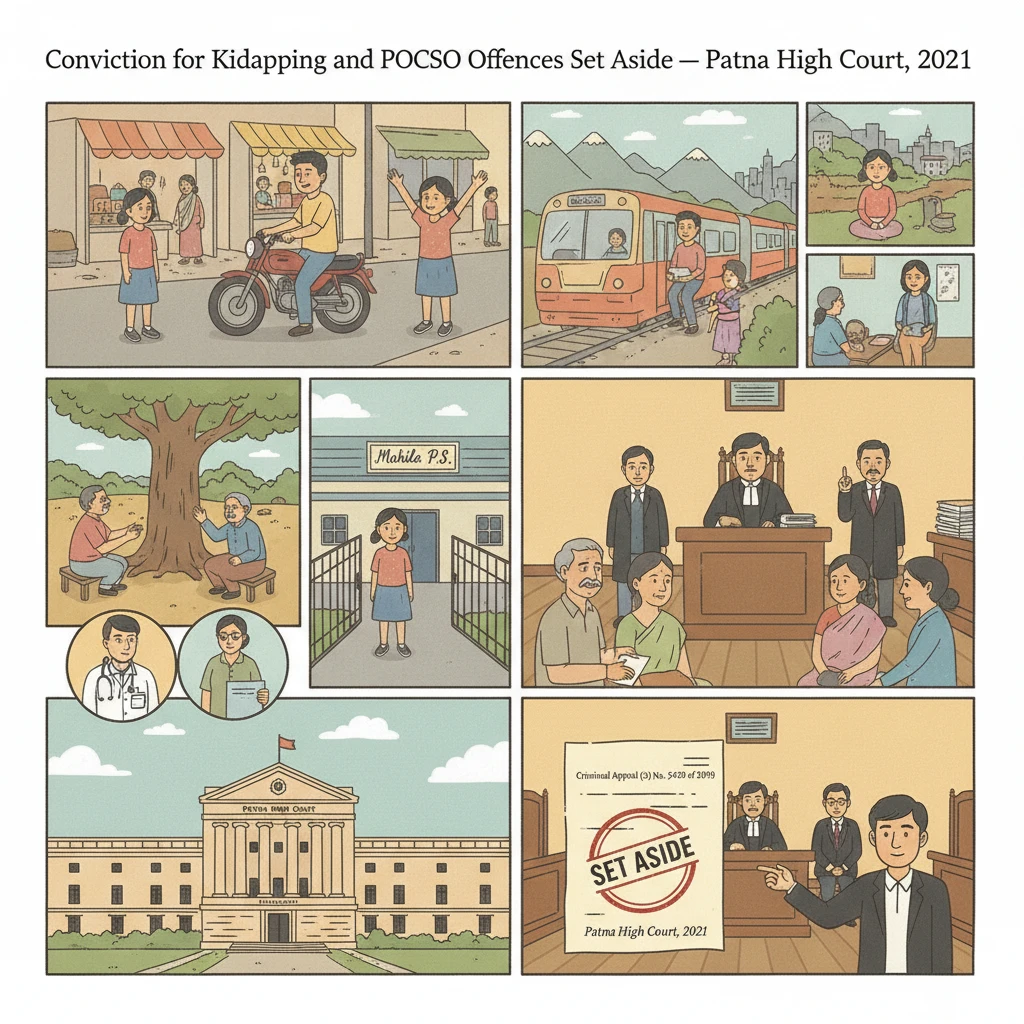
According to the written report lodged by the informant (PW 7, Ashok Paswan), his daughter, stated to be aged about 12 years, went to the market on 09.07.2016 at about 5 PM. She was accompanied by her elder sister, Chanda Kumari (PW 3), and her friend, Sarita Kumari (PW 2).
PW 2 and PW 3 went inside a shop. The informant’s daughter remained standing alone on the road. At that time, the appellant allegedly arrived on a motorcycle, made her sit on the pillion seat and drove away. The two girls raised alarm, but the appellant allegedly fled. The written report also alleged that the appellant’s parents were involved in this kidnapping and that a panchayat was convened to secure the girl’s return, but without result.
The written report was filed on 23.07.2016, about two weeks after the alleged kidnapping. In the meantime, the girl later appeared of her own accord at the Mahila P.S., Madhubani. Her medical examination was conducted on 27.08.2016 (Exhibit-5) and her statement under Section 164 Cr.P.C. was recorded on 29.08.2016 before the Magistrate (Exhibit-1).
After trial, by judgment dated 24.09.2019, the Special Judge convicted the appellant under Sections 366A and 376 IPC and Section 4 POCSO. By order dated 25.09.2019, he was sentenced to rigorous imprisonment for ten years and a fine of Rs.10,000 for each of the three offences, with sentences to run concurrently.
The appellant challenged this conviction and sentence before the Patna High Court in Criminal Appeal (SJ) No.5420 of 2019.
What the Court Examined and Decided
Hon’ble Mr. Justice Birendra Kumar heard the appeal. The key questions before the Patna High Court were whether the prosecution had proved that the girl was a minor at the time of the incident and whether the alleged kidnapping and sexual assault were without her consent.
Counsel for the appellant argued that the case was essentially one of a love affair between the appellant and the prosecutrix. He relied strongly on the testimony of PW 1, the girl herself. It was highlighted that:
- She travelled with the appellant on public transport – bus and train – from Madhubani to Nepal and later to Delhi.
- She stayed with him for about one month in Nepal and another month in Delhi.
- During this period, although surrounded by other passengers and people in the vicinity, she admittedly never raised any protest or complaint against the appellant.
The defence further submitted that the prosecutrix was actually a major. She was said to be a Class VII student, yet no school records were produced to establish her date of birth. Her parents (PW 5, Anila Devi and PW 7, Ashok Paswan) did not state her exact date of birth in their evidence.
The medical board, through PW 8 Dr. Gargi Singh and PW 9 Dr. Rama Jha, opined that the girl was between 16 and 17 years old, based on radiological examination. However, the prosecution did not produce the radiological report, nor did it examine the radiologist who carried out the test.
It was also contended that there was deliberate delay in lodging the FIR, giving room for concoction. In the written report (Exhibit-4), the informant had explained the delay by saying that a panchayat was going on regarding the incident. But in his evidence as PW 7, he denied having convened any panchayat, creating a clear inconsistency.
Reliance was placed by defence on the Patna High Court decision in Arjun Kumar @ Prince v. State of Bihar, reported in 2021(4) BLJ 260, on the aspect of proof of age and consent.
On the other side, the Additional Public Prosecutor argued that where a victim of sexual assault claims she was ravished without consent, the Court should presume absence of consent and the burden shifts to the accused to show consent. He submitted that:
- The testimony of the prosecutrix was supported by eyewitnesses PW 2 (Sarita Kumari), PW 3 (Chanda Kumari), PW 4 (Bechan Paswan) and PW 6 (Dayaram Paswan), who stated that they had seen the appellant taking away the girl on a motorcycle.
- The prosecutrix consistently deposed that the appellant had sexual relations with her against her will.
- Witnesses asserting that she was a minor were not cross-examined on that point, and medical evidence placed her age between 16–17 years, supporting the trial court’s conclusion.
The High Court closely analysed the evidence. PW 1, the girl, stated that she was alone on the road when her sister and friend had gone inside a shop and that the appellant made her sit on his motorcycle by putting her in fear not to raise alarm. She stated that she had no shopping to do. According to her, the appellant took her by bus from Madhubani to Nepal, and later by train to Delhi, where they stayed about a month. She said the appellant “used to ravish” her despite her protests and later brought her back by train to Madhubani, leaving her near the police station before going away.
However, PW 2, though stating that she saw the appellant taking the victim, also admitted she did not see the victim crying. PW 4 deposed that he saw the appellant seat the girl on the motorcycle, but there was no evidence of resistance.
On a “close scrutiny” of these testimonies, the Court concluded that the girl appeared to have gone with the appellant of her own free will:
- She voluntarily sat on the motorcycle as pillion while others were nearby, yet made no attempt to jump off or raise alarm.
- She travelled long distances in public vehicles, surrounded by co-passengers, yet did not protest to anyone.
- She stayed with the appellant for about two months in Nepal and Delhi, in places where other people were in the vicinity, but still made no complaint.
- Only after the criminal case was instituted did she appear and make allegations.
From this, the Court inferred that she was in a consensual relationship with the appellant. In such a situation, consent would only be legally irrelevant if the prosecution could firmly prove that she was a minor at the relevant time.
On the age question, the Court found that the prosecution had “relied only on approximate age.” Despite the girl being a school-going student, no school documents were produced, and her parents did not give her exact date of birth in their sworn testimony. The medical evidence only said that secondary sexual characters were well developed and that she was between 16–17 years. This was treated as an approximate opinion, particularly because neither the radiological report nor the radiologist were produced.
The Court relied on several Supreme Court judgments:
In Sunil v. State of Haryana, AIR 2010 SC 392, where the radiologist was not examined, the Supreme Court called it a serious prosecutorial lapse and stressed the importance of primary documents such as school records to prove age.
In State of Madhya Pradesh v. Munna @ Shambhoo Nath, (2016) 1 SCC 696, the Supreme Court held that approximate age is insufficient to reach a firm conclusion about the victim’s exact age.
In Jarnail Singh v. State of Haryana, 2013 Cri. L.J. 3976, it was laid down that the age of a rape victim must be determined as per Rule 12 of the Juvenile Justice (Care and Protection of Children) Rules, 2007. The same principle is now embedded in Section 94 of the Juvenile Justice (Care and Protection of Children) Act, 2015, which gives a clear hierarchy: first school certificate, then birth certificate from local authorities, and only in their absence, medical tests like ossification.
Applying these principles, the Patna High Court held that, in this case, the prosecution failed to follow the statutory method. It neither produced school or birth certificates nor the underlying medical/radiological evidence. Therefore, the exact age of the prosecutrix remained unproved, and she could not be conclusively treated as a minor.
The Court then examined the delay in lodging the FIR. The written report claimed that the delay was due to an ongoing panchayat. Yet in his oral evidence, PW 7 denied convening any panchayat. This contradiction weakened the explanation.
Referring to Tulshidas Kanolkar v. State of Goa, AIR 2004 SC 978, the Court noted that delay in reporting rape is not automatically fatal but must be satisfactorily explained. If not explained and if it creates room for embellishment, it becomes a relevant factor against the prosecution.
Here, the Court observed that if, as some witnesses claimed, they had clearly seen the appellant kidnapping the girl, there was no reason to wait for a panchayat, since cognizable offences cannot be lawfully settled through panchayat. This conduct suggested that the informant might have been aware the girl left home due to an existing affair and that the FIR was lodged only when the family could not secure her return.
Summing up, the Court noted three serious infirmities:
- Delayed information to police without a satisfactory and consistent explanation.
- Conduct of the girl indicating that she left with the appellant due to some affair and remained with him for two months without protest, showing a consensual relationship.
- Failure of the prosecution to prove her exact age and establish that she was a minor on the date of occurrence.
Because of these reasons, the Court held that the prosecution had “miserably failed” to prove any of the charges under Sections 366A, 376 IPC or Section 4 POCSO. The appeal was allowed, the conviction and sentence were set aside, and the appellant was directed to be released at once.
Why This Judgment Matters
This decision of the Patna High Court has significant implications for both victims and accused persons in sexual offence and POCSO cases.
First, it underlines that when the prosecution claims the victim is a minor, they must bring the “best evidence” of age, especially school or birth records. Medical opinions that give only an approximate age, without proper supporting documents and examination of the radiologist, may not be enough.
Second, the judgment shows that courts will carefully examine the conduct of the prosecutrix and surrounding circumstances to decide whether there was consent. Where a young woman travels freely with a man, stays with him for weeks or months, and does not complain despite many chances, the court may infer a consensual relationship unless minor status is firmly proved.
Third, the Court’s discussion on delay in lodging FIR reminds informants and police that unexplained delay can create doubts about the prosecution story. Contradictory explanations, such as claiming a panchayat in the written report and denying it in court, seriously affect credibility.
For families and communities in Bihar, this judgment emphasises the importance of promptly approaching the police in serious offences and preserving proper documents like school certificates for age-related disputes. For lawyers, it shows how Patna High Court applies Supreme Court precedents on age determination and consent in POCSO-linked prosecutions.
Legal Issues and Answers
Issue: Did the prosecution prove beyond reasonable doubt that the girl was a minor at the time of the incident?
Answer: No. The prosecution relied only on an approximate medical opinion (16–17 years) without producing school records, birth certificate, radiological report or the radiologist. Hence, minority was not established.
Issue: Was the girl kidnapped and sexually assaulted without her consent so as to attract Sections 366A, 376 IPC and Section 4 POCSO?
Answer: No. The Court found, from her conduct during two months of travel and stay with the appellant without protest, that the relationship was consensual, and therefore the essential ingredients of the offences were not proved.
Issue: What is the effect of delay and inconsistent explanation for late FIR in such cases?
Answer: Unexplained or inconsistently explained delay weakens the prosecution case, especially when it creates room for fabrication. In this case, the conflicting stand about panchayat proceedings undermined the prosecution’s version.
Cases Cited by the Court
- Arjun Kumar @ Prince v. State of Bihar, 2021(4) BLJ 260 (Patna High Court; cited by defence counsel).
- Sunil v. State of Haryana, AIR 2010 SC 392.
- State of Madhya Pradesh v. Munna @ Shambhoo Nath, (2016) 1 SCC 696.
- Jarnail Singh v. State of Haryana, 2013 Cri. L.J. 3976.
- Tulshidas Kanolkar v. State of Goa, AIR 2004 SC 978.
Case Details
Case Number: Criminal Appeal (SJ) No.5420 of 2019; arising out of Jaynagar P.S. Case No.168 of 2016, G.R. No.1548 of 2016, District Madhubani.
Case Title: Shonu Kumar Paswan v. The State of Bihar.
Citation: 2022 (1) PLJR 170.
Coram: Hon’ble Mr. Justice Birendra Kumar.
Judgment Date: 01.12.2021 (CAV; CAV date 26.11.2021).
Advocates: Mr. Vikas Kumar Sharma, Advocate and Mr. Subhash Kumar Jha, Advocate for the appellant; Mr. Sujit Kumar Singh, Additional Public Prosecutor for the State.
Nature of Case: Criminal appeal (single judge) against conviction and sentence under Sections 366A, 376 IPC and Section 4 POCSO Act.
Link to Judgment: Click here to access the full Patna High Court judgment.
If you found this explanation helpful and wish to stay informed about
how legal developments may affect your rights in Bihar,
you may consider following Samvida Law Associates for more updates.







