

Case Background
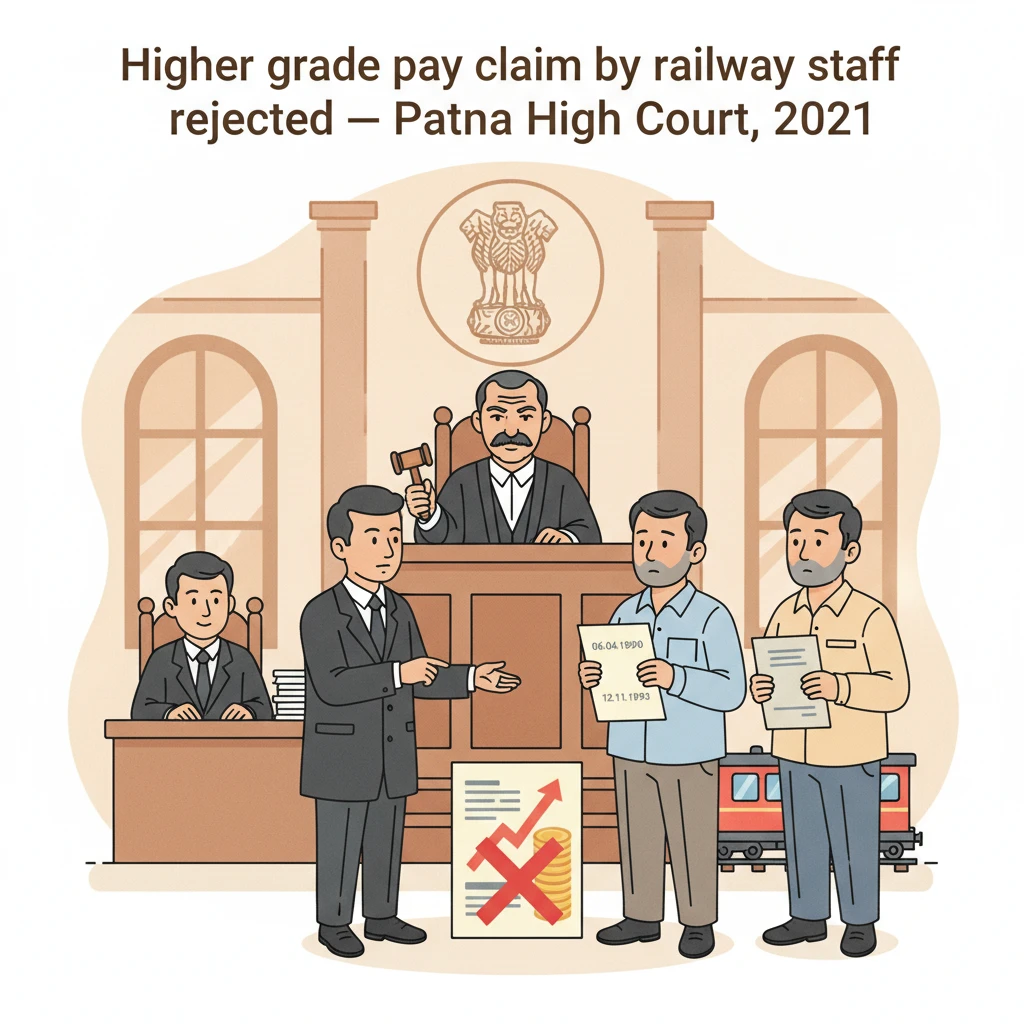
The case concerns two employees of East Central Railway, Samastipur Division. Both were initially appointed on compassionate grounds to the post of Relieving Unskilled (RUS/Hamal), which was then a Group-D post.
Petitioner no. 1 was appointed on 12.11.1993 and petitioner no. 2 on 06.04.1990. According to them, from 1994 onwards, the railway administration made them work as Couriers on an officiating basis. Courier was a Group-C post. Despite this, they continued to draw the pay-scale of their substantive Group-D post of RUS (Hamal).
With the implementation of the recommendations of the 6th Pay Revision Commission, all Group-D posts in Railways were merged with Group-C posts with effect from 01.01.2006. The post of RUS (Hamal) was also merged with the Group-C post of Courier from this date.
As per the 6th Pay Revision Commission recommendation, the Group-C post of Courier carried a pay band of Rs. 5200-20200 with Grade Pay of Rs. 1800. This position was not disputed in the case.
Many years later, in October 2014, the petitioners submitted a representation to the railway authorities. They claimed that from the date they were asked to work as Couriers, they should have been given the higher pay-scale of that post, including a higher grade pay of Rs. 1900 instead of Rs. 1800. They also demanded arrears of salary from that earlier period.
By letter dated 10.11.2014, the railway authorities rejected their claim for higher pay-scale and arrears. The petitioners then approached the Central Administrative Tribunal, Patna Bench, by filing Original Application No. 050/00336/2015 under Section 19 of the Administrative Tribunals Act, 1985.
Before the Tribunal, they sought quashing of the rejection letter dated 10.11.2014 and a direction to grant them the higher pay-scale, higher pay band and grade pay with retrospective effect, along with all consequential benefits. They also claimed they were entitled to regularisation on the post of Courier, a Group-C post, because they had allegedly been discharging the duties of that post for a long period.
The petitioners relied upon Railway Board Establishment Order No. 137/2007 dated 31.10.2007, Rule 108 of the Indian Railway Establishment Manual, 2009, and certain Railway Board’s orders, to support their demand for higher pay and regularisation.
The Tribunal, by judgment and order dated 13.05.2019, dismissed their Original Application. It held essentially that they could not claim a pay-scale higher than what was fixed for the Courier post itself, and also rejected their claim for arrears. Aggrieved by this, the petitioners filed the present civil writ petition before the Patna High Court under Article 226 of the Constitution of India.
What the Court Examined and Decided
The Patna High Court, speaking through Hon’ble Mr. Justice Chakradhari Sharan Singh (for the Division Bench also comprising Hon’ble Mr. Justice Madhuresh Prasad), examined two major aspects: the claim for a higher grade pay and the claim for arrears of salary for the period during which the petitioners said they worked as Couriers.
On the first issue, the petitioners argued that, in terms of the recommendations of the 6th Pay Revision Commission, the minimum grade pay for Group-C posts was Rs. 1900. They submitted that since the post of Courier was a Group-C post, they should get at least this grade pay of Rs. 1900, and not the grade pay of Rs. 1800 which was actually attached to that post after the merger.
They also contended that they had been made to discharge the duties of Courier for a substantial period of time and, therefore, they were entitled to be paid as Couriers. They invoked the doctrine of “equal pay for equal work” and sought arrears of salary from the date they started officiating as Couriers till 01.01.2006, when their own substantive post of RUS (Hamal) was merged with the Courier post.
The petitioners’ counsel relied upon a Division Bench judgment reported in 2017 (4) PLJR 282 (Chairman, Bihar State Power Holding Company Limited & Ors. vs. Ganesh Lal) to support their arguments.
The Court first addressed the claim for a higher grade pay of Rs. 1900. It found this claim to be completely unsustainable. The Court noted that the petitioners had been granted the pay band with grade pay of Rs. 1800, which was the grade pay allowed for the Courier post in Group-C after the merger. In other words, they were already getting the pay-scale attached to the merged post.
The Bench held that it was “preposterous” for the petitioners to demand a higher grade pay than the grade pay prescribed for the Courier post itself. The Court emphasised that they could not claim more than what the post legally carried.
Further, the Court recorded that learned counsel for the petitioners could not point out any material to show that Rs. 1900 was in fact the minimum grade pay recommended by the 6th Pay Revision Commission for all Group-C posts. Since there was no supporting material, this contention failed. On this basis, the Court agreed with the Tribunal that the claim for higher grade pay had been rightly rejected.
The Bench then turned to the broader question of judicial interference in matters of pay fixation. It observed that fixation of pay is essentially an executive function, i.e., a matter for the Government and competent authorities, not the Court. The Court made it clear that in writ jurisdiction under Article 226, it would not normally interfere with pay fixation.
Such interference is justified only if an employee can demonstrate arbitrariness or discrimination in violation of Articles 14 and 16 of the Constitution of India. In this case, the petitioners were unable to show any such arbitrariness or discrimination by the authorities in fixing the pay-scale and grade pay. Therefore, the Court found no reason to intervene.
On the second issue, the petitioners’ claim for arrears of salary for the period they say they worked as Couriers, the Court rejected the demand on two clear grounds.
Firstly, the claim was highly belated. The petitioners were asked to work as Couriers from 1994 but did not raise any claim for higher pay at that time. According to the Court, the cause of action to claim higher pay on the basis of allegedly higher responsibilities arose in 1994 itself, when they started doing those duties.
However, they kept silent and only made a representation in 2014, after the posts had been merged and they had already benefited from the merger. This 20-year delay was fatal. The Court agreed with the Tribunal that such a late claim could not be entertained.
Secondly, the Court held that the petitioners had not been able to show that they were actually made to shoulder higher responsibilities than those of their substantive post. There were no specific pleadings explaining the nature of their work as Couriers as compared to their duties as RUS (Hamal). The judgment notes the absence of any details of the distinguishing features of the two posts.
Without such factual foundation, the Court held, the claim that they discharged higher responsibilities deserving higher pay could not be accepted. This also undermined their reliance on the principle of equal pay for equal work, which generally requires a clear demonstration of similarity or higher responsibility, supported by facts.
The petitioners had also relied on Railway Board Establishment Order No. 137/2007 (R.B.E. No. 137/2007). The Court extracted the relevant portion, which stated that if staff in a lower grade are made to shoulder responsibilities of higher grade posts, they may be compensated monetarily by suitable awards granted by General Managers, depending on the circumstances and the extent of work involved.
The Court held that this guideline did not help the petitioners. It is essentially an enabling provision giving General Managers the discretion to grant suitable awards in appropriate cases. It does not automatically confer a right to higher pay or arrears, especially where there are no pleadings or evidence about actual higher responsibilities and where the claim is made after an inordinate delay.
As regards the Division Bench judgment in Chairman, Bihar State Power Holding Company Limited vs. Ganesh Lal (2017 (4) PLJR 282), the Court held that this precedent had no application in the present case. It noted that, in the background of the pleadings on record, the facts and circumstances were different, and therefore the petitioners could not rely on that decision.
Summing up, the Court concluded that the petitioners’ writ application had no merit. Their challenge to the Tribunal’s judgment dated 13.05.2019 failed. Consequently, the writ petition was dismissed, and the order of the Central Administrative Tribunal rejecting their claims stood confirmed.
Why This Judgment Matters
This judgment is significant for railway employees and other government staff who are sometimes asked to work on higher posts or different duties without a formal promotion order.
Firstly, the Patna High Court has clearly held that an employee cannot claim a grade pay or pay-scale higher than what is legally attached to the post. If a post like Courier in Group-C carries a grade pay of Rs. 1800, then no employee can demand Rs. 1900 on the assumption that this should be the minimum for all Group-C posts, unless supported by clear rules or notifications.
Secondly, the judgment stresses that claims for higher pay based on performing higher duties must be made promptly. Waiting for 20 years before raising such a claim will usually result in rejection on the ground of delay, especially when no earlier protest was made.
Thirdly, the Court requires clear and specific pleadings about the actual work done and the difference in responsibilities between the two posts. Simply saying “we worked on a higher post” is not enough. Employees must be able to show how the duties were different and heavier than their substantive post.
Lastly, the ruling reinforces that pay fixation is mainly an administrative matter. Courts will not interfere unless there is strong evidence of arbitrariness or discrimination violating constitutional guarantees of equality.
Legal Issues and Answers
- Issue: Can railway employees, whose Group-D posts were merged with a Group-C post, claim a higher grade pay (Rs. 1900) than the grade pay (Rs. 1800) fixed for the merged Group-C post of Courier under the 6th Pay Revision Commission?
Answer: No. The Court held it was unjustified and “preposterous” to claim a grade pay higher than what was fixed for the Courier post. The petitioners could not produce any material to prove that Rs. 1900 was the minimum grade pay for all Group-C posts, so their claim was rightly rejected. - Issue: Are the petitioners entitled to arrears of salary for the period they allegedly worked as Couriers on officiating basis since 1994, based on equal pay for equal work and Railway Board guidelines?
Answer: No. The Court rejected the arrears claim as being belated and unsupported. The cause of action arose in 1994, but the first representation was made only in 2014. Moreover, there were no specific pleadings showing they actually shouldered higher responsibilities or explaining the difference between the duties of RUS (Hamal) and Courier. The Railway Board guideline about possible monetary awards by General Managers did not give them a right to higher pay. - Issue: Can the High Court interfere with pay fixation in writ jurisdiction under Article 226 of the Constitution without proof of arbitrariness or discrimination?
Answer: No. The Court reiterated that pay fixation is an executive function. Writ courts interfere only when an employee proves arbitrariness or discrimination in violation of Articles 14 and 16. No such violation was shown in this case, so the Court refused to interfere.
Cases Cited by the Court
- 2017 (4) PLJR 282, Chairman, Bihar State Power Holding Company Limited & Ors. vs. Ganesh Lal – cited by the petitioners, but held by the Court to be inapplicable on the facts of this case.
Case Details
Case Number: Civil Writ Jurisdiction Case No. 13169 of 2021
Case Title: Bishnudeo Roy & Anr. vs. The Union of India & Ors.
Citation: 2022(1) PLJR 126
Court: High Court of Judicature at Patna
Bench (Coram): Hon’ble Mr. Justice Chakradhari Sharan Singh and Hon’ble Mr. Justice Madhuresh Prasad
Date of Judgment: 07.12.2021
Advocates:
- For the Petitioners: Mr. Munna Pd. Dixit, Advocate; Mr. S.K. Dixit, Advocate; Mr. Sanjay Kr. Choubey, Advocate; Ms. Swastika, Advocate
- For the Respondents (Railways): Mr. Ramadhar Shekhar, Addl. Standing Counsel (Railway); Mr. Anil Singh, Advocate
Nature of the Case: Writ petition under Article 226 of the Constitution challenging the dismissal of an Original Application (No. 050/00336/2015) by the Central Administrative Tribunal, Patna Bench, relating to claim for higher pay band, higher grade pay, arrears of salary, and regularisation on the post of Courier.
Link to Judgment: Full text of Patna High Court judgment
If you found this explanation helpful and wish to stay informed about how legal developments may affect your rights in Bihar, you may consider following Samvida Law Associates for more updates.







