

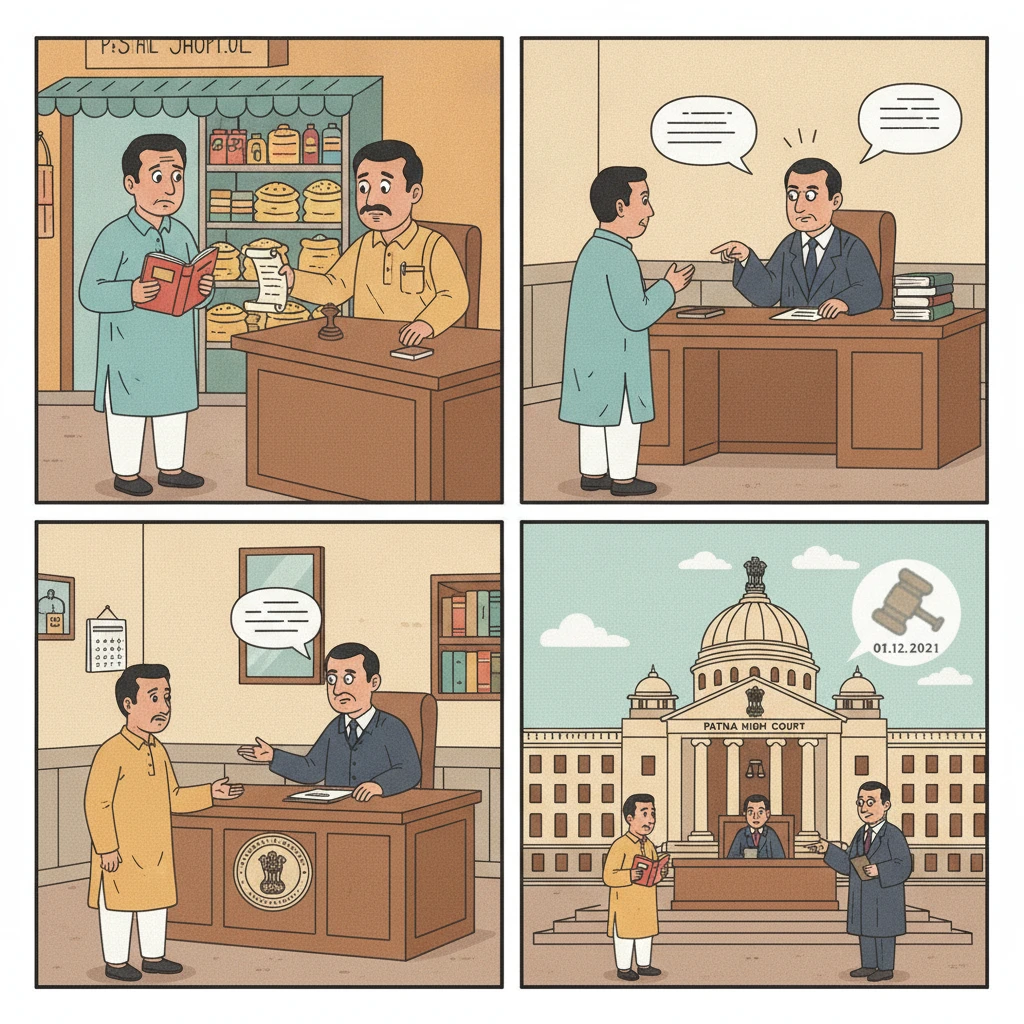
Case Background
The matter arose from action taken against a licence holder running a shop under the Public Distribution System (P.D.S.) in Sitamarhi district, Bihar.
The Sub-Divisional Officer, Pupri-cum-Licensing Authority, cancelled the petitioner’s PDS licence by an order dated 21.10.2016. The cancellation was based on allegations of certain irregularities committed by the licence holder in running the shop.
Before passing this order, the licensing authority issued notice and gave the licence holder an opportunity to show cause why his licence should not be cancelled. The petitioner submitted his explanation, but it was found unsatisfactory, and the licence was cancelled.
The petitioner then filed Supply Appeal No. 102 of 2016 before the Collector, Sitamarhi. On 22.06.2018, the Collector dismissed the appeal and upheld the cancellation order.
Not satisfied with this, the petitioner approached the Divisional Commissioner, Tirhut Division, Muzaffarpur, by filing P.D.S. Revision Case No. 240/2019. On 10.01.2020, the Commissioner dismissed the revision petition and affirmed the orders of the licensing authority and the Collector.
After losing before all these administrative authorities, the licence holder filed Civil Writ Jurisdiction Case No. 10410 of 2020 before the Patna High Court under Article 226 of the Constitution of India. He sought to set aside all three orders dated 21.10.2016, 22.06.2018 and 10.01.2020.
What the Court Examined and Decided
The Bench of Hon’ble Mr. Justice Chakradhari Sharan Singh and Hon’ble Mr. Justice Madhuresh Prasad heard the writ petition. The central question was whether the High Court should interfere in writ jurisdiction with the concurrent findings of the licensing authority, the appellate authority, and the revisional authority cancelling the PDS licence.
The Court first looked at the procedure followed by the authorities. From the pleadings and documents, the Court noted that the petitioner was given an opportunity to show cause against the proposed cancellation. He was allowed adequate time to submit his explanation and he actually did so.
The impugned order dated 21.10.2016 of the Sub-Divisional Officer, Pupri-cum-Licensing Authority, was closely examined. The High Court observed that this order was a speaking and reasoned order. It showed that the licensing authority had considered the show cause reply of the petitioner before deciding to cancel the licence.
The Court then examined the order dated 22.06.2018 passed by the Collector, Sitamarhi, in Supply Appeal No. 102 of 2016. The Collector had gone through the material and the order of the licensing authority and rejected the appeal. The High Court found that the appellate order also discussed the case and specifically found no infirmity in the order of the licensing authority.
Similarly, the Court perused the revisional order dated 10.01.2020 passed by the Divisional Commissioner, Tirhut Division, in P.D.S. Revision Case No. 240/2019. This order too was found to be a speaking and reasoned one, affirming the earlier orders.
After confirming that all three orders were reasoned and based on consideration of the petitioner’s explanation, the High Court turned to the specific grievance raised by the petitioner’s counsel.
The petitioner’s main argument was about one of the allegations against him. According to him, the authorities wrongly held that he had fraudulently maintained two separate registers for lifting and distribution of food grains.
His counsel submitted before the High Court that the licence holder had given a specific explanation at every stage. He had stated that he was maintaining two separate registers not with any fraudulent intent, but under the direction of the Block Development Officer. This, he claimed, was done to facilitate inspection of records and smooth running of the PDS shop.
The argument was that this explanation had not been correctly appreciated by the licensing authority, the appellate authority or the revisional authority. On this basis, the petitioner asked the Patna High Court to interfere and set aside the cancellation.
The High Court, however, carefully examined the revisional order and the other material. It noted that the revisional authority had specifically recorded that the petitioner could not produce any document or evidence to support his plea about the Block Development Officer’s directions.
In other words, though the petitioner claimed that he maintained two registers on the direction of the Block Development Officer, he was unable to show any written instruction or other proof of such direction before the authorities.
The Bench observed that whether the petitioner was in fact maintaining two registers under the direction of the Block Development Officer or not was a pure question of fact. Such disputed questions of fact, especially those involving appreciation of evidence, are normally not examined by the High Court in a petition under Article 226 of the Constitution.
Article 226 gives the High Court power to issue writs for enforcement of rights and to examine legality of actions of public authorities. But this power is usually exercised to see if there is any legal infirmity, violation of natural justice, lack of jurisdiction, or procedural irregularity in the decision-making process. It is not meant to re-appreciate evidence like an appellate court in factual disputes.
Here, the Court noted that the authorities had given the petitioner opportunity to be heard. They had considered his explanation. They had passed detailed, speaking and reasoned orders. There was no complaint of denial of hearing, no allegation that the authorities lacked jurisdiction, and no concrete claim of violation of procedure.
The Court also took note that the cancellation of licence was based on serious irregularities said to have been committed by the petitioner in running the PDS shop. In this background, and when all three levels of authority had concurred after considering the facts, the High Court found no ground to interfere.
The Bench clearly recorded that it found no legal infirmity in the impugned orders that would justify interference in writ jurisdiction under Article 226. The learned counsel for the petitioner was also unable to point out any procedural irregularity in the decision-making process.
Having reached this conclusion, the Patna High Court held that the writ petition lacked merit. Accordingly, the Civil Writ Jurisdiction Case No. 10410 of 2020 was rejected on 01.12.2021. As a result, the orders of the Sub-Divisional Officer, the Collector and the Divisional Commissioner cancelling the petitioner’s PDS licence all remain in effect.
Why This Judgment Matters
This judgment is significant for PDS licence holders and other government licensees in Bihar.
First, it shows that once authorities follow due process, give proper notice, and pass speaking and reasoned orders, the High Court will be slow to interfere in writ jurisdiction. This is especially so when multiple authorities, including appellate and revisional forums, have all upheld the action.
Second, the decision underlines the importance of documentary proof. If a licence holder claims that he acted on the instructions of a superior officer, it is essential to have some written direction or other evidence. Mere oral assertion may not be enough, and courts may treat such claims as disputed facts not suitable for writ proceedings.
Third, the judgment reinforces that serious irregularities in running PDS shops can lead to cancellation of licence, and such decisions can be sustained if the procedure is fair and reasons are clearly recorded.
For beneficiaries and the public, the case signals that the administration and courts are attentive to the integrity of the Public Distribution System. For PDS dealers, it is a reminder to maintain proper records and comply strictly with the rules, as failure can result in permanent loss of licence without relief from the High Court.
Legal Issues and Answers
-
Issue: Should the Patna High Court interfere under Article 226 with the concurrent orders of the licensing, appellate and revisional authorities cancelling a PDS shop licence on allegations of irregularities?
Answer: No. The Court held that the authorities had given adequate opportunity, passed speaking and reasoned orders, and there was no legal or procedural infirmity justifying interference in writ jurisdiction. -
Issue: Can the High Court in writ jurisdiction re-examine a disputed factual question, such as whether the licence holder maintained two registers under instructions of the Block Development Officer?
Answer: No. The Court held that this was a question of fact, and since the petitioner had produced no supporting evidence and the authorities had already considered and rejected this plea, such factual disputes could not be reopened under Article 226.
Cases Cited by the Court
- The judgment does not record any specific precedent or earlier case being cited or relied upon by the Court.
Case Details
Case Number: Civil Writ Jurisdiction Case No. 10410 of 2020
Case Title: Arun Kumar Singh v. The State of Bihar & Ors.
Coram: Hon’ble Mr. Justice Chakradhari Sharan Singh and Hon’ble Mr. Justice Madhuresh Prasad
Citation: 2022(1) PLJR 124
Advocates: For the petitioner – Ms. Kumari Sujata Sinha, Advocate; For the respondents – Mr. Anisul Haque, A.C. to AAG-5
Nature of the Case: Writ petition under Article 226 of the Constitution of India challenging cancellation of PDS shop licence and the dismissal of appeal and revision by the Collector and Divisional Commissioner.
Link to Judgment: Click here to read the full judgment of the Patna High Court
If you found this explanation helpful and wish to stay informed about
how legal developments may affect your rights in Bihar,
you may consider following Samvida Law Associates for more updates.







