

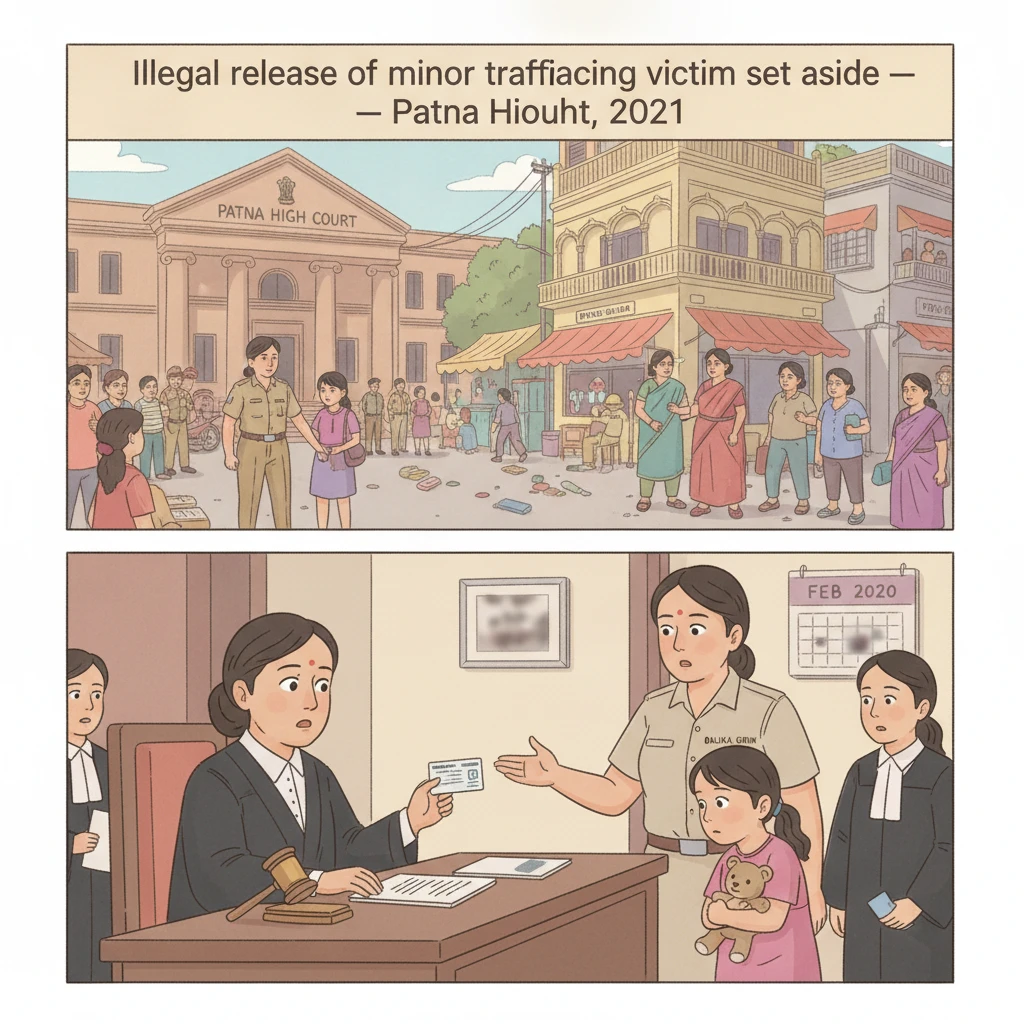
Case Background
This criminal writ case arose from Bakhri P.S. Case No. 58 of 2020 in Begusarai district. The petitioner was the informant. On the basis of his confidential information, Begusarai police conducted a raid on 08.02.2020 in a house at Ismailnagar, Ward No. 8, described as a brothel and belonging to the victim’s maternal uncle and aunt.
During the raid, a girl about 15 years old was rescued. Two women, Sunita Devi and Meera Devi, said to be relatives (aunt and others) of the girl, were arrested. Police seized two empty wine bottles, medicines relating to AIDS, pregnancy test kits, eleven used condoms, one hundred unused condoms and some money.
The victim told the police that she had been brought in childhood from Patna by one Punam @ Tanuja, wife of her maternal uncle Mantun Nutt. She did not remember the names of her parents. She alleged that Sunita Devi, Meera Devi, Punam @ Tanuja and Mantun Nutt had been forcing her into prostitution and taking all the money from customers. On refusal, she was beaten. She also named another girl taken away at the time of raid.
On these allegations, a detailed FIR was registered under Sections 346, 366A, 367, 370, 370A, 372, 373, 376 and 120B of the Indian Penal Code, Sections 4, 6, 12 and 17 of the POCSO Act, Sections 46, 12 and 17 of the Immoral Traffic (Prevention) Act, 1956, Sections 75, 80 and 81 of the Juvenile Justice (Care and Protection of Children) Act, 2015 and Section 37(c) of the Bihar Prohibition and Excise Act, 2016.
The girl’s statement under Section 164 Cr.P.C. was recorded on 18.02.2020, ten days after the raid. She stated that her maternal uncle had two wives, Sunita and Punam. She admitted that men used to come to her room and have physical relations with her and claimed she was doing this voluntarily, though it was within the knowledge of her maternal uncle. In reply to court questions, she said no one had met her since childhood, her father had died, and for the last one month her mother, named as Meena Khatoon, was staying with her and she wanted to go with her.
Before this statement, on 12.02.2020, one Meena Khatoon appeared before the POCSO Court, claimed to be the girl’s mother and applied to meet her in the Balika Grih (girls’ home) where she was kept. On the same day, a petition was also filed for recording the girl’s statement under Section 164 Cr.P.C. The Special POCSO Judge first heard Meena Khatoon’s petition and allowed her to meet the girl, subject to proper identification.
When the girls’ home showed Meena Khatoon’s Aadhaar card and CCTV photograph to the child, she did not identify her. This was informed to the Special POCSO Court by letter dated 15.02.2020.
On 18.02.2020 itself, another petition was filed for release of the girl in favour of Meena Khatoon. That very day the girl was produced, her Section 164 statement was recorded, and she was sent back to the Balika Grih.
On 19.02.2020, the Special POCSO Court considered the release application and, relying solely on the girl’s wish in her Section 164 statement to go with her mother, handed her over to Meena Khatoon (respondent no. 2) without any detailed inquiry.
The petitioner informant challenged this release order dated 19.02.2020 before the Patna High Court in Criminal Writ Jurisdiction Case No. 160 of 2021.
What the Court Examined and Decided
The Patna High Court, through Hon’ble Mr. Justice Rajeev Ranjan Prasad, carefully examined whether the Special POCSO Court had complied with the mandatory procedures under three key laws: the Immoral Traffic (Prevention) Act, 1956; the Juvenile Justice Act, 2015; and the POCSO Act, 2012.
The petitioner argued that the Special Court acted in “hot haste” and failed to protect the best interests of the child. He pointed out that no proper inquiry was conducted to verify if Meena Khatoon was truly the girl’s mother, despite clear warning signs. The most important sign was that when shown her photo and Aadhaar at the Balika Grih, the girl did not recognize her. Yet within six days the girl started describing her as her mother in her Section 164 statement.
The petitioner’s counsel stressed that Section 17(2) of the Immoral Traffic (Prevention) Act requires the Magistrate to hold an inquiry into the correctness of information about trafficking, the age, character and antecedents of the rescued person, and the suitability of parents or guardians before handing over custody.
The court noted that no such inquiry was ordered. There was no direction to any Probation Officer under the Probation of Offenders Act to investigate the child’s background, the genuineness and capacity of the supposed mother, or the conditions at home.
Under the Juvenile Justice Act, a child like this victim clearly falls within “child in need of care and protection” under Section 2(14). Section 31 requires that such a child be produced before the Child Welfare Committee (CWC) without loss of time. The CWC must inquire under Section 36 and decide, under Section 37, whether the child should be placed in a children’s home or with a fit person, even if some family exists.
The High Court noticed that despite serious allegations of forced prostitution and the girl’s age being below 18, she was not produced before the Child Welfare Committee at the initial stage. Instead, the Special POCSO Court directly gave custody to respondent no. 2.
From the POCSO Act side, the girl was a “child” below 18 years. Section 27 requires medical examination by a woman doctor in such offences, but the Special Court did not order this when she was first produced. The overall child‑friendly and protective approach mandated by POCSO was absent.
The High Court also looked at subsequent events. After the Special Court released the victim to respondent no. 2, she was again found in the house of the accused maternal uncle, following an order of the High Court dated 20.07.2021. A compromise petition dated 20.03.2020 had been filed before the POCSO Court, signed by respondent no. 2 and filed through the same advocate who represented her and the accused persons. This indicated a close link between respondent no. 2 and the accused, with a likelihood of tutoring and pressuring the minor to weaken the prosecution case.
On the High Court’s directions, the Child Welfare Committee, Begusarai later conducted counselling and a social investigation. The girl told the counsellor she had lived with her maternal uncle and aunt since childhood, had been caught earlier for “wrong acts”, and was now doing stage performances and dance to support herself and her “mother”, respondent no. 2. A medical board assessed her age as between 16 and 17 years, confirming that she remained a minor.
Considering all this, the High Court held that the Special POCSO Judge had ignored mandatory statutory safeguards. The Court observed that at the time of the raid the girl had no idea who her parents were, and respondent no. 2 did not appear or claim to be her mother then. Only days later, after an unverified meeting allowed by the Special Court, she started claiming Meena Khatoon as her mother. The Court found that the identity of respondent no. 2 as mother was “still shrouded by mystery”.
The High Court referred at length to earlier binding and persuasive judgments, including:
- Apne Aap Women Worldwide Trust India v. State of Bihar (2015 (1) PLJR 268) of the Patna High Court, which had already issued detailed directions on rescue, inquiry, custody and rehabilitation of trafficked victims under the Immoral Traffic (Prevention) Act and Juvenile Justice Act.
- Delhi High Court Legal Services Committee v. Union of India (Crl. Rev. No. 443/2009), where the Delhi High Court held that children found in prostitution must be treated as “children in need of care and protection”, and custody questions must be decided by the Child Welfare Committee, not ordinary criminal courts, after mandatory inquiries.
- Prerana v. State of Maharashtra (2003(2) MHLJ 105), in which the Bombay High Court laid down that magistrates must ascertain age of rescued persons, transfer matters of minors to the JJ Board or CWC, and release them to parents only after inquiry by a Probation Officer and finding the parent fit.
- Arjun Kishanrao Malge v. State of Maharashtra (2021 Cri LJ 2269; (2021) 2 Bom CR (Cri) 677), stressing the need to keep victims and their families informed, and to involve them in bail proceedings under POCSO.
Against this backdrop, the Patna High Court concluded that the Special POCSO Court had failed to:
- Order age determination when the child was first produced.
- Ensure her medical examination under Section 27 POCSO.
- Treat her as a child in need of care and protection and send her to the CWC as required by the JJ Act.
- Inquire into the genuineness and capacity of respondent no. 2 before giving custody, as required by Sections 17(2) and 17A of the Immoral Traffic (Prevention) Act.
The Court therefore held the release order dated 19.02.2020 to be illegal, bad in law and against the interest of the child.
The writ petition was allowed to this extent. The High Court set aside the order and directed that the girl, who was already back at Balika Grih, Begusarai, shall continue to reside there until she attains majority.
The Court further directed that after she turns 18, her release should be considered under Section 46 of the Juvenile Justice Act, which provides for after‑care and financial support for reintegration into mainstream society. Balika Grih, Begusarai was instructed to work out her rehabilitation, including vocational courses.
The High Court also issued strong directions to the trial court to examine whether the accused had obtained bail by concealing criminal antecedents and whether they were tampering with evidence or influencing the victim. The trial court was told to ensure that the accused and their supporters do not get access to the victim and to hold a proper inquiry into the genuineness of respondent no. 2’s claim as mother.
Finally, the Court extended its concern beyond this single case. It ordered the Chief Secretary, Home Secretary and Director General of Police, Bihar, to hold a joint meeting within one month to review compliance with child‑protection and anti‑trafficking laws, identify gaps and set up a monitoring cell. Bihar State Legal Services Authority was asked to review implementation of directions earlier issued in Apne Aap Women’s case, and all District Judges were requested to organise workshops with judicial officers, JJ Board members and CWC members to ensure proper compliance in future.
Why This Judgment Matters
This decision is very important for victims of trafficking and child sexual offences in Bihar.
First, it clearly says that a child rescued from a brothel cannot be casually handed back to any person claiming to be a parent. Courts must verify identity, background and capacity through proper inquiry and involve Probation Officers and Child Welfare Committees.
Second, it reinforces that all rescued minor girls in such situations are “children in need of care and protection”. Their wishes are relevant but cannot override their safety when they are under pressure or influence of traffickers.
Third, the judgment ensures that this particular victim will stay in a safe institution, get rehabilitation and support, and will not be pushed back into exploitation while still a minor.
Fourth, the Patna High Court has used this case to remind all police, prosecutors, judges and welfare authorities in Bihar to strictly follow the Immoral Traffic (Prevention) Act, the Juvenile Justice Act and the POCSO Act, and to organise training and monitoring. This can help many other children in similar danger.
Legal Issues and Answers
-
Issue: Could the Special POCSO Court lawfully release a rescued minor girl to a claimant‑mother without inquiry, based mainly on the girl’s Section 164 statement?
Answer: No. The Patna High Court held that the Special Court was bound to follow Sections 17 and 17A of the Immoral Traffic (Prevention) Act, the Juvenile Justice Act provisions on children in need of care and protection, and POCSO safeguards. Since it failed to conduct mandatory inquiries or involve the Child Welfare Committee, the release order was illegal and was set aside. -
Issue: How should authorities treat a minor rescued from prostitution under these laws?
Answer: Such a minor must be treated as a child in need of care and protection, produced before the Child Welfare Committee, kept in a safe home, medically examined under POCSO, and released to parents or guardians only after detailed inquiry into their genuineness and capacity, and only if it serves the child’s best interest. -
Issue: What immediate directions did the Court give for the rescued girl’s custody and future?
Answer: The Court directed that she remain in Balika Grih, Begusarai, till she attains 18 years, with protection and vocational rehabilitation. After majority, her release is to be considered under Section 46 of the Juvenile Justice Act with financial support for reintegration.
Cases Cited by the Court
- Apne Aap Women Worldwide Trust India and Ors. v. State of Bihar and Ors., 2015 (1) PLJR 268 (Patna High Court).
- Delhi High Court Legal Services Committee v. Union of India and Anr., Crl. Rev. No. 443/2009 & Crl. M.A. No. 3071/2010 (Delhi High Court).
- Prerana v. State of Maharashtra and Ors., 2003(2) MHLJ 105 (Bombay High Court).
- Arjun Kishanrao Malge v. State of Maharashtra and Ors., 2021 Cri LJ 2269 = (2021) 2 Bom CR (Cri) 677 (Bombay High Court).
- Eera through Dr. Manjula Krippendorf v. State (NCT of Delhi) and Anr., (2017) 15 SCC 133 (Supreme Court of India).
- Alakh Alok Srivastava v. Union of India and Ors., (2018) 17 SCC 291 (Supreme Court of India).
- M.C. Mehta v. State of T.N., (1996) 6 SCC 756 (Supreme Court of India) – quoted for observations on children.
- Supreme Court Women Lawyers Assn. v. Union of India, (2016) 3 SCC 680 (Supreme Court of India).
- Budhadev Karmaskar v. State of West Bengal, AIR 2011 SC 2636 (Supreme Court of India) – referred in Apne Aap Women case.
- Kumari Sangeeta v. State and Another, 1995 JCC 509 (Delhi High Court) – discussed within Delhi HC judgment.
Case Details
Case Number: Criminal Writ Jurisdiction Case No. 160 of 2021
Case Title: Hanif Ur Rahman v. The State of Bihar & Ors.
Citation: 2022(1) PLJR 93
Court: High Court of Judicature at Patna
Coram: Hon’ble Mr. Justice Rajeev Ranjan Prasad
Date of Judgment: 14-12-2021
Advocates:
- For the Petitioner: Ms. Kriti Awasthi, Advocate; Mr. Sambhav Gupta, Advocate; Mr. Navnit Kumar, Advocate; Mr. Shyam Kumar, Advocate.
- For the State/Respondent No. 1 & 3: Mr. Nadim Seraj, G.P.5.
- For Respondent No. 2: Ms. Archana Sinha, Advocate.
- For Respondent No. 4: Mr. Prabhu Narain Sharma, Advocate.
Nature of the Case: Criminal writ petition challenging the order of the Special POCSO Court, Begusarai in POCSO Case No. 3/2020 (arising out of Bakhri P.S. Case No. 58/2020), regarding custody and release of a rescued minor girl.
Link to Judgment: Click here to read the full judgment of the Patna High Court
If you found this explanation helpful and wish to stay informed about
how legal developments may affect your rights in Bihar,
you may consider following Samvida Law Associates for more updates.







