

Case Background
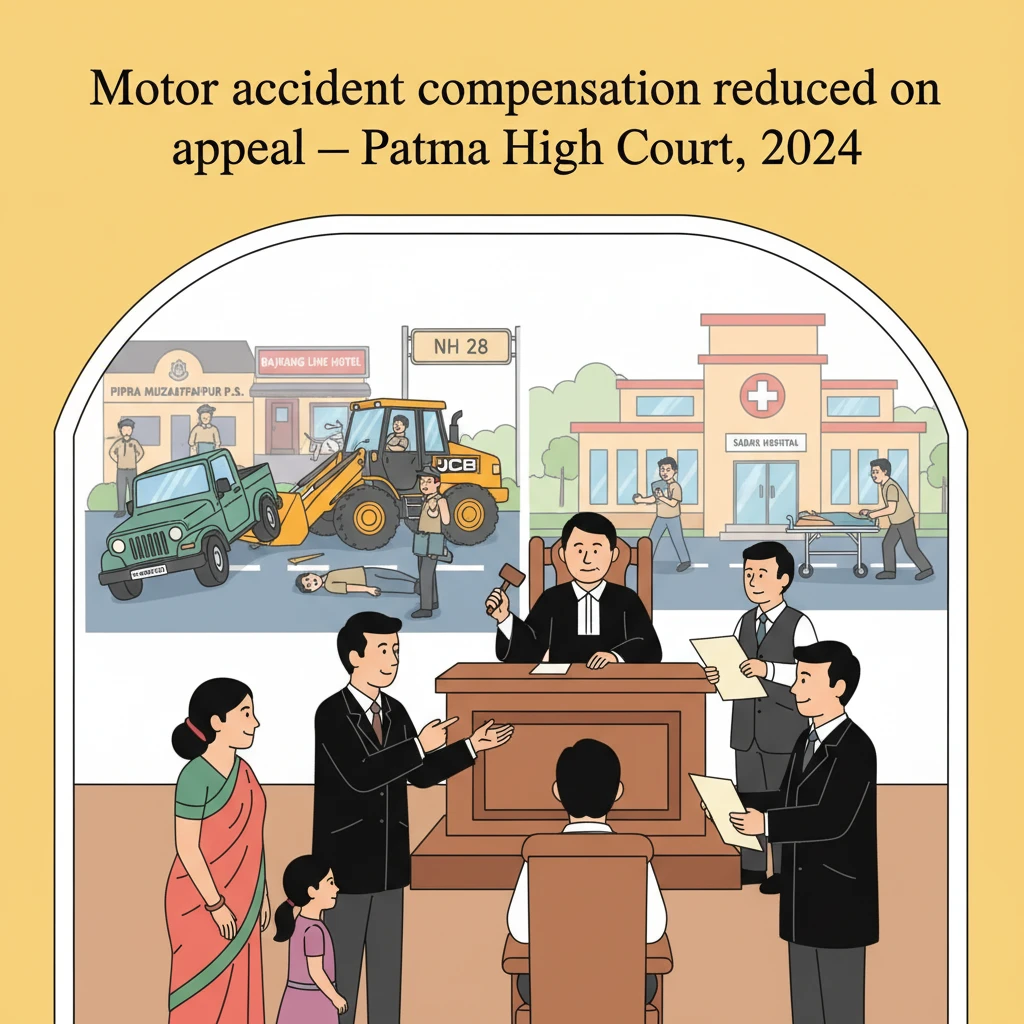
This case arises from a tragic road accident that occurred on 19.06.2012.
The deceased, a government school teacher employed at Jawahar Navodaya Vidyalaya, Purnia, was travelling from Muzaffarpur to Motihari in a jeep bearing registration number BR-06PB-0315 (the “accidental vehicle”).
When the jeep reached Muslim Tola Chap, in front of Bajrang Line Hotel near National Highway 28, it was allegedly being driven rashly and negligently by its driver, Raj Kumar. The jeep dashed against a J.C.B. machine which was standing by the roadside.
The teacher suffered grievous injuries. He was taken to Sadar Hospital, Motihari, where he succumbed to his injuries and died. Pipra Muzaffarpur P.S. Case No.160 of 2012 under Sections 279 and 304A of the Indian Penal Code was registered against the jeep driver.
At the time of the accident, the deceased was about 43 years old. He left behind his wife and two minor children as dependants.
The widow and minor children filed Claim Case No.161 of 2013 before the Additional District & Sessions Judge VIII-cum-Motor Accident Claims Tribunal, Muzaffarpur. They sought compensation under Section 166 of the Motor Vehicles Act, 1988, from the jeep owner and the insurer, New India Assurance Company Ltd.
The owner of the jeep (Opposite Party No.1) did not appear despite notice and was proceeded ex parte.
The insurance company (Opposite Party No.2) appeared and filed a written statement on 08.07.2014. It admitted that the jeep was insured with it under policy no. 54050031110100002782, valid from 21.02.2012 to 20.02.2013, in the name of the owner.
However, the insurer raised several objections. It claimed the case suffered from mis-joinder and non-joinder of necessary parties. It also alleged contributory negligence, saying the J.C.B. was also responsible and therefore only 50% liability could be fastened on the insured jeep. It further stated that if the driver did not have a valid driving licence or if there was no valid route permit, it would not be liable to pay.
On 18.09.2014 the Tribunal granted an interim compensation of Rs.50,000/- under Section 140 of the Motor Vehicles Act, which the insurer paid to the widow.
After full trial, the Tribunal, by judgment dated 23.01.2018 and award dated 31.01.2018, held that the accident was caused by rash and negligent driving of the jeep driver. It found that the jeep was insured with New India Assurance and that the driver had a valid licence. It awarded total compensation of Rs.65,98,760/-, adjusted the interim amount of Rs.50,000/-, and directed the insurance company to pay Rs.65,48,760/- with 6% interest per annum from 22.04.2013 (date of filing of the claim case) till realization.
Aggrieved, the insurance company filed Miscellaneous Appeal No.904 of 2018 before the Patna High Court under Section 173 of the Motor Vehicles Act. There was a delay of 97 days in filing the appeal. By I.A. No.01 of 2019, the insurer sought condonation of delay. The respondents had no objection, and the Court condoned the delay on 24.10.2024, then proceeded to decide the appeal on merits.
What the Court Examined and Decided
The Patna High Court, through Hon’ble Mr. Justice Sunil Dutta Mishra, examined both the challenge to liability and the quantum of compensation.
First, the Court noted the evidence led before the Tribunal. The claimants examined three witnesses: two eye-witnesses (CW-1 Arjun Mandal and CW-2 Dharmendra Kumar) and the widow (CW-3 Neelam Kumari). They produced documentary evidence such as the matriculation certificate (age proof), post-mortem documents, last pay certificate (LPC) from Jawahar Navodaya Vidyalaya, the FIR, and the charge-sheet in Pipra Muzaffarpur P.S. Case No.160 of 2012.
The insurance company did not examine any witness. It only produced two documents: a verification report regarding the vehicle permit (Ext. A) and a DTO certificate about the driver’s licence (Ext. B).
On this basis, the Tribunal had framed specific issues on maintainability, rash and negligent driving, cause of death, validity of the driver’s licence and vehicular documents, insurance coverage, entitlement and quantum of compensation.
The High Court first reappreciated the finding on negligence and liability. The FIR and charge-sheet showed that the case was registered only against the jeep driver. CW-1 and CW-2, as eye-witnesses, supported the claim that the accident occurred due to the rash and negligent driving of the jeep.
The Court emphasised that in a claim under Section 166 of the Motor Vehicles Act, proof of rashness and negligence is essential. It also reiterated the settled law that where oral evidence recorded by the Tribunal contradicts the FIR, the evidence before the Tribunal has greater weight. Further, when the driver has been charge-sheeted after investigation under Section 173 Cr.P.C., it is safe to infer prima facie rash and negligent driving by that driver.
Here, there was no contrary evidence from the insurer. Therefore, the Court held that the deceased lost his life due to rash and negligent driving of the insured jeep. The argument of contributory negligence involving the J.C.B. was rejected as unsupported by any material.
The insurer had argued that the FIR itself suggested collusion and that the Tribunal had wrongly ignored Ext. A, which allegedly showed that the jeep’s permit was fake. It also argued that the driver was not authorised to drive a commercial vehicle, and so the insurer should at least have been given “recovery rights” against the owner under the “pay and recover” principle.
The Court dealt with this by referring to several Supreme Court decisions on the “pay and recover” doctrine and Section 149 of the Motor Vehicles Act, including Shamanna, Parminder Singh, Kurvan Ansari, Swaran Singh, and Mukund Dewangan.
From these rulings, the Court distilled two key principles:
First, the insurer can be given “pay and recover” relief (that is, it must pay the victim and then recover from the owner) mainly where there is breach of policy conditions such as absence of valid driving licence. But the insurer must prove such breach by cogent evidence and also show willful violation by the insured.
Second, under Mukund Dewangan, a licence to drive a “Light Motor Vehicle” (LMV) covers certain transport vehicles up to 7,500 kg gross vehicle weight, and no separate endorsement is required for such transport vehicles.
The Court found as a matter of record that the jeep driver held a valid licence to drive the jeep at the time of the accident. There was nothing to show he was disqualified. Therefore, the conditions for avoiding liability or invoking “pay and recover” were not met. The High Court agreed with the Tribunal that the insurer remained fully liable, and no recovery right could be granted.
Next, the Court turned to the quantum of compensation. The central question framed was whether the Tribunal had awarded “just compensation”. The Court recalled that compensation under Section 166 must be fair and reasonable, aimed at compensating the pecuniary loss to dependants, even though perfect compensation is impossible.
The Tribunal had originally calculated the compensation by taking monthly salary of Rs.39,173/-, deducting one-third towards personal expenses, applying multiplier 15, adding Rs.15,00,000/- for future prospects, and awarding comparatively larger amounts under conventional heads such as loss of estate, love and affection, consortium, and funeral expenses.
The insurance company attacked these figures on three main grounds: (i) failure to deduct income tax from salary, (ii) wrong rate of future prospects considering the age, and (iii) excessive amounts under conventional heads.
On income tax, the High Court relied on Sarla Verma and Pranay Sethi, which hold that where income is in the taxable range, “actual salary” must be read as salary after deduction of income tax. The Court examined the last pay certificate (Ext. 3) and found that the deceased’s monthly salary was Rs.39,173/-, giving an annual salary of approximately Rs.4,70,000/-. For the relevant assessment year 2013–14, income tax payable would be Rs.27,000/-. Thus, net annual income was Rs.4,43,000/-.
Since there were three dependants (wife and two minor children), the Court affirmed one-third deduction towards personal and living expenses, consistent with Sarla Verma and Pranay Sethi. One-third of Rs.4,43,000/- came to Rs.1,47,667/-. Net annual contribution to the family was, therefore, Rs.2,95,333/-.
On future prospects, while the Tribunal had granted 50%, the High Court applied binding Supreme Court law and restricted future prospects to 30% for this age group (the deceased being 43 years old and in secure government employment). Accordingly, 30% of Rs.2,95,333/- was calculated as Rs.88,600/-, making the annual figure for loss of dependency Rs.3,83,933/-.
On the choice of multiplier, the Court noted that for age 41–45 years, the correct multiplier as per Sarla Verma and Pranay Sethi is 14, not 15 as used by the Tribunal. Hence, the multiplier was reduced to 14.
Multiplying Rs.3,83,933/- by 14, the Court arrived at Rs.53,75,062/- as loss of dependency.
On the conventional heads (loss of estate, funeral expenses and various forms of consortium), the Court examined the latest Supreme Court rulings, including Pranay Sethi, Somwati, Magma General Insurance, United India Insurance v. Satinder Kaur, and Rojline Nayak. These decisions standardise the figures for such heads and provide for 10% enhancement every three years.
Applying these principles, the Court recast these heads as follows: Rs.18,150/- for loss of estate (Rs.15,000/- with two 10% enhancements), Rs.18,150/- for funeral expenses on the same basis, and Rs.1,45,200/- for consortium (Rs.48,400/- each for three dependants—wife and two minor children—after two 10% enhancements on the base of Rs.40,000/-).
Thus, total compensation under conventional heads came to Rs.1,81,500/-. Adding this to the loss of dependency (Rs.53,75,062/-), the total compensation worked out to Rs.55,56,562/-.
After adjusting the interim amount of Rs.50,000/- already paid under Section 140 of the Act, the net payable compensation was fixed at Rs.55,06,562/-.
The Court ordered that this amount carry simple interest at 6% per annum from the date of filing of the claim case (22.04.2013) till realisation, payable by the insurance company, with adjustment of any amount already paid.
Consequently, the High Court modified the Tribunal’s judgment and award to this extent only, reduced the compensation but upheld the insurer’s liability. The appeal was disposed of accordingly, without costs.
The Court also vacated the stay it had earlier granted on the execution proceedings in Execution Case No.53 of 2018 and directed the insurance company to deposit the due amount within two months. The statutory deposit made at the time of filing the appeal was directed to be remitted to the Tribunal for adjustment. Trial court records were ordered to be returned.
Why This Judgment Matters
This judgment is significant for families of road accident victims and insurance companies alike.
First, it shows that once rash and negligent driving is proved through FIR, charge-sheet and eye-witnesses, the insurance company cannot avoid liability by merely alleging contributory negligence or collusion without solid evidence.
Second, it confirms that where the driver holds a valid driving licence for the class of vehicle, the insurer cannot demand a “pay and recover” order. The Patna High Court strictly followed Supreme Court rulings that the insurer must prove a willful breach of policy conditions by the owner.
Third, the judgment carefully applies the latest Supreme Court guidelines to ensure “just compensation”. It corrects over-calculation by requiring deduction of income tax, proper multiplier, and standardised amounts for consortium, funeral expenses and loss of estate, with periodic 10% enhancement.
For dependants of government employees who die in accidents, the case explains how salary, tax, personal expenses and future prospects will be considered. For insurers, it clarifies when they remain fully liable and how quantum can be revisited in appeal.
Legal Issues and Answers
- Issue: Was the accident caused by rash and negligent driving of the insured jeep, or was there contributory negligence/collusion as alleged by the insurer?
Answer: The Court held that the accident was caused by rash and negligent driving of the jeep driver alone, based on FIR, charge-sheet and eye-witness evidence. There was no proof of contributory negligence or collusion. - Issue: Could the insurance company avoid or limit its liability, or at least claim “pay and recover” rights on the ground of fake permit or improper licence?
Answer: No. The Court found the driver held a valid licence for the class of vehicle at the time of accident. The insurer failed to prove breach of policy conditions by the owner, so “pay and recover” was not available. - Issue: Was the compensation awarded by the Tribunal “just”, especially regarding income calculation, future prospects, multiplier and conventional heads?
Answer: Partly no. The High Court recalculated compensation by deducting income tax, applying 30% future prospects, using multiplier 14 instead of 15, and fixing conventional heads as per Supreme Court norms, reducing the total payable amount to Rs.55,06,562/- with interest.
Cases Cited by the Court
- Shamanna and Anr. v. Divisional Manager Oriental Insurance Co. Ltd., (2018) 9 SCC 650
- Parminder Singh v. New India Assurance Company Ltd. & Ors., (2019) 7 SCC 217
- Kurvan Ansari Alias Kurvan Ali v. Shyam Kishore Mummu, (2022) 1 SCC 317
- National Insurance Co. Ltd. v. Swaran Singh and Ors., (2004) 3 SCC 297
- Mukund Dewangan v. Oriental Insurance Ltd., (2017) 14 SCC 663
- Sarla Verma & Ors. v. Delhi Transport Corporation & Anr., (2009) 6 SCC 121
- National Insurance Co. Ltd. v. Pranay Sethi & Ors., (2017) 16 SCC 680
- Meenakshi v. The Oriental Insurance Co. Ltd., 2024 SCC OnLine SC 1872
- National Insurance Company Limited v. Nalini & Ors., 2024 SCC OnLine SC 2252
- New India Assurance Company Ltd. v. Somwati and Ors., (2020) 9 SCC 644
- Magma General Insurance Co. Ltd. v. Nanu Ram, (2018) 18 SCC 130
- United India Insurance Company Ltd. v. Satinder Kaur @ Satwinder Kaur & Ors., (2021) 11 SCC 780
- Rojline Nayak and Ors. v. Ajit Sahoo and Ors., 2024 SCC OnLine SC 1901
Case Details
Case Number: Miscellaneous Appeal No.904 of 2018
Case Title: Divisional Manager, New India Assurance Company Ltd., Muzaffarpur Division through Deputy Manager v. Nilam Kumari & Ors.
Coram: Hon’ble Mr. Justice Sunil Dutta Mishra
Citation: 2024 (4) PLJR 706
Advocates:
For the Appellant (Insurance Company): Mr. Ashok Priyadarshi, Advocate
For the Respondents (claimants): Mr. Alok Kumar @ Alok Kr Shahi, Advocate
Nature of the Case: Miscellaneous Appeal under Section 173 of the Motor Vehicles Act, 1988, against an award of the Motor Accident Claims Tribunal, Muzaffarpur, in Claim Case No.161 of 2013.
Link to Judgment: Patna High Court official judgment link
If you found this explanation helpful and wish to stay informed about how legal developments may affect your rights in Bihar, you may consider following Samvida Law Associates for more updates.







