

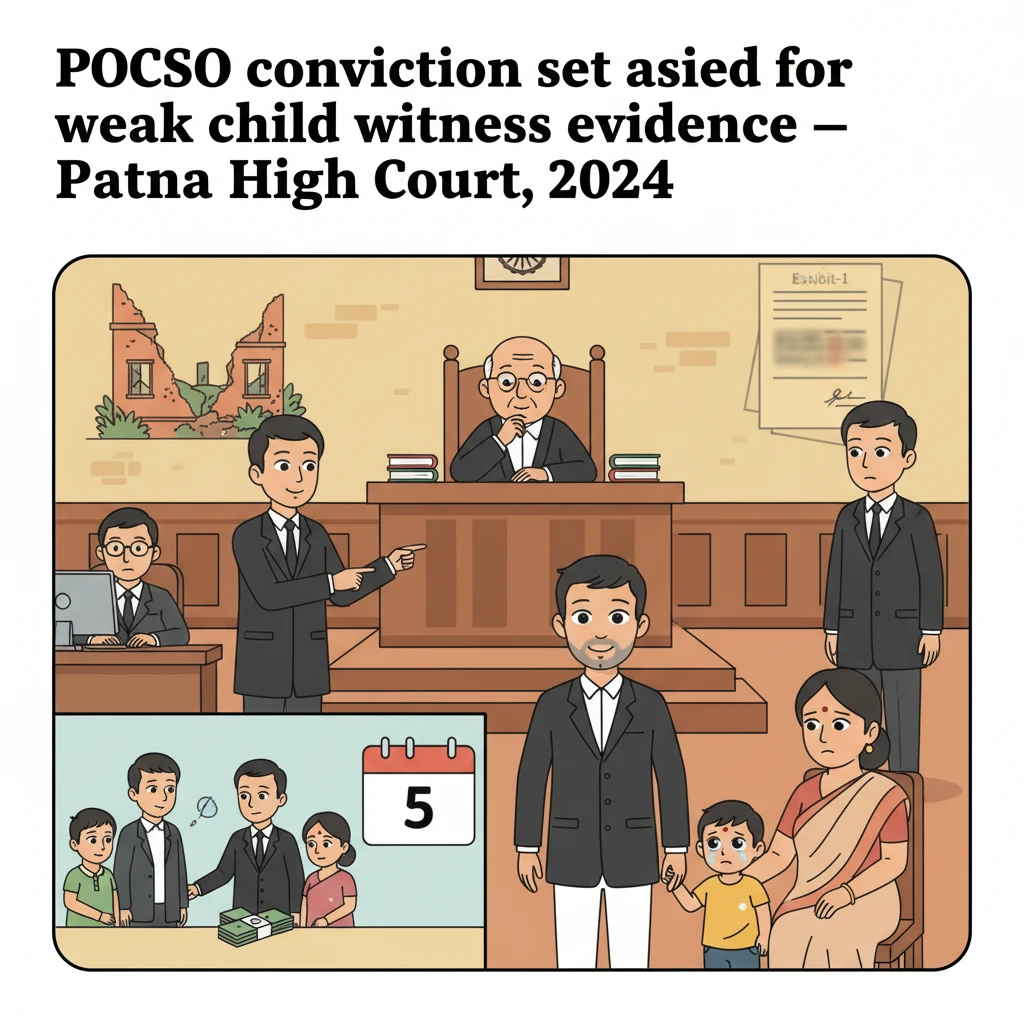
Case Background
The case began with a written complaint lodged at Mahila Police Station, Bhabua, Kaimur, on 22.03.2018. The informant alleged that his five-year-old daughter was playing outside the house when the appellant, a neighbour, took her to a nearby dilapidated house.
According to the written information, the appellant allegedly removed the child’s undergarment and also took off his own clothes. Hearing the child cry, her mother rushed to the spot and claimed to have seen the appellant without clothes and the child’s undergarment removed. On being questioned, the appellant allegedly abused the mother, threatened to kill the child, and fled when she raised alarm.
On this basis, Mahila Bhabua P.S. Case No. 21 of 2018 was registered under Sections 354-B, 504 and 506 of the Indian Penal Code and Section 10 of the Protection of Children from Sexual Offences (POCSO) Act. After investigation, the police submitted a charge-sheet under the same provisions.
The Special Judge, POCSO Act, Kaimur at Bhabua took cognizance and framed charges under Sections 504 and 506 of the IPC and Section 10 of the POCSO Act. The appellant pleaded not guilty and claimed trial.
After examining witnesses and documents, the trial court convicted the appellant under Section 10 of the POCSO Act. He was sentenced on 21.05.2022 to five years’ rigorous imprisonment and a fine of Rs. 5,000/-, with three months’ further rigorous imprisonment in default of payment.
Aggrieved by the judgment of conviction dated 18.05.2022 and order of sentence dated 21.05.2022, the appellant filed Criminal Appeal (SJ) No. 2313 of 2022 before the Patna High Court under Section 374(2) CrPC. On the appellant’s request, and without objection from the State, the appeal was taken up for final hearing under Section 374(4) CrPC.
What the Court Examined and Decided
The Patna High Court, presided over by Hon’ble Mr. Justice Chandra Shekhar Jha, closely re-examined the entire trial record. The Court focused on three key areas: the quality of the child’s evidence, contradictions among witnesses, and failure to comply with legal safeguards in POCSO and evidence law.
The prosecution examined six witnesses in total, including the child victim (P.W.1), her mother (P.W.3), her father and informant (P.W.5), an uncle (P.W.2), a neighbour (P.W.4), and the Investigating Officer (P.W.6). Documentary evidence included the written complaint (Exhibit-1) and the informant’s statement under Section 164 CrPC (Exhibit-2).
The appellant, when examined under Section 313 CrPC, completely denied the allegations and claimed false implication. He did not examine any defence witness or produce documents.
Evidence of the child victim
The Court treated the child victim (P.W.1) as the most important witness. In her deposition, she stated that the appellant took her to a nearby dilapidated house, removed her undergarment and his pant, and touched her between the legs. She said that she raised alarm and then her mother came, after which the appellant ran away. She also said that the appellant was her neighbour.
However, the High Court noted a serious procedural lapse: before administering oath and recording the testimony of this very young child, the trial court did not put any preliminary questions to test her understanding of truth and falsehood, or her ability to give rational answers.
The Court referred to the Supreme Court decision in Pradeep vs. State of Haryana, 2023 SCC OnLine SC 777. Quoting paragraphs 7 to 10 of that judgment, the High Court reiterated that under Section 118 of the Evidence Act and Section 4 of the Oaths Act, it is the duty of the trial judge to:
- ascertain whether a child witness can understand the questions and give rational answers,
- form and record an opinion that the child understands the duty of speaking the truth, and
- ideally record the preliminary questions and answers for appellate scrutiny.
In this case, the High Court found that no such preliminary examination was conducted. For a child of about five years, this omission was significant. It made the reliability of her sworn testimony questionable and raised the possibility of tutoring, which courts must carefully guard against in child witness cases.
Contradictions between witnesses
The High Court then examined inconsistencies in the evidence of different prosecution witnesses.
P.W.1 stated that after she raised alarm, her mother came to the spot. In cross-examination, she also said that her mother saw the appellant at the gate of their house and was the only one present there at that time. This suggested a sequence different from that given by the mother.
P.W.3, the mother, deposed that when she came out of the house she saw the appellant with his pant open and the undergarments of her daughter removed. On her alarm, she said, P.W.4 Mala Devi, one Pankaj Seth (not examined), and P.W.5 Rinku Seth came there, and the appellant fled to his home.
P.W.2, the child’s uncle, stated that on hearing the child’s cries he himself went to the place and saw the appellant fleeing. According to him, the mother informed him that she found the appellant running away near the victim. This version did not match the mother’s claim of seeing the appellant at the spot with his pant open.
P.W.4 stated that she was washing clothes, heard the alarm, came out, and saw the appellant running near the victim. She further said she came to know of the full occurrence only from P.W.3. The Court treated her as a hearsay witness.
P.W.5, the father and informant, gave yet another version. He deposed that he learned of the incident from the victim herself. After getting this information, his wife went with the child to the place of occurrence and allegedly found both the child and appellant naked, and then went to the police station to lodge the case. In cross-examination he said he first met his daughter in the courtyard, where she was naked, and that he learned about the incident from both P.W.1 and P.W.3.
The High Court found the deposition of P.W.5 so contradictory that it “makes entire allegation false on its face”. The varying accounts of who saw what, and when, were not minor differences but went to the root of how and whether the alleged assault took place.
Background money dispute and delay
During cross-examination, P.W.3 admitted that there was a monetary dispute of Rs. 25,000/- between her father and the appellant’s father. She said the appellant’s father had advanced this loan to her father, who ran a jewellery shop, and disputes about repayment had led to 2–3 panchayats.
She also stated that an exchange of hot words took place on the date of occurrence between her father and 8–10 other persons outside her house. Although she denied lodging a false case due to the money dispute, the High Court considered this background important. It made the genesis of the case doubtful and meant that the possibility of false implication could not be ruled out straight away.
The appellant had also argued that the FIR was lodged after a delay of five days following failed panchayats over the money dispute. The High Court noted this contention though it focused more on contradictions and evidentiary gaps.
Non-recording of key statements and no medical examination
Apart from contradictions, the Court highlighted several investigative and procedural shortcomings.
First, the statement of the child victim was never recorded under Section 164 CrPC before a magistrate. The Investigating Officer (P.W.6) only got the statement of the informant recorded under Section 164 CrPC, which became Exhibit-2. The Court treated the absence of a Section 164 statement of the child as a serious omission.
Second, the Investigating Officer admitted in cross-examination that he “never enquired about the victim”. He also stated that the informant refused to give consent for the medical examination of the child. As a result, there was no medical evidence on record to support the allegation of sexual assault or even physical injury.
The appellant’s counsel argued that on such evidence, there was no clear sexual intent to attract Sections 7 and 9 of the POCSO Act and that the prosecution had failed to establish the foundational facts required before invoking presumptions under Sections 29 and 30 of the POCSO Act.
Application of law and final decision
Taking all these factors together, the High Court held that the prosecution had failed to prove the basic or “foundational” elements of the alleged sexual assault. Without reliable foundational facts, the statutory presumptions under Sections 29 and 30 of the POCSO Act could not be used to uphold the conviction.
The Court observed that:
- the trial court had not tested the competence of the child witness through preliminary questions, contrary to the Supreme Court’s guidance in Pradeep vs. State of Haryana,
- there were material contradictions between the evidence of P.W.1 (child), P.W.2 (uncle), P.W.3 (mother), and P.W.5 (father),
- the monetary dispute and panchayats cast doubt on the genesis of the case and made false implication a live possibility,
- the victim’s statement was not recorded under Section 164 CrPC, and
- no medical examination of the child was conducted.
In paragraph 33, the Court concluded that “prosecution failed to established foundational aspect qua alleged sexual assault so as to import presumption as available under Section 29 & 30 of the POCSO Act.”
Accordingly, the appeal was allowed. The judgment of conviction dated 18.05.2022 and order of sentence dated 21.05.2022 in POCSO Case/Registration No. 11 of 2018 were set aside. The appellant Satish Singh was acquitted of all charges.
The Court directed that if the appellant was in custody in this case, he be released forthwith, if not wanted in any other matter. Any fine deposited by him was ordered to be refunded immediately. The trial court records were directed to be sent back along with a copy of the High Court judgment.
Why This Judgment Matters
This judgment from the Patna High Court is important for both families of victims and those accused in POCSO cases. It reminds everyone that while child protection is vital, convictions cannot be based on weak or doubtful evidence.
For trial courts, the decision reinforces a clear duty: before recording the evidence of a very young child, judges must test and record whether the child understands questions and the duty to speak the truth. Skipping this step can make the child’s testimony unreliable on appeal.
The judgment also shows that courts will look carefully at contradictions among family members, background disputes such as money quarrels, delays, and gaps like absence of a Section 164 CrPC statement or medical examination. Where these factors together raise serious doubt, an accused is entitled to acquittal.
For citizens, especially in Bihar, the ruling underlines that POCSO cases require careful investigation and proper procedure. Fair trials depend not only on strong laws but also on accurate statements, honest testimonies, and respect for safeguards laid down by higher courts.
Legal Issues and Answers
- Issue: Whether the prosecution had proved the foundational facts of sexual assault by the appellant on a five-year-old child to justify conviction under Section 10 of the POCSO Act and application of presumptions under Sections 29 and 30.
Answer: No. Due to lack of preliminary competence testing of the child witness, major contradictions in testimonies, background money dispute, absence of the child’s Section 164 CrPC statement, and no medical examination, the foundational facts were not proved and the conviction could not stand. - Issue: Whether failure to follow safeguards for recording the evidence of a child witness, as highlighted in Pradeep vs. State of Haryana, affected the reliability of the prosecution case.
Answer: Yes. The trial court’s failure to assess and record the child’s understanding before administering oath undermined the reliability of her evidence and contributed to the High Court’s decision to set aside the conviction.
Cases Cited by the Court
- Pradeep vs. State of Haryana, 2023 SCC OnLine SC 777 (quoted and relied upon regarding the manner of recording evidence of a child witness and the duty of the trial judge under Section 118 of the Evidence Act and Section 4 of the Oaths Act).
Case Details
Case Number: Criminal Appeal (SJ) No. 2313 of 2022; arising out of Mahila Bhabua P.S. Case No. 21 of 2018; POCSO Case/Registration No. 11 of 2018
Case Title: Satish Singh vs. The State of Bihar
Citation: 2024 (4) PLJR 666
Coram: Hon’ble Mr. Justice Chandra Shekhar Jha
Advocates: Mr. Praveen Kumar, Advocate; Mr. Uday Pratap Singh, Advocate; Ms. Anju Kumar Sinha, Advocate (for the appellant); Mrs. Anita Kumari Singh, APP (for the State)
Nature of the Case: Criminal appeal under Section 374(2) CrPC against conviction and sentence under the POCSO Act and related IPC provisions, decided finally under Section 374(4) CrPC.
Link to Judgment: Patna High Court judgment link
If you found this explanation helpful and wish to stay informed about
how legal developments may affect your rights in Bihar,
you may consider following Samvida Law Associates for more updates.







