

Case Background
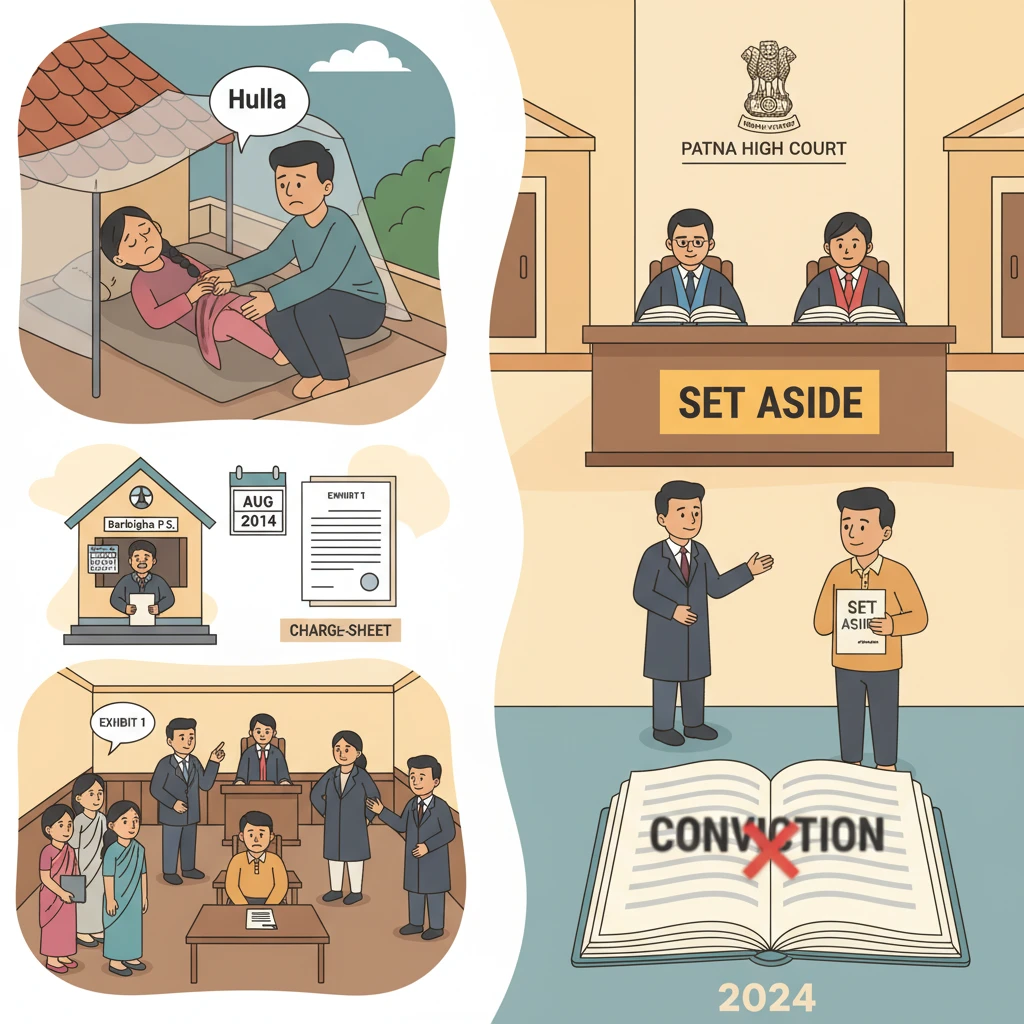
The case started from a written report given by a 15‑year‑old girl. She stated that in the night of 7/8 August 2014 she was sleeping on the roof of her house.
According to her, at about 1:00 a.m., the appellant, a neighbour living in the adjoining house, came to the roof where she was lying. She alleged that he sat beside her and tried to untie the string of her pajama with bad intention. She woke up and raised alarm (hulla), after which the appellant ran away from the roof.
On the basis of this written report, Barbigha Police Station registered a formal FIR on 08.08.2014 at 05:30 a.m. The FIR was for offences under Sections 376/511 of the Indian Penal Code and Sections 4, 5 and 6 of the POCSO Act against the sole accused, the present appellant.
After investigation, the police submitted charge‑sheet no. 237 of 2014 dated 31.08.2014. The charge‑sheet was for offences under Section 376 read with Section 511 of the IPC and Sections 7/8 of the POCSO Act.
The trial court framed charges accordingly under Section 376 read with Section 511 IPC and Section 8 of the POCSO Act. The charges were read over and explained to the appellant. He pleaded not guilty and claimed to be tried, leading to a full trial.
What the Court Examined and Decided
During the trial, the prosecution examined five witnesses. P.W.‑1 was the cousin of the victim. P.W.‑2 was her sister‑in‑law (bhabhi). P.W.‑3 was her mother. P.W.‑4 was the victim herself. P.W.‑5 was the Investigating Officer, Mahanand Jha.
The prosecution also produced Exhibit 1, which was the signature of the victim/informant on the written report.
After the prosecution evidence closed, the trial court examined the accused under Section 313 of the Code of Criminal Procedure. He was confronted with the incriminating circumstances that had come on record. He admitted that he had heard the evidence of the prosecution witnesses, but claimed that their evidence was false, that he was innocent, and that he had been falsely implicated. He did not offer any detailed explanation of the specific circumstances put to him.
In his defence, the appellant examined one witness, D.W.‑1 Sudhir Prasad.
On appreciation of the evidence, the trial court convicted the appellant for attempt to commit rape under Section 376 read with Section 511 IPC and for sexual assault under Section 8 of the POCSO Act. He was sentenced to rigorous imprisonment for ten years and fine of Rs. 50,000/‑ under Section 376/511 IPC, and rigorous imprisonment for five years and fine of Rs. 50,000/‑ under Section 8 POCSO. In default of payment of fine under each section, he was directed to undergo additional simple imprisonment for six months.
Aggrieved by this judgment of conviction and sentence, the appellant filed the present criminal appeal before the Patna High Court.
Arguments of the Appellant
The learned counsel for the appellant attacked both the conviction and the sentence. He argued that the trial court had not properly appreciated the evidence and had passed the judgment in an erroneous manner.
He submitted that even if the prosecution story was taken at its highest, no case was made out under Section 376 read with Section 511 IPC or under Section 8 of the POCSO Act.
According to the defence, the alleged act was at best a preparation to commit rape, which by itself is not punishable as “attempt to rape”. Counsel further argued that, even as per the definition of “sexual assault” in Section 7 of the POCSO Act, the alleged act did not come within Sections 7/8 at all.
It was argued that, at most, the facts could amount to outraging the modesty of a woman, punishable under Section 354 IPC, but not to the more serious offences of attempt to rape or sexual assault under POCSO.
The appellant’s counsel also attacked the credibility of the victim as a witness. He pointed out that she was the only eye‑witness and, in his submission, not a trustworthy or reliable witness because there were major discrepancies and contradictions in her statement before the trial court.
He referred in particular to paragraph 4 of her testimony, where she admitted that a similar case had been filed by her against another person, Rajesh Choudhary. On that basis, counsel suggested that she was habitual in filing false cases of a similar nature and that the appellant ought to get the benefit of doubt.
Arguments of the State
The learned Additional Public Prosecutor, appearing for the State, supported the trial court’s judgment. He argued that the prosecution had proved its case beyond reasonable doubt and that the sentence awarded was proper.
Assessment of Evidence by the High Court
The Patna High Court carefully perused the entire evidence and considered the submissions of both sides.
The Court first noted that out of five prosecution witnesses, only P.W.‑4, the informant and victim, was an eye‑witness to the alleged offence. The other non‑official witnesses—her cousin, sister‑in‑law and mother—were witnesses only to pre‑occurrence and post‑occurrence circumstances. All these non‑official witnesses were closely related to the informant.
The Court then examined the testimony of P.W.‑4 in detail. It found “inherent contradictions and improbability” in her version. In the written report and in her examination‑in‑chief, she said that she was sleeping alone on the roof that night.
However, in paragraph 15 of her cross‑examination, she stated that her mother and bhabhi were also sleeping on the roof but, due to rain, they went down into the house, while she remained on the roof.
The High Court considered this change as creating serious doubt in the prosecution case. It questioned that if the weather was not suitable for her mother and sister‑in‑law to sleep on the roof, how it could still be suitable for the victim to stay there alone.
The Court further observed from her testimony that a similar case had also been filed by the informant against another man named Rajesh Choudhary. This fact added to the Court’s doubts about the reliability of her accusation.
Whether the Acts Amounted to Attempt to Rape or POCSO Offence
The Court next considered whether, even if her version was accepted, the alleged acts fulfilled the legal ingredients of attempt to rape under Section 376/511 IPC or sexual assault under POCSO.
As per the victim’s account, the appellant had come to the roof, sat beside her and tried to untie her pajama string with ill intent. She raised alarm and he ran away. There was no allegation of any further physical act or penetration.
The High Court held that this alleged “actus reus” did not constitute an offence of attempt to rape. At most, it might show “mens rea” (criminal intention) to commit rape, but intention alone, without acts crossing the stage of mere preparation, does not amount to a punishable attempt.
Thus, the essential element of attempt under Section 511 IPC was found missing.
The Court also observed that, on these facts, the offence of sexual assault under Section 7/8 of the POCSO Act was not made out. The judgment records that, at most, the alleged facts and circumstances might constitute an offence of outraging the modesty of a woman.
Benefit of Doubt and Final Decision
After weighing both the contradictions in the victim’s testimony and the legal shortcomings in the prosecution case, the Court concluded that the appellant was entitled to the benefit of doubt.
The High Court therefore allowed the criminal appeal. It acquitted the appellant of all charges under Section 376 read with Section 511 IPC and Section 8 of the POCSO Act.
Since the appellant was already on bail, he was discharged from all liabilities under his bail bond. The Court directed that the trial court records be returned forthwith. Any pending interlocutory applications were also disposed of.
Why This Judgment Matters
This decision of the Patna High Court is important for both accused persons and complainants in sexual offence cases, especially those involving children.
First, it shows that courts will closely scrutinise the sole testimony of a victim where there are serious contradictions or improbabilities. If the court finds that the evidence does not firmly support the prosecution story, the accused may get the benefit of doubt.
Second, the judgment clearly separates “intention” from “attempt”. Merely having bad intention or preparing to commit a sexual offence, without taking further steps that clearly show an attempt, may not be enough for conviction for attempt to rape or sexual assault under POCSO.
Third, it underlines that stronger, more consistent evidence is needed to uphold heavy sentences like ten years’ rigorous imprisonment. When liberty is at stake for such long periods, the court insists on strict proof.
For ordinary readers, this case reinforces that while sexual offences are taken very seriously, criminal law also requires that guilt be proved beyond reasonable doubt. Where there is reasonable doubt in the evidence itself, the accused cannot be punished for the most serious charges.
Legal Issues and Answers
Issue: Did the prosecution evidence prove beyond reasonable doubt that the appellant attempted to commit rape and committed sexual assault under Section 8 of the POCSO Act?
Answer: No. The Patna High Court held that the alleged acts showed at most intention or preparation, not a punishable attempt, and that the victim’s testimony suffered from serious contradictions creating reasonable doubt.
Issue: Was the sole testimony of the victim reliable enough to sustain conviction under Section 376/511 IPC and Section 8 POCSO?
Answer: No. The Court found inherent contradictions and improbabilities in her evidence, including differing versions about who was sleeping on the roof and the existence of a similar prior case against another man, and therefore extended the benefit of doubt to the appellant.
Issue: Even if the prosecution story was accepted, what offence, if any, did the alleged conduct amount to?
Answer: The Court observed that, at most, the facts could constitute outraging the modesty of a woman, but did not proceed to convict for that offence in view of the overall doubts in the case.
Cases Cited by the Court
- The judgment does not mention or rely upon any other decided case. No precedents are cited.
Case Details
Case Number: Criminal Appeal (SJ) No. 43 of 2016, arising out of P.S. Case No. 267 of 2014, Barbigha Police Station, District Sheikhpura
Case Title: Pramod Chaudhary vs. The State of Bihar
Coram: Hon’ble Mr. Justice Jitendra Kumar
Citation: 2024 (4) PLJR 682
Advocates: For the appellant – Mr. Ajay Kumar Thakur, Advocate; Ms. Vaishnavi Singh, Advocate; Mr. Ritwik Thakur, Advocate. For the State – Mr. Abhay Kumar, APP.
Date of Judgment: 21.10.2024
Nature of the Case: Criminal appeal (single judge) against conviction and sentence under Section 376 read with Section 511 IPC and Section 8 of the POCSO Act.
Link to Full Judgment (Patna High Court website): https://patnahighcourt.gov.in/viewjudgment/MjQjNDMjMjAxNiMxI04=-34jyaAf–am1–kvk=
If you found this explanation helpful and wish to stay informed about how legal developments may affect your rights in Bihar, you may consider following Samvida Law Associates for more updates.







