

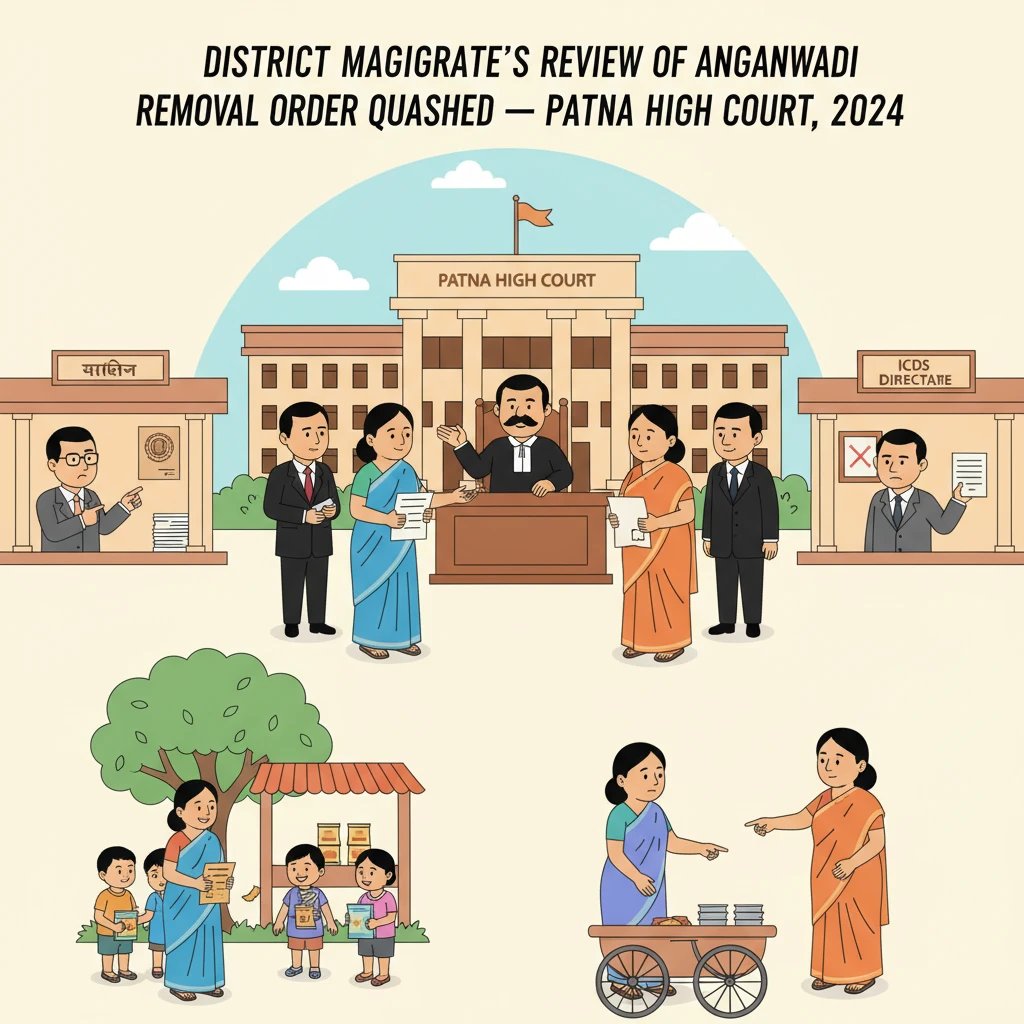
Case Background
The dispute concerns the post of Anganwadi Sevika at Centre No. 121, Ward No. 23, Nagar Panchayat No. 1, Naugachhia in Bhagalpur district.
According to the writ petitioner, respondent no. 8 was first appointed as Anganwadi Sevika at this centre. Complaints were then made by the ward councillor about irregularities in distribution of Take Home Ration and Poshahar. On this complaint, a detailed enquiry was entrusted to the Executive Magistrate, Naugachhia.
The enquiry resulted in the removal of respondent no. 8 from the post. The District Magistrate, Bhagalpur, by order dated 30.06.2009, removed respondent no. 8.
After this removal, a fresh selection took place. The petitioner was selected on the sanctioned vacant post of Anganwadi Sevika at the same centre.
Respondent no. 8 challenged her removal order dated 30.06.2009 by filing C.W.J.C. No. 9028 of 2009 before the Patna High Court. By order dated 31.07.2009, the High Court disposed of that writ petition with liberty to respondent no. 8 to file an appeal before the District Magistrate, Bhagalpur.
Respondent no. 8 then filed an appeal bearing Case No. 12/09-10. That appeal was dismissed by order dated 10.09.2009 passed by the Divisional Commissioner, Bhagalpur. Respondent no. 8 thereafter filed another writ petition, C.W.J.C. No. 14243 of 2009, challenging the Commissioner’s order. This writ petition was dismissed by order dated 10.11.2009.
After these proceedings, the petitioner continued on the post. Respondent no. 8 remained silent regarding the petitioner’s engagement for some time.
Subsequently, respondent no. 8 filed another appeal bearing No. 153/12-15. In this appeal, the District Magistrate, Bhagalpur, passed an order dated 20.04.2018 in Misc. (Anganbari) Appeal Case No. 80/15-16, by which he set aside his own earlier removal order dated 30.06.2009 in favour of respondent no. 8.
Based on the District Magistrate’s order dated 20.04.2018, the Child Development Project Officer (C.D.P.O.), Naugachhia, issued a consequential order dated 23.05.2018 directing the petitioner to hand over charge to respondent no. 8.
The petitioner, feeling aggrieved, filed the present writ petition, Civil Writ Jurisdiction Case No. 11547 of 2018, before the Patna High Court challenging both these orders.
What the Court Examined and Decided
Hon’ble Mr. Justice Dr. Anshuman heard the matter. The State was represented, as was respondent no. 8. An interlocutory application (I.A. No. 5623 of 2018) filed earlier in the case was not pressed by the petitioner and was dismissed as such.
The core challenge in the writ petition was to the District Magistrate’s order dated 20.04.2018 in Misc. (Anganbari) Appeal Case No. 80/15-16, and to the C.D.P.O.’s order dated 23.05.2018 directing the petitioner to hand over charge to respondent no. 8.
The petitioner’s counsel argued that the District Magistrate’s 2018 order was without jurisdiction. He submitted that the same District Magistrate had earlier, by order dated 30.06.2009, removed respondent no. 8 after enquiry. That removal order had been tested in appeal before the Divisional Commissioner and in writ proceedings before the Patna High Court and had been upheld.
According to the petitioner, once the removal order dated 30.06.2009 had been approved up to the level of the High Court, it could not later be set aside by the District Magistrate himself in a fresh appeal proceeding. In other words, the District Magistrate had no authority to review his own order which had already merged into and been confirmed by higher authorities.
The petitioner’s counsel further stressed that after respondent no. 8’s removal was upheld, a fresh selection process was held and the petitioner was validly appointed as Anganwadi Sevika at Centre No. 121. He also pointed out that respondent no. 8 had been silent for a considerable period with respect to the petitioner’s appointment and then tried to indirectly challenge it by filing another appeal years later.
On this basis, the petitioner contended that both the District Magistrate’s order dated 20.04.2018 and the C.D.P.O.’s consequential order dated 23.05.2018 were illegal and liable to be quashed.
The State’s counsel informed the Court that a counter affidavit had been filed. However, he candidly submitted that the State was not able to explain under what circumstances the District Magistrate could review an order that had already been approved by the Divisional Commissioner and the Patna High Court. This placed the State’s stand broadly in line with the petitioner’s contention on lack of jurisdiction.
On the other hand, counsel for respondent no. 8 argued that the petitioner’s appointment was bad in law. Based on that assertion, respondent no. 8 supported the impugned orders.
The Court then examined the records.
The Court noted that appointment on the post of Anganwadi Sevika for Centre No. 121, Ward No. 23, Nagar Panchayat No. 1, Naugachhia had, in effect, taken place twice. First, respondent no. 8 was appointed and later removed. Her removal order was then affirmed up to the High Court in the sequence of proceedings: appeal before the Divisional Commissioner (Case No. 12/09-10, dismissal on 10.09.2009) and C.W.J.C. No. 14243 of 2009 (dismissed on 10.11.2009).
The Court also recorded that the petitioner was appointed subsequently on the same post after the removal of respondent no. 8. It was not clear from the record whether respondent no. 8 participated in this second appointment process or not. However, despite this, she started challenging the petitioner’s appointment indirectly by filing fresh appeals and other challenges.
The Court held that such a course adopted by respondent no. 8 was not permissible in law. The judgment notes that the petitioner’s appointment had “already been tested up to the Hon’ble High Court” and in that process it had been found that respondent no. 8’s appointment was illegal.
Although the judgment does not spell out every earlier order in detail, the Court clearly accepted that the previous litigation had conclusively settled the legality of removing respondent no. 8 and filling the post afresh.
In light of these facts, the Court agreed with the petitioner’s contention that the District Magistrate could not review his earlier order of 30.06.2009 after it had been upheld by superior authorities. When an order has been confirmed by the higher forum, it attains finality and cannot be disturbed by the original authority through a subsequent proceeding.
Because the foundational order dated 20.04.2018 was without jurisdiction and contrary to this settled finality, the consequential order dated 23.05.2018 issued by the C.D.P.O., which directed the petitioner to hand over charge to respondent no. 8, also could not stand.
Accordingly, the Court concluded that the petitioner’s writ petition deserved to be allowed.
In paragraph 12 of the judgment, the Court expressly states that the writ petition is allowed. In paragraph 13, it quashes both the District Magistrate’s order dated 20.04.2018 in Misc. (Anganbari) Appeal Case No. 80/15-16 and the consequential C.D.P.O. order dated 23.05.2018.
As a result, the earlier removal of respondent no. 8 and the petitioner’s appointment as Anganwadi Sevika at Centre No. 121 continue to stand unaffected by the later review attempt.
Why This Judgment Matters
This judgment is important for Anganwadi workers and other low-paid government scheme workers who often face uncertain service conditions.
The Patna High Court has made it clear that once an authority’s order has been challenged in appeal and before the High Court and has been upheld, that authority cannot later reopen or review its own order in a fresh proceeding.
For workers, this means that after a dispute over appointment or removal has gone through appeal and court scrutiny, the matter should reach finality. They should not be disturbed years later by fresh appeals filed by the earlier incumbent before the same authority that has already been overruled or upheld in higher forums.
The decision also signals to District Magistrates and programme officers that they must respect the finality of judicial and appellate orders. Once higher authorities have confirmed an order, they cannot act as if they are sitting in review over those decisions.
For people engaged in schemes like Integrated Child Development Services, the case shows that High Courts can protect them from such repeated attempts to unsettle their positions based on old disputes that have already been decided.
Legal Issues and Answers
- Issue: Can the District Magistrate review and set aside his own Anganwadi removal order after that order has been upheld by the Divisional Commissioner and the Patna High Court, and on that basis direct displacement of the subsequently appointed Sevika?
Answer: No. The Patna High Court held that once the removal order had been approved up to the High Court, the District Magistrate had no authority to review it in a fresh appeal. The subsequent orders dated 20.04.2018 and 23.05.2018 were therefore quashed.
Cases Cited by the Court
- The judgment does not mention or rely upon any reported case law by name. It proceeds on the facts and prior orders in C.W.J.C. No. 9028 of 2009 and C.W.J.C. No. 14243 of 2009.
Case Details
Case Number: Civil Writ Jurisdiction Case No. 11547 of 2018
Case Title: Shila Devi v. The State of Bihar & Ors.
Coram: Hon’ble Mr. Justice Dr. Anshuman
Date of Judgment: 27.08.2024
Citation: 2024 (4) PLJR 78
Advocates:
- For the petitioner: Mr. Ashok Kumar Yadav, Advocate
- For private respondent no. 8: Mr. Diwakar Yadav, Advocate
- For the State/respondents: Smt. Kumari Amrita, GP 3
Nature of the Case: Writ petition (service-related dispute concerning appointment and removal of Anganwadi Sevika under Integrated Child Development Services)
Link to Judgment: Click here to view the official Patna High Court judgment
If you found this explanation helpful and wish to stay informed about how legal developments may affect your rights in Bihar, you may consider following Samvida Law Associates for more updates.







