

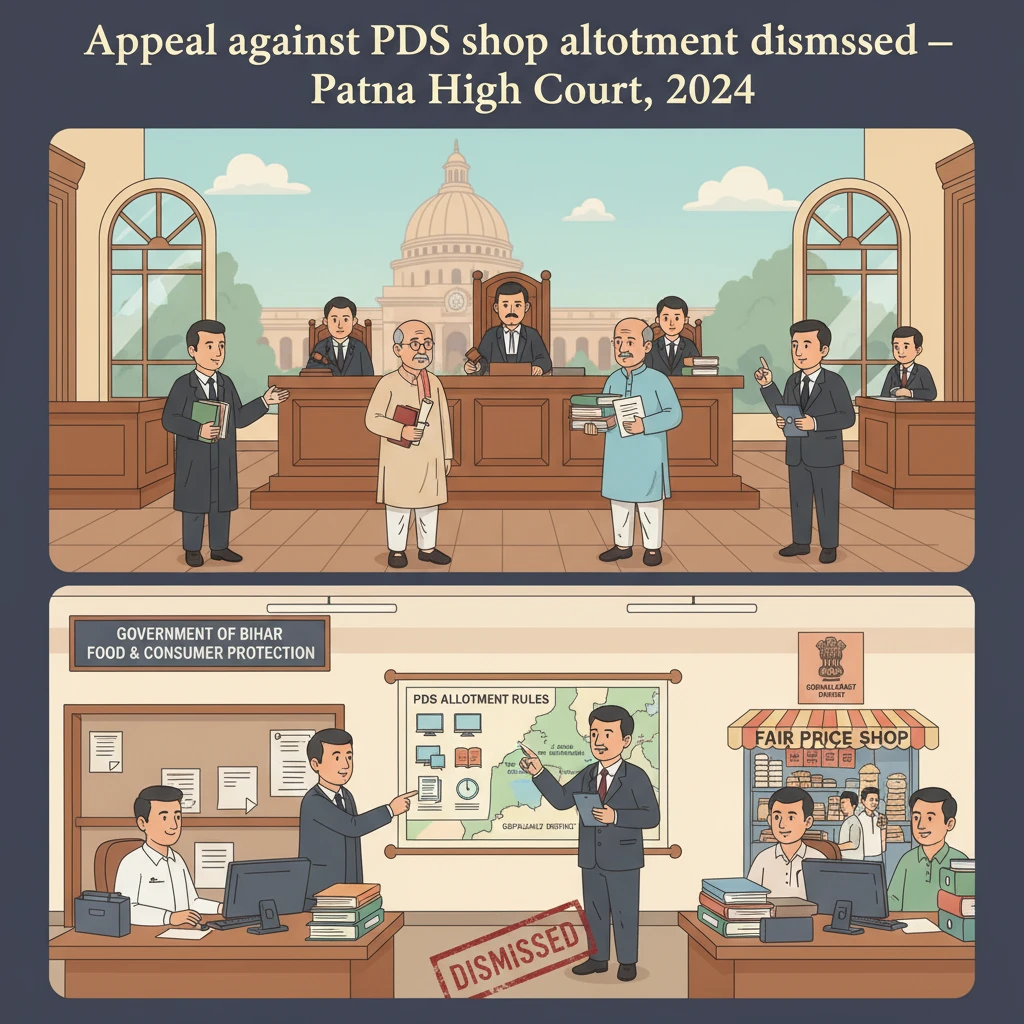
Case Background
This case arises out of a dispute over allotment of a Public Distribution System (PDS) fair price shop in district Gopalganj, Bihar.
The appellant had also applied for the same PDS dealership. A writ petition was filed earlier before a Single Judge of the Patna High Court, in which the present writ petitioner challenged the non-grant of dealership in his favour.
The learned Single Judge allowed that writ petition and directed that the PDS dealership be granted to the writ petitioner. Feeling aggrieved, the present appellant filed a Letters Patent Appeal (LPA No. 509 of 2023) before a Division Bench of the Patna High Court.
The Division Bench, consisting of Hon’ble the Chief Justice and Hon’ble Mr. Justice Partha Sarthy, delivered an oral judgment on 29.08.2024 deciding this intra-court appeal.
What the Court Examined and Decided
The main question before the Division Bench was whether the appellant had a better or prior claim to the PDS dealership than the writ petitioner under Rule 9(v) of the Bihar Targeted PDS (Control) Order, 2016.
The appellant’s lawyer argued that the appellant was a Post Graduate and, therefore, should be appointed to the PDS dealership post. It was submitted that, in terms of Rule 9(v), a candidate with higher educational qualification should get preference. On this basis, the appellant claimed that his Post Graduation in Arts put him ahead of the writ petitioner.
The appellant also tried to disqualify the writ petitioner on two additional grounds. First, he argued that the writ petitioner had applied under the Extremely Backward Class (EBC) category, while the PDS dealership in question was in the unreserved category. Second, he questioned the writ petitioner’s Graduation in Information Technology because it was obtained through distance education.
On the other hand, the State’s counsel, supporting the writ petitioner, relied on the writ petitioner’s higher qualification in computer studies. The Court records that the writ petitioner had a Bachelor of Science Graduation in Information Technology, as seen from Annexure-A series. The appellant, by contrast, had a Diploma in Computer Application and a Post Graduation in Arts.
To properly understand the dispute, the Bench first reproduced Rule 9(v) of the Bihar Targeted PDS (Control) Order, 2016. This provision states that an applicant for a fair price shop licence must be at least matric pass and an adult. The proviso then says that applicants having computer knowledge shall be given priority. Further, in case of equality in computer knowledge, priority goes first to the candidate having the highest qualification and, if that is also equal, then to the candidate who is older in age.
The Division Bench explained that the basic eligibility to apply for a PDS fair price shop is only matriculation (10th pass) and adulthood. Beyond that, the law gives special weightage to “computer knowledge”. This means that among eligible candidates, those with computer knowledge are to be preferred.
The crucial interpretative question was: when the proviso talks of “highest qualification” in a situation where there is equality in computer knowledge, does it mean highest general educational qualification (for example, any postgraduate degree), or does it refer to the highest qualification specifically in computers?
The Court noted that the writ petitioner was a Graduate in Information Technology, whereas the appellant held a Diploma in Computer Application and a Post Graduation in Arts. The appellant’s claim to preference was built on his Post Graduation in Arts, which is not a computer-related degree.
The Bench categorically held that a Post Graduation in any other subject would not be relevant for deciding highest qualification under this proviso. It reasoned that the proviso starts by giving priority to applicants with computer knowledge. Therefore, when it later refers to “highest qualification” in the same context, it must reasonably be read as highest qualification in computers.
The Court applied the principle of ejusdem generis (a rule of interpretation where general words following specific words are understood in the same class as the specific words). Here, since the proviso is centred on “computer knowledge”, the phrase “highest qualification” must be understood as highest qualification in that same field, that is, in computers.
On that interpretation, the writ petitioner’s Graduation in Information Technology is a higher computer-related qualification than the appellant’s Diploma in Computer Application. Consequently, the writ petitioner falls into a higher qualification bracket for the purpose of Rule 9(v) and is entitled to priority in appointment to the PDS dealership.
The Court then turned to the argument regarding the writ petitioner’s category. The appellant had argued that because the writ petitioner applied under the EBC category, he could not be considered for an unreserved dealership.
The Bench clearly rejected this objection. It held that, since the dealership is unreserved, there is no prohibition on candidates belonging to reserved categories applying for or being selected for unreserved vacancies or allotments. The Court added that if such a restriction were imposed, meritorious candidates from reserved categories would be unjustly kept away from unreserved allotments or appointments. Thus, being an EBC candidate did not disqualify the writ petitioner from getting an unreserved PDS dealership.
The Court also addressed the third challenge raised by the appellant regarding the mode of education. The appellant had questioned the writ petitioner’s Graduation in I.T. on the ground that it was obtained by way of distance education.
The Division Bench found no difference in Rule 9(v) between distance education and classroom (regular) education. The Rule simply prescribes matriculation and then gives priority based on computer knowledge and computer-related higher qualification. It does not distinguish between the manner in which the degree was obtained. Therefore, the Court refused to treat a distance education degree as inferior or invalid for this purpose.
After examining all three objections raised by the appellant—the meaning of “highest qualification”, the EBC status of the writ petitioner, and the distance education issue—the Court concluded that there was no legal infirmity in the Single Judge’s decision.
The Single Judge had directed that the PDS dealership be granted to the writ petitioner, and the Division Bench found no reason to interfere with that judgment. As a result, the Letters Patent Appeal filed by the appellant failed and was dismissed.
With this dismissal, the writ petitioner’s right to the PDS fair price shop dealership, as recognised by the Single Judge, stands confirmed.
Why This Judgment Matters
This judgment is important for people applying for PDS fair price shops and for authorities conducting such selections in Bihar.
First, it clarifies that where rules give priority to “computer knowledge”, higher education specifically in computers—like a degree in Information Technology—will carry more weight than general higher degrees in other subjects.
Second, the decision confirms that candidates from reserved categories are free to compete for unreserved PDS dealerships. If they are more meritorious, they cannot be excluded simply because they belong to a reserved category.
Third, the Court has made it clear that, for the purposes of Rule 9(v) of the Bihar Targeted PDS (Control) Order, 2016, there is no legal difference between a degree obtained through distance education and one obtained through classroom education.
For applicants and officials alike, this ruling from the Patna High Court gives clear guidance on how to apply Rule 9(v) fairly and consistently in future selections.
Legal Issues and Answers
- Issue: Whether a candidate with a general Post Graduation (in Arts) should get preference over a candidate with a Graduation in Information Technology under Rule 9(v) of the Bihar Targeted PDS (Control) Order, 2016.
Answer: No. The Court held that “highest qualification” refers to highest qualification in computers. A Graduation in I.T. is higher than a Diploma in Computer Application, so the writ petitioner had priority. - Issue: Whether a reserved category (EBC) candidate can be allotted an unreserved PDS dealership.
Answer: Yes. The Court held there is no bar on reserved category candidates applying for or being allotted unreserved vacancies or shops. - Issue: Whether a computer degree obtained through distance education is inferior for eligibility under Rule 9(v).
Answer: No. The Court found no distinction in the Rule between distance and classroom education and refused to treat distance education as a ground of disqualification.
Cases Cited by the Court
- No previous judicial decisions or case law have been cited or relied upon in this judgment.
Case Details
Case Number: Letters Patent Appeal No. 509 of 2023 in Civil Writ Jurisdiction Case No. 7786 of 2022
Case Title: Munna Kumar Ram v. The State of Bihar & Ors.
Coram: Hon’ble the Chief Justice; Hon’ble Mr. Justice Partha Sarthy
Citation: 2024 (4) PLJR 189
Advocates: For the appellant: Mr. Ranjeet Kumar Pandey, Advocate; For the respondents: Mr. S. Raza Ahmad, AAG-5
Nature of the case: Letters Patent Appeal against the judgment of a Single Judge in a writ petition relating to allotment of PDS fair price shop dealership
Link to judgment: Patna High Court Judgment Link
If you found this explanation helpful and wish to stay informed about how legal developments may affect your rights in Bihar, you may consider following Samvida Law Associates for more updates.







