

Case Background
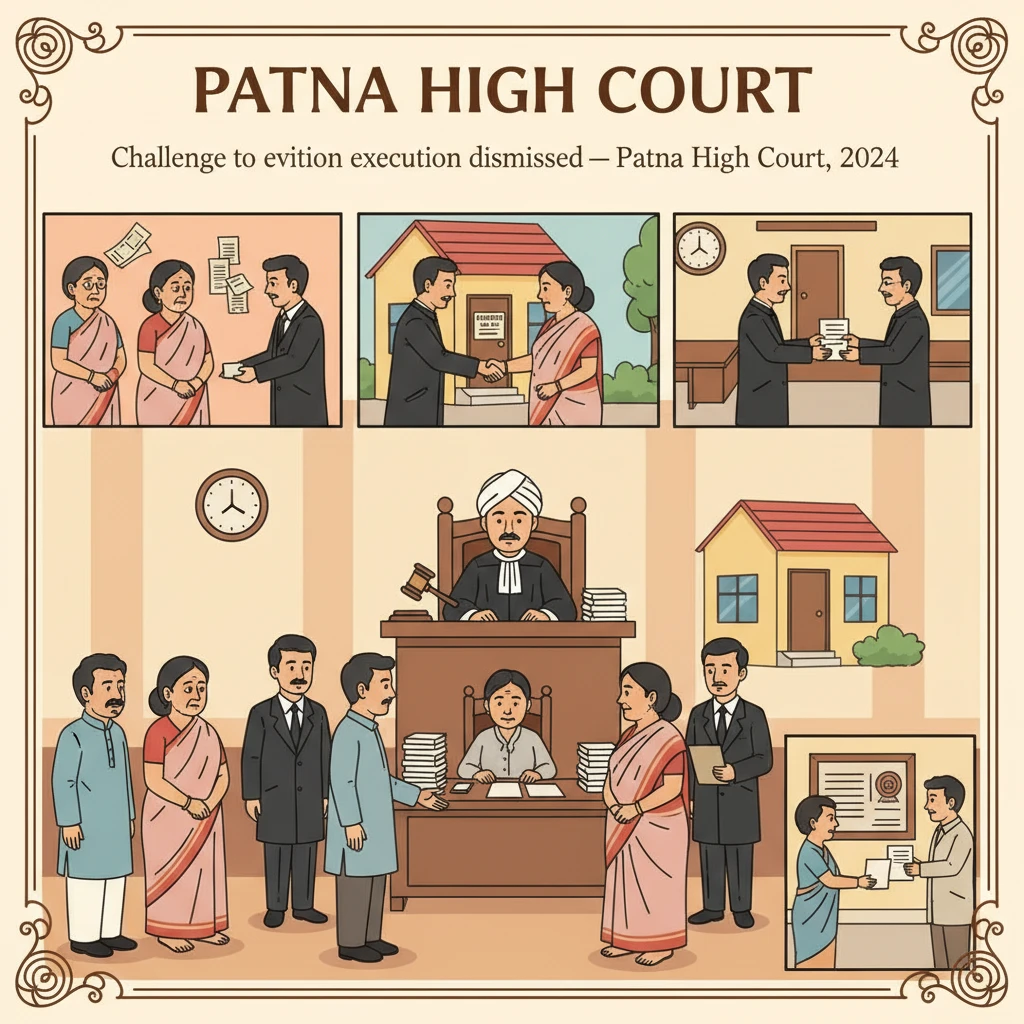
The dispute arises from a long-running family conflict over a house at Dehri-on-Sone, District Rohtas. The property was purchased in the name of Ashma Bibi @ Ashma Khatoon, the second wife of Khadim Khan, by a registered sale deed dated 25.11.1968 from one Hussaini Bhai. Another plot of 5 kathha at Dehri-on-Sone was also bought in her name.
From the first wife, Rabia @ Rabia Khatoon, Khadim Khan had one son, Makdum Khan, and three daughters, all of whom later died. From his second wife, Ashma Khatoon, he had one daughter, respondent no. 1, Naseema Khatoon. Ashma Khatoon died in 1974 and Khadim Khan died on 24.12.1984. Makdum Khan died later on 24.12.2015.
The petitioners in this case are the widow and sons of late Makdum Khan. Respondent nos. 2 to 5 are his daughters. Respondent no. 1, Naseema Khatoon, is the daughter of Khadim Khan from Ashma Khatoon.
According to the petitioners, Ashma Khatoon had no income of her own and the consideration for both purchases was paid by Khadim Khan. They claimed that she orally gifted the 1968-purchased house back to Khadim Khan, who then executed a registered gift deed on 18.04.1981 in favour of his son, Makdum Khan. On this basis, the petitioners say Makdum Khan and, after him, they themselves have been in possession, paying taxes and treating the property as their own.
Respondent no. 1 disputed this version and filed Title Suit No. 129 of 1991 before the Munsif, 2nd Court, Sasaram, seeking to set aside the 18.04.1981 gift deed in favour of Makdum Khan, claiming instead that her mother Ashma had orally gifted the house to her.
By judgment dated 20.02.1993 and decree dated 25.02.1993 in Title Suit No. 129 of 1991, the trial court declared the registered gift deed dated 18.04.1981 in favour of Makdum Khan to be null and void. Title Appeal No. 27 of 1993 filed by Makdum Khan was dismissed by the Additional District Judge, Fast Track Court No. 3, Rohtas at Sasaram, on 27.12.2005. The first appellate court went further and held that neither the oral gift claimed by respondent no. 1 nor the registered gift to Makdum Khan stood proved.
Makdum Khan then filed Second Appeal No. 33 of 2006 before the Patna High Court. The second appeal was admitted on 20.10.2008 and remains pending.
While the title dispute was pending in appeal, respondent no. 1 filed Eviction Suit No. 09 of 1993 before the Munsif, Dehri-on-Sone, Rohtas, against tenant Hussaini Bhai, seeking eviction on grounds of arrears of rent and personal necessity. Hussaini Bhai denied any landlord–tenant relationship with her.
By judgment dated 14.03.2013 and decree dated 20.03.2013, the eviction suit was decreed in favour of respondent no. 1. Hussaini Bhai’s Title Eviction Appeal No. 42 of 2013 was later dismissed in default on 09.02.2016 by the Additional District Judge-II, Rohtas at Sasaram, after he left the premises, stopped pursuing the appeal, went to Gujarat and died.
Execution Case No. 01 of 2013 was then filed to execute the eviction decree. Since tenant Hussaini Bhai had left the premises, execution was pressed against Makdum Khan and his family, because they claimed possession of the house.
On 23.01.2014, Makdum Khan filed an application under Order 21 Rules 97 and 99 of the Code of Civil Procedure, 1908, before the executing court, asserting that his possession was lawful and asking that eviction proceedings be stayed till disposal of Second Appeal No. 33 of 2006.
No order was passed on this application during Makdum Khan’s lifetime. After his death on 24.12.2015, petitioner no. 2 informed the executing court about his death and the details of his legal heirs on 02.07.2016. Respondent no. 1 opposed this move.
In 2016, after the death of judgment-debtor tenant Hussaini Bhai, petitioner no. 2 filed another petition on 19.01.2017 in Execution Case No. 01 of 2013, arguing that execution cannot continue against a dead person and should be dropped. Respondent no. 1 replied that Order 22 Rule 4 CPC did not apply at the execution stage in this way. The executing court, by order dated 04.01.2018, rejected this petition, holding that petitioner no. 2 was a stranger to the execution and had no locus standi. That order was confirmed up to the High Court.
Undeterred, the petitioners filed further applications dated 19.04.2018 and 06.09.2018, requesting disposal of the original Order 21 Rules 97 and 99 application of 23.01.2014.
Meanwhile, on 21.07.2018, the executing court ordered the ejectment of the petitioners from the premises. Their earlier civil miscellaneous petition (Civil Misc. No. 1499 of 2018) challenging this order was dismissed by the Patna High Court on 29.08.2023, with a direction to the executing court to expeditiously decide the pending 23.01.2014 application under Order 21 Rules 97 and 99.
The petitioners then approached the Supreme Court in SLP (Civil) No. 20762 of 2023. The Supreme Court issued notice on 20.09.2023 and stayed further proceedings in Execution Case No. 01 of 2013.
During pendency of the SLP, the executing court finally decided the Order 21 Rules 97 and 99 application and dismissed it by order dated 20.02.2024. Taking note of this, the Supreme Court disposed of the SLP on 11.03.2024, granting liberty to the petitioners to approach the appropriate authority against the order dated 20.02.2024, and continued the interim stay only for four weeks.
The petitioners then filed the present Civil Miscellaneous Petition No. 411 of 2024 under Article 227 of the Constitution before the Patna High Court, challenging the executing court’s order dated 20.02.2024.
What the Court Examined and Decided
Hon’ble Mr. Justice Arun Kumar Jha identified a narrow core issue: whether the executing court was right in rejecting the petitioners’ application under Order 21 Rules 97 and 99 CPC in Execution Case No. 01 of 2013, and whether the petitioners had any right to maintain such an application at all.
The petitioners’ senior counsel, Mr. Amit Shrivastava, argued that the executing court had ignored vital facts. He said that tenant Hussaini Bhai was inducted by the petitioners’ father-in-law (Khadim Khan) and that, before leaving for Gujarat, Hussaini Bhai had handed over possession to late Makdum Khan. According to him, the petitioners had been in actual possession ever since.
He relied on two strands of reasoning. First, even without a clear title, they had at least an “interest” or “right” in the house: they had been living there, paying municipal and Malguzari taxes, and came in the line of inheritance from both Khadim Khan and Ashma Khatoon. He referred to mutation proceedings in which the Circle Officer had once rejected respondent no. 1’s claim in view of the 1981 gift deed and to municipal receipts issued in the name of Makdum Khan.
Second, he said that since the first appellate court had also held that the oral gift to respondent no. 1 was not proved, the property of Ashma Khatoon, who died intestate in 1975, must devolve under Muslim law on her husband Khadim Khan and her daughter Naseema. After Khadim’s death, his share would pass to his heirs, including Makdum and, through him, to the petitioners and respondent nos. 2 to 5. From this, he tried to derive at least a partial share for the petitioners, arguing that they could not be treated as rank strangers.
He further pressed that even if they were treated as “strangers”, anyone with an interest in the property could maintain an application under Order 21 Rule 97. He insisted that the executing court should have conducted a full-fledged adjudication like a regular suit, as contemplated by Order 21 Rule 101, including framing of issues and deciding questions of right, title or interest. For this he relied on earlier decisions such as Sanjha Devi v. Amar Yadav, 2007(4) PLJR 727, and the Supreme Court’s decision in Noorduddin v. K.L. Anand, (1995) 1 SCC 242.
He also cited Supreme Court and Patna High Court precedents (Mool Chand Yadav, (1982) 3 SCC 484; Tej Rani Devi, (2001) 1 PLJR 661; Sanjay Verma v. Longi Devi, Civil Appeal No. 8775 of 2013; and Union of India v. West Coast Paper Mills Ltd., AIR 2004 SC 1596) to argue that when an appeal is pending and the appellant is in possession, courts should maintain status quo and normally stay execution of the decree to avoid irreparable loss.
On the other hand, senior counsel for respondent no. 1, Mr. Devendra Kumar Sinha, argued that the petitioners were confounding two separate things: the title dispute, and the eviction decree. According to him, the title question had already been settled against the petitioners in Title Suit No. 129 of 1991 and Title Appeal No. 27 of 1993, where the 18.04.1981 gift deed was declared void. The second appeal was, therefore, only a continuation of that separate title proceeding.
He emphasized that the eviction decree arose from Eviction Suit No. 09 of 1993, which was strictly between landlord (respondent no. 1) and tenant (Hussaini Bhai). That decree had become final after the tenant’s appeal was dismissed in default. The petitioners had never sought to be added as parties to that eviction suit or to the eviction appeal. In his view, the question of who held title could not be reopened inside the execution of an eviction decree.
Mr. Sinha further pointed out that the gift deed relied on by the petitioners had already been declared void by two courts. Therefore, their entire claim was without legal basis. Labeling their repeated applications as attempts to deny the decree-holder the fruits of her decree, he urged that there was no ground to interfere with the reasoned order of the executing court.
After carefully reviewing the record, the Patna High Court first reproduced Order 21 Rules 97, 99 and 101 CPC and recognised that, generally, questions of right, title or interest raised under these provisions are to be decided by the executing court, often in a manner similar to a regular suit.
However, the Court underlined an important qualification: when the “admitted position” on record leaves no doubt about title, a detailed enquiry is not mandatory in every case under Order 21 Rules 97 and 99. Here, the admitted position was that the petitioners’ basis of title—the 18.04.1981 gift deed—had already been rejected and declared a nullity by both the trial court and first appellate court in the earlier title litigation. The first appellate court’s comments regarding lack of proof of the oral gift in favour of respondent no. 1 were treated as unwarranted observations, because no issue on that point had been formally framed.
The Court noted that, as a result of the decree in the title suit, “title and possession of respondent-Naseema Khatoon was declared over the suit property.” After that declaration, respondent no. 1 filed and succeeded in the eviction suit against her tenant, reinforcing her position as landlord. The appeal from the eviction decree was also dismissed.
In this background, the Court held that the petitioners’ claims lacked any “substantive basis”. Merely having a second appeal pending was not sufficient ground to stall the execution of a final eviction decree, especially when the document on which they based their title had twice been declared invalid.
The Court went so far as to describe the petitioners not as strangers, but as “trespassers, illegally claiming possession without any right and title.” It held that where there is no material to show right and title, a bare assertion of vague “interest” in the property cannot sustain an objection under Order 21 Rule 97.
On the argument that the executing court should have framed issues and conducted a detailed trial under Order 21 Rule 101, the High Court said that such technicality cannot override the reality that title and possession had already been conclusively decided in favour of respondent no. 1 in previous proceedings. Since “nothing remains to be decided” on right and title in the context of the execution, a fresh full trial-like enquiry was unnecessary.
The Court also addressed the petitioners’ reliance on various precedents about staying execution during pendency of appeals. It distinguished those cases as being based on different facts, mostly where the execution sought to enforce the very decree under appeal. In contrast, in this matter, execution was of an eviction decree, while the pending second appeal related to a separate title suit. Therefore, those decisions were held not applicable.
On the question of possible future relief, the Court clarified that if the petitioners ultimately succeed in Second Appeal No. 33 of 2006, they would still have a remedy. In that event, they could seek restitution under Section 144 CPC, which allows restoration of benefits lost under a decree that is later reversed.
Ultimately, the High Court concluded that there was “no infirmity” in the executing court’s order dated 20.02.2024 rejecting the Order 21 Rules 97 and 99 application. It affirmed the order and dismissed Civil Miscellaneous No. 411 of 2024.
Why This Judgment Matters
This judgment has clear practical lessons for families and occupants facing eviction in Bihar and elsewhere.
First, it shows that if your claimed title to a house has already been rejected by competent civil courts, you cannot easily use execution proceedings to re-open the same dispute. Execution is for enforcing the decree, not for re-trying the entire case.
Second, the Patna High Court has made it clear that just living in a house and paying some taxes does not by itself give you a legal shield against a valid eviction decree, especially when your main title document stands declared void.
Third, the decision warns that repeatedly filing objections in execution without a solid legal foundation may be treated as obstruction. The Court described such objectors as trespassers rather than genuine third parties with independent rights.
Finally, the Court pointed to the proper remedy: if someone’s appeal on title is still pending and they later win, they can seek restitution under Section 144 CPC. But they cannot insist that execution of an already final eviction decree must stop automatically during the pendency of that separate appeal.
Legal Issues and Answers
- Issue: Can legal heirs of a person whose gift deed has been declared void maintain an objection under Order 21 Rules 97 and 99 CPC to stop execution of an eviction decree in favour of the decree-holder?
Answer: No. Where title and possession have already been decided in favour of the decree-holder and the objectors’ basis of title has been concurrently rejected, they lack any right or title sufficient to maintain such an objection. - Issue: Must the executing court always hold a full-fledged enquiry like a civil suit under Order 21 Rule 101 CPC whenever an objection is filed under Order 21 Rules 97 or 99?
Answer: No. If the admitted facts and prior binding judgments leave no real doubt about right and title, a detailed enquiry with framed issues is not required; technical lapses will not defeat execution of a valid decree. - Issue: Does the mere pendency of a second appeal in a related title suit automatically justify staying execution of an eviction decree?
Answer: No. The pending second appeal in the separate title proceeding does not, by itself, bar execution of the eviction decree. If the appellants later succeed, their remedy lies in restitution under Section 144 CPC.
Cases Cited by the Court
- Mool Chand Yadav v. Raza Buland Sugar Co. Ltd., (1982) 3 SCC 484 (cited by petitioners, distinguished).
- Tej Rani Devi v. Indira Devi, (2001) 1 PLJR 661 (cited by petitioners, distinguished).
- Sanjoy Verma @ Sanjay Kumar Verma v. Smt. Longi Devi & Ors., Civil Appeal No. 8775 of 2013 (arising out of SLP (Civil) No. 26142 of 2012), decided on 30.09.2013 (cited by petitioners, distinguished).
- Union of India & Ors. v. West Coast Paper Mills Ltd. & Anr., AIR 2004 SC 1596 (cited by petitioners, distinguished).
- Sanjha Devi v. Amar Yadav & Ors., 2007(4) PLJR 727 (cited by petitioners on scope of Order 21 Rule 97, considered).
- Noorduddin v. K. L. Anand, (1995) 1 SCC 242 (cited by petitioners on requirement of adjudication before execution, considered).
- Union of India & Ors. v. Shapoorji Palloonji and Co. Pvt. Ltd., AIR 2023 SC 5153 (cited on interpretation of “or” and “and”, considered).
Case Details
Case Number: Civil Miscellaneous Jurisdiction No. 411 of 2024
Case Title: Zaibunnisha & Ors. v. Naseema Khatoon & Ors.
Coram: Hon’ble Mr. Justice Arun Kumar Jha
Citation: 2024(4) PLJR 650
Nature of the Case: Civil miscellaneous petition under Article 227 of the Constitution of India challenging an order of the executing court in Execution Case No. 01 of 2013 relating to an eviction decree.
Impugned Order: Order dated 20.02.2024 passed by the Munsif, Dehri-on-Sone, Rohtas, in Execution Case No. 01 of 2013, rejecting objections under Order 21 Rules 97 and 99 CPC.
Final Outcome: Petition dismissed; impugned order affirmed; execution of eviction decree can proceed.
Advocates:
- For the petitioners: Mr. Amit Shrivastava, Senior Advocate; Mr. Puneet Siddhartha, Advocate; Mr. Girish Pandey, Advocate.
- For the respondents: Mr. Devendra Kumar Sinha, Senior Advocate; Mr. Akhouri Vipin Bihari Shrivastava, Advocate; Ms. Patla Kumari, Advocate.
Link to Judgment: Full text of Patna High Court judgment
If you found this explanation helpful and wish to stay informed about
how legal developments may affect your rights in Bihar,
you may consider following Samvida Law Associates for more updates.







