

Case Background
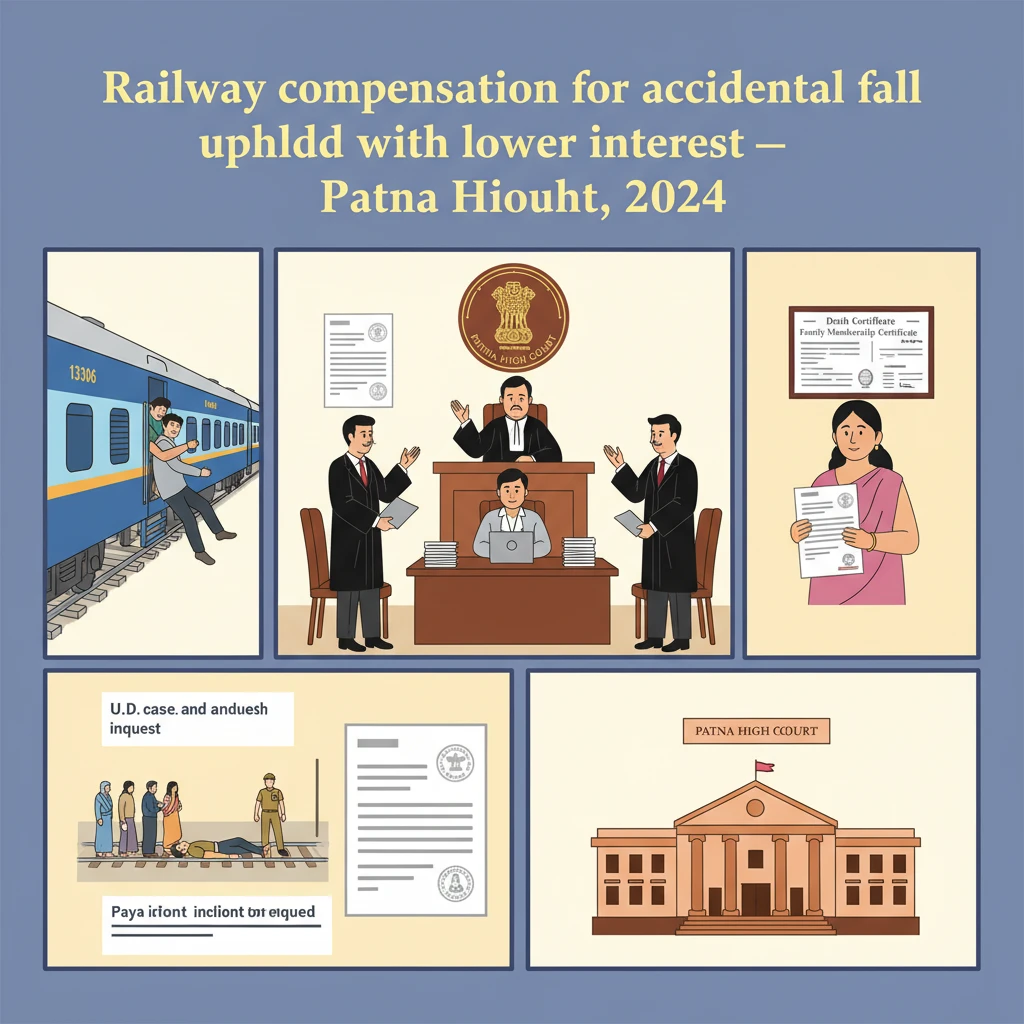
This case arose from a tragic incident on 27.04.2014 involving a passenger travelling by train in Bihar.
The deceased, Mantu Kumar, husband of the claimant, had come to Gaya Junction from Vishakhapatnam. On the same date, he allegedly purchased a second-class valid train ticket from Gaya Junction for travelling to Koderma. He then boarded Train No. 13306 Down (Gaya–Dhanbad Intercity Express) at Gaya Junction.
According to the claimant, there was heavy rush in the general compartment of the train. Because of this, the deceased was standing near the gate inside the coach. Due to intense jostling of passengers, he accidentally fell down from the running train about 1 km east of Gaya Junction, near Vairagi.
It is stated that he sustained serious injuries from the fall and died on the spot.
The widow approached the Railway Claims Tribunal, Patna, by filing Original Application No. 00643 of 2014 under the Railway Claims Tribunal Act, 1987, seeking statutory compensation for an “untoward incident”.
The Union of India, through the General Manager, East Central Railway, Hajipur, contested the claim. It disputed that the incident was an “untoward incident” and also denied that the deceased was a bonafide passenger, mainly because no ticket was mentioned as recovered in the inquest report.
After considering pleadings and evidence, the Tribunal framed issues relating to: (i) whether the deceased was a bonafide passenger, (ii) whether his death was an untoward incident under Section 123(c)(2) of the Railways Act, 1989, (iii) whether the applicant was a dependent, and (iv) entitlement and quantum of compensation.
By judgment dated 14.03.2016, the Railway Claims Tribunal, Patna, partly allowed the claim. It held that the deceased had met with an untoward incident by falling from the train and had died due to the injuries. The Tribunal directed the Railways to pay compensation of Rs. 4 lakhs along with simple interest at 10% per annum from 07.10.2014 (the date of registration of the application), to be paid within 60 days of submission of bank details. It further directed that if not paid in time, an additional 2% per annum simple interest would apply on the entire compensation from the date of registration till realization.
Aggrieved, the Union of India filed Miscellaneous Appeal No. 1175 of 2016 under Section 23 of the Railway Claims Tribunal Act, 1987, before the Patna High Court challenging the Tribunal’s judgment.
What the Court Examined and Decided
The Patna High Court, through Hon’ble Mr. Justice Sunil Dutta Mishra, heard the appeal and examined both factual and legal aspects. The key questions were whether the deceased was a bonafide passenger, whether his death amounted to an “untoward incident”, and whether the Tribunal’s award and interest rate were justified.
On behalf of the appellant–Railways, several arguments were raised. The first was that the deceased was not a bonafide passenger because no valid ticket was recovered from his body and the inquest report did not record any ticket. The second argument was that the deceased had allegedly committed suicide. The Railway relied on an alleged admission by the deceased’s father in his Fardbeyan, stating that the deceased had committed suicide as he was disappointed with his life. The Railway also claimed that the seizure list prepared with the inquest report mentioned seizure of a suicide note of the deceased.
Further, the appellant argued that the Tribunal had awarded an exorbitant rate of interest at 10% per annum, which was said to be higher than the then prevailing rate of 4% on savings accounts in nationalised banks. The Railways contended that the burden was on the applicant to prove that the deceased was a bonafide passenger and that this burden had not been discharged.
The respondent–claimant, through her counsel, supported the Tribunal’s findings. She relied on her own affidavit (marked Ext.-AW1/A) filed before the Tribunal, where she explained the circumstances of travel and stated that her husband had a valid ticket which was lost during the occurrence.
She was cross-examined by the Railway. In cross-examination she stated that she was at her house when the incident occurred and came to know about it from family members. Importantly, no material fact was drawn from her in cross-examination that contradicted her version in the Original Application.
The claimant also produced several documents: Station Memo issued by Station Manager, Gaya Junction (Ext.-A1), letter/statement of one Sri Suresh Prasad (Ext.-A2), inquest report (Ext.-A3), post-mortem report (Ext.-A4), dead body receipt (Ext.-A5), final report (Ext.-A6), death certificate (Ext.-A7), family membership certificate issued by the Circle Officer, Ekangarsarai, Nalanda (Ext.-A8), and her voter identity card (Ext.-A9).
On behalf of the Railways, the Divisional Railway Manager (DRM) report (Ext.-R1) was filed. This report showed that the deceased had died due to falling from the train, and it attributed the fall to his own negligence.
The High Court noted that the Tribunal had already analysed these materials and held that the deceased met with an untoward incident due to falling down from the said train and succumbed to injuries during medical treatment. The High Court then turned to the governing legal principles.
The Court referred to Section 55 of the Railways Act, which makes it mandatory to possess a ticket, proper pass, or permission while entering railway premises or travelling by train, and to Section 137 which provides punishment for violation. However, the Court emphasised that, in claim cases, the question is not criminal liability but entitlement to statutory compensation under the “untoward incident” provisions.
The Court relied heavily on the Supreme Court’s judgment in Union of India v. Rina Devi, reported in 2019(3) SCC 572. The Supreme Court had held that death or injury during boarding or deboarding a train is an “untoward incident” under Section 123(c), entitling the victim or dependants to compensation under Section 124A. Such claims do not fail merely because the victim may have been negligent; contributory negligence of the victim does not take the case out of the category of “untoward incident” unless it falls under the specific exceptions in the proviso to Section 124A.
Relying on Rina Devi, the High Court reiterated that mere presence of a dead body on railway premises is not enough to hold that the person was a bonafide passenger. At the same time, mere absence of a ticket on the body is also not a ground to reject the claim. The initial burden to show that the deceased was travelling as a passenger lies on the claimant, but this burden can be discharged by filing an affidavit on relevant facts. Once that is done, the onus shifts to the Railways to rebut or disprove the claim through evidence or surrounding circumstances.
The Court further noted that in Rina Devi, the Supreme Court had clarified this burden-shifting approach and held that each case must be decided on its own facts.
Applying these principles, the Patna High Court examined the evidence in this case. The inquest report, post-mortem report and final report of U.D. Case No. 31 of 2014 all showed that the deceased died due to a fall from the running Dhanbad–Gaya Intercity Express train. On these materials, the Court held that the occurrence of an untoward incident could not be doubted in the absence of any other material.
The claimant had filed her affidavit stating the relevant facts regarding her husband’s travel and the fall from the train, thereby discharging her initial burden. On the other hand, the Railways had not adduced any evidence in rebuttal or denial of the claimant’s case, apart from the DRM report that simply labelled the fall as due to his own negligence.
The High Court found that the Tribunal had correctly appreciated the evidence and applied the law laid down in Rina Devi. Thus, the findings that the deceased was a bonafide passenger and that his death was an untoward incident were upheld. Consequently, the award of statutory compensation of Rs. 4 lakhs was affirmed.
The only aspect where the High Court interfered was the rate of interest. The Court observed that, considering the facts and circumstances of the case, interest at the rate of 6% per annum from the date of filing of the Original Application till realization would be appropriate, instead of the 10% (and possible additional 2%) awarded by the Tribunal.
The Court again referred to Rina Devi (supra) to note that interest on such compensation can be awarded without any distinction between stages, but adjusted the rate to 6% per annum.
Accordingly, the High Court confirmed the compensation of Rs. 4 lakhs but modified the interest component. The Miscellaneous Appeal was disposed of with this modification, with no order as to costs. The Court further directed that the appellant–Railways shall pay the compensation amount with interest, minus any amount already deposited, within two months from the date of the High Court’s order.
Why This Judgment Matters
This judgment is important for families of railway accident victims, especially in Bihar and Jharkhand, who approach the Railway Claims Tribunal after accidental falls from trains.
The Patna High Court clearly accepts that just because a ticket is not found on the body, the claim cannot be rejected. If the family files an affidavit explaining the travel and the fall, and basic documents like inquest report and post-mortem support a fall from a running train, the burden shifts to the Railways.
For ordinary passengers, this means that even in crowded trains where tickets may get lost or burnt or stolen in the chaos of an accident, dependants can still succeed in getting statutory compensation, provided they place the basic facts on record.
The judgment also shows that while courts will uphold the statutory compensation fixed by law, they may adjust the interest rate to a reasonable level depending on prevailing conditions and higher court guidance.
Legal Issues and Answers
- Issue: Was the deceased a bonafide passenger whose death resulted from an “untoward incident” under Section 123(c)(2) of the Railways Act, 1989, entitling his dependant to compensation?
Answer: Yes. Based on the claimant’s affidavit and supporting documents like the inquest, post-mortem and final report, the Court accepted that the deceased fell from the running Dhanbad–Gaya Intercity Express train and died. The Railways produced no effective rebuttal, so compensation was rightly awarded. - Issue: Was the Railway Claims Tribunal justified in awarding interest at 10% per annum (with a possible additional 2%) on the compensation amount?
Answer: No, not fully. While interest was justified, the Patna High Court held that a lower rate of 6% per annum from the date of filing of the claim application till realization was appropriate and modified the award accordingly.
Cases Cited by the Court
- Union of India v. Rina Devi, 2019(3) SCC 572.
Case Details
Case Number: Miscellaneous Appeal No. 1175 of 2016
Case Title: Union of India, through the General Manager, East Central Railway, Hajipur v. Smt. Priyanka Verma
Court: High Court of Judicature at Patna
Coram: Hon’ble Mr. Justice Sunil Dutta Mishra
Date of Judgment: 20.08.2024
Impugned Order: Judgment/order dated 14.03.2016 passed by Railway Claims Tribunal, Patna in O.A. No. 00643 of 2014
Citation: 2024(4) PLJR 626
Advocates:
- For the Appellant (Union of India / Railways): Mr. Amarendra Nath Verma, Sr. Panel Counsel; Mr. Rakesh Kumar No. 1, Advocate
- For the Respondent (Claimant / Widow of deceased): Mr. Anant Kumar-1, Advocate
Nature of the Case: Miscellaneous Appeal under Section 23 of the Railway Claims Tribunal Act, 1987, against an award of compensation for death in an alleged “untoward incident”.
Link to Judgment: Patna High Court Judgment in MA No. 1175 of 2016
If you found this explanation helpful and wish to stay informed about how legal developments may affect your rights in Bihar, you may consider following Samvida Law Associates for more updates.







