
Case Background
The case began with Hajipur Sadar P.S. Case No. 633 of 2020, registered on the basis of a written report by Sub-Inspector Sanjeev Kumar (PW-1), who was posted at Sadar Police Station, Hajipur.
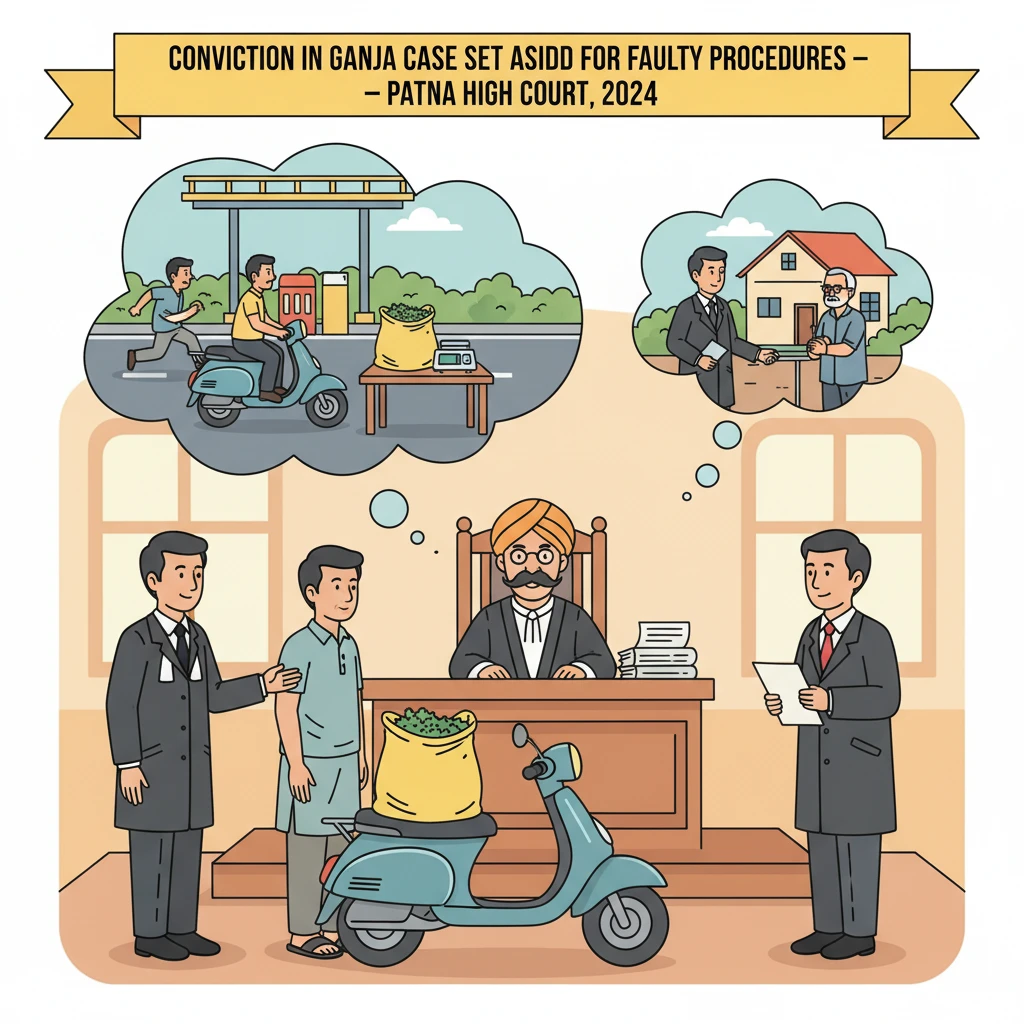
According to this report, on 13.10.2020 at about 10.45 a.m., while on patrolling duty with armed forces and Homeguards, PW-1 allegedly received secret information that two persons on a scooter were carrying ganja towards Daulatpur. Acting on this, he moved towards Hajipur–Muzaffarpur road near a weighbridge (Dharamkanta).
The patrolling party noticed a scooter with two riders and a yellow plastic bag. On seeing the police, the pillion rider jumped off and fled. The driver was caught and disclosed his name as Ravi Kumar (the appellant). He allegedly named the absconding pillion rider as Prince @ Babul Chaudhary.
The police claim that the appellant admitted that the bag contained ganja belonging to his father, who was engaged in selling ganja, and that he was carrying it on his father’s direction. The bag was opened, two packets were found and, on weighing, the contents allegedly came to 20.100 kg. The scooter and bag were seized and a seizure list was prepared, with two Homeguards as witnesses.
On this basis, the FIR was registered under Sections 8, 20(b)(ii)(c), 25 and 29 of the NDPS Act. Investigation was handed over to A.S.I. Ranjan Kumar Jaiswal (PW-4). After investigation, a charge-sheet dated 31.12.2020 was submitted against the appellant and his father, Shyam Narayan Chaudhary, under the same sections.
The District and Sessions Judge-cum-Special Judge, NDPS, Vaishali, took cognizance on 04.06.2021. On 04.10.2021, charges were framed under Sections 8(c), 20(b)(ii)(c) read with 29 and Section 25 read with Section 29 of the NDPS Act. The appellant pleaded not guilty and claimed trial.
The trial court examined seven prosecution witnesses and one defence witness, and looked at several documents including seizure list, notice under Section 50 NDPS Act, FIR, FSL report, malkhana register, and defence exhibits like an earlier FIR, medical report, and prescription of the appellant. After trial, the Special Judge convicted the appellant under Section 20(b)(ii)(c) NDPS Act and sentenced him to 10 years’ rigorous imprisonment with a fine of Rs.1,00,000/-, and two years’ further imprisonment in default.
Aggrieved, the appellant filed Criminal Appeal (SJ) No. 3793 of 2023 before the Patna High Court under Section 374(2) CrPC. The judgment in appeal was delivered on 02.09.2024 by Hon’ble Mr. Justice Chandra Shekhar Jha.
What the Court Examined and Decided
The High Court re-analysed the entire evidence, keeping in mind the strict standards required in NDPS cases. It also considered arguments based on Supreme Court judgments such as Union of India v. Mohanlal, Gorakh Nath Prasad v. State of Bihar, Noor Aga v. State of Punjab, Khet Singh v. Union of India, and Union of India v. Balmukund, as well as the Standing Instructions No. 1 of 1988 issued under Section 52-A NDPS Act.
Contradictions about “secret information”
PW-1 (the informant) stated that he had received “secret information” that a scooter with two persons carrying ganja was coming from Hajipur side. On this basis, he claimed to have informed his superior officers and then intercepted the scooter.
However, PW-2 (Homeguard Pramod Jha) clearly said in cross-examination that no secret information was received and that the appellant was apprehended only on suspicion while on patrol duty. PW-3 also supported this version. This contradiction on the very genesis of the operation made the Court doubtful about the prosecution story itself.
The Court noted that no written information to superior officers about the alleged secret tip-off was produced, and PW-1 admitted that this assertion was not mentioned in his written report.
Lack of independent witnesses
PW-1 admitted that around 14–15 people were present at the place of interception. PW-2 spoke of 35–40 persons and PW-3 spoke of 10–20 persons. Yet, no independent member of the public was made a seizure witness, nor were their names even noted. Only Homeguards were made witnesses.
Given that NDPS cases carry very heavy punishments, the Court treated the absence of any independent witness and lack of attempt to secure their signatures, despite a crowd being present, as a serious weakness.
Defects in search, seizure, sampling and sealing
The High Court gave detailed attention to how the ganja was allegedly seized and handled. PW-1 claimed that the bag contained two packets, that the total weight was 20.100 kg, and that “sampling of seized ganja was done” at the spot. However, on close reading, several problems appeared:
First, PW-1 did not state how much quantity was taken as sample. He did not say that the packets or samples were marked or given serial numbers. There was no description of how the packets were sealed or whether the accused and witnesses signed the samples, as required by Standing Instruction No. 1 of 1988.
Second, the evidence showed that instead of immediately depositing the seized contraband and vehicle in the malkhana, the police took the appellant and the seized material first to his house to arrest his father. Nothing incriminating was found there. Only after this detour was the material brought to the police station and deposited. The Court considered this movement of alleged contraband, without any clear record of seals or markings, as highly unsafe.
Third, PW-1 admitted that he did not use any field test or detection kit to confirm even prima facie that the seized material was ganja. It was simply presumed to be ganja on the basis of appearance and experience, and sealed as such. PW-5, the Assistant Director of FSL, specifically stated that by mere visual inspection the material could not be identified as ganja.
Fourth, Standing Instructions require that samples be drawn on the spot in duplicate, properly sealed, and signed by the accused, witnesses and seizing officer, with clear details of quantity and packaging. The Court found no evidence of such compliance. PW-7, the malkhana incharge, stated that the entire seized material of 20.100 kg was entered in the register and sent to Central Malkhana, raising a doubt whether any sample had been separated at the time of seizure.
Delay and doubts in sending sample to FSL
The recovery allegedly took place on 13.10.2020. PW-4, the Investigating Officer, admitted that he sent the sample for FSL examination only on 24.12.2020, more than two months later. The FSL report was communicated by letter dated 07.04.2022.
The charge-sheet, however, had already been submitted on 31.12.2020, before the FSL report was available. The Court observed that, therefore, at the time of charge-sheet the prosecution had no scientific confirmation that the seized material was ganja.
Importantly, there was no clear evidence about the seals on the sample packet, or that the seals tallied with those affixed at the time of seizure. The Court found it suspicious whether the material produced in court or examined by FSL was the same as that allegedly seized from the appellant.
Evidence that “nothing was recovered” from the appellant
PW-3, one of the seizure witnesses, stated in cross-examination that “nothing was recovered” from the possession of the appellant. This statement directly hit the prosecution claim of recovery from the appellant’s scooter.
Coupled with the absence of independent witnesses, lack of proper sealing and sampling, and internal contradictions, this added to the reasonable doubt in the Court’s mind.
Non-compliance with Section 52-A NDPS Act and Standing Instructions
The Court referred to Supreme Court decisions explaining that although Standing Orders may be executive guidelines, they acquire mandatory force when issued under statutory authority like Section 52-A.
Quoting Noor Aga and other decisions, the Court stressed that in NDPS cases, where punishments are very severe and presumptions of guilt can operate, procedural safeguards must be “scrupulously followed” and any substantial non-compliance can lead to an adverse inference against the prosecution.
The Court also noted that samples were admittedly not drawn in the presence of a Magistrate as contemplated under Section 52-A(2)(c). In light of the Supreme Court’s judgment in Union of India v. Mohanlal, this requirement is mandatory. Failure to follow it weakened the prosecution case further.
High standard of proof in NDPS cases
Relying on Gorakh Nath Prasad and Noor Aga, the Court reiterated that although the NDPS Act contains reverse burden clauses (Sections 35 and 54), the prosecution must first establish “foundational facts” such as proper seizure, safe custody, and clear identification of the contraband.
Only after such a prima facie case is made can the burden shift to the accused. Stringent punishments under the Act demand stricter scrutiny and a higher degree of assurance. Any “iota of doubt” must go in favour of the accused.
Here, the Court found multiple serious doubts: origin of information, conduct of search, absence of independent witnesses, lack of clear sampling and sealing procedure, delay and uncertainty in sending to FSL, and even testimony that nothing was recovered from the appellant. Therefore, the foundational facts of possession and proper handling of ganja were not proved beyond reasonable doubt.
Final decision
After weighing the entire evidence and legal position, the Patna High Court held that the prosecution had “failed to establish its case beyond reasonable doubt” against the appellant regarding recovery of contraband/ganja.
The appeal was allowed. The judgment of conviction dated 28.06.2023 and order of sentence dated 03.07.2023 passed by the Additional Sessions Judge-I-cum-Special Judge, NDPS, Vaishali at Hajipur in NDPS No. 91 of 2020 were quashed and set aside.
The appellant Ravi Kumar was acquitted of the charge under Section 20(b)(ii)(c) NDPS Act. Since he was in custody in connection with this case, the Court directed that he be released forthwith if not required in any other case. Any fine deposited was ordered to be returned.
Why This Judgment Matters
This judgment is important for anyone facing NDPS charges, especially in Bihar, because it shows that courts will not blindly accept police versions in serious drug cases. Even if the alleged quantity is “commercial”, the prosecution must strictly follow the law in search, seizure, sampling, sealing, and sending material for testing.
For ordinary citizens, the decision underlines that:
First, if police claim to have recovered contraband, they must involve independent witnesses where possible, mark and seal the recovered items carefully, draw samples properly, and maintain an unbroken chain of custody.
Second, scientific reports like FSL opinions must be clearly connected to the material actually seized from the accused. If there is any break or doubt, the benefit goes to the accused.
Third, NDPS offences carry long jail terms and heavy fines, but courts insist that foundational facts be proved beyond reasonable doubt before any reverse burden can apply.
Practically, this judgment will guide trial courts and investigating officers in Vaishali and elsewhere in Bihar to respect Standing Instructions and Section 52-A. It also gives defence lawyers concrete grounds to challenge defective investigations in NDPS matters before the Patna High Court.
Legal Issues and Answers
- Issue: Whether the prosecution proved beyond reasonable doubt that ganja was lawfully recovered from the possession of the appellant and handled in accordance with NDPS procedures.
Answer: No. Due to contradictions on secret information, lack of independent witnesses, improper sampling and sealing, delay and doubts in FSL examination, and evidence that nothing was recovered from the appellant, the Court held that recovery itself was doubtful. - Issue: Whether non-compliance with Section 52-A NDPS Act and Standing Instructions No. 1 of 1988 vitiated the prosecution case.
Answer: Yes. The Court held that substantial non-compliance with these mandatory safeguards regarding sampling before a Magistrate and proper sealing and documentation undermined the sanctity of the physical evidence and attracted an adverse inference against the prosecution. - Issue: Whether the reverse burden provisions of Sections 35 and 54 NDPS Act could be invoked against the appellant in the facts of the case.
Answer: No. As the prosecution failed to prove foundational facts of possession and proper handling of contraband, the statutory presumptions could not be pressed into service and the appellant was entitled to acquittal.
Cases Cited by the Court
- Union of India v. Mohanlal and Another, (2016) 3 SCC 379
- Gorakh Nath Prasad v. State of Bihar, (2018) 2 SCC 305
- Noor Aga v. State of Punjab and Another, (2008) 16 SCC 417
- Khet Singh v. Union of India, AIR 2002 SC 1450
- Union of India v. Balmukund and Others, (2012) 9 SCC 161
- Sk. Raju @ Abdul Haque @ Jagga v. State of West Bengal, AIR 2018 SC 4255
- Jitendra v. State of M.P., (2004) 10 SCC 562 (quoted in Gorakh Nath Prasad)
- Ashok @ Danga Jaiswal v. State of Madhya Pradesh, (2011) 5 SCC 123 (quoted in Gorakh Nath Prasad)
- State of Punjab v. Baldev Singh, (1999) 6 SCC 172 (quoted in Noor Aga)
- State of Kerala & Ors. v. Kurian Abraham (P) Ltd. & Anr., (2008) 3 SCC 582 (quoted in Noor Aga)
- Union of India v. Azadi Bachao Andolan, (2004) 10 SCC 1 (quoted in Noor Aga)
Case Details
Case Number: Criminal Appeal (SJ) No. 3793 of 2023; arising out of Hajipur Sadar P.S. Case No. 633 of 2020; NDPS No. 91 of 2020.
Case Title: Ravi Kumar v. The State of Bihar.
Court: High Court of Judicature at Patna.
Coram: Hon’ble Mr. Justice Chandra Shekhar Jha.
Date of Judgment (Appeal): 02.09.2024.
Citation: 2024(4) PLJR 172.
Advocates:
- For the Appellant: Mr. Ajay Kumar Thakur, Advocate; Mrs. Vaishnavi Singh, Advocate; Mr. Ritwik Thakur, Advocate; Ms. Kiran Kumari, Advocate; Mr. Purushottam Kumar, Advocate.
- For the Respondent-State: Mrs. Anita Kumari Singh, APP.
Nature of the Case: Criminal appeal under Section 374(2) CrPC against conviction and sentence under Section 20(b)(ii)(c) of the NDPS Act passed by the Additional Sessions Judge-I-cum-Special Judge, NDPS, Vaishali at Hajipur.
Final Outcome: Appeal allowed; conviction and sentence set aside; appellant acquitted and directed to be released if not required in any other case; fine to be refunded.
Link to Judgement;file:///C:/Users/Adity/OneDrive/Documents/Vaktrita%20Final/case%201671.pdf
If you found this explanation helpful and wish to stay informed about how legal developments may affect your rights in Bihar, you may consider following Samvida Law Associates for more updates.







