

Case Background
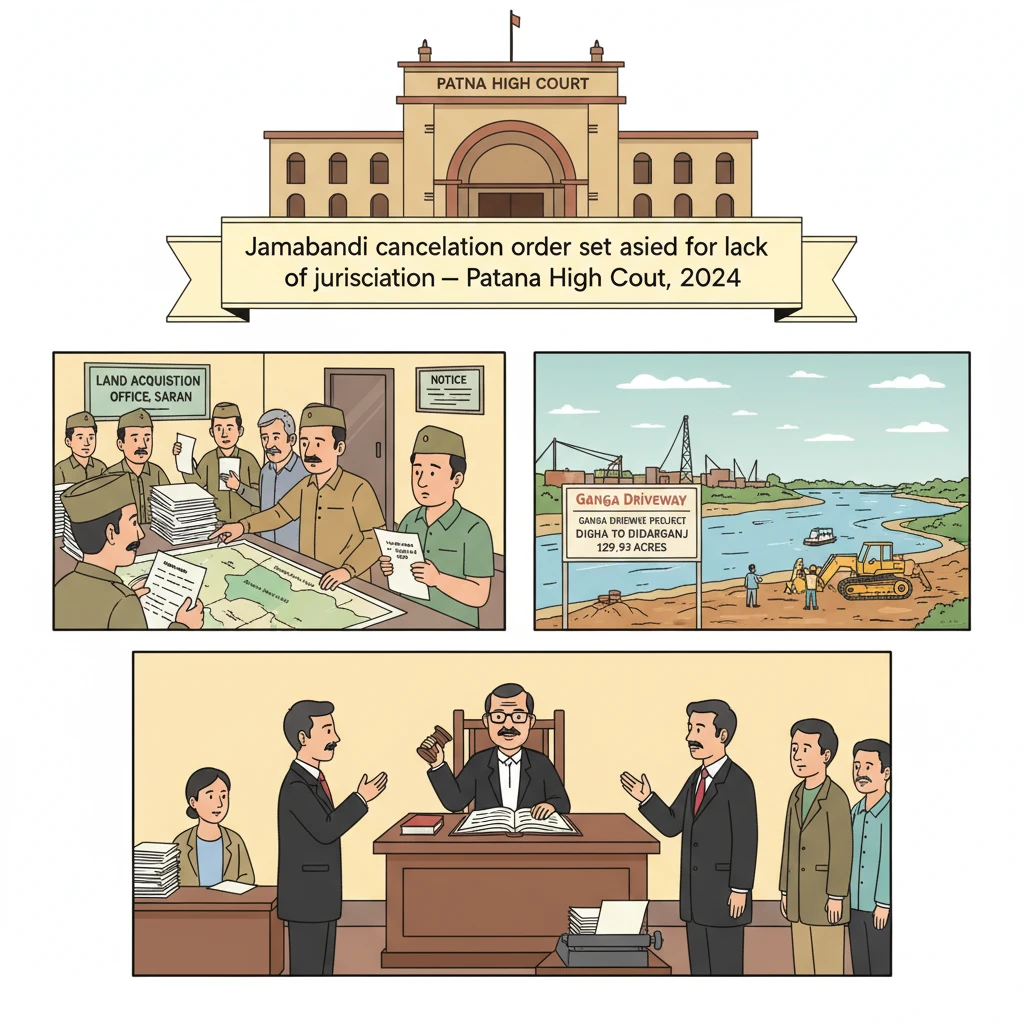
The case arises from the construction of the Ganga Driveway from Digha to Didarganj. For this project, the district authorities of Saran were directed to make 129.93 acres of land available under Sonepur Circle, village Sabalpur, Thana No. 110, to the Road Construction Department.
Out of this total requirement, 88.99 acres of Government land in Thana No. 110 were transferred to the Road Construction Department after obtaining approval from the Revenue Department, Bihar. The dispute concerns the remaining 40.24 acres of unsurveyed land in the same thana.
For these 40.24 acres, 99 raiyats claimed right and title. The office of the District Land Acquisition Officer, Saran, asked the Deputy Collector Land Reforms (DCLR), Sonepur, Saran, to report on these claims. The DCLR issued notices to all 99 raiyats asking them to prove their claims. After notice, 131 applicants appeared and produced documents.
On comparing the documents with revenue records and conducting a spot enquiry, the DCLR Sonepur found three broad categories among the 131 claimants. First, 48 claimants had jamabandi in their favour, but these entries were without any order of the competent authority and appeared forged and suspicious. Second, for 19 claimants who had jamabandi, no corresponding land actually existed on the ground. Third, the remaining 64 claimants had no jamabandi at all.
The DCLR Sonepur, by letter dated 02.03.2015, recommended initiation of cancellation proceedings for all suspicious jamabandi entries that appeared to have been created by forgery. Based on this, the process of cancellation started. A report was called from the Halka Karamchari through the Circle Inspector for Jamabandi No. 282/1, which concerned the petitioner.
The Halka Karamchari reported that village Sabalpur, Thana No. 110 was unsurveyed, making it difficult to identify the correct land without khata and khesra numbers. It was also found that the jamabandi had been created without an order from the competent authority and without any case number.
The Circle Officer submitted the records and enquiry report to the DCLR, who recommended cancellation of the jamabandi and forwarded the matter to the Additional Collector, Saran. The Additional Collector, by order dated 21.03.2015 in Jamabandi Cancellation Case No. 29/14-15, cancelled the petitioner’s jamabandi.
Subsequently, the Deputy Secretary, Department of Revenue and Land Reforms, Bihar, by letter dated 07.09.2015, sought clarification from the Collector, Saran. On examining the case records, the Collector observed that the Additional Collector had passed the order without giving an opportunity of hearing to the concerned parties, in violation of principles of natural justice.
The Collector then set aside the Additional Collector’s order dated 21.03.2015 and started a fresh hearing. Notice dated 31.12.2015 was issued to the petitioner. The petitioner appeared in Misc. Case No. 24 of 2015 arising out of Jamabandi Cancellation Case No. 29/14-15. After hearing the parties, the Collector passed the order dated 05.05.2016, again cancelling the petitioner’s jamabandi. This order and the entire process were challenged in the present writ petition.
What the Court Examined and Decided
The petitioner approached the Patna High Court seeking several reliefs. First, he asked for quashing of the Collector-cum-District Magistrate’s order dated 05.05.2016 in Misc. Case No. 24 of 2015, contained in Memo No. 781 dated 12.05.2016, by which his jamabandi as a “dakhalkar raiyat” had been cancelled and he had been told to approach the competent authority regarding the validity of his sale deeds.
Second, he sought a declaration that initiation of the jamabandi cancellation proceeding, the Additional Collector’s order dated 21.03.2015 in Jamabandi Cancellation Case No. 29/14-15, and all subsequent orders were contrary to the Bihar Land Mutation Act, 2011. He alleged that the proceedings were arbitrary and mala fide, aimed at depriving him of compensation for acquisition of his raiyati land for the Ganga Highway project.
Third, he asked the Court to declare that his raiyati land for the Ganga Highway could be taken only through proper acquisition under the Land Acquisition Act and only after payment of due compensation.
Fourth, he sought a restraint order against acquisition of his land for the project until final adjudication of the case, or at least until compensation at market value was paid for the land whose jamabandi had been cancelled.
On facts, the petitioner’s counsel argued that his land lay in the proposed highway area in village Sabalpur, Thana No. 110, and that it was being measured and taken for the project based on recommendations from the Anchal Amin and Circle Officer. He contended that the District Magistrate had no legal authority to cancel jamabandi, especially in a suo motu proceeding, and that this action violated Section 9(6) of the Bihar Land Mutation Act, 2011.
He further submitted that the jamabandi cancellation was motivated by a desire to deny him compensation for acquisition of his land for the Ganga Highway. According to him, his land could only be taken after following due land acquisition procedure and paying compensation, but the authorities passed the impugned order to avoid this obligation.
Counsel also recalled that earlier, when the authorities allegedly took over his land and stopped him from entering it without any acquisition proceedings, he and others filed CWJC No. 21520 of 2013. That writ was disposed of on 03.07.2014. In that earlier case, the Court had directed the respondents to conduct proper enquiry. It also directed that if the petitioner was found to be the owner, he must not be stopped from going over the land, and if the land belonged to him, he should be suitably compensated in accordance with law.
The petitioner’s grievance now was that instead of complying with that order by making proper enquiry and physical verification, and without giving him notice, the authorities initiated a suo motu jamabandi cancellation proceeding to defeat his rights.
He argued that under Section 9 of the Bihar Land Mutation Act, the cancellation proceeding was neither initiated suo motu by the Additional Collector nor on an application in the prescribed manner, but only on the recommendation of the Circle Officer and the DCLR. He claimed the Additional Collector’s order cancelling his jamabandi was ex parte and passed without giving him any opportunity of hearing, therefore illegal, arbitrary, and violative of natural justice.
Further, referring to Section 9(6) of the Act, the petitioner’s counsel submitted that the Collector has no suo motu power to re-examine the Additional Collector’s decision in a jamabandi cancellation proceeding. The Collector’s power is only appellate, exercisable on an appeal filed within 30 days. According to him, there was no such appeal here. Yet the Collector set aside the Additional Collector’s order, and then, on the same reports of the Circle Officer and DCLR, proceeded to cancel the petitioner’s jamabandi again. This, he argued, was without jurisdiction.
In response, the State, through a counter affidavit, took a different stand. It pointed to the Deputy Secretary’s letter dated 07.09.2015 seeking clarification from the Collector, Saran. The Collector called for the records from the Additional Collector’s office and, on examination, found that the Additional Collector had passed the 21.03.2015 order without hearing the affected parties, violating the principles of natural justice.
The Collector therefore set aside the Additional Collector’s order and started fresh hearing. Notices were issued to the petitioner, who appeared in Misc. Case No. 24 of 2015 and submitted his defence. After hearing all parties and perusing the documents, the Collector passed a detailed and reasoned order dated 05.05.2016 cancelling the petitioner’s jamabandi. The State defended this action as a lawful correction of a defective earlier order and argued that since the jamabandi had been created without any proper jamabandi proceeding, cancellation was justified.
The High Court then turned to the statutory framework. It noted that Section 9 of the Bihar Land Mutation Act, 2011, read with Rule 13 of the Bihar Land Mutation Rules, 2012, governs cancellation of jamabandi. The Court reproduced Section 9 in full. Under this provision, the “Additional Collector” is empowered to make enquiry, either suo motu, on an application, or on a reference from a Government Department, regarding any jamabandi created in violation of law or executive instructions. After giving reasonable opportunity to interested parties to appear, lead evidence, and be heard, the Additional Collector may cancel such jamabandi, dispossess the person claiming under it and deliver possession to the legitimate owner or custodian.
Section 9 also makes it clear that jamabandi cannot be cancelled without giving reasonable opportunity of being heard to interested parties, and that petitions for cancellation are to be filed before the Additional Collector in whose jurisdiction the land is situated. It is the Additional Collector who may initiate proceedings for cancellation and pass orders after enquiry.
From a plain reading of these provisions, the Court concluded that only the Additional Collector is the competent authority to cancel jamabandi. The statute does not vest this cancellation power in the District Collector-cum-District Magistrate.
On this basis, after considering the submissions and examining the records, the Patna High Court held that the impugned order dated 05.05.2016 passed by the Collector-cum-District Magistrate, Saran, Chapra was without jurisdiction. Since Section 9 clearly vests the cancellation power in the Additional Collector, the Collector could not have assumed that role.
In the interest of justice, the Court did not simply restore the earlier Additional Collector’s order, because that order had also been criticised for being passed without hearing. Instead, the Court quashed both the order dated 21.03.2015 of the Additional Collector, Saran, Chapra in Jamabandi Cancellation Case No. 29/14-15, and the order dated 05.05.2016 of the Collector-cum-District Magistrate in Misc. Case No. 24 of 2015 arising out of the same jamabandi cancellation case, as contained in Memo No. 781 dated 12.05.2016.
The matter was remanded to the Additional Collector, Saran, Chapra (Respondent No. 7). The High Court directed that the Additional Collector must afford an opportunity of hearing to all parties concerned, examine the documents, and then pass a detailed and reasoned order in accordance with law within three months from receipt or production of a copy of the High Court’s judgment.
With these directions, the writ petition was allowed to the extent indicated, focusing on jurisdiction and procedure rather than directly deciding title or compensation.
Why This Judgment Matters
This judgment is important for landholders facing jamabandi cancellation, especially in areas where land is being taken for large projects like highways.
The Patna High Court has made it clear that only the Additional Collector has the legal power to cancel jamabandi under Section 9 of the Bihar Land Mutation Act, 2011. If any other authority, including the District Magistrate, cancels jamabandi, such orders can be challenged as being without jurisdiction.
The Court has also reinforced that before cancelling jamabandi, authorities must give notice and a proper hearing to those whose names are recorded. Even when there are allegations of forged jamabandi or suspicious entries, the law must be followed.
For landowners in Bihar, this decision confirms that their land records cannot be set aside casually or by the wrong authority. If jamabandi is cancelled to deny compensation or possession without following legal procedure, the High Court can intervene and set aside such orders.
Legal Issues and Answers
- Issue: Can the Collector-cum-District Magistrate cancel a person’s jamabandi under the Bihar Land Mutation Act, 2011?
Answer: No. The Patna High Court held that under Section 9 of the Act, only the Additional Collector is competent to cancel jamabandi. The Collector’s order dated 05.05.2016 was therefore without jurisdiction and was quashed. - Issue: What should be done when jamabandi has been cancelled without proper authority or hearing?
Answer: The Court quashed both the Additional Collector’s earlier order and the Collector’s order and remanded the matter to the Additional Collector to conduct a fresh proceeding, after hearing all concerned parties and considering documents, and to pass a detailed, reasoned order within a fixed time.
Cases Cited by the Court
- The judgment does not mention or rely on any other reported case law. The Court’s reasoning is based on Section 9 of the Bihar Land Mutation Act, 2011 and Rule 13 of the Bihar Land Mutation Rules, 2012.
Case Details
Case Number: Civil Writ Jurisdiction Case No. 13189 of 2016
Case Title: Amresh Kumar v. The State of Bihar & Ors.
Citation: 2024(4) PLJR 591
Court: High Court of Judicature at Patna
Bench: Hon’ble Mr. Justice Rudra Prakash Mishra
Date of Judgment: 05.08.2024
Advocates: Mr. Arun Kumar, Advocate for the petitioner; Mr. Sajid Salim Khan (SC25) for the respondents/State
Nature of the Case: Writ petition under civil writ jurisdiction, challenging orders cancelling jamabandi and seeking protection of raiyati land and compensation rights in the context of land required for the Ganga Driveway project.
Statutes and Rules Involved: Bihar Land Mutation Act, 2011 (particularly Section 9); Bihar Land Mutation Rules, 2012 (particularly Rule 13); references in pleadings to land acquisition law and compensation but without detailed statutory citation in the judgment.
Link to Full Judgment: https://patnahighcourt.gov.in/viewjudgment/MTUjMTMxODkjMjAxNiMxI04=-LHGVsrh30cw=
If you found this explanation helpful and wish to stay informed about
how legal developments may affect your rights in Bihar,
you may consider following Samvida Law Associates for more updates.







