

Case Background
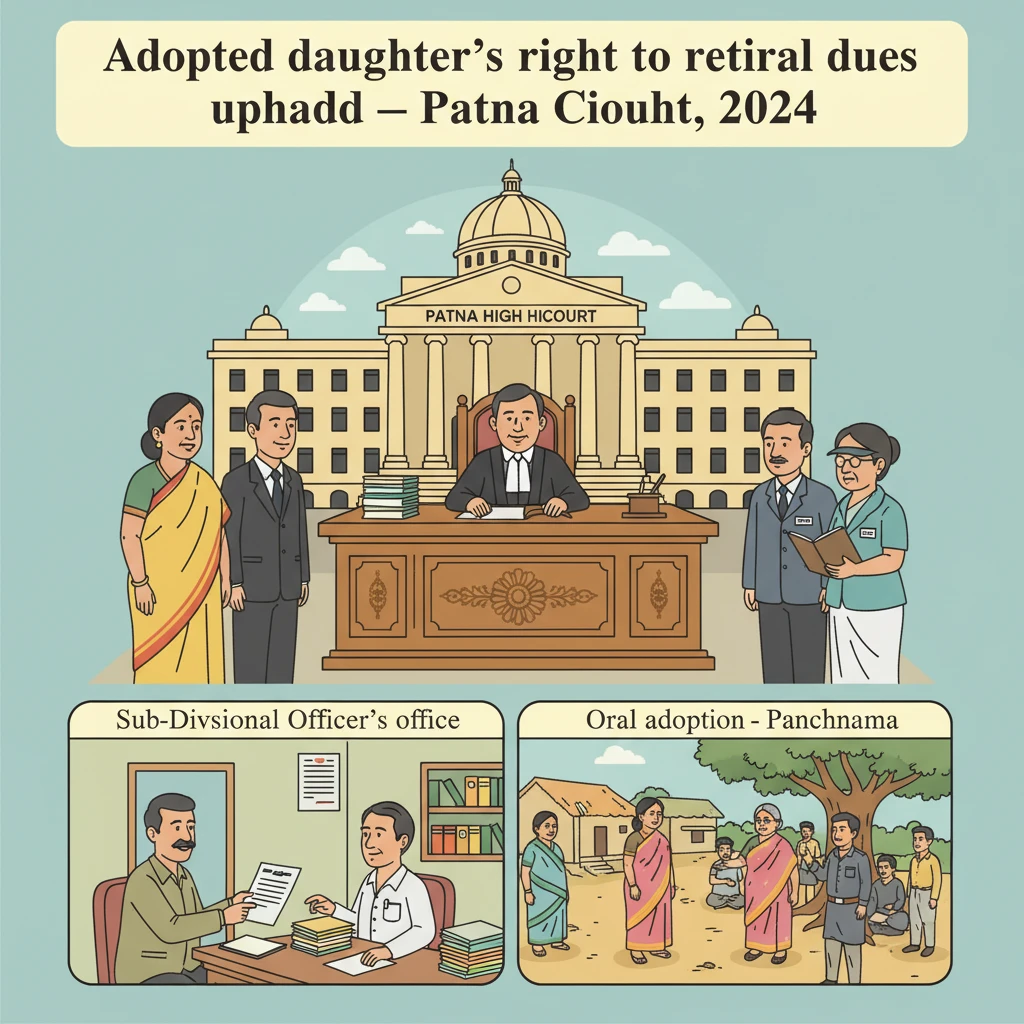
The petitioner is the adopted daughter of late Kamrun Khatoon. Kamrun Khatoon was working as an Office Peon in the office of the Sub-Divisional Officer, Begusarai, and was later posted in the office of Begusarai Block.
She herself had been appointed on compassionate grounds after the death of her husband, late Md. Nizamuddin, who had also served as a Peon in the office of the Sub-Divisional Officer, Begusarai.
Kamrun Khatoon died in harness on 05.12.2018 while still in government service. After her death, the petitioner approached the authorities for release of all death-cum-retiral benefits, including pension, gratuity, leave encashment, provident fund, group insurance and other dues.
On 25.06.2019, the petitioner filed an application before the Sub-Divisional Officer (SDO), Begusarai, requesting payment of all terminal benefits of her deceased mother.
Acting on this, the SDO, Begusarai, by letter no. 1107 dated 15.07.2019, directed the Circle Officer, Begusarai, to issue a family list or family certificate to enable payment of retiral dues. As the matter did not progress, the petitioner submitted another representation along with necessary documents such as the family list certificate, educational certificate from the Madarsa Education Board, and documents relating to her oral adoption.
On receipt of these documents, the SDO, Begusarai, issued another letter, no. 1821 dated 21.10.2019, directing the Circle Officer to verify all documents minutely and submit a clear report so that admissible death-cum-retirement benefits could be sanctioned.
Pursuant to this, the Circle Officer asked the Revenue Clerk to conduct an enquiry. The Revenue Clerk submitted an enquiry report dated 20.11.2019. In that enquiry, local people and villagers admitted that the petitioner had been adopted by late Kamrun Khatoon and her husband, late Md. Nizamuddin. The Revenue Clerk also noted a declaration-cum-will executed before a Notary Public and a Panchnama of the adoption deed.
Despite these steps and documents, the petitioner was not granted any terminal or retiral benefits. Left with no alternative, she filed Succession Case No. 02 of 2021 before the learned Sub Judge 1, Begusarai, seeking a succession certificate for the estate of late Md. Nizamuddin.
By order dated 18.04.2023, the civil court declared the petitioner as the successor of late Md. Nizamuddin for his estate and directed her to execute a security bond of Rs. 15 lakh with two sureties. A succession certificate under Section 373 of the Indian Succession Act, 1925 was then issued in her favour, and its copy was placed before the High Court as Annexure-P/5.
Even after obtaining and producing this succession certificate before the authorities, the petitioner still did not receive terminal or retiral dues. She therefore approached the Patna High Court under Article 226 of the Constitution, seeking directions particularly against the District Magistrate, Begusarai, for sanction and payment of all death-cum-retiral benefits.
What the Court Examined and Decided
The Patna High Court, presided over by Hon’ble Mr. Justice Harish Kumar, heard both sides and examined the records produced.
On behalf of the petitioner, it was argued that she was the adopted daughter of late Kamrun Khatoon, who had died in harness on 05.12.2018. The petitioner emphasised that an adopted child stands on the same footing as a natural child for the purpose of pension and other service benefits, under the Bihar Pension Rules, 1950 and notifications issued by the Government of Bihar.
The petitioner’s counsel submitted that these rules and notifications clearly recognise adopted sons and daughters as part of the “family” for liberalised pension benefits. He further argued that where there is doubt about who is the rightful widow, widower or eligible child, the authorities are required to act on a succession certificate issued by a competent court.
He pointed out that the petitioner had already obtained such a succession certificate from the competent civil court under Sections 372 and 373 of the Indian Succession Act, 1925, declaring her as the successor of late Md. Nizamuddin. No one had challenged this certificate, and there was no rival claimant.
The petitioner also expressed willingness to give an undertaking that if any future order by a competent authority or appellate court went against her, she would abide by it.
On the other hand, the State, represented by learned counsel Mr. Anil Kumar, filed a counter affidavit on behalf of respondent nos. 2 and 3. The State argued that the petitioner’s claim based on an unregistered adoption deed was not acceptable. It was contended that there is no provision for adoption under Muslim Personal Law, and therefore, the adoption itself could not be recognised.
The State also pointed out that the family certificate earlier issued in favour of the petitioner (Certificate No. 288 dated 04.06.2019) had been cancelled because in her application she had not mentioned that she was the adopted daughter of late Kamrun Khatoon. Although she had filed an affidavit, she had allegedly not disclosed the fact of adoption.
Further, the SDO, Begusarai, by letter no. 3437 dated 19.12.2020, had directed her to produce cogent evidence to prove she was the adopted daughter. The State also submitted that late Kamrun Khatoon, in her nomination form under the General Provident Fund Rules, had nominated two cousins and not the petitioner. On that basis, the State argued that the petitioner was not entitled to any terminal or retirement benefits.
The Court first noted that the petitioner claimed to be the adopted daughter of late Kamrun Khatoon and late Md. Nizamuddin and had produced a declaration-cum-will executed before a Notary Public and a Panchnama regarding oral adoption. The Court observed that even if, for argument’s sake, the State’s contention under Mohammadan Law that there is no provision for adoption is accepted, the authorities could not ignore the statutory rules and government guidelines governing service conditions and payment of retiral benefits.
The Court then referred to the guidelines of the Finance Department, Government of Bihar, issued by Resolution No. 1918 dated 04.06.1986. These guidelines lay down how to determine the real claimant of family pension and terminal dues.
The resolution states that it is the responsibility of the claimant to satisfy the Head of Department or Office that he or she is the widow, widower or eligible child of the deceased government servant and to prove identity by producing relevant records like the pension payment order or other documents. Where no such records are available, the claimant may be asked to produce either a succession certificate of the court, or a declaration with affidavit before a Magistrate, or an affidavit with two supporting documents acceptable to the pension sanctioning authority.
Applying this resolution, the Court found that the petitioner had already approached the civil court under Section 372 of the Indian Succession Act, 1925, and the court had granted her a succession certificate under Section 373 of the Act. The succession certificate was on record, and the petitioner had furnished the required security bond and sureties as directed by that court.
The High Court noted that the succession certificate issued by the competent court was not in dispute and that no other person had raised any objection to the petitioner’s entitlement based either on the adoption documents or on the succession certificate.
The Court then dealt with the State’s argument about the nomination in favour of two cousins. It referred to the Division Bench judgment in Ati Razia Devi Vs. The State of Bihar and Ors., 2016 SCC Online Pat 339. In that case, the Court had held that nomination is primarily to enable the State to discharge its obligation by making payment to a nominee and obtain a valid discharge. If no one disputes the nominee’s right, the State may pay the nominee. However, where someone disputes the status or right of the nominee, that person can approach the appropriate court.
The Division Bench in Ati Razia Devi had clearly laid down that a nominee, where status and right are disputed, is only a trustee for the rightful owner. Nomination itself does not create ownership or make the nominee the rightful recipient of property. The nominee holds the amount in trust for the lawful person entitled to it.
In the present case, the High Court observed that the petitioner had already obtained a succession certificate from a competent civil court, thus establishing her right as successor. In light of that certificate, the plea based on nomination in favour of two cousins could not stand. The nominee’s position, as per the earlier judgment, was only that of a trustee, and not of an absolute owner.
Considering all these factors, the Court concluded that the authorities were under a legal obligation to consider the petitioner’s claim in line with the rules, regulations and guidelines issued by the Government of Bihar. Since the petitioner held a valid and undisputed succession certificate, she was entitled to be treated as the rightful recipient of terminal and retiral benefits and other dues of her deceased mother.
Accordingly, the Court directed the respondent authorities to accord all admissible terminal and retiral benefits and other dues of the deceased employee to the petitioner. The benefits were to be released preferably within eight weeks from the date of receipt or production of a copy of the Court’s order.
The writ petition was allowed, with no order as to costs.
Why This Judgment Matters
This judgment is important for family members of deceased government employees in Bihar, especially where there is confusion over who is the rightful claimant to pension and other dues.
The Patna High Court has clarified that when a person has a valid succession certificate from a competent civil court, authorities cannot deny retiral benefits on the ground of personal law or on the basis of a competing nomination. The succession certificate is a strong and sufficient document for deciding who should be paid.
The Court also reinforced the Government of Bihar’s own guidelines that recognise succession certificates, affidavits and other specified documents as the basis for determining the real claimant of family pension and dues. This is particularly helpful where records are incomplete or where family relationships are disputed.
For adopted children and other dependants who may not be named as nominees, the judgment shows that approaching a civil court for a succession certificate can be an effective route to secure terminal and retiral benefits. Government departments are bound to respect and act upon such certificates within a reasonable time.
Legal Issues and Answers
- Issue: Can the authorities deny terminal and retiral benefits to an adopted daughter of a deceased Muslim government employee by questioning the adoption and relying on nomination in favour of other relatives?
Answer: No. Once a competent civil court has granted a succession certificate in favour of the claimant and there is no rival claimant, the authorities are legally bound, under government guidelines, to treat her as the rightful recipient of the deceased employee’s terminal and retiral dues. - Issue: What is the effect of a nominee when another person establishes a better legal right to the deceased employee’s benefits?
Answer: As held in Ati Razia Devi, and followed here, a nominee is only a trustee for the rightful owner and does not become the owner merely by nomination. Where a succession certificate establishes someone else as the lawful successor, the claim based on nomination alone cannot defeat that right. - Issue: What documents must authorities consider while deciding the real claimant of family pension and retiral benefits where records are not clear?
Answer: Under Finance Department Resolution No. 1918 dated 04.06.1986, authorities must consider documents such as a court-issued succession certificate or specified affidavits and supporting documents, and cannot ignore a valid succession certificate produced by the claimant.
Cases Cited by the Court
- Ati Razia Devi Vs. The State of Bihar and Ors., 2016 SCC Online Pat 339
Case Details
Case Number: Civil Writ Jurisdiction Case No. 1233 of 2024
Case Title: Nazara Khatoon @ Najra Khatun v. The State of Bihar through the District Magistrate, Begusarai & Ors.
Court: High Court of Judicature at Patna
Coram: Hon’ble Mr. Justice Harish Kumar
Date of Judgment: 06-08-2024
Citation: 2024(4) PLJR 571
Advocates:
- For the petitioner: Mr. Mukesh Kumar Sinha, Advocate
- For the State/respondents: Mr. Anil Kumar, AC to SC-8
- For the Accountant General: Mr. Ram Kinker Choubey, Advocate
Nature of the Case: Writ petition under Article 226 of the Constitution of India seeking direction for payment of death-cum-retiral benefits of a deceased government employee.
Link to Judgment: Click here to access the full judgment of the Patna High Court
If you found this explanation helpful and wish to stay informed about
how legal developments may affect your rights in Bihar,
you may consider following Samvida Law Associates for more updates.







