

Case Background
This case arises from Simultala Awasiya Vidyalaya (SAV), a residential government school located in the district of Jamui, Bihar. The State Cabinet, by decision dated 17.11.2009, approved setting up this fully residential school at Simultala.
To run the school, a society named Simultala Education Society (SES) was registered under the Societies Registration Act, 1860. The SES has its own bye-laws. The General Body is headed by the Principal Secretary, Department of Education, Government of Bihar, and the School Management Committee is headed by the District Magistrate, Jamui.
Rule 33 of the SES bye-laws provides that the posts of Principal and Vice-Principal shall be filled either on deputation or on contract basis. Acting on the Cabinet decision, the State issued an advertisement on 04.06.2010 for appointment of Principal, Vice-Principal and teachers for SAV. The advertisement clearly stated that all posts were on contract basis and that the retirement age of teachers, Principal and Vice-Principal would be 60 years.
Under these advertisements, petitioner no.1 applied for the post of Principal (in 2011) and petitioner no.2 applied for the post of Vice-Principal pursuant to advertisement dated 04.06.2010. Both were selected after due process and were issued appointment letters. They have been working as Principal and Vice-Principal for about eight and nine years respectively without any complaint regarding their conduct.
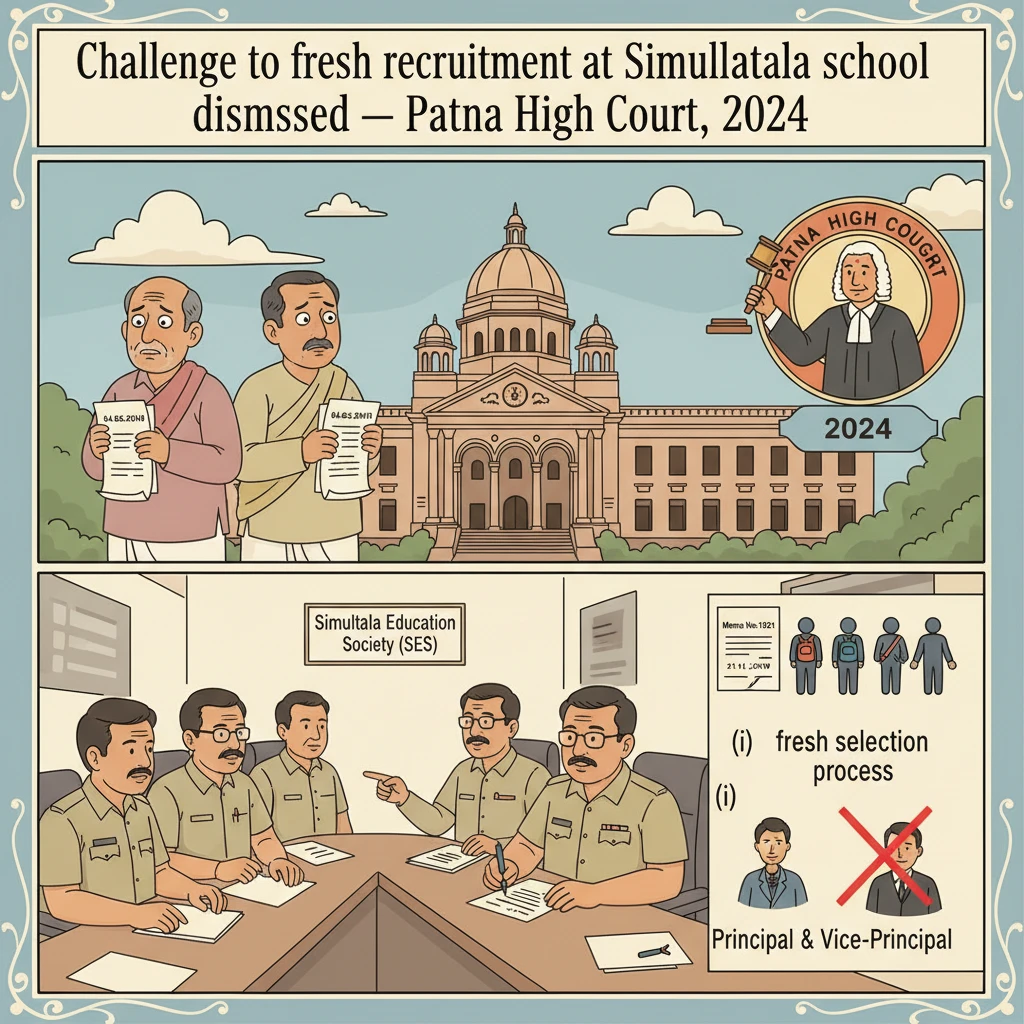
On 31.08.2019, the Executive Committee of SES, chaired by the Additional Chief Secretary, Department of Education, Government of Bihar, held a meeting to review staffing of SAV. Its decisions were recorded in minutes, later issued as Memo No.1321 dated 21.11.2019. In that meeting, the Committee decided that all sanctioned posts of teaching and non-teaching staff would be filled through a fresh selection process and that the posts of Principal and Vice-Principal would be filled through Bihar Public Service Commission (BPSC). It was also decided that existing staff, including the current Principal and Vice-Principal, must participate in the fresh selection, with an age relaxation of 10 years.
Feeling aggrieved, the two contractual appointees filed this writ petition in Patna High Court seeking to quash the Executive Committee’s decision and to protect their tenure till 60 years of age.
What the Court Examined and Decided
The petitioners asked for two main reliefs. First, they sought a writ of certiorari to quash the Executive Committee’s decisions no.2 and 12 dated 31.08.2019, issued through Memo No.1321 dated 21.11.2019, by which SES resolved to fill all sanctioned posts of SAV by a fresh selection process. Second, they sought a writ of mandamus directing the authorities not to disturb their tenure, which they claimed was valid till they reached 60 years of age.
The petitioners argued that the SES bye-laws permit appointments on contract basis and do not authorise replacing an existing set of contractual employees with another, without any allegation of inefficiency or misconduct. According to them, compelling serving staff to sit in a fresh selection was arbitrary and unjust.
They stressed that SAV had earned high reputation due to their hard work and that of other teachers. The school was ranked as the best government boarding school in India during 2019-20 and 2016-17, and was consistently in the top five, including third place in 2018-19. Instead of rewarding this performance with regularisation or security, they said, the authorities were forcing them into open competition again.
The petitioners pointed out that the original advertisement mentioned that their retirement age would be 60 years, even though the posts were contractual. They claimed that nothing in the advertisement indicated that they would be subjected to any further test for continuing in the institution, and that use of the word “minimum” with the tenure and retirement age of 60 years protected their continuity.
They also relied on subsequent actions: their service continuity was approved by letter no.671 dated 08.09.2015, and they were given annual increments of 3% in 2012 by letter no.63 dated 10.01.2012. They argued that the process of framing service rules for SES staff was started in 2011, and a draft “Simultala Education Society Teaching and Non-Teaching Employees Service Condition and Disciplinary Rules, 2017” was prepared and circulated. Instead of finalising those rules, the State decided to initiate fresh recruitment, which the petitioners said was effectively a termination of their services.
The petitioners further contended that this Court had earlier, on 16.07.2020, granted a stay on the ground that one set of contractual employees cannot be replaced by another set of contractual employees. They alleged that, despite that stay, the authorities amended SES bye-laws, sent a requisition to BPSC on 22.08.2023 for regular recruitment of Principal, Vice-Principal and teachers, and BPSC issued an advertisement with last date 21.05.2024.
They asserted that the respondents committed contempt by proceeding with the selection process without obtaining any order vacating the stay. They also criticised the new BPSC advertisement for prescribing minimum and maximum age limits of 40 and 55 years for Principal and Vice-Principal, with retirement at 60 years. Since petitioner no.1 was about 54½ and petitioner no.2 about 57½ years, they argued that it was irrational and violated Articles 14 and 21 of the Constitution to force them to compete with younger candidates.
They additionally submitted that under the newly amended SES Rules, contractual posts were described as “dying posts” which would end on retirement. On this basis, they argued that the posts of Principal and Vice-Principal at SAV should become vacant only when they attained 60 years, and that any recruitment should be undertaken only after their retirement.
On the other hand, the State, through its counter-affidavit, clarified that SES had framed “Simultala Education Society Teaching and Non-Teaching Employees Contract and Service Condition and Discipline Rules, 2021” via notification no.369 dated 18.03.2021. The main aim of these Rules was to appoint staff on regular basis, in place of earlier contractual appointments.
Rule 5 of the 2021 Rules provided that posts of contractual teaching and non-teaching employees would be “dying posts”, which would automatically end on retirement or other reasons. Later, by Resolution No.1355 dated 14.12.2021, the Education Department created 127 substantive posts in SAV: one Principal, one Vice-Principal, 62 teachers and 63 non-teaching employees. A requisition was sent to BPSC to conduct selection, with age relaxation and preference for contractual staff, including Principal, Vice-Principal and teachers already working in SES, Jamui, under Resolution No.1003 dated 22.01.2021.
The State argued that this was a policy decision. Since the petitioners were given both age relaxation and weightage in the selection for permanent posts, they could not challenge the policy. It was also emphasised that, as per the 2010 advertisement, their engagement as Principal and Vice-Principal was purely contractual, on fixed remuneration of Rs.50,000/- and Rs.37,800/- respectively, and for a period of three years only. The petitioners accepted these terms with full knowledge and therefore had no right to demand continuation on a permanent basis.
The State further relied on the Supreme Court decision in State of Gujarat v. Arvind Kumar T. Tiwari, reported in (2013) 3 PLJR 558, to underline that fixation of eligibility criteria and mode of appointment lies exclusively with the competent authority and cannot be questioned by candidates who accepted the terms.
In rejoinder, the petitioners repeated that the advertisement mentioned the retirement age of 60 and minimum contract period. They referred to the 2017 draft rules, contending that the posts of Principal and Vice-Principal were to be tenure-based for five years, extendable once, and argued that the 2021 Rules did not provide age relaxation or weightage for these posts, unlike for teachers.
After examining the material, the Patna High Court held that it was undisputed that the petitioners were appointed purely on contractual basis. The Court noted that the petitioners tried to rely on the principle that one contractual arrangement cannot be replaced by another. However, the Court found that in this case the State was not replacing contractual staff with another set of contractual appointees; instead, it was moving to make regular appointments on substantive posts through open competition, which the Court considered the correct remedy under the Rules framed by the Government.
The Court held that the selection process could not be halted until the petitioners attained 60 years merely because they were on contract. The Court also accepted that Rule 5 of the 2021 Rules clearly made contractual posts “dying posts” and observed that the petitioners were being given both weightage and age relaxation for the permanent posts. Therefore, the Court found no infirmity in the Executive Committee’s decision to conduct a regular selection process.
The Court further observed that, in exercise of writ jurisdiction under Article 226 of the Constitution, it normally does not interfere with policy decisions of the State. It referred to the earlier interim order of 06.07.2020 which had restrained the State from acting on the Executive Committee decision on the understanding that contractual appointments were being replaced by other contractual appointments. On a close reading of the notification dated 31.08.2019, however, the Court now found no clause showing that contractual staff would be replaced by new contractual appointees.
In light of all this, the Court concluded that the petitioners had no enforceable right to continue till 60 years solely on the basis of a contractual appointment and original advertisement. Since the State was proceeding to fill newly created regular posts through BPSC, with safeguards like age relaxation and weightage for existing contractual staff, judicial interference was unwarranted. As a result, the writ petition was dismissed and all pending applications stood disposed of.
Why This Judgment Matters
This judgment is important for contractual teachers and administrators working in government-run institutions, especially in Bihar. The Patna High Court made it clear that if an appointment is made on a clearly defined contractual basis with fixed tenure and honorarium, the appointee cannot insist on continuing till a particular age as if holding a permanent post.
The decision also clarifies that the government can decide, as a matter of policy, to convert contractual set-ups into regular cadres by creating permanent posts and filling them through open competition, including via BPSC. Even if existing contractual employees have long service and good performance, they cannot block such a process through writ petitions.
At the same time, the judgment shows that giving age relaxation and weightage to existing contractual staff is treated as a fair balancing measure. It signals that courts are less likely to interfere where the State provides such transitional benefits while moving towards regular recruitment.
Legal Issues and Answers
- Issue: Can contractual appointees to posts of Principal and Vice-Principal in Simultala Awasiya Vidyalaya insist on continuation till 60 years and prevent the State from holding a fresh selection for regular posts through BPSC?
Answer: No. The Court held that the petitioners were appointed purely on contract for a fixed period and fixed pay, and the State is entitled to make regular appointments through open competition. Their contractual tenure cannot be treated as a permanent right to serve till 60 years. - Issue: Does the Executive Committee’s decision to conduct fresh recruitment for all posts, including those held by contractual appointees, amount to an illegal replacement of one set of contractual employees with another?
Answer: No. The Court found that the decision aimed at regular appointments on substantive posts, not fresh contractual appointments, and therefore did not violate the principle that one set of contractual employees cannot be replaced by another. - Issue: Can the Court, in writ jurisdiction, interfere with the State’s policy decision on eligibility criteria, age limits and mode of recruitment for these posts?
Answer: Generally no. Relying on Supreme Court precedent, the Court held that fixing eligibility criteria and recruitment mode is within the exclusive domain of the appointing authority and is not to be disturbed when candidates had accepted earlier contractual terms.
Cases Cited by the Court
- State of Gujarat v. Arvind Kumar T. Tiwari, reported in (2013) 3 PLJR 558, cited to affirm that eligibility criteria and mode of appointment are within the exclusive domain of the competent authority and cannot be questioned by candidates who accepted the conditions.
Case Details
Case Number: Civil Writ Jurisdiction Case No.1668 of 2020
Case Title: Dr. Rajiv Ranjan and another v. The State of Bihar and others
Citation: 2024 (4) PLJR 115
Court: High Court of Judicature at Patna
Coram: Hon’ble Mr. Justice Anjani Kumar Sharan
Date of Judgment: 28.08.2024
Nature of Case: Writ petition (civil) challenging policy decision for fresh recruitment and seeking protection of contractual tenure
Advocates:
For the petitioners: Mr. Mrigank Mauli, Senior Advocate; Mr. Abhishek Anand, Advocate
For the respondents (State): Mr. Kameshwar, G.P. 17
Link to Full Judgment: Patna High Court Judgment in CWJC No.1668 of 2020
If you found this explanation helpful and wish to stay informed about how legal developments may affect your rights in Bihar, you may consider following Samvida Law Associates for more updates.







