

Case Background
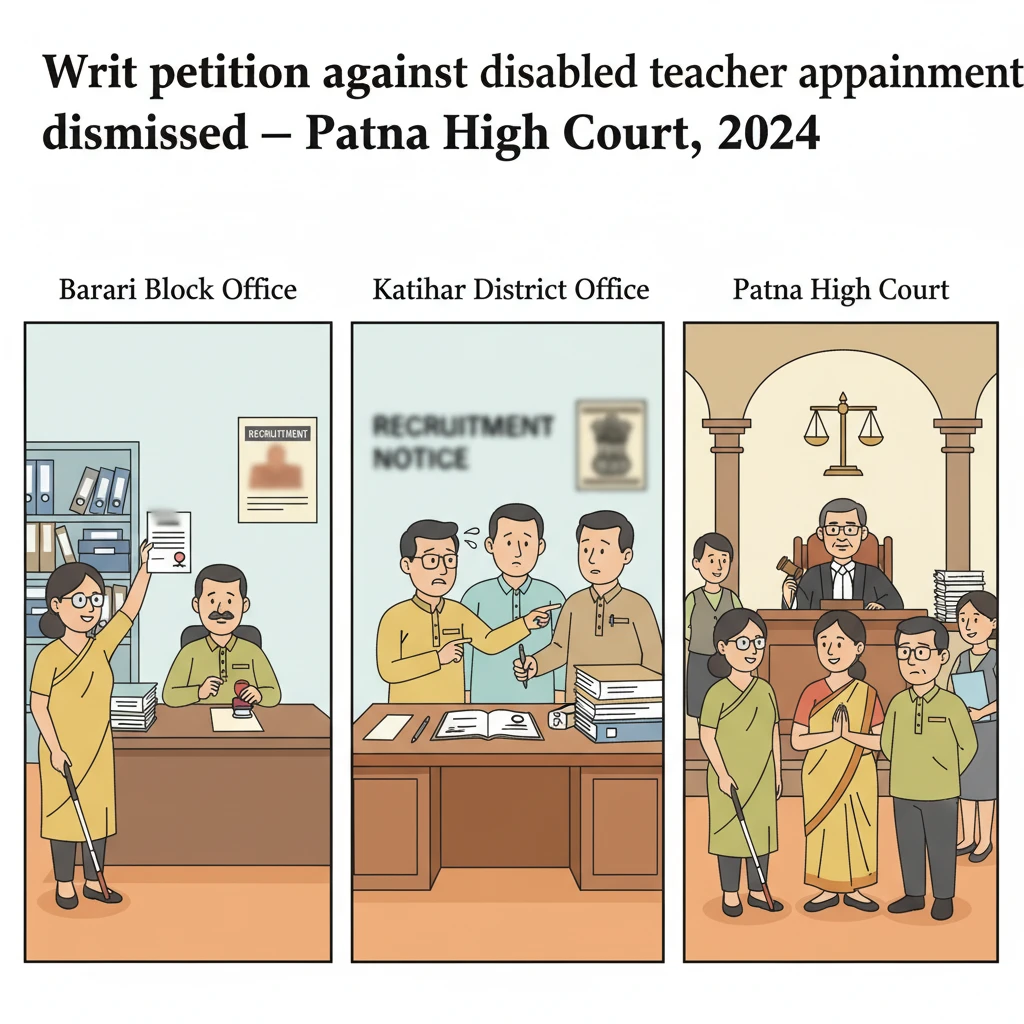
This case arises from the second phase of Panchayat/Prakhand Teachers’ appointments in Barari Block, District Katihar, under the Bihar Panchayat Teachers Employment and Service Condition Rules, 2008 (as amended).
As per the reservation roster issued by the State, one post of Prakhand Teacher in Barari Block was earmarked at roster point 6701 for a visually impaired candidate in the unreserved female (UR(F)) category. The petitioner is a visually impaired woman with an Intermediate degree, having 49.10 marks. She applied on 07.11.2008 before the Employment Unit, Panchayat Samittee, Barari.
Several male and female candidates, including private respondent no. 6, also applied under the disabled category after obtaining disability certificates from the competent authority. A separate merit list was prepared by the Selection Committee specifically for disabled candidates after counselling.
In the merit list for female disabled candidates, one Ashiaria Khatoon was placed at serial no. 1 and the petitioner at serial no. 2. On verification, Ashiaria Khatoon was found to have disability of less than 40%, so she was held ineligible. The petitioner, having 60% permanent disability, was then recognized as eligible and was appointed Prakhand Teacher against the UR(F) visually impaired post at roster point 6701 through Memo No. 23 dated 15.08.2010 issued by the Block Development Officer-cum-Executive Officer, Barari.
Respondent no. 6, a visually impaired male candidate with a Maulvi degree and higher marks, challenged this appointment before the District Teachers Employment Appellate Authority, Katihar. That appeal, numbered Appeal Case No. 11 of 2010, set the stage for the dispute which ultimately reached the Patna High Court.
What the Court Examined and Decided
The petitioner wanted three main reliefs from the Patna High Court: setting aside the District Appellate Authority’s order dated 10.08.2011, setting aside the State Appellate Authority’s order dated 17.09.2019 in Appeal No. 341 of 2017, and quashing the appointment of respondent no. 6 with reinstatement of her own appointment as Prakhand Teacher.
Her central grievance was that the post at roster point 6701 was reserved for a visually impaired UR(F) candidate and that a male candidate with Maulvi qualification could not be appointed against that general teacher post. She also argued that respondent no. 6’s disability certificate did not mention that his disability was permanent, and that both appellate authorities had ignored Government Resolution No. 62 dated 05.01.2007 regarding appointment and reservation of handicapped candidates issued in view of the Persons with Disabilities (Equal Opportunity, Protection of Right and Full Participation) Act, 1995.
According to the petitioner, Rule 8(Ka)(2) of the 2008 Teachers Appointment Rules allows a Maulvi degree holder to be considered only for the post of Urdu Teacher and not for a general subject teacher. She asserted that roster point 6701 clearly reflected a UR(F) general teacher post for visually impaired candidate, and that respondent no. 6 had been wrongly appointed as Prakhand Teacher (Untrained) and later posted in a school where an Urdu Teacher post was also available. On that basis, she contended that he could not be treated as appointed against the Urdu Teacher post.
The record shows that after the District Appellate Authority’s order dated 10.08.2011 (Memo No. 205), the Employment Unit cancelled the petitioner’s appointment through Memo No. 01 dated 16.09.2011 and simultaneously appointed respondent no. 6 via Memo No. 02 dated 16.09.2011. The petitioner initially challenged this in C.W.J.C. No. 15121 of 2011 before the Patna High Court. That writ was disposed of with liberty to approach the State Appellate Authority.
Exercising that liberty, the petitioner filed Appeal Case No. 341 of 2017 before the State Appellate Authority, Bihar, Patna. The State Appellate Authority dismissed the appeal on 17.09.2019, upholding the District Appellate Authority’s decision. The present writ petition (C.W.J.C. No. 4217 of 2020) challenged that dismissal.
On the other side, respondent no. 6 defended the orders. He stated that the petitioner had raised three grounds: his Maulvi qualification allegedly disqualified him from general post; the post was supposedly reserved for UR(F) candidate; and his disability certificate allegedly did not show permanent disability. He pointed out that both the District Appellate Authority and the State Appellate Authority had examined these points in detail.
It was emphasized that respondent no. 6 had applied as a physically disabled candidate belonging to the BC category for appointment as Block Teacher against the Urdu post. A separate list of disabled candidates was prepared, in which he, having more than 76% marks in the Maulvi examination, was placed at serial no. 1, while the petitioner was at serial no. 3. Before the appointment letter was issued, his name was allegedly removed by using whitener, and the petitioner was appointed instead.
Respondent no. 6 made a complaint to the authorities. The Block Education Officer, Barari, wrote to the District Superintendent of Education (DSE), Katihar, pointing out the irregularity. The Block Pramukh, who was part of the selection committee, also wrote to DSE Katihar that the petitioner’s appointment resulted from interpolation in the approved merit list of disabled candidates.
The DSE Katihar, in turn, issued instructions through letter no. 716 dated 19.11.2010, stating that interpolation had been made in the approved list and the petitioner was appointed on that basis. The District Appellate Authority then had the disability certificate of respondent no. 6 verified. The Chief Medical Officer, by letter no. 1575 dated 18.06.2011, confirmed his disability.
It was further pointed out that the Department of Personnel and Administrative Reforms, Government of Bihar, had issued letter no. 502 dated 02.11.2002 explaining how reservation for disabled candidates is to be applied. The respondent side also brought on record that 16 posts of Urdu Teachers were allotted to Barari Block in the second phase of appointments, with one Urdu post earmarked for Middle School, Laxmipur Kawar, where respondent no. 6 has been serving as Urdu Teacher since 2011 pursuant to the appellate order.
The District Programme Officer (Establishment), Katihar, in his counter affidavit, supported the appellate decisions. He clarified that a separate disabled category merit list had been prepared in which respondent no. 6 stood above the petitioner with 76.8% marks against her 45.55%. Despite this, the Employment Unit had initially appointed the petitioner as a Block Teacher in the disabled category, leading to respondent no. 6’s appeal and the eventual cancellation of the petitioner’s appointment.
The Patna High Court focused on how reservation for disabled candidates has to be applied. It noted that such reservation is horizontal. This means that, within any category, the person who is most suitable in the disabled category gets the benefit and the post he or she occupies is treated as reserved within that category.
The Court observed that the government instructions relied on in the case clearly supported this legal position. Respondent no. 6 had applied for an Urdu Block Teacher post, and there were 16 vacancies in that Urdu category. Once he was found to be the most suitable physically disabled candidate, he was entitled to the appointment. The post reserved for Urdu Teacher would, in law, be treated as including the roster point meant for physically disabled candidates.
On this reasoning, the Court held that respondent no. 6 was not appointed against a general post but against an Urdu post. Therefore, the petitioner’s arguments that a Maulvi-qualified candidate could not occupy a general teacher post and that the roster point 6701 for UR(F) visually impaired candidate was violated did not persuade the Court.
After considering the entire material, the High Court concluded that there was no illegality or infirmity in the orders passed by the District Appellate Authority or the State Appellate Authority. Both had correctly applied the principle of horizontal reservation and taken note of the comparative merit in the disabled category.
As a result, the writ petition was dismissed. The appointment of respondent no. 6 continues, and the petitioner does not get reinstatement.
Why This Judgment Matters
This judgment is important for disabled candidates, especially those seeking government teaching posts in Bihar. It explains that reservation for disabled persons works horizontally, across all categories, and the most meritorious disabled candidate in that category will get the seat.
Here, even though the petitioner was a visually impaired woman and the roster mentioned UR(F), the Court focused on who was highest in the disabled merit list and on which subject post the candidate had applied. Since respondent no. 6 was the top disabled candidate and had applied for an Urdu Teacher post where many vacancies were available, his appointment was protected.
For others in similar situations, the case shows that the Court will closely look at the merit list, the type of post applied for, and the applicable government instructions on horizontal reservation. It also shows that if appointment is made by changing an approved merit list, later appellate authorities can correct it, and the High Court may not interfere.
Legal Issues and Answers
- Issue: Whether the appointment of respondent no. 6, a Maulvi-qualified visually impaired male candidate, against the post treated as reserved for a visually impaired UR(F) candidate was illegal.
Answer: No. The Court held that reservation for disabled candidates is horizontal, respondent no. 6 was the most suitable disabled candidate for an Urdu Teacher post with 16 vacancies, and he was in fact appointed against an Urdu post, not a general post. - Issue: Whether the orders of the District Teachers Employment Appellate Authority (10.08.2011) and the State Appellate Authority (17.09.2019) suffered from illegality or ignored relevant government resolutions and rules.
Answer: No. The Court found no illegality or infirmity in these orders and accepted that they correctly applied the government instructions on horizontal reservation and the factual merit position.
Cases Cited by the Court
- No prior judicial precedents are quoted in the text of this judgment. The Court relies on government instructions and the general principle of horizontal reservation without citing specific cases.
Case Details
Case Number: Civil Writ Jurisdiction Case No. 4217 of 2020
Case Title: Vandana Kumari @ Bandana Kumari v. The State of Bihar & Others
Citation: 2024(4) PLJR 517
Coram: Hon’ble Mr. Justice Anjani Kumar Sharan
Date of Judgment: 07.10.2024
Advocates:
For the petitioner: Mr. Arun Kumar, Advocate
For the State/respondents: Mr. Madhaw Prasad Yadav, GP23; Mr. Shivendra Prasad, Advocate
Nature of the Case: Writ petition under Article 226 challenging orders of District Teachers Employment Appellate Authority and State Appellate Authority regarding appointment of a disabled Block/Urdu Teacher.
Link to Judgment: View full judgment on Patna High Court website
If you found this explanation helpful and wish to stay informed about
how legal developments may affect your rights in Bihar,
you may consider following Samvida Law Associates for more updates.







