

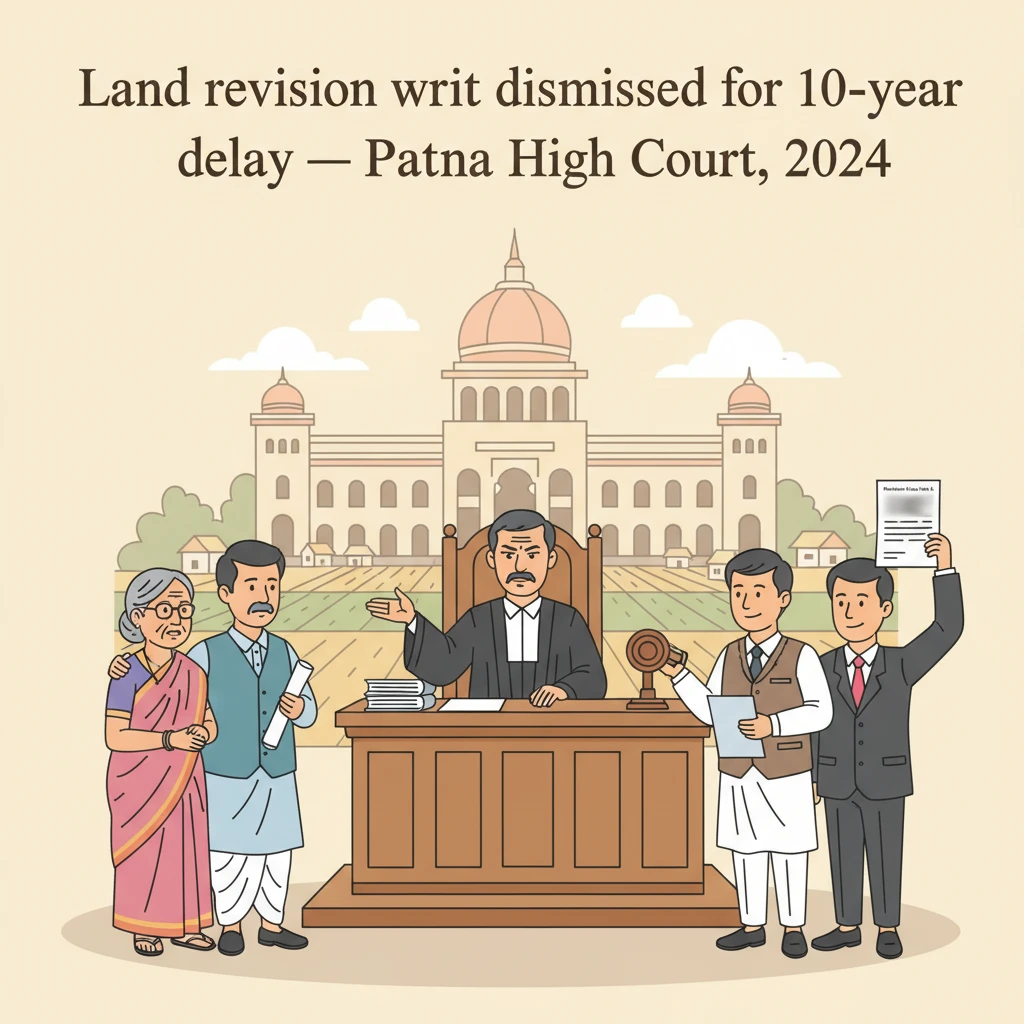
Case Background
This case arises out of a long‑running land dispute in village Abhuar, P.S. Kishanpur, District Supaul. The land is situated at Mauza Keotapatti, Thana No. 74, and relates to various C.S. and R.S. plots, including C.S. Khata No. 85, C.S. Plot No. 540, and C.S. Khata No. 419, C.S. Plot No. 4126, later corresponding to R.S. Khata No. 1235 and R.S. Plot No. 5309/7398.
According to the petitioner, his ancestors, Udit Narayan Jha and Awadh Narayan Jha, had obtained settlement of land appertaining to C.S. Khata No. 85, C.S. Plot No. 540, area 2 bigha, 4 katha and 5 dhur from the ex‑landlord in 1357 Fasli. Half of this land allegedly fell in the share of Udit Narayan Jha and the other half was allotted to Madhav Jha, Awadh Narayan Jha and other co‑sharers. The petitioner claims that his family and co‑sharers remained in peaceful possession and that the ex‑landlord submitted return in their names.
During revisional survey, R.S. Plot Nos. 900, 901, 902 and 905 were carved out of C.S. Plot No. 540. The petitioner states that these plots, measuring 62 decimals, 23 decimals, 80 decimals and 36/37 decimals respectively, were wrongly recorded as lands of the State of Bihar, even though, according to him, the State had no concern with the land.
The petitioner’s ancestors filed Objection Case Nos. 214 and 179 under Section 103(A) of the relevant Act before the survey authorities. The Survey Officer ordered recording of their names for R.S. Plot No. 900 (Case No. 214) and R.S. Plot No. 901 (Case No. 179), but kept R.S. Plot Nos. 902 and 905 recorded in the name of the State of Bihar, despite alleged spot verification by the Assistant Settlement Officer showing their possession.
Thereafter, an objection under Section 10(2) of the Bihar Consolidation of Holdings and Prevention of Fragmentation Act (Consolidation Act) was filed as Case No. 35/76 before the Consolidation Officer, Kishanpur. After enquiry, the Consolidation Officer, by order dated 03.04.1976, directed recording of the names of the petitioner’s ancestors and other co‑sharers regarding R.S. Plot Nos. 900, 901, 902 and 905. However, when khatiyan was issued, only R.S. Plot Nos. 900 and 901 stood recorded in their names, while R.S. Plot No. 902 (80 decimals) and R.S. Plot No. 905 (37 decimals) remained in the name of the State of Bihar.
Later, Revision Case No. 1113/1994 was filed before the Deputy Director, Consolidation, Purnea, by one Bijay Jha and Bahadur Yadav against the State of Bihar and others in respect of the same land. On learning of this case, the petitioner’s ancestors filed an intervention petition and were added as intervenors. They produced their documents and asserted their rights over R.S. Plot Nos. 902 and 905.
The Deputy Director, Consolidation, Purnea (respondent no. 3), by order dated 22.04.1998 passed in Revision Case No. 1113/1994/162/1997, decided in favour of the intervenors. He directed the concerned authority to correct the record‑of‑rights and enter the names of the petitioner’s ancestors in the khatiyan for R.S. Plot No. 902 (80 decimals) and R.S. Plot No. 905 (37 decimals).
Respondent no. 5, who had been one of the original revisionists in Revision Case No. 1113/1994/162/1997, thereafter filed Consolidation Revision Case No. 104 of 2002 before the Director, Consolidation, Bihar, Patna. The petitioner alleges that in this later revision, respondent no. 5 did not implead the petitioner or his ancestors as parties and prayed for recording his own name over R.S. Plot No. 902 (80 decimals), R.S. Plot No. 905 (36 decimals) and R.S. Plot No. 5309/7398 (01 decimal).
By order dated 10.10.2011 in Consolidation Revision Case No. 104 of 2002, the Director, Consolidation, Bihar, Patna allowed the revision filed by respondent no. 5 and directed recording of his name in respect of the said plots.
The petitioner obtained a certified copy of the Director’s order on 27.01.2012. However, he did not immediately challenge it before any court or authority. Only in 2021 did he file the present writ petition, Civil Writ Jurisdiction Case No. 9085 of 2021, before the Patna High Court, seeking quashing of the Director’s order dated 10.10.2011 and confirmation of the Deputy Director’s earlier order dated 22.04.1998.
What the Court Examined and Decided
The writ petition was heard by Hon’ble Mr. Justice Rajesh Kumar Verma. The petitioner was represented by Mr. Ashwani Kumar Tiwary, Advocate, and the State was represented by Mr. Nutan Sahay, AC to AAG‑12.
The core relief sought was to quash the order dated 10.10.2011 of the Director, Consolidation in Revision Case No. 104 of 2002, and to uphold and confirm the order dated 22.04.1998 passed by the Deputy Director, Consolidation, Purnea, in Revision Case No. 1113/1994/162/1997. The petitioner asserted that respondent no. 5 had suppressed the earlier revision order that had gone in favour of his ancestors and had obtained the later order without making them parties.
The petitioner’s counsel narrated the history of settlement from the ex‑landlord, payment of rent, revisional survey proceedings, consolidation proceedings under Section 10(2), and the favourable orders passed in their favour. It was argued that the land in question actually belonged to the petitioner’s family and co‑sharers, and that the State of Bihar had no concern with it. On this basis, the Director’s order directing mutation in favour of respondent no. 5 was said to be highly illegal and unjustified.
On the other hand, learned counsel for the State opposed the writ petition primarily on the ground of delay. He pointed out that the impugned order of the Director, Consolidation, Bihar, Patna was passed on 10.10.2011 in Revision Case No. 104 of 2002. The petitioner had obtained the certified copy of this order on 27.01.2012. Despite this, he did not take any action for several years and chose to challenge the order only in 2021 by filing the present writ petition.
The State’s stand was that such a long and unexplained delay made the writ petition liable to dismissal on the ground of laches. It was emphasised that even though the Limitation Act does not prescribe a specific period for filing a writ under Article 226 of the Constitution, the High Court must refuse relief when a litigant approaches after an inordinate delay without justification.
The Court agreed that the central question to be addressed first was the delay and laches on the part of the petitioner. The Court observed that a person seeking discretionary relief under Article 226 must approach within a reasonable time, and that reference may be made to the three‑year period under the Limitation Act as a guiding factor. Although not strictly binding for writs, it indicates what can generally be treated as reasonable.
To support this approach, the Court relied on the judgment of the Supreme Court in State of Jammu and Kashmir v. R.K. Zalpuri and Others, reported in AIR 2016 Supreme Court 3006. Paragraph 20 of that decision, which in turn quotes from City and Industrial Development Corporation v. Dosu Aardeshir Bhiwandiwala and Others, was reproduced.
In that passage, the Supreme Court laid down that while exercising jurisdiction under Article 226, the High Court is duty‑bound to consider several factors, including:
- whether the dispute involves complex and disputed questions of fact,
- whether the petition reveals all material facts,
- whether there exists an alternative or effective remedy,
- whether the person invoking jurisdiction is guilty of unexplained delay and laches,
- whether the claim is ex facie barred by limitation laws, and
- whether grant of relief is against public policy or barred by valid law, along with other relevant considerations.
The Patna High Court particularly stressed that delay and laches are crucial considerations before granting any writ relief. The Court noted that the Supreme Court has consistently held that if a person sleeps over his rights for long and wakes up after many years to file a writ, the Court should ordinarily refuse to interfere.
Applying these principles to the facts, the Court examined the timeline. The impugned order of the Director, Consolidation was passed on 10.10.2011. The petitioner obtained a certified copy on 27.01.2012. Yet the writ petition was filed only in 2021. Thus, there was a gap of about ten years from the date of the order, and at least nine years from the date of obtaining the certified copy, before the petitioner approached the High Court.
The judgment notes that the petitioner did not file any application before any other appropriate forum during this long interval. There was no explanation placed on record to justify such a delay. In these circumstances, the Court held that the writ petition suffered from serious delay and laches.
The Court observed that it was bound, in view of the Supreme Court’s guidance, to consider laches before entertaining a writ petition. Once it found a delay of about ten years with no satisfactory explanation, the Court concluded that it had no option but to decline relief, irrespective of the merits of the land dispute or the alleged illegality in the Director’s order.
Therefore, without entering into a detailed re‑examination of the rival land claims, the Court dismissed the writ petition solely on the ground of inordinate delay and laches in challenging the 2011 order.
In paragraph 10 of the judgment, the Court clearly states that on account of delay and laches of about ten years in filing the writ, it has no other option but to dismiss the petition. Consequently, in paragraph 11, the writ petition is formally dismissed.
As a result, the order dated 10.10.2011 passed by the Director, Consolidation, Bihar, Patna in Revision Case No. 104 of 2002, which had directed recording of the name of respondent no. 5 over the concerned plots, remains undisturbed.
Why This Judgment Matters
This judgment is important for land holders and litigants in Bihar, especially those involved in consolidation and survey disputes. It shows that even if someone believes a consolidation or mutation order is wrong, the High Court will not come to their aid if they wait for many years before filing a writ.
The Patna High Court reaffirmed that under Article 226, relief is discretionary. A person must come to court within a reasonable time. Here, the petitioner waited about ten years after the Director’s order, despite having a certified copy since 2012. Because of this, the Court refused to consider his grievance about the land.
For ordinary citizens, the message is clear: if a government authority or consolidation officer passes an order affecting your land, you cannot delay challenging it. If you sleep over the matter, courts may treat the dispute as closed, even if you believe you have a strong case on merits.
The judgment also reinforces the Supreme Court’s guidance that High Courts should actively screen writ petitions for delay and laches and decline relief where the challenge is stale. This helps bring certainty to land records and avoids reopening very old disputes after long gaps.
Legal Issues and Answers
- Issue: Can the Patna High Court interfere under Article 226 with a consolidation revision order passed in 2011 when the writ petition challenging it is filed only in 2021, despite the petitioner having obtained a certified copy in 2012?
Answer: No. The Court held that the writ petition was barred by inordinate delay and laches of about ten years and refused to entertain it.
Cases Cited by the Court
- State of Jammu and Kashmir v. R.K. Zalpuri and Others, AIR 2016 Supreme Court 3006, including the quoted passage from City and Industrial Development Corporation v. Dosu Aardeshir Bhiwandiwala and Others, on factors to be considered while exercising jurisdiction under Article 226, especially delay and laches.
Case Details
Case Number: Civil Writ Jurisdiction Case No. 9085 of 2021
Case Title: Ashwani Kumar Jha v. The State of Bihar & Others
Coram: Hon’ble Mr. Justice Rajesh Kumar Verma
Citation: 2024 (4) PLJR 330
Advocates:
- For the petitioner: Mr. Ashwani Kumar Tiwary, Advocate
- For the respondents/State: Mr. Nutan Sahay, AC to AAG‑12
Nature of the case: Writ petition under Article 226 of the Constitution challenging an order passed by the Director, Consolidation in a consolidation revision proceeding.
Impugned Order: Order dated 10.10.2011 passed by the Director, Consolidation, Bihar, Patna in Consolidation Revision Case No. 104 of 2002.
Date of High Court Judgment: 23.09.2024
Link to judgment: Patna High Court Judgment in CWJC No. 9085 of 2021
If you found this explanation helpful and wish to stay informed about
how legal developments may affect your rights in Bihar,
you may consider following Samvida Law Associates for more updates.







