
Case Background
The case was a writ petition filed before the Patna High Court, Civil Writ Jurisdiction, being CWJC No. 2996 of 2024. The petitioner was a proprietorship firm engaged in supply of medicines and medical equipment. The respondents were the State of Bihar through the Health Department and the Civil Surgeon-cum-Chief Medical Officer, Arwal.
According to the petition, the Health Department had issued a Notice Inviting Tender (NIT). The petitioner participated in this tender process. The authorities found the petitioner to be the lowest tenderer and work orders were issued in favour of the petitioner for supply of different medicines and medical equipment.
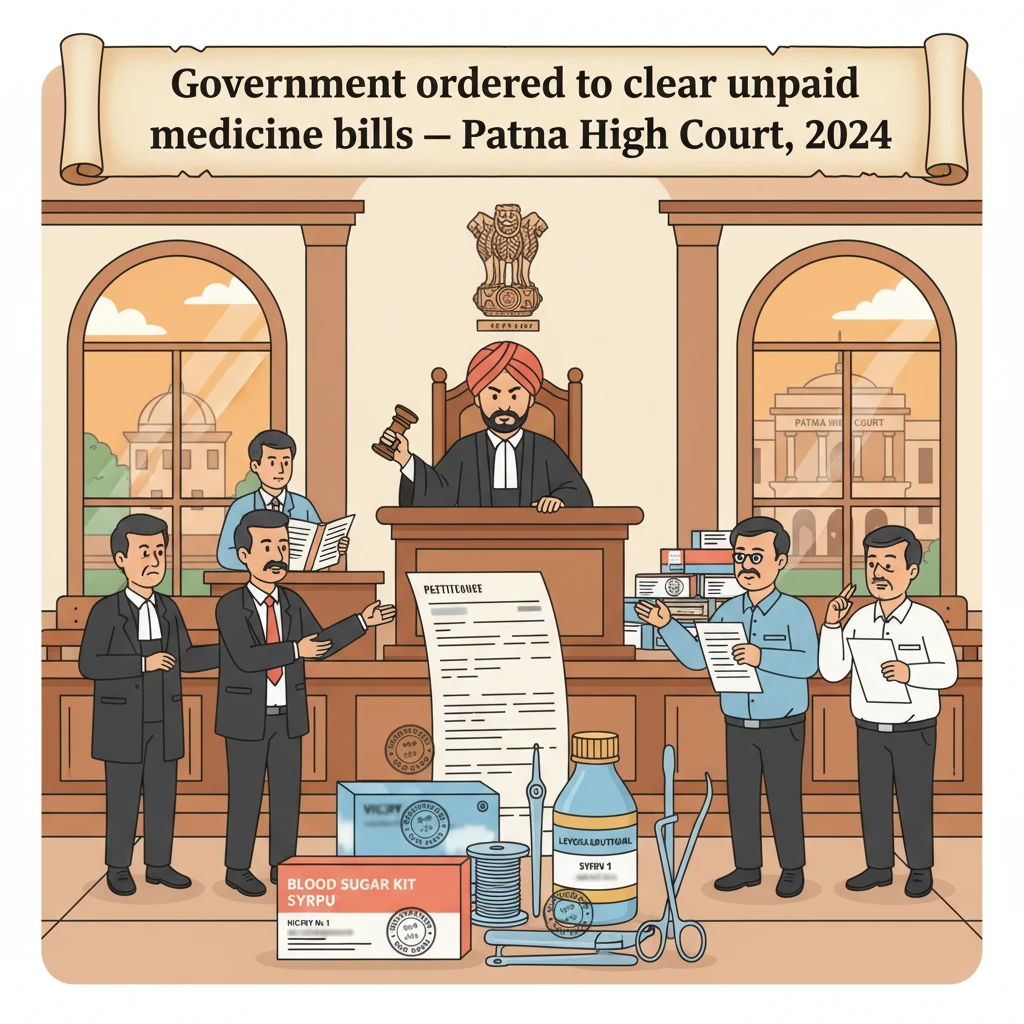
From 2018 onwards, the petitioner supplied several items, including blood sugar kits, Vicryl No. 1, Levosalbutamol syrup, needle holders and forceps. For the year 2018–19, the petitioner received work orders from the Civil Surgeon-cum-Chief Medical Officer, Arwal. The invoiced amount for supplies during that period was Rs. 12,95,806/-, which remained unpaid.
Later, on the basis of further orders bearing Memo Nos. 539 and 540 dated 30.03.2019, the petitioner supplied blood sugar kits and Vicryl No. 1. The amounts claimed under these two invoices were approximately Rs. 27,93,500/- and Rs. 12,78,700/- respectively. The total claim thus stood at Rs. 58,56,670/- (Rs. 45,60,864/- + Rs. 12,95,806/-).
The petitioner stated that all the medicines and equipment supplied were specially marked as “government supply and not for sale”. After supply, by Memo No. 664 dated 04.05.2019, the Civil Surgeon-cum-Chief Medical Officer, Arwal informed that some medicines and equipment supplied under the order dated 30.03.2019 had been received at the fag end of the financial year 2018–19 and directed the petitioner to take them back.
Though the letter was dated 04.05.2019, the petitioner received it only on 05.11.2019. The petitioner said he had been orally informed of it in August 2019. The petitioner replied that taking back the supplied goods was not possible, since they were stamped for government use only and could not be resold and because GST returns had already been filed.
Meanwhile, the petitioner repeatedly approached the respondents’ offices for release of payment, but no amount was paid. The petitioner was informed that the Joint Secretary, Department of Health, had constituted an enquiry committee to look into the matter, and that the committee had submitted a report dated 04.12.2019.
When the bills still remained unpaid, the petitioner approached the High Court earlier in CWJC No. 7013 of 2020. That writ petition was disposed of on 15.11.2021 by directing the petitioner to file a suitable representation before the authorities.
The petitioner then submitted a detailed representation dated 26.11.2021. This representation was rejected by Memo No. 1357 dated 12.11.2022 issued by the Civil Surgeon-cum-Chief Medical Officer, Arwal. The petitioner complained that this rejection order was passed without any notice to him and without giving him an opportunity of hearing.
Aggrieved by this rejection and continued non-payment, the petitioner filed the present writ petition, seeking quashing of Memo No. 1357 dated 12.11.2022 and a direction to the State to pay Rs. 58,56,670/- with interest at 8% per annum.
What the Court Examined and Decided
The matter was heard by Hon’ble Mr. Justice A. Abhishek Reddy. Both sides were represented: the petitioner by counsel and the State by Government Advocate 8.
The petitioner’s side argued that the supplies were made strictly as per valid work orders arising out of a proper tender process. The petitioner’s rates were accepted as lowest and work orders were issued by the Civil Surgeon-cum-Chief Medical Officer, Arwal. The petitioner had fully performed his part and submitted bills totalling Rs. 58,56,670/-, yet payment was not released.
It was stressed that the goods were specially marked for government supply and not for sale. Therefore, once supplied to the Health Department, they could not be diverted or sold anywhere else. The petitioner also pointed out that GST returns had already been filed on these supplies, making it practically impossible to reverse the transaction by taking back the goods.
The petitioner also complained that after the earlier writ (CWJC No. 7013 of 2020), he had filed the representation as directed, but the representation was rejected without any hearing or prior notice to him, which was said to be arbitrary.
On the other hand, the State opposed the writ petition and questioned its very maintainability. The State did not dispute that supplies were made. However, it argued that the then Civil Surgeon-cum-Chief Medical Officer, Arwal, had issued the work orders without approval from higher authorities and in violation of departmental guidelines.
The State pointed out that the work orders were placed one day before the end of the financial year 2018–19 and one day before that officer’s transfer. It was also stated that the petitioner did not have any registration as a small-scale industry at the relevant time and that the norms were not properly followed when orders were placed.
The State informed the Court that an enquiry committee had been constituted by the Joint Secretary, Health Department, through Memo No. 1434(9) dated 28.11.2019, and the committee had submitted its report vide Memo No. 1431 dated 12.12.2019. The report recorded that supply orders were placed by the then Civil Surgeon-cum-Chief Medical Officer, Arwal, one day prior to his transfer, without following departmental guidelines, at the fag end of the financial year and in excess of requirement. The State further said that necessary departmental action had been taken against that officer.
After considering the rival stands, the Court first took note that, as seen from the pleadings and documents, the petitioner had participated in the tender, was found to be the lowest tenderer, and supply orders were actually issued. The petitioner then supplied medicines and medical equipment in accordance with those orders.
The Court framed the central question: whether the competence or misconduct of the Civil Surgeon-cum-Chief Medical Officer, Arwal, in issuing the work orders could be used to deny payment to the petitioner who had already supplied the goods.
The Court held that this question was not relevant for deciding the relief claimed by the petitioner, for several reasons clearly stated in the judgment.
First, the Court held that even if lapses or irregularities had been committed by the then Civil Surgeon-cum-Chief Medical Officer in placing the supply orders, the petitioner could not be blamed for them. The petitioner’s limited role was to respond to the tender and supply goods when ordered.
Second, the Court observed that the petitioner had supplied the medicines and equipment purely as per the supply orders given. Whether those orders were in excess of actual requirement was not the petitioner’s concern. That issue was internal to the department.
Third, the Court noted that it was an admitted fact that the medicines supplied by the petitioner had been fully utilised by the Health Department. The goods were specifically marked “for government use and not for sale”, and they had been distributed to various health centres across the State. The respondents themselves admitted in their counter affidavit that none of the medicines or equipment supplied by the petitioner had gone to waste.
Turning to the specific rejection order (Memo No. 1357 dated 12.11.2022), the Court examined the reasons recorded in it. The only ground for rejecting the petitioner’s claim was that the officer who issued the supply order was transferred one day after the order was placed.
The Court found that the total dues of the petitioner were in two parts: Rs. 12,95,806/- relating to earlier supplies in 2018–19 and Rs. 45,60,864/- relating to the March 2019 supply orders under Memo Nos. 539 and 540. The judgment records that it was not clear from the impugned order why even the earlier admitted amount of Rs. 12,95,806/- had been denied, when it clearly related to supplies made earlier.
In light of the State’s own admission that all the medicines and equipment had been utilised and that none had gone waste, the Court held that denial of payment to the petitioner had no legal basis. Once a competent authority places an order and the supplier fulfils it, the department is legally bound to make payment. Internal disciplinary issues with the officer cannot be used to deprive the supplier of legitimate dues.
On this reasoning, the Court allowed the writ petition. The respondents were directed to pay the amounts due to the petitioner “as expeditiously as possible”, preferably within eight weeks from the date of receipt of a copy of the order.
The Court further clarified that if the due amounts were not paid within the stipulated period, the petitioner would be entitled to simple interest at the rate of 8% per annum from the date of submission of the bills till the date of actual payment.
With these directions, the writ petition was allowed to the extent indicated.
Why This Judgment Matters
This Patna High Court judgment is important for suppliers dealing with government departments, especially in Bihar. It makes clear that once a supplier has lawfully supplied goods under work orders and the government has used those goods, the department cannot refuse payment because of internal irregularities by its officers.
Here, even though the Health Department said that the Civil Surgeon-cum-Chief Medical Officer had violated guidelines and placed orders just before his transfer and the financial year-end, the Court refused to put that burden on the supplier. The State is free to take departmental action against its officer, but it must still pay for goods already used.
The decision is also relevant for small firms supplying medicines and medical equipment. The Court noted that the goods were specifically marked for government use and not for sale, and had been distributed to health centres. In such a situation, asking the supplier to take back the goods or denying payment was considered unjust.
The judgment further reinforces that when the State delays or denies payment without legal basis, the Court can not only direct payment but also award interest to compensate the supplier for the time value of money.
Legal Issues and Answers
- Issue: Can the State refuse to pay for medicines and medical equipment supplied under work orders, on the ground that the officer who issued the orders acted without proper approval or in violation of guidelines?
Answer: No. The Patna High Court held that any irregularity or lapse by the officer cannot be used to deny payment to the supplier, especially when the goods have been fully utilised by the department. - Issue: Is the government bound to pay admitted dues for supplies already made and used, even if the supply orders were placed at the fag end of the financial year and just before the officer’s transfer?
Answer: Yes. The Court directed the respondents to pay the entire amount of Rs. 58,56,670/-, noting that all supplies were used and none had gone waste, and that the petitioner had acted on valid supply orders. - Issue: What happens if the State delays payment even after a court direction?
Answer: The Court ordered that if payment is not made within eight weeks, the petitioner will be entitled to simple interest at 8% per annum from the date of submission of the bills until actual payment.
Cases Cited by the Court
- The judgment does not refer to or rely on any other reported case law.
Case Details
Case Number: Civil Writ Jurisdiction Case No. 2996 of 2024
Case Title: M/s Garg Drugs v. The State of Bihar & Ors.
Citation: 2024(4) PLJR 495
Court: High Court of Judicature at Patna
Coram: Hon’ble Mr. Justice A. Abhishek Reddy
Date of Judgment: 07.10.2024
Advocates: For the petitioner – Mr. Avinash Shekhar; For the respondents – Government Advocate 8
Nature of the Case: Writ petition under civil writ jurisdiction seeking quashing of rejection of payment claim and direction for release of dues with interest.
Impugned Order: Memo No. 1357 dated 12.11.2022 issued by the Civil Surgeon-cum-Chief Medical Officer, Arwal
Amount in Dispute: Rs. 58,56,670/- (Rs. 45,60,864/- + Rs. 12,95,806/-)
Relief Granted: Writ petition allowed; direction to pay dues within eight weeks, failing which interest at 8% per annum from date of submission of bills till payment.
Link to Judgment: Click here to read the full judgment of the Patna High Court
If you found this explanation helpful and wish to stay informed about how legal developments may affect your rights in Bihar, you may consider following Samvida Law Associates for more updates.







