

Case Background
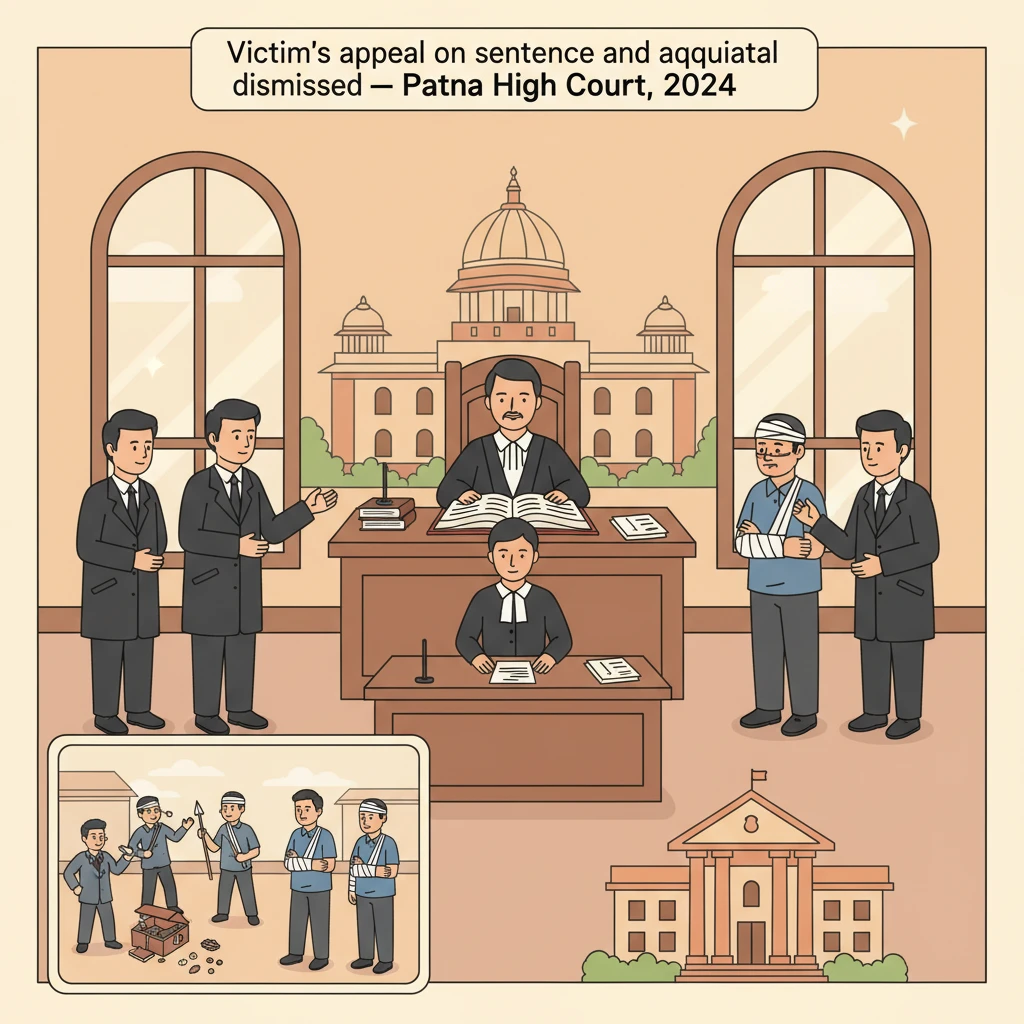
The dispute started with Town P.S. Case No. 160 of 2007, Motihari, East Champaran. The informant, later the appellant in the Patna High Court, gave his fardbeyan at Sadar Hospital, Motihari on 19.06.2007. He alleged that on the previous night, 18.06.2007 at about 9:30 p.m., several co-villagers armed with weapons came to his house.
According to him, the accused demanded Rs. 25,000/-. One of them allegedly attacked his son Arjun Kumar on the head with a farsa, causing bleeding. Others allegedly caught hold of the informant and called two more persons, including Shivji Raut. It was claimed that Shivji tried to stab the informant with a spear (bhala), causing an elbow injury, and that the assailants also beat him with lathi, danda and fists. Arjun Kumar allegedly became unconscious and fell down.
The informant further claimed that the accused then entered his house, broke open a box and took away ornaments. On his cries, some neighbours were said to have reached the spot, after which the accused fled. On this fardbeyan, Town P.S. Case No. 160 of 2007 was registered against five persons for several offences including rioting, house-trespass, hurt, theft and attempt to murder under various sections of the Indian Penal Code.
After investigation, a chargesheet dated 30.06.2007 was filed only against two of the named accused, Lalan Raut and Chhotan Raut. The investigating agency did not send up Pappu Raut and Mithu Raut, and noted that accused Shivji had died. However, the Magistrate took cognizance not only against the chargesheeted accused but also against Pappu and Mithu, and committed the case to the Court of Sessions.
In Sessions Trial No. 573 of 2010 (CIS No. 2228 of 2016), charges were framed under Sections 379, 323, 307 read with Section 34 of the Indian Penal Code against four accused who later became respondent nos. 2 to 5 in the High Court appeal. All pleaded not guilty and claimed trial.
The trial court examined six prosecution witnesses: the informant, his injured son Arjun, his wife, two other sons and the doctor who examined the injuries. Several documents including injury reports and certified copies of orders and a previous judgment were exhibited. The defence did not produce oral evidence but placed on record documents relating to Town P.S. Case No. 161 of 2007, apparently a counter-case lodged by the accused side.
On 22.07.2023, the Additional Sessions Judge-V, East Champaran at Motihari convicted respondent nos. 2, 3 and 4 under Section 323 IPC and respondent no. 5 under Section 324 IPC. All four were acquitted of charges under Sections 307 and 379 IPC. Instead of sending them to jail, the court granted them the benefit of the Probation of Offenders Act, 1958: respondent nos. 2 to 4 under Section 3 and respondent no. 5 on bond under Section 4.
Feeling aggrieved, the informant filed Criminal Appeal (DB) No. 923 of 2023 before the Patna High Court. He challenged both the acquittal from the serious charges and the grant of probation in place of imprisonment.
What the Court Examined and Decided
The Division Bench of Hon’ble Mr. Justice Ashutosh Kumar and Hon’ble Mr. Justice Jitendra Kumar heard the appeal. Arguments were advanced by counsel for the appellant, the State, and the private respondents.
Counsel for the appellant argued that the trial court had not properly appreciated the evidence. According to him, the materials on record clearly made out offences under Sections 307 and 379 IPC, but the accused were wrongly acquitted of these charges. He also contended that the respondents should not have been granted the benefit of the Probation of Offenders Act and ought to have been sentenced to imprisonment.
On the other side, the Additional Public Prosecutor and counsel for respondent nos. 2 to 5 supported the trial court judgment. They submitted that, based on the evidence, the prosecution had failed to prove the ingredients of Sections 307 and 379 IPC. They further stressed that in an appeal against acquittal, the High Court’s power to interfere is limited and cannot be used merely because another view is possible.
They also raised a preliminary objection: that a victim or informant has no right to file an appeal for enhancement of sentence or to challenge the grant of probation. Such a right, they argued, lies only with the State Government under Section 377 of the Code of Criminal Procedure (Cr.P.C.).
The Bench first considered this preliminary legal issue. It examined the proviso to Section 372 Cr.P.C., which grants a victim the right to appeal only against three types of orders: acquittal of the accused, conviction for a lesser offence, or imposition of inadequate compensation. The Court noted that this provision does not mention any right to appeal against the quantum of sentence.
The Court then referred to the Supreme Court decision in Parvinder Kansal v. State (NCT of Delhi), (2020) 19 SCC 496. The Supreme Court there had clearly held that while a victim can appeal regarding inadequate compensation, there is no provision allowing a victim to appeal for enhancement of sentence. That right is specifically given to the State under Section 377 Cr.P.C.
Applying this law, the Patna High Court held that the informant’s challenge to the grant of benefit under the Probation of Offenders Act, or to the “inadequacy” of the sentence, was not maintainable. It observed that sentencing and grant of probation are alternative choices open to the trial court, and the victim has no statutory right to seek a harsher sentence. Therefore, the High Court declined to examine the correctness of the trial court’s order granting probation.
Next, the Court turned to the other part of the appeal: the challenge to acquittal from charges under Sections 307 and 379 IPC. Here again, the Bench began by setting out the legal framework for appeals against acquittal.
Relying on earlier Supreme Court judgments, including Harbans Singh v. State of Punjab, Chandrappa v. State of Karnataka, Murugesan v. State, H.D. Sundara v. State of Karnataka, and Babu Sahebagouda Rudragoudar v. State of Karnataka, the Court summarised the principles. It emphasised that:
When a trial court acquits an accused of a particular charge, the presumption of innocence stands further strengthened. An appellate court can reappreciate evidence, but if the view taken by the trial court is a reasonable and possible view based on the evidence, the appellate court should not interfere simply because another view is also possible.
Interference is justified only when the acquittal is perverse, is based on ignoring material evidence, or when no two reasonable views are possible and only guilt is the logical conclusion.
With these principles in mind, the Bench examined the evidence relating to the alleged attempt to murder and theft.
The informant, examined as P.W.-5, repeated the allegations of the fardbeyan in his chief examination. However, in cross-examination he admitted that only he and his family members were present at the time of the occurrence; no neighbours were then present. He also said he was assaulted only once and acknowledged that the accused had also lodged a criminal case against him, though he denied that his case was a counterblast.
The injured son Arjun Prasad (P.W.-1) supported his father’s version in chief. In cross-examination he stated that there was no land dispute between the families and denied that their case was a counterblast.
The informant’s wife Radhika Devi (P.W.-2) also supported the prosecution story, but in cross-examination she could not recall whether her statement had been recorded by the police. The High Court noted that this suggested she might be deposing for the first time only before the trial court.
Another son Santosh Kumar (P.W.-3) initially supported the version, but in cross-examination stated that when he reached the place of occurrence, the accused had already fled and his brother was lying on the ground. He admitted that the accused had also filed a criminal case against his family. This showed that he was not an eye-witness.
The fourth son, Jagdish Prasad (P.W.-4), likewise supported the case but in cross-examination admitted that he arrived when the accused were fleeing and his brother was already injured. He too acknowledged that one of the respondents had lodged a criminal case against him and his family regarding an incident on the same day.
The medical evidence came from P.W.-6, Dr. Alok Kumar, who examined both the injured Arjun Kumar and the informant. He found a single incised wound on Arjun’s scalp, 3” x 0.25” x skin deep. X-ray showed no bone injury, and he categorised the injury as simple. On the informant, he found a small lacerated wound on the upper right side of the face, also simple in nature.
In cross-examination the doctor clarified that Arjun’s injury could have been caused by a sharp-edged stone and that a skin-deep wound is a superficial injury. He added that the informant’s injury could be due to a fall on the ground.
The High Court then referred to Supreme Court decisions in Sagayam v. State of Karnataka, (2000) 4 SCC 454 and Pulicherla Nagaraju @ Nagaraja Reddy v. State of A.P., (2006) 11 SCC 444, which explain how courts should judge “intention to cause death” under Section 307 IPC. These decisions list factors such as the nature of the weapon, part of the body targeted, force used, number of blows, prior enmity, and overall circumstances.
Applying these principles to the present case, the Bench highlighted that both injuries were not only simple but even superficial, and each injured person had only one injury. There was also the fact of a cross-case by the accused side, indicating mutual hostility. From all this, the Court concluded that there was no intention on the part of the respondents to commit murder. The “mens rea” required for Section 307 IPC was missing.
On the theft allegation under Section 379 IPC, the Court observed that the prosecution had not provided details of what ornaments or articles were allegedly stolen. In the absence of such particulars or supporting material, the allegation appeared “superfluous” and could not be said to be proved beyond reasonable doubt.
In light of the limited scope of interference in an appeal against acquittal and the actual evidence on record, the Court held that the trial court’s view was a possible and reasonable one. There was no patent perversity or misreading of evidence. Therefore, there was no ground to overturn the acquittal from the charges under Sections 307 and 379 IPC.
Finally, having rejected both the challenge to acquittal and the complaint regarding probation and sentence, the Patna High Court dismissed the appeal on merits and confirmed the judgment of conviction under Sections 323 and 324 IPC along with the probation orders.
Why This Judgment Matters
This judgment is important for victims and their families who want stronger punishment in criminal cases. The Patna High Court has clearly said that, under present law, a victim cannot file an appeal only to ask for a harsher sentence or to challenge the grant of probation to the convict. That power lies with the State Government.
For people involved in village disputes or assault cases, the ruling also shows that courts look very closely at the nature of injuries and exact evidence before upholding a charge of “attempt to murder”. Simple and superficial injuries, with only one blow and no bone damage, usually do not support a Section 307 IPC conviction unless other strong facts show clear intention to kill.
The decision also warns that if theft is alleged, the prosecution must give clear details of what was stolen. Vague statements without description are unlikely to result in conviction for theft.
Overall, the judgment reassures accused persons that acquittals on serious charges will not be lightly overturned in appeal, and at the same time guides victims about the correct legal route—through the State—for seeking enhancement of sentence.
Legal Issues and Answers
- Issue: Can a victim or informant file an appeal challenging the inadequacy of sentence or grant of benefit under the Probation of Offenders Act?
Answer: No. The Patna High Court held that under Section 377 Cr.P.C., only the State can appeal for enhancement of sentence. The proviso to Section 372 Cr.P.C. allows a victim to appeal only against acquittal, conviction for a lesser offence, or inadequate compensation, not against the sentence or probation. - Issue: Was the trial court wrong in acquitting the respondents of charges under Sections 307 and 379 IPC?
Answer: No. The High Court found that the injuries were simple and superficial and did not show intention to kill, so Section 307 IPC was not made out. The allegation of theft under Section 379 IPC lacked details of the stolen property and was not proved beyond reasonable doubt. The trial court’s view was a reasonable and possible one, so the High Court refused to interfere. - Issue: When can a High Court interfere with an acquittal in appeal?
Answer: The Court reaffirmed that interference is permissible only when the acquittal is perverse, based on ignoring material evidence, or when only a conclusion of guilt is reasonably possible. If two reasonable views are possible and the trial court has chosen one in favour of the accused, the appellate court should not substitute its own view.
Cases Cited by the Court
- Parvinder Kansal v. State (NCT of Delhi), (2020) 19 SCC 496
- Harbans Singh v. State of Punjab, 1961 SCC OnLine SC 40
- Chandrappa v. State of Karnataka, (2007) 4 SCC 415
- Murugesan v. State, (2012) 10 SCC 383
- H.D. Sundara v. State of Karnataka, (2023) 9 SCC 581
- Babu Sahebagouda Rudragoudar v. State of Karnataka, 2024 SCC OnLine SC 561
- Sagayam v. State of Karnataka, (2000) 4 SCC 454
- Pulicherla Nagaraju @ Nagaraja Reddy v. State of A.P., (2006) 11 SCC 444
Case Details
Case Number: Criminal Appeal (DB) No. 923 of 2023, arising out of Town P.S. Case No. 160 of 2007, Sessions Trial No. 573 of 2010 (CIS No. 2228 of 2016)
Case Title: Ram Ekbal Raut @ Ram Ekbal Prasad @ Ekbal Prasad v. The State of Bihar & Ors.
Citation: 2024 (4) PLJR 61
Coram: Hon’ble Mr. Justice Ashutosh Kumar and Hon’ble Mr. Justice Jitendra Kumar
Advocates: For the appellant – Mr. Abhishek Kumar, Advocate; Mr. Sagar Kumar, Advocate; Mr. Sharad Kumar Verma, Advocate; Ms. Rashmi Jha, Advocate. For the State – Mr. Manish Kumar No. 2, APP. For respondent nos. 2 to 5 – Mr. Karandeep Kumar, Advocate.
Date of Patna High Court Judgment: 21.08.2024
Nature of Case: Criminal appeal (Division Bench) by informant/victim challenging part acquittal and sentence, including grant of probation, in a sessions trial for offences under Sections 323, 324, 307 and 379 IPC.
Link to Judgment: Click here to read the full Patna High Court judgment
If you found this explanation helpful and wish to stay informed about
how legal developments may affect your rights in Bihar,
you may consider following Samvida Law Associates for more updates.







