

Case Background
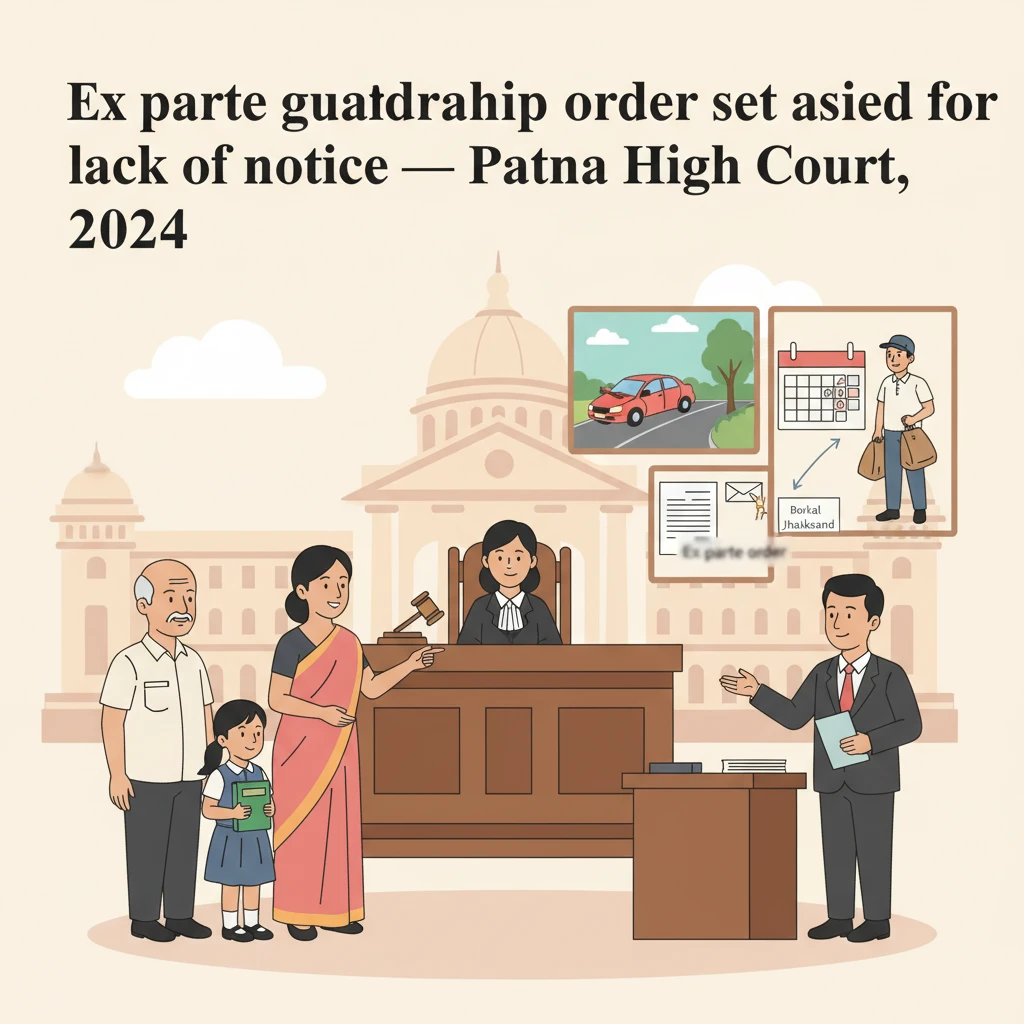
This case concerns the custody and guardianship of a minor girl, appellant no. 2, whose mother, Nikita Anand, died in a road accident on 05.06.2017 at Sikri N.H. 2 near Kaili bypass road, Faridabad, Haryana.
The child’s mother was the daughter of appellant no. 1. After her death, appellant no. 1 started taking care of the minor girl at Banka. At that time, the child was about four to five years old.
According to the record, the minor girl has been residing with her grand maternal uncle and is studying in 5th Class in Saraswati Shisha Mandir, Banka.
The respondent, who is the father and natural guardian of the child, filed a case before the Principal Judge, Family Court, Banka. He sought guardianship of his minor daughter under Section 7(1) of the Guardians and Wards Act, 1890 and asked for custody from appellant no. 1.
In Guardian and Wards Case No. 01 of 2020, the father requested three main reliefs: a declaration that he is the guardian of the minor (appellant no. 2); a direction to appellant no. 1 to hand over the child to him; and an order restraining appellant no. 1 from interfering in his guardianship.
The Family Court proceeded ex parte, that is, without the appearance of the appellants, and on 18.09.2023 allowed the father’s petition. It declared the respondent as natural guardian of the girl and ordered appellant no. 1 to hand over the child.
Aggrieved by this ex parte order, the maternal grandfather (appellant no. 1) and the minor girl (appellant no. 2) filed Miscellaneous Appeal No. 82 of 2024 before the Patna High Court. With consent of both sides, the High Court took up the appeal for final disposal.
What the Court Examined and Decided
The central complaint of the appellants before the Patna High Court was that the Family Court’s order dated 18.09.2023 had been passed behind their back.
They argued that they were never served with summons or notices in Guardian and Wards Case No. 01 of 2020. Therefore, they had no opportunity to appear and contest the father’s claim for guardianship and custody.
The appellants’ counsel pointed out that the Family Court had presumed service of summons on them and straightaway posted the matter for ex parte hearing under Order IX Rule 6(1)(a) of the Code of Civil Procedure, 1908 (CPC). According to them, this was contrary to law and the service reports should have been properly examined.
The appellants further submitted that the court below relied only on the service report of the postal peon without examining him as a witness. In their view, this violated the requirements of Order 5 of the CPC, particularly Rules 12, 15 and 17, which deal with how summons must be served and what must be recorded if the defendant is not found or does not accept service.
On the other hand, the respondent’s counsel maintained that proper notice had been served. He submitted that the Principal Judge, Family Court, Banka had passed the impugned order on the basis of materials available on record and no interference by the High Court was needed.
To decide which version was correct, the Patna High Court looked closely at the original record and order sheets of the Family Court.
The order sheet dated 19.12.2020 showed that a petition under Section 7(1) of the Guardians and Wards Act along with vakalatnama was filed on behalf of the respondent and was ordered to be registered. On 23.12.2020, the petition was admitted and requisites for summons were ordered to be submitted.
On 04.02.2021, postal receipts were submitted by the respondent. From 27.03.2021 to 29.10.2021, no effective order was passed. On 21.12.2021, it was merely recorded that the receipt was tagged with the record, and the matter was posted for 04.02.2022.
A significant entry appears on 04.02.2022. On that date, it was recorded that the opposite party (the present appellants) were presently residing in Jharkhand. The respondent therefore prayed that summons be issued on their present address, and the court ordered submission of requisites again.
However, when the High Court examined the later order sheet dated 10.10.2022, it found that the Family Court simply wrote that all processes for service of summons had been completed and that the opposite party had not appeared. On that basis, the case was posted for ex parte hearing.
The High Court noted an important gap: there was no specific order anywhere showing that the Family Court had actually satisfied itself that summons had been duly served at the new Jharkhand address, or even at the earlier address. There was also no discussion of how service had been effected.
At this point, the High Court turned to the legal requirements of Order 5 of the CPC, which regulates the issuance and service of summons.
Under Order 5 Rule 9, when the defendant resides within the jurisdiction of the court, the summons must be delivered to the proper officer or approved courier services. Sub-rule (3) allows service by registered post acknowledgment due, speed post or approved courier, addressed to the defendant or authorised agent.
Order 5 Rule 17 describes what must be done when the defendant cannot be found or refuses to accept summons. In such cases, the serving officer must affix a copy of the summons on the outer door or some conspicuous part of the house where the defendant ordinarily resides or works, and then return the original with a detailed report. The report must mention the circumstances, and name and address of the person who identified the house and in whose presence the copy was affixed.
Further, under Order 5 Rule 19, when a summons is returned under Rule 17, the court has to examine the serving officer. Only then can the court decide whether service has been duly effected.
After going through the Family Court record, the Patna High Court concluded that these mandatory requirements had not been followed. There was no material to show proper service of summons.
The High Court observed that there was no finding by the Family Court anywhere that notice had in fact been served on the appellants. The order sheet dated 10.10.2022 merely recorded that processes had been completed and then moved the case to ex parte hearing, without explaining how satisfaction of service was reached.
According to the High Court, the steps taken by the Family Court were against the provisions of Order 5 Rules 12, 15 and 17 of the CPC. The Family Court never expressed satisfaction on how it had completed all processes to secure the presence of the appellants. It did not record whether notices sent to the new Jharkhand address were properly served.
The High Court found that, in such a matter involving custody and guardianship of a minor, the Family Court ought not to have followed a mechanical approach. Instead, it should have strictly complied with the statutory provisions relating to issuance and service of summons.
In paragraph 12, the High Court described the Family Court’s approach as “casual and mechanical”. It noted that although the order sheets created an impression that all processes had been exhausted, in reality the mandatory statutory provisions had not been complied with before fixing the case for ex parte hearing.
Because of these procedural lapses, the Patna High Court held that the appellants had not been duly served with notice. Therefore, the procedure adopted by the Family Court was vitiated and the ex parte order could not stand.
Without going into the merits of who should finally get guardianship or custody, the High Court set aside the order dated 18.09.2023 passed in Guardian and Wards Case No. 01 of 2020 by the Principal Judge, Family Court, Banka.
The High Court restored the Guardians and Wards Case No. 01 of 2020 to the file of the Family Court and remitted the matter back for fresh decision in accordance with law and on its own merits.
The Family Court has been directed to decide the matter afresh within six months from the date of receipt or production of a copy of this judgment, after giving ample opportunity of adducing evidence and hearing to both sides.
The Patna High Court also directed the parties to cooperate in the disposal of the guardianship case. It specifically directed the Family Court, Banka to list Guardian and Wards Case No. 01 of 2020 on 21.09.2024 at 3:00 PM, and asked parties and their counsel to appear on that date without any further notice from the Family Court.
The trial court record was ordered to be sent back to the Family Court forthwith, and any pending interlocutory applications in the appeal were disposed of.
Why This Judgment Matters
This judgment is important for families involved in guardianship and custody disputes, especially where one side lives in a different district or state.
The Patna High Court has emphasised that before a court can hear a matter ex parte and pass orders affecting the future of a minor child, it must be fully satisfied that the other side has received proper notice.
The decision makes clear that simply writing in the order sheet that “all processes are complete” is not enough. Courts must follow the detailed steps laid down in Order 5 of the CPC, and must record how and where summons were served, particularly when the party’s address has changed.
For ordinary people, this ruling means that if a court order has been passed against them without their knowledge, they can question whether due procedure was followed in serving notice. If not, higher courts may set aside such ex parte orders and give them a fair chance to be heard.
In guardianship cases, the judgment underlines that the welfare of the child includes a fair and complete hearing of all concerned caregivers, not just the biological parent. Procedural shortcuts cannot replace proper notice and opportunity to contest.
Legal Issues and Answers
- Issue: Was the ex parte guardianship order of the Family Court valid when there was no clear proof that summons had been duly served on the appellants?
Answer: No. The Patna High Court held that the appellants were not duly served, the procedure under Order 5 CPC was not followed, and therefore the ex parte order was legally unsustainable and had to be set aside. - Issue: What should be done with Guardian and Wards Case No. 01 of 2020 in view of the defective service of summons?
Answer: The High Court restored the case to the file of the Principal Judge, Family Court, Banka and remitted it for fresh decision on merits within six months, after giving full opportunity to both parties.
Cases Cited by the Court
- The judgment text does not mention or rely upon any other specific decided case. No authorities are cited by name.
Case Details
Case Number: Miscellaneous Appeal No. 82 of 2024
Case Title: Nishi Kant Jha and another v. Sanjay Kumar Jha
Court: High Court of Judicature at Patna
Coram: Hon’ble Mr. Justice P. B. Bajanthri and Hon’ble Mr. Justice Alok Kumar Pandey
Date of Judgment: 21.08.2024
Citation: 2024 (4) PLJR 49
Advocates: Mr. Rajib Ranjan Jha for the appellants; Mr. Rajendra Kumar Jha for the respondent
Nature of the Case: Miscellaneous appeal against an ex parte order passed in Guardian and Wards Case No. 01 of 2020 by the Principal Judge, Family Court, Banka, concerning guardianship and custody of a minor.
Relevant Statutes and Provisions: Section 7(1) of the Guardians and Wards Act, 1890; Order 5 Rules 9, 12, 15, 17, 19 and Order 9 Rule 6(1)(a) of the Code of Civil Procedure, 1908.
Link to Judgment: Patna High Court official judgment
If you found this explanation helpful and wish to stay informed about
how legal developments may affect your rights in Bihar,
you may consider following Samvida Law Associates for more updates.







