

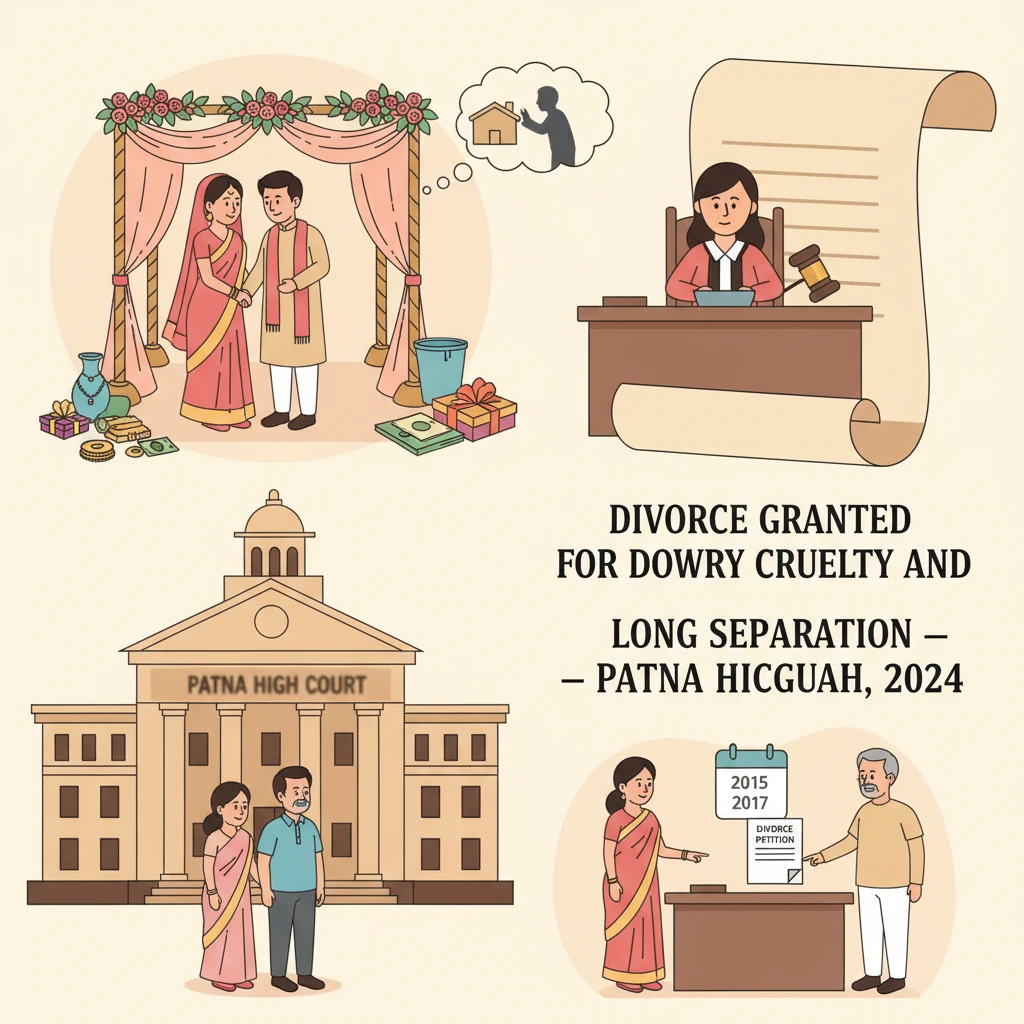
The Patna High Court set aside that order and granted her divorce on cruelty.
The Court relied on her unrebutted evidence and the husband’s total absence from proceedings.
The marriage now stands dissolved and a decree of divorce will be prepared.
Case Background
The case arose from a marriage solemnised on 30.11.2014 at House No. 33, Kidwaipuri, Patna, according to Hindu rites and customs.
According to the wife, her father had given cash of ten lakh rupees, 12 bhar (approximately 12 grams) of gold, 500 grams of silver, a television, fridge, washing machine and other household articles as gifts at the time of marriage.
On 01.12.2014, she went to her matrimonial home at village Jogiara, P.S. Jale, District Darbhanga.
She alleged that soon after she reached there, the husband and his family members started demanding more dowry. When this alleged demand was not met, she stated that she was assaulted and forced to leave the matrimonial home on 05.12.2014.
It was also claimed in the divorce petition that the marriage had not been consummated.
The wife further stated that after negotiation by her parents, she was taken back to the matrimonial home by the husband on 17.01.2015 (the father, examined as AW-2, mentioned the date as 17.12.2014).
According to her, the torture and dowry demand continued. She alleged that the husband refused to have physical relations with her despite her request and that she was again driven out on 20.03.2015 by the husband and his family members.
From that date, she claimed to have been living continuously at her parental home.
In October 2017, her parents again approached the husband and requested him to take her back. She alleged that the husband clearly refused.
On these facts, she filed a divorce petition on 03.01.2018 under Section 13(A) of the Hindu Marriage Act before the Additional Principal Judge, Family Court, Patna in Matrimonial (Divorce) Case No. 04 of 2018, asserting cruelty and desertion. She also stated that there was no issue from the marriage.
The Family Court issued notice to the husband, but he did not appear and the case proceeded ex parte. After recording evidence of the wife and her father, the Family Court dismissed the divorce petition by judgment dated 01.05.2023 and decree dated 09.05.2023.
Aggrieved, the wife filed this Miscellaneous Appeal No. 461 of 2023 before the Patna High Court.
What the Court Examined and Decided
The Patna High Court considered the appeal against the Family Court’s refusal to grant divorce. The appeal was heard by a Division Bench comprising Hon’ble Mr. Justice P. B. Bajanthri and Hon’ble Mr. Justice Alok Kumar Pandey (who authored the judgment).
The High Court first noted that all necessary processes had been issued by the Family Court to secure the presence of the husband, yet he never appeared. Similarly, this Court also issued notice, including substituted service, but the husband again did not appear. Thus, the allegations of the wife remained unrebutted at both stages.
The Court then carefully examined the oral evidence led by the wife and her father, and the documentary exhibits.
The wife, examined as AW-1 on 02.12.2019, deposed in a short but clear statement:
First, she confirmed the marriage on 30.11.2014 at Patna as per Hindu customs and that there was no child from the wedlock. She repeated the details of the gifts and cash given at the time of marriage and stated that she went to her matrimonial home on 01.12.2014 with her husband.
Second, she stated that she wanted divorce because her husband used to assault her after consuming wine. She said that he used to torture her, demand dowry and abuse her and her parents, due to which she was mentally harassed.
Third, she stated that she had been residing separately from her husband for the last four years on account of torture.
Finally, she said that the statements made in the divorce petition were true.
The father, Vijay Kumar Singh, was examined as AW-2 on 21.01.2021. In one concise paragraph, he supported and repeated the wife’s story.
He confirmed the marriage, the gifts given at the time of marriage and that his daughter went to her sasural, where the husband and his family allegedly demanded dowry and tortured her. Because of this, she came back to her parental home (Maike) on 05.12.2014.
He further stated that the appellant returned to her matrimonial home on 17.12.2014 after negotiation, but the husband and his family again began to torture her, forcing her to return to her Maike once more.
According to him, he and his family members tried to pacify the husband, but nothing worked. On 03.01.2018, the divorce case was filed. He also said that since March 2015 the parties had been living separately, that there was no child from the marriage, and that the case was filed due to torture and the husband’s drinking habit. He affirmed that the divorce claim was true.
The High Court observed that, though the evidence of both witnesses was short, it captured the essence of the divorce petition and clearly showed continuous separation since March 2015 due to alleged cruelty and dowry demands.
Turning to the impugned judgment, the Court recorded that the Family Court dismissed the divorce petition mainly on technical grounds.
The Family Court had reasoned that the wife had not lodged any complaint before any police station, appropriate forum or competent court regarding cruelty. It also held that neither she nor her witnesses could clearly describe the exact conduct of the husband and his family that amounted to torture. Further, it took note that, in her evidence, she did not state that the marriage was not consummated, though this was alleged in the petition. It concluded that occasional drinking, as stated in evidence, and alleged quarrels were merely “trivial matters” which did not amount to legal cruelty.
The Patna High Court disagreed with this approach.
The Court emphasised that matrimonial disputes are sensitive family matters. In such cases, strict standards of proof “beyond reasonable doubt” do not apply. Instead, the Court must decide on the basis of “preponderance of probability”, that is, what is more likely than not, after weighing the evidence as a whole.
The Court held that when the respondent does not appear in spite of due service and does not deny the facts stated in the divorce petition, the Court cannot step into the shoes of a party. It has to evaluate whether the evidence that is available supports the claim.
In this case, the wife had clearly stated that she was tortured for dowry, assaulted after the husband consumed wine, and mentally harassed. She had also consistently said that she had been living separately since 20.03.2015 due to this conduct. Her father fully corroborated her version.
The High Court noted that the husband had made no effort to resume the matrimonial relationship or even to contest the allegations. The parties had been separated for more than eight years by the time the appeal was heard. The wife, who was about 30 years old when she filed the divorce petition, was about 35 years old at the time of the appeal, having spent her “precious and valuable time” in litigation while the husband showed no concern.
The Court observed that in a normal matrimonial life, both husband and wife are expected to care for each other, and occasional quarrels should not lead to long-term neglect. Where one spouse has “nothing to do” with the other for years and does not even appear in court, it shows a clear lack of emotional bond and responsibility.
In such circumstances, the Court held that continuing the marriage only keeps the wife’s life hanging in a “pendulum” and converts the relationship into a “loaded bearing unit”, rather than a source of companionship. Divorce then becomes a remedy on the ground of cruelty.
To support its reasoning, the Court referred to several Supreme Court decisions on cruelty under the Hindu Marriage Act.
It cited Dr. N.G. Dastane v. Mrs. S. Dastane (AIR 1975 SC 1534), where cruelty was described as wilful and unjustified conduct causing danger to life, limb or health, or giving rise to a reasonable apprehension of such danger.
It referred to V. Bhagat v. D. Bhagat (1994 AIR 710) and Shobha Rani v. Madhukar Reddi (1988) 1 SCC 105, where the Supreme Court explained that cruelty includes mental as well as physical cruelty and covers a course of conduct that adversely affects the other spouse.
It relied on Roopa Soni v. Kamalnarayan Soni (2023 SCC OnLine SC 1127), which stressed that “cruelty” under Section 13(1)(ia) has no fixed meaning and must be understood in the context of the parties’ social and economic conditions, and that courts should adopt a “social justice adjudication” approach, being sensitive to the imbalance between parties.
Finally, it referred to Samar Ghosh v. Jaya Ghosh (2007) 4 SCC 511, especially the guideline that the entire matrimonial relationship must be considered, including non-violent forms of cruelty like constant reproaches, accusations and taunts, and the effect of such conduct on the mind of the complaining spouse.
Applying these principles to the facts, the High Court found that:
The wife had clearly given reasons for living separately, namely torture, dowry demands and assault by a drinking husband.
The parties had been living apart since 20.03.2015, with no attempt by the husband to resume cohabitation, not even by filing a petition for restitution of conjugal rights under Section 9 of the Hindu Marriage Act.
The husband’s complete absence from the litigation showed neglect and lack of emotional concern, causing mental agony to the wife for several years.
On this basis, the Court held that the wife had established cruelty and long separation sufficient to grant divorce.
The High Court found the Family Court’s approach to be “hyper technical and pedantic” and held that it had failed to appreciate the evidence in the correct legal perspective.
Consequently, the Patna High Court set aside the judgment dated 01.05.2023 and decree dated 09.05.2023 passed by the Additional Principal Judge, Family Court, Patna.
It declared that the marriage between the appellant and the respondent held on 30.11.2014 at House No. 33, Kidwaipuri, P.S. Kotwali, District Patna “stands dissolved from this day”.
Miscellaneous Appeal No. 461 of 2023 was allowed, and the office was directed to prepare the decree of divorce accordingly.
Why This Judgment Matters
This judgment is important for spouses, especially women, who face cruelty and long-term neglect in marriage but may not have filed police complaints or other cases at the time of the abuse.
The Patna High Court has made it clear that in family matters, the court will look at the total picture of the marriage, the conduct of the parties and their long separation. The absence of criminal complaints or very detailed evidence is not fatal if the story told in court is consistent, supported by another witness and remains unrebutted.
The judgment recognises that when a husband refuses to participate in proceedings, makes no effort to bring his wife back and allows the marriage to remain dead for years, this behaviour can itself amount to mental cruelty.
For litigants in Bihar and elsewhere, the decision reinforces that family courts must avoid overly technical objections and should decide divorce cases on preponderance of probability, keeping in mind social realities and the need for “social justice adjudication”.
Legal Issues and Answers
- Issue: Whether the wife proved cruelty by the husband under the Hindu Marriage Act, despite no criminal complaint and brief oral evidence.
Answer: Yes. The Patna High Court held that her consistent and corroborated testimony, unrebutted by the absent husband and supported by long separation and neglect, established cruelty on a preponderance of probability. - Issue: Whether the Family Court was right in dismissing the divorce petition on technical grounds and for want of “strict proof”.
Answer: No. The High Court found the Family Court’s approach hyper technical and contrary to the standard applicable in matrimonial cases; it set aside the judgment and granted divorce.
Cases Cited by the Court
- Dr. N.G. Dastane v. Mrs. S. Dastane, AIR 1975 SC 1534
- V. Bhagat v. D. Bhagat, 1994 AIR 710
- Shobha Rani v. Madhukar Reddi, (1988) 1 SCC 105
- Vishwanath Agrawal v. Sarla Vishwanath Agrawal, (2012) 7 SCC 288
- Badshah v. Urmila Badshah Godse, (2014) 1 SCC 188
- Roopa Soni v. Kamalnarayan Soni, 2023 SCC OnLine SC 1127
- Samar Ghosh v. Jaya Ghosh, (2007) 4 SCC 511
Case Details
Case Number: Miscellaneous Appeal No. 461 of 2023
Case Title: Shweta Singh v. Pranav Kumar Singh
Citation: 2024 (4) PLJR 437
Court: High Court of Judicature at Patna
Coram: Hon’ble Mr. Justice P. B. Bajanthri and Hon’ble Mr. Justice Alok Kumar Pandey
Date of High Court Judgment: 12.09.2024
Impugned Order: Judgment dated 01.05.2023 and decree dated 09.05.2023 in Matrimonial (Divorce) Case No. 04 of 2018, Additional Principal Judge, Family Court, Patna
Advocates: Mr. Sahil Kumar for the appellant; advocate for the respondent not specified; respondent remained absent
Nature of Case: Miscellaneous appeal against dismissal of a divorce petition under the Hindu Marriage Act; matrimonial (divorce) matter
Link to Full Judgment: Click here to read the Patna High Court judgment
If you found this explanation helpful and wish to stay informed about
how legal developments may affect your rights in Bihar,
you may consider following Samvida Law Associates for more updates.







