

Case Background
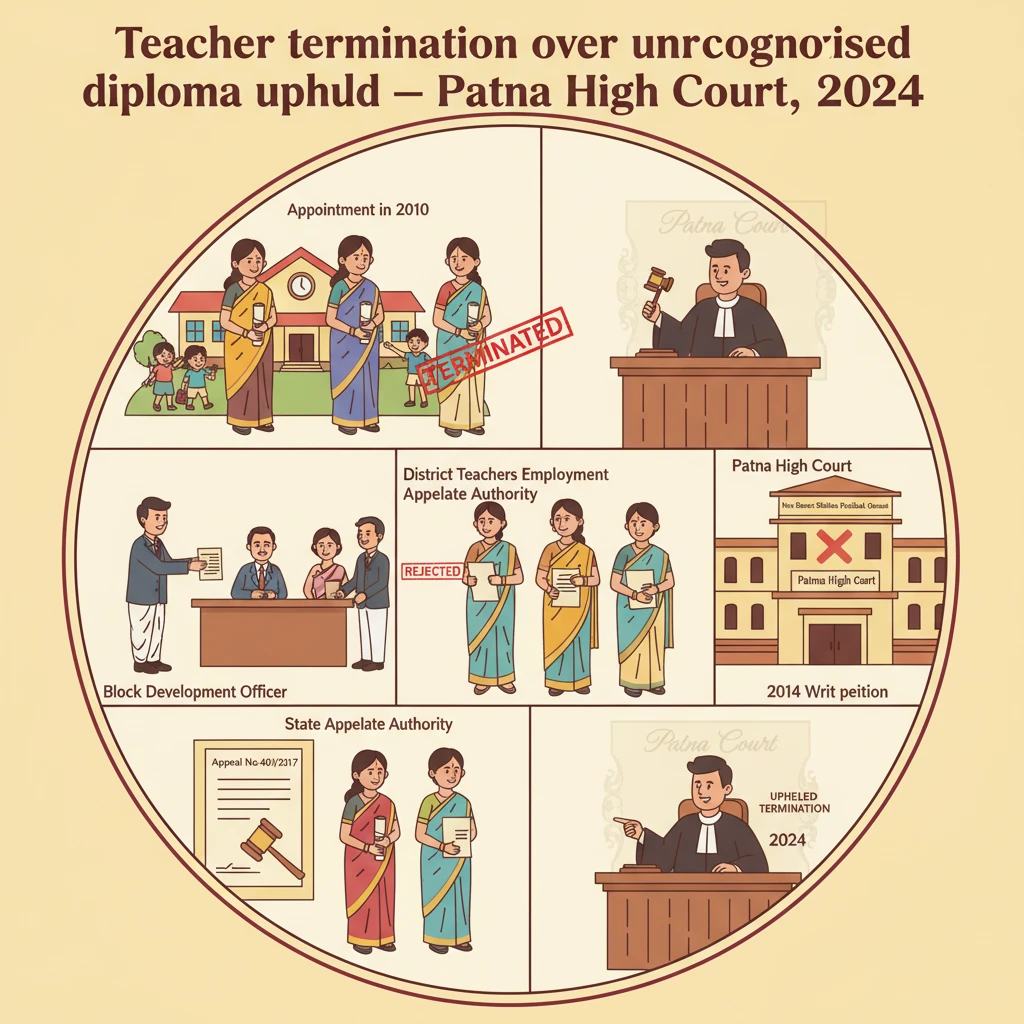
The case arose from appointments made in response to an advertisement issued in 2008 for the post of Block Physical Teacher and other posts under the Education Department. The advertisement required candidates to possess a Certificate in Physical Education (C.P.Ed.).
The petitioners had obtained their physical education qualification from Nav Bharat Shiksha Parishad (NSP), Orissa (India). Relying on these certificates, they applied for the Block Physical Teacher posts and were selected. They were appointed in 2010 and posted in different middle schools under Saraiya Block in the Muzaffarpur district.
According to the petitioners, they discharged their duties satisfactorily and there was no complaint about their work. However, in 2013, things changed. The Block Development Officer, Saraiya (respondent no.6), issued Memo No.471 dated 05.09.2013, by which the petitioners were terminated from service as Prakhand Teachers.
The termination order referred to a rejection order earlier passed by the Principal Secretary, Education Department (respondent no.2) in relation to some other candidates who had also claimed to hold qualifications from Nav Bharat Shiksha Parishad, Orissa. The petitioners’ services were ended without, according to them, any prior notice or personal hearing.
The petitioners then approached the District Teachers Employment Appellate Authority, Muzaffarpur (respondent no.5). By order dated 13.12.2013, contained in Memo No.151/2012, the Authority rejected their appeal and upheld the termination orders.
Unsatisfied, the petitioners filed CWJC No.7365 of 2014 before the Patna High Court. The Court directed them to move before the State Appellate Authority, Patna (respondent no.9) within 30 days, and ordered that the appeal be decided within the statutory period. The petitioners duly filed an appeal, but the State Appellate Authority also rejected their claim, agreeing with the District Appellate Authority.
The petitioners then filed the present Civil Writ Jurisdiction Case No.3281 of 2020. They sought quashing of the State Appellate Authority’s order dated 07.08.2019 in Appeal No.401/2017, as well as the original termination orders of 2013, and prayed for reinstatement with all monetary benefits.
What the Court Examined and Decided
Justice Anjani Kumar Sharan of the Patna High Court heard the matter and examined the petitioners’ challenge to their termination and the orders passed by the District and State Appellate Authorities.
The petitioners’ core case was that the certificates issued by Nav Bharat Shiksha Parishad, Orissa, were valid and had been accepted earlier by the Education Department and by courts. They argued that their termination was based only on suspicion, without proper enquiry or notice, and that it violated principles of natural justice and Article 14 of the Constitution of India.
They pointed out that the advertisement for Block Physical Teachers in 2008 required a C.P.Ed. qualification and that they fulfilled this requirement with better marks than other candidates. After their appointment, they worked at different schools under Saraiya Block and no doubt was raised about their work.
According to them, the Block Development Officer, Saraiya, had no jurisdiction to terminate them and merely relied on a letter of the Principal Secretary, Education Department, issued in connection with other employees. That letter was Memo No.617 dated 17.05.2013, issued in compliance with an earlier High Court order in CWJC No.14819 of 2012.
The petitioners argued that instead of independently verifying their certificates or holding an enquiry, the authorities simply presumed that their qualifications were fake or invalid. They highlighted that the District Appellate Authority, Muzaffarpur, in another case, had earlier held that certificates issued by Nav Bharat Shiksha Parishad were valid, as reflected in Memo No.463 dated 26.12.2011.
The petitioners also relied on departmental correspondence. They referred to Letter No.562 dated 26.05.2009 issued by the Principal Secretary, Education Department, to the Administrative Officer of Nav Bharat Shiksha Parishad, Orissa. In that letter, the Department noted that in some cases appointments might have been made on the basis of fake institutions, and therefore directed that certificates from NSP should be verified by departmental representatives. The letter enclosed eleven certificates for verification and requested that no extra amount be demanded for verification.
They further stated that the State Government had sent lists of candidates and their certificates to NSP for verification. In response, NSP sent a list of 323 verified certificates to the Principal Secretary on 27.07.2009. The State Certificate Verification Cell also continued to verify certificates from NSP from time to time through its representatives.
The petitioners submitted that prior to the appointment of 34,540 teachers, a panel of candidates was prepared under the supervision of Hon’ble Mr. Justice S.K. Chattopadhaya (Retd.). During that process, certificates, including those from NSP, were verified and accepted. On that basis, the State Government, before the Supreme Court, asserted that the panel and certificates were valid and genuine, leading to the Supreme Court directing appointments from that panel. The petitioners stressed that several candidates with NSP certificates had been appointed.
On this foundation, the petitioners argued that once the Principal Secretary had, on affidavit before the Supreme Court, stated that NSP and its certificates were valid, the same authority could not now take a different stand for them. They claimed discrimination when others with similar qualifications were allowed to continue.
They also referred to earlier writ petitions, CWJC No.6753 of 2013 and CWJC No.17365 of 2014, where termination of Assistant Teachers based on doubt over NSP certificates was set aside by the High Court and the employees were ordered to be reinstated.
The State, in its counter affidavit, took a firm stand against the petitioners. The State pointed out that in CWJC No.14819 of 2012 the Court had directed the Principal Secretary, Human Resources Development Department, to examine the claim relating to NSP certificates. Thereafter, in LPA No.921 of 2012, the Division Bench of the Patna High Court held that the appellants in that case failed to prove that Nav Bharat Shiksha Parishad, Orissa, was recognised by the State of Bihar for appointment to the post of Panchayat Teacher.
In compliance with these directions, the Principal Secretary, Education Department, issued Memo No.617 dated 17.05.2013, categorically stating that Nav Bharat Shiksha Parishad, Orissa, was not recognised by the National Council for Teacher Education (NCTE), University Grants Commission (UGC) or any State. The State argued that the petitioners’ C.P.Ed. certificates being from an unrecognised institution, they did not meet the basic eligibility criteria for appointment.
On this basis, the State submitted that the petitioners’ appointments were irregular and illegal from the very beginning. Therefore, the Block Development Officer, Saraiya, was justified in terminating their services through Memo No.471 dated 05.09.2013. The State defended the termination as legal and bona fide.
The State also distinguished the petitioners’ reliance on Special Leave Petition No.22882 of 2024 (Nand Kishore Ojha vs. The State of Bihar & Ors.), saying that it was not similar and could not govern their case.
After hearing both sides at length, the Patna High Court focused on a single decisive question: whether the petitioners had proved that the institution from which they obtained their C.P.Ed. certificates, Nav Bharat Shiksha Parishad, Orissa, was recognised by the State of Bihar for the purpose of appointment as teachers.
The Court noted that the petitioners had failed to establish that NSP was recognised. It referred to the earlier decision in LPA No.921 of 2012, where the Division Bench had clearly held that the appellants there failed to prove that NSP was recognised by the State of Bihar for appointment to the post of Panchayat Teacher.
In the present case, the Court found no material placed by the petitioners to overcome or contradict that finding. The Court therefore concluded that the petitioners’ certificates from NSP could not be treated as valid qualifications for appointment as Block Physical Teachers under the State of Bihar.
Because this basic eligibility was missing, the Court held that there was no merit in the petitioners’ challenge to their termination. The order records:
“It is clear that the petitioners have failed to establish that the certificate procured by them from the institution i.e. Nav Bharat Shiksha Parisad, Orrisa (NSP) is recognized by the State of Bihar. It is also clear from the order passed in L.P.A. No.921 of 2012 that the petitioner has failed to prove or establish that the institution in question is recognized by the State of Bihar for appointment to the post of Panchayat Teacher.”
On this reasoning, the Court dismissed the writ petition, leaving the termination orders and appellate orders undisturbed.
Why This Judgment Matters
This judgment is important for candidates and teachers who rely on certificates from private or out-of-State institutions. The Patna High Court has made it clear that, for government teacher appointments in Bihar, it is not enough that a person holds a certificate; the institution issuing that certificate must be formally recognised by the competent authorities.
If an institution like Nav Bharat Shiksha Parishad, Orissa, is not recognised by NCTE, UGC, or by the State of Bihar, then its certificates cannot be used to claim a right to appointment or to continue in service as a teacher. Even if a person has worked for several years and has performed duties satisfactorily, the appointment can still be treated as invalid if the basic qualification is not recognised.
The judgment also shows that earlier departmental correspondence or verification exercises do not, by themselves, amount to recognition of an institution unless there is a clear and formal recognition by law or by the State. Candidates must therefore verify the legal status of their training institute before depending on such qualifications for public employment.
Legal Issues and Answers
- Issue: Were the petitioners’ C.P.Ed. certificates from Nav Bharat Shiksha Parishad, Orissa, recognised by the State of Bihar so as to make them eligible for appointment as Block Physical Teachers?
Answer: No. The Court held that the petitioners failed to prove that Nav Bharat Shiksha Parishad, Orissa, was recognised by the State of Bihar, and relied on LPA No.921 of 2012 which had already taken the same view. - Issue: In light of the status of their certificates, were the petitioners entitled to quashing of their termination and reinstatement with benefits?
Answer: No. Since their certificates were from an unrecognised institution, their appointments were not valid, and the Court found no merit in the writ application and dismissed it.
Cases Cited by the Court
- CWJC No.14819 of 2012 – the Court had earlier directed examination of claims based on NSP certificates.
- LPA No.921 of 2012 – Division Bench held that Nav Bharat Shiksha Parishad, Orissa, was not proved to be recognised by the State of Bihar for appointment as Panchayat Teacher; this finding was relied upon in the present case.
Case Details
Case Number: Civil Writ Jurisdiction Case No.3281 of 2020
Case Title: Ramesh Kumar Trivedi & Ors. vs. The State of Bihar & Ors.
Coram: Hon’ble Mr. Justice Anjani Kumar Sharan
Date of Judgment: 17.09.2024
Citation: 2024(4) PLJR 376
Advocates:
- For the petitioners: Mr. Shashi Bhushan Singh
- For the respondents/State: Mr. Madhaw Pd. Yadaw (GP 23)
- For the respondents/State: Mr. Arvind Kumar, AC to GP 23
Nature of the Case: Writ petition (service matter relating to termination of Block Physical Teachers and validity of qualification)
Link to the Judgment: Click here to read the full judgment of the Patna High Court
If you found this explanation helpful and wish to stay informed about
how legal developments may affect your rights in Bihar,
you may consider following Samvida Law Associates for more updates.







