

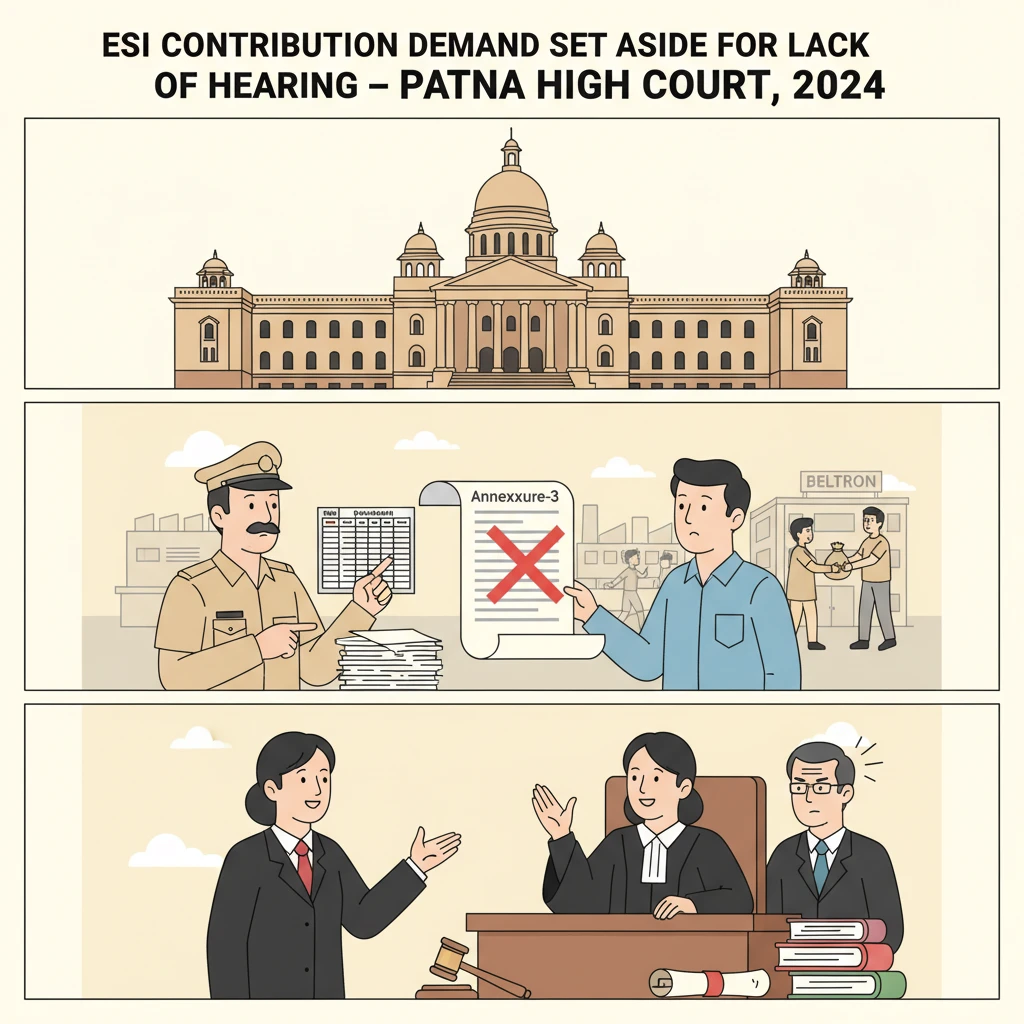
Case Background
This case arose from a dispute over ESI contribution demanded from a contractor supplying manpower to a government corporation in Bihar.
The first respondent was a firm engaged in supplying personnel to the second respondent, Bihar State Electronic Development Corporation Ltd. (BELTRON), described by the Court as the principal employer. The firm was treated as the immediate employer.
During the period from 01.12.2010 to 31.03.2012, BELTRON disbursed an amount of Rs. 21,00,900 towards ESI contribution for the manpower supplied by the immediate employer. This amount was deposited with the Employees State Insurance Corporation.
A Social Security Officer (SSO) conducted an inspection of the records of the immediate employer under the ESI Act. Based on this inspection, a notice (Annexure-3 in the writ petition) was issued to the contractor and its partner, pointing out alleged non-filing of returns and short payment of ESI contribution.
In the notice, the Corporation claimed the total contribution for the period as Rs. 1,18,14,512, acknowledged the deposit of Rs. 21,00,900, and demanded the balance of Rs. 97,13,612. The notice directed payment within 15 days, failing which coercive recovery under Sections 45-C to 45-I of the ESI Act was threatened.
The contractor approached the High Court in a writ petition challenging this demand and proposed recovery. A learned Single Judge allowed the writ petition, found fault with the recovery process, and directed refund of Rs. 27,51,118, while requiring fresh determination after notice and hearing.
Aggrieved, the Union of India and ESI officials filed this Letters Patent Appeal (LPA No. 1611 of 2017) before a Division Bench of the Patna High Court.
What the Court Examined and Decided
The Division Bench, speaking through the Hon’ble Chief Justice, confined itself to one core question: when the ESI authorities claim additional contribution after inspection based on the employer’s own records, is it still mandatory to determine the dues under Section 45-A of the ESI Act after giving an opportunity of hearing?
The appellants (Union of India and ESI officials) argued that the demand in this case was based squarely on the records maintained by the employer and inspected by the SSO. According to them, once the books disclosed the relevant figures and the demand matched those figures, the amount should be treated as admitted. Therefore, no separate determination under Section 45-A, and no further hearing, was necessary.
They further submitted that the ESI Corporation is a welfare body created to protect employees, and employers cannot be allowed to withhold contributions that should go to employees’ benefit. They relied on a Division Bench judgment of the Madras High Court in Writ Appeal No. 2171 of 2023 (Deputy Director v. Management of SRTC Tech Solutions), where it was held that when demand is raised on “actuals” after inspecting the employer’s records, Section 45-A does not apply.
On the other side, counsel for the respondent-employer highlighted that the notice itself alleged non-filing of returns by the employer. Once the Corporation takes this stand, Section 45-A is clearly attracted, because that provision specifically covers cases where returns, registers or records have not been submitted, furnished or maintained in accordance with Section 44 of the ESI Act.
The employer argued that substantial amounts had already been deposited with the Corporation, and that the Single Judge’s order only required the Corporation to go back and properly determine what, if any, additional amount was due, after issuing notice to both the immediate employer and the principal employer. No prejudice, therefore, was caused to the Corporation.
The employer also pointed out that, given that the appeal had been pending since 2017, any continued retention of money by the Corporation would attract interest liability under Section 39(5)(a) of the ESI Act at 12% per annum or such higher rate as might be prescribed.
The Division Bench reviewed the impugned Single Judge judgment, which had discussed the ESI Act, particularly the definitions of “immediate employer” and “principal employer,” and had found that the first respondent was the immediate employer, with BELTRON as principal employer.
The Single Judge had also noted that Annexure-3 set out the obligation of the principal employer to pay both the employer’s and employees’ shares of contribution and to submit returns of contribution in Form-6 along with bank challans, in terms of Regulation 26 of the Employees’ State Insurance (General) Regulations, 1950.
The Division Bench then turned to the legal framework. It recalled the Supreme Court’s decision in ESI Corporation v. C.C. Shantakumar (2007) 1 SCC 584. In that case, the Supreme Court explained that Section 45-A was inserted to deal with the practical difficulty of first going to the ESI Court under Section 75 whenever there was dispute about contributions. Section 45-A empowers the Corporation itself to determine, by order, the amount of contribution payable on the basis of available information, when proper returns or records are not available or the SSO is obstructed.
The Bench noted that once an order is passed under Section 45-A, the determined amount can then be recovered more speedily as arrears of land revenue under Section 45-B, instead of proceeding through the ESI Court.
The Court emphasized that Section 45-A is triggered not only when no documents exist, but also when the returns or records are not maintained “in accordance with” Section 44. Section 44(3) requires principal and immediate employers to maintain prescribed registers and records. If an inspection reveals that the information in the returns does not tally with actual employment records, or the registers are not as required, Section 45-A becomes applicable.
The Division Bench accepted the employer’s submission that where non-filing of returns is alleged, Section 45-A necessarily comes into play. Even if the employer’s argument is accepted that some returns had been filed and some contributions paid, the Court held that if inspection shows a shortfall or discrepancy, then the returns cannot be treated as being “in accordance with” Section 44. That again triggers Section 45-A.
The Court highlighted the first proviso to Section 45-A, which clearly states that no order under Section 45-A shall be passed unless the principal or immediate employer (or person in charge) has been given a reasonable opportunity of being heard. The Bench also reminded that, quite apart from this express proviso, the broader principles of natural justice, as explained by the Supreme Court in Mohinder Singh Gill v. Chief Election Commissioner (1978) 1 SCC 405, require a hearing before any prejudicial order such as a large monetary demand is passed.
Therefore, the Court concluded that the Corporation’s action in raising a demand and threatening recovery without first holding a proper determination proceeding under Section 45-A, preceded by notice and hearing, violated both the statute and natural justice.
The Bench rejected the Corporation’s plea that an alternative remedy was available and so the writ petition should not have been entertained. Relying on the Supreme Court decision in Gujarat Ambuja Exports v. State of Uttarakhand (2016) 3 SCC 601, the Court held that when recovery is initiated contrary to the statute, it becomes an abuse of process, and the High Court can intervene under Article 226 of the Constitution.
On the argument of “admitted dues,” the Division Bench clarified that the SSO’s statement that a certain amount appears payable from the inspected records does not itself become an admission by the employer. A proper determination under Section 45-A would require the SSO, acting for the Corporation, to clearly set out the facts and figures gathered from records and to show how they differ from the employer’s returns. The employer must then be given an opportunity to explain or dispute these figures before any binding order is passed.
The Court then examined the Madras High Court decision in Management of SRTC Tech. Solutions Pvt. Ltd., Writ Appeal No. 2171 of 2023, which spoke of two types of notices: Form C-18 (adhoc) and Form C-18 (actual). In that decision, it was held that Section 45-A deals only with adhoc claims and not with actuals.
To test this proposition, the Patna High Court asked counsel where these forms came from, since they are not in the ESI Act or the Rules. On being given time, counsel for the respondent produced an internal Revenue Manual of the ESI Corporation. Paragraph L.12.5 of Chapter 12, quoted in the judgment, describes how SSOs should deal with omitted wages detected during inspection, and prescribes the issue of observation slips and then notice in Form C-18 (actual) or Form C-18 (adhoc).
Importantly, the same paragraph states that while determining contribution on either adhoc or actual basis, a “well reasoned speaking order under Section 45-A” must be issued, after giving the employer a reasonable opportunity of being heard. The Division Bench underlined this part and treated it as a significant clarification that even the Corporation’s own internal manual contemplates a Section 45-A order, with hearing, in both types of cases.
The Court noted that the Manual is not statutory, but the portion insisting on a reasoned order under Section 45-A and a prior hearing correctly reflects the statutory requirement. Therefore, the Madras High Court view that Section 45-A is inapplicable when contributions are demanded on actuals could not assist the appellants in this case.
Finding that the statutory requirement of Section 45-A determination and hearing had admittedly not been followed, the Division Bench upheld the Single Judge’s decision to interfere with the demand and recovery.
On the question of refund, the Single Judge had directed repayment of Rs. 27,51,118. The Division Bench slightly modified how this refund would operate. It held that the Corporation need not immediately refund the amount if it initiates proper proceedings under Section 45-A within one month from the date of uploading of this judgment.
The Court issued a clear timetable. A fresh notice must be issued to both the principal employer (BELTRON) and the immediate employer (the contractor) within one month from uploading of the judgment. The employers then have one month from receipt of notice to file detailed objections. After objections are filed, the Corporation must fix a hearing within two weeks and give an opportunity of personal hearing. The employers must cooperate and may seek not more than one adjournment.
An order under Section 45-A must then be passed within three months from the date of hearing, and in any case within one month from the first date of posting for hearing. If such an order is passed within the time fixed, no refund need be made and further recovery will depend on that final order, including any interest liability.
However, if no order is passed within the prescribed time, the Corporation must refund Rs. 27,51,118 to the employer. Any further recovery and interest obligations will then depend on whatever final orders are eventually made.
With these directions and clarifications, the Division Bench dismissed the Letters Patent Appeal.
Why This Judgment Matters
This judgment is important for contractors, principal employers, and workers covered by the ESI Act in Bihar and beyond.
The Patna High Court has made it clear that ESI officers cannot straightaway demand large sums and start recovery just because an inspection has been carried out, even if they rely on records maintained by the employer. A proper determination proceeding under Section 45-A, with a speaking order and a fair hearing, is mandatory.
For small and medium establishments, especially those supplying manpower to government bodies, this ruling provides protection against sudden, unilateral demands. At the same time, the Court has not allowed employers to escape liability; it has only insisted that the Corporation follow the law and principles of natural justice before taking money.
The decision also clarifies that the existence of an alternative statutory remedy does not stop the High Court from intervening when recovery is attempted contrary to the scheme of the ESI Act.
Legal Issues and Answers
- Issue: Can the ESI Corporation recover alleged short-paid contributions based solely on inspection of the employer’s records without first determining dues under Section 45-A and giving a hearing?
Answer: No. The Corporation must pass a well reasoned order under Section 45-A after issuing notice and giving the principal and immediate employer a reasonable opportunity of being heard. - Issue: Does the existence of an alternative remedy bar a writ petition when recovery is initiated in violation of the ESI Act procedure?
Answer: No. When recovery is not in accordance with the statute and amounts to abuse of process, the High Court can exercise jurisdiction under Article 226. - Issue: Is a demand based on the employer’s own records to be treated as an admission of liability, dispensing with Section 45-A proceedings?
Answer: No. The SSO must still set out the basis of calculation and discrepancies, and the employer must get an opportunity to contest them before any binding determination is made.
Cases Cited by the Court
- Gujarat Ambuja Exports v. State of Uttarakhand & Others; (2016) 3 SCC 601.
- ESI Corporation v. C.C. Shantakumar; (2007) 1 SCC 584.
- Mohinder Singh Gill & Another v. The Chief Election Commissioner; (1978) 1 SCC 405.
- Management of SRTC Tech. Solutions Pvt. Ltd., Writ Appeal No. 2171 of 2023 (Madras High Court) — distinguished based on statutory scheme and ESI Revenue Manual.
Case Details
Case Number: Letters Patent Appeal No. 1611 of 2017 in Civil Writ Jurisdiction Case No. 6882 of 2014
Case Title: The Union of India and Ors v. M/s Electronic Net Through its Partner Sanjeev Kumar and Anr & The Bihar State Electronic Development Corporation Ltd. BELTRON Bhawan, Bailey Road, Shastrinagar, Patna
Coram: Hon’ble The Chief Justice K. Vinod Chandran; Hon’ble Mr. Justice Nani Tagia
Date of Judgment: 13-09-2024
Citation: 2024 (4) PLJR 206
Advocates:
- For the Appellants (Union of India and ESI officials): Mr. S. D. Sanjay, Sr. Advocate; Mr. Sheo Narayan Singh, Advocate
- For the Respondents (employer and BELTRON): Mr. Alok Kumar Sinha, Advocate; Mr. Girijish Kumar, Advocate; Mr. Kumar Aditya Karan, Advocate; Mr. Indrajit Bhushan, Advocate
Nature of the Case: Letters Patent Appeal against judgment in writ petition concerning recovery of ESI contributions and procedure under Section 45-A of the Employees’ State Insurance Act, 1948
Link to Judgment: Full text of Patna High Court judgment
If you found this explanation helpful and wish to stay informed about
how legal developments may affect your rights in Bihar,
you may consider following Samvida Law Associates for more updates.







