

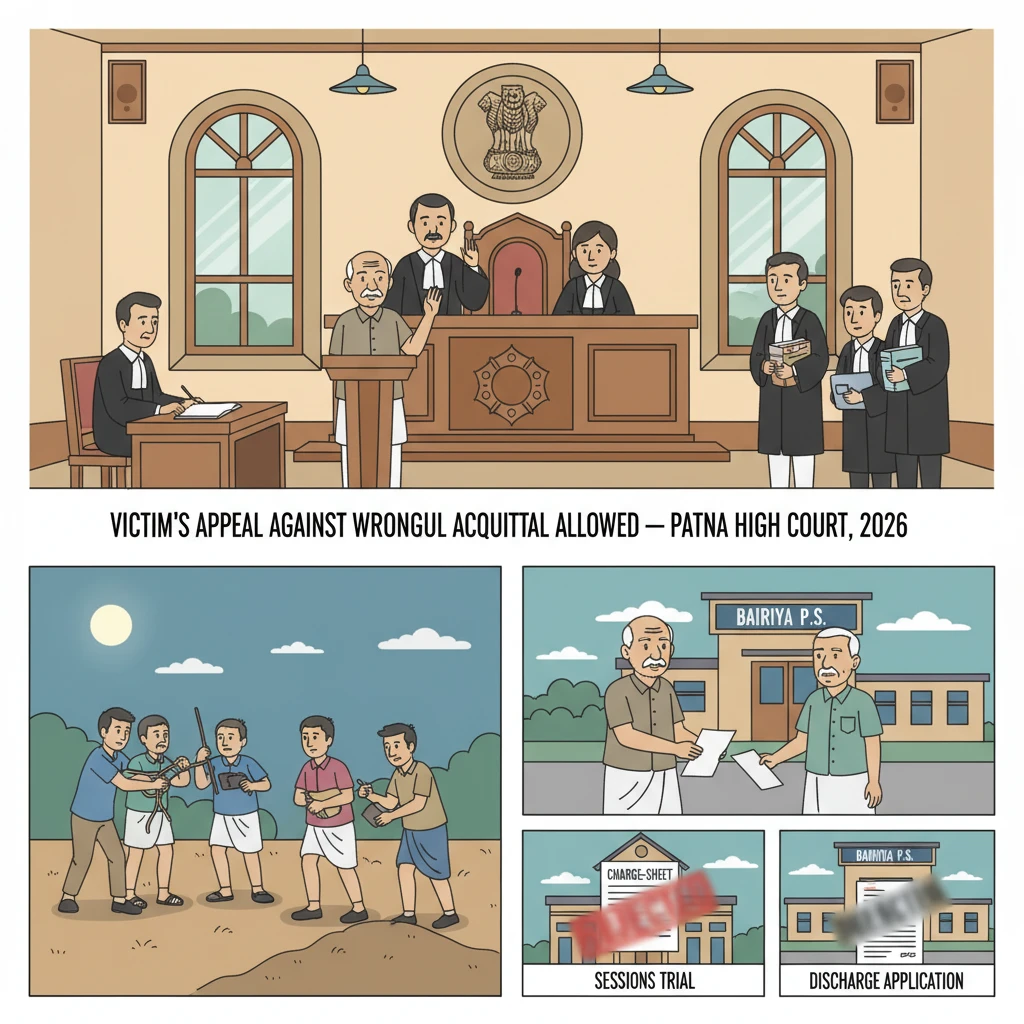
The Court held that the trial judge and public prosecutor had failed to do their basic duties to secure witnesses.
The case is sent back for a fresh criminal trial, and a non-bailable warrant has been issued against the accused.
The trial court must now ensure witnesses are produced and the case is decided after hearing real evidence.
Case Background
This case arises from a village dispute in Bhitaha, P.S. Bairiya, District West Champaran. The victim, Sharma Dubey, lodged a fardbeyan on 22.01.2009 at 18:15 hours before S.I. Nagendra Paswan of Town Police Station, Bettiah.
He alleged that on 21.01.2009 around 8–9 PM, his co-villager Rajendra Dwivedi was cutting the ridge of his land with a spade. When he objected, a quarrel took place but was pacified by villagers. Later that night, around 8 PM, it is alleged that Rajendra Dwivedi, his sons Amit and Sumit, and Barristar (Barisrar) Dwivedi entered the informant’s house armed with lathi, danda and a rope, abused him and then attacked him.
According to the fardbeyan, Rajendra and his two sons put a rope around the informant’s neck and pulled, causing suffocation and shortness of breath, while Barristar allegedly assaulted him with a lathi on his back and other parts of the body. When the informant’s wife and daughter tried to save him, several co-villagers rushed and intervened. The informant also alleged that Rs. 1,500 was taken from his pocket and he was threatened with death if he lodged a case.
On this basis, Bairiya P.S. Case No. 22 of 2009 dated 01.02.2009 was registered for offences under Sections 341, 323/307, 379, 427, 428, 504/34 of the Indian Penal Code (IPC).
Police investigated and submitted a charge-sheet naming seven witnesses, including the informant, three eye-witness villagers, the doctor from M.J.K. Hospital, Bettiah, and two police officers (the Investigating Officer and an Assistant Sub-Inspector). On 10.06.2010, the Chief Judicial Magistrate, Bettiah took cognizance of offences under Sections 341, 323, 307, 379, 427, 448 and 504/34 IPC, and summoned four accused to face trial. Two of the originally named persons, Amit and Sumit, were not sent up for trial.
Since Section 307 IPC is exclusively triable by the Court of Sessions, the case records were committed to the Sessions Court on 20.07.2011. Sessions Trial No. 323 of 2011 was registered on 22.07.2011.
The accused persons filed a discharge application under Sections 227 and 228 Cr.P.C., claiming the case was a counter blast to Bairiya P.S. Case No. 29 of 2009 arising out of a land dispute. The trial court rejected this plea on 18.04.2012 and proceeded to frame charges on 01.05.2012 under Sections 307/34, 448, 504 and 342 IPC.
However, from 2012 onwards, the trial virtually stalled. No prosecution witness was examined. The records show multiple adjournments, transfers between different Additional District and Sessions Judges, lack of effective steps for securing witnesses, and repeated non-appearance or inaction by the Assistant Public Prosecutor (APP).
Despite some orders mentioning summons, bailable warrants and non-bailable warrants, there is no proof on record that these were actually served or executed. Even a letter supposedly addressed to the Superintendent of Police, Bettiah, for helping secure the witnesses has no proof of dispatch or receipt in the record.
At one point, on 05.12.2018, a prosecution witness (Rakesh Kumar Dwivedi) did appear, but because the accused’s side did not appear that day and his bail bond was cancelled, the witness had to return without examination.
Ultimately, on 13.12.2019, the District and Additional Sessions Judge-V-cum-Special Judge, Excise, Bettiah acquitted respondent no. 2, Barristar Dwivedi, under Section 232 Cr.P.C., holding that the prosecution had failed to examine even a single witness despite several opportunities. This was a one-page order passed in the absence of the State representative.
The victim, using the proviso to Section 372 of the Code of Criminal Procedure (since repealed), filed Criminal Appeal (DB) No.144 of 2021 before the Patna High Court, challenging the acquittal.
What the Court Examined and Decided
The Patna High Court first dealt with the issue of delay in filing the appeal. The impugned judgment was dated 13.12.2019, and the normal limitation period would have ended on 12.03.2020. The appeal was filed beyond this period.
The appellant explained that due to the surge in Covid-19 cases and the nationwide lockdown, he could not file within time. Relying on the Supreme Court’s orders in Civil Writ (Suo Moto) No. 03 of 2020, the Court noted that the period between 15.03.2020 and 28.02.2022 was to be excluded from the limitation calculation. The learned Additional Public Prosecutor for the State did not contest this position.
The High Court accepted the explanation, found that the delay of 324 days had been properly accounted for, and allowed I.A. No. 01 of 2025, thereby condoning the delay.
Coming to the merits, the Court closely examined the one-page acquittal order dated 13.12.2019 under Section 232 Cr.P.C. The trial court had recorded that despite several steps and several opportunities, no prosecution witness had appeared, and therefore, the accused, facing trial since 2012, was acquitted “in the interest of justice” on the ground of no evidence.
The High Court then turned to the actual lower court record to see what had really happened over these years. This detailed scrutiny revealed serious lapses.
Firstly, after charges were framed on 01.05.2012, the trial court’s order sheet has a margin note that summons had been issued to witnesses 1 to 4. However, there was no signature under this endorsement and no actual summons or service reports on record to show that witnesses were ever properly summoned.
Secondly, the order sheet for 04.03.2013 has “W.A. issued” written in the margin, suggesting a warrant of arrest against witnesses. Again, there is no signature, no warrant on record, and no execution report. The High Court stressed that there was nothing to show that any such warrant was ever actually executed.
Thirdly, on 07.08.2014 the trial court directed that a letter be written to the Superintendent of Police, Bettiah, for producing witnesses. A cyclostyled copy of such a letter is in the record, but there is no proof of dispatch, and no indication whether it reached the S.P.’s office or evoked any response.
For years thereafter, the case mostly moved only by way of routine adjournments. The High Court noticed that the Public Prosecutor frequently did not appear, and such non-appearance was formally recorded. The file was shifted between different Additional District and Sessions Judges. Before A.D.J.-IV, Bettiah, the prosecution made no hazari or pairvi at all.
When the matter came before A.D.J.-V, Bettiah, on 03.04.2018, the prosecution presence was recorded for the first time. The court ordered issuance of a bailable warrant for witnesses, but again there was no execution report on record.
On 05.12.2018, a key moment occurred: one prosecution witness, Rakesh Kumar Dwivedi, actually came to court. However, that very day there was no appearance from the accused side, his bail bond was cancelled, and the witness returned without being examined. Thus, even when a witness was ready, the system failed to record his evidence.
On 23.02.2019, the accused surrendered, his bail bond was restored after he paid Rs. 1,000 as witness cost and undertook to appear on all dates. The orders after this still show that no witnesses turned up and, importantly, the APP mostly did not do any pairvi.
On 06.11.2019, a non-bailable warrant (NBW) was said to have been issued against witnesses, but again there is no execution report on record.
On 06.12.2019, when the State was again unrepresented but the accused was present, the trial court recorded that despite several opportunities, no prosecution witness had been examined. It gave a “last opportunity” to the prosecution and warned that evidence would be closed if no witness was produced. Crucially, this order carried an endorsement “Seen Chandrashekhar Prasad, APP, 06.12.2019”, clearly showing that the APP knew of the gravity of the situation. Still, no action was taken to produce witnesses in the following week, leading to the impugned acquittal on 13.12.2019.
After going through these facts, the High Court concluded that the trial court had only mechanically mentioned issuance of summons, bailable warrants and non-bailable warrants but had never ensured service or execution. There was no effective effort to secure witnesses. The Superintendent of Police had not been properly followed up, and there was no clarity on whether the letter to him was ever delivered.
The Court also found that the APP’s conduct was “most casual.” On most dates, he stayed away or failed to do pairvi, and even after seeing the “last opportunity” order on 06.12.2019, he did nothing to safeguard the prosecution’s case.
To underline how courts and prosecutors must act in criminal trials, the High Court relied on two Supreme Court decisions.
First, it cited Shailendra Kumar v. State of Bihar & Ors., AIR 2002 SC 272. In paragraph 9 of that judgment, the Supreme Court had criticised a situation where a court and APP proceeded as if no evidence had been led without even informing the station house officer, and had emphasised that:
- Sessions Judges must ensure presence of the Investigating Officer;
- It is the I.O.’s duty to keep witnesses present;
- If witnesses do not appear, the court must act, including issuing bailable or non-bailable warrants;
- Prosecution cannot be allowed to be frustrated by such methods, leaving victims in the lurch.
Second, the High Court referred to Harendra Rai v. State of Bihar & Ors., (2023) 13 SCC 563, especially paragraphs 66 and 67, where the Supreme Court had summed up serious lapses by prosecution and trial courts, including non-production of key witnesses and I.O., and a tainted role of the Public Prosecutor.
Taking guidance from these rulings, the Patna High Court held that the trial court in this case had not followed established legal procedure. By failing to properly secure witnesses and then acquitting the accused for “no evidence”, the trial court created a “stumbling block in fair-play in action.”
The concept of a fair trial, the Bench stressed, required interference. The Court therefore:
- Set aside the acquittal order dated 13.12.2019;
- Remitted the matter back to the trial court for fresh consideration, with a clear direction to ensure attendance of witnesses in accordance with law;
- Directed the Superintendent of Police, Bettiah and the Public Prosecutor, Bettiah to ensure production of witnesses on the dates fixed by the trial court;
- Noted that the accused-respondent no. 2 had not appeared before the High Court despite service of notice, and consequently issued a non-bailable warrant (NBW) against him.
The Court further directed that the accused-respondent no. 2 must surrender or be produced before the trial court, where he may seek bail. Any bail application must be decided the same day, with conditions sufficient to secure his appearance on all dates.
Finally, the appeal was allowed. The Patna High Court also specifically ordered the Superintendent of Police, Bettiah to personally ensure execution of the NBW within two weeks of receiving the order and to send a report to the Registrar General of the High Court.
Why This Judgment Matters
This decision is important for victims of violent crime and for all criminal cases pending in Bihar. It shows that the Patna High Court will not allow an accused to be acquitted merely because the system slept over the case.
When a trial court and public prosecutor do not take basic steps to call witnesses or follow up on summons and warrants, the case should not simply be closed on the ground of no evidence. The High Court has clarified that the duty of the court and prosecution is to actively ensure that evidence is brought on record.
The judgment reinforces the idea that a “fair trial” is not only for the accused but also for the victim. If witnesses are not summoned properly or returned without examination despite appearing, it is the justice system that has failed, not necessarily the victim or the credibility of the case.
The direction to issue a non-bailable warrant against the accused and the personal responsibility fixed on the Superintendent of Police for its execution also send a message: once the High Court orders a fresh trial, all authorities must cooperate and cannot delay.
Legal Issues and Answers
- Issue: Whether delay in filing the victim’s appeal against acquittal could be condoned in view of Covid-19 disruption and the Supreme Court’s limitation orders.
Answer: Yes. Excluding the period between 15.03.2020 and 28.02.2022 as directed by the Supreme Court, the Patna High Court held that the delay of 324 days was satisfactorily explained and condoned the delay. - Issue: Whether the trial court was justified in acquitting the accused under Section 232 Cr.P.C. on the ground that no prosecution witness had been examined.
Answer: No. The High Court found that the trial court and the APP had failed to take necessary legal steps to secure and examine witnesses, and had not ensured execution of summons and warrants. The acquittal was therefore contrary to established procedure and was set aside. - Issue: What directions were required to secure a fair trial in the circumstances of this case.
Answer: The High Court remitted the case for fresh consideration, directed the trial court to ensure attendance of witnesses, required the Superintendent of Police and Public Prosecutor, Bettiah to produce witnesses, issued a non-bailable warrant against the accused and directed that any bail application be decided expeditiously with strict conditions.
Cases Cited by the Court
- Shailendra Kumar v. State of Bihar & Ors., AIR 2002 SC 272 – relied upon for the duties of the Sessions Judge and Public Prosecutor to secure the presence of the Investigating Officer and witnesses, and to prevent frustration of prosecution.
- Harendra Rai v. State of Bihar & Ors., (2023) 13 SCC 563 – cited for summarising serious lapses by prosecution and trial court when key witnesses and formal aspects of investigation are not produced or proved.
- If any other cases were referred, they are not mentioned in the extracted judgment text.
Case Details
Case Number: Criminal Appeal (DB) No.144 of 2021; arising out of Bairiya P.S. Case No. 22 of 2009; Sessions Trial No. 323 of 2011; CIS-Session Case 2123 of 2013.
Case Title: Sharma Dubey v. The State of Bihar & Anr.
Citation: 2026(3) PLJR 294
Coram: Hon’ble Mr. Justice Rajeev Ranjan Prasad and Hon’ble Justice Smt. Soni Shrivastava
Advocates: Mr. Bimlesh Kumar Pandey, Advocate for the appellant (victim); Mr. Dilip Kumar Sinha, Additional Public Prosecutor for the State (respondent no. 1). The record does not specify any separate counsel for respondent no. 2.
Nature of the case: Victim’s criminal appeal (under proviso to Section 372 Cr.P.C., since repealed) against an order of acquittal passed under Section 232 Cr.P.C. in a sessions trial involving offences under Sections 307/34, 448, 504 and 342 IPC.
Link to the judgment: Full text of Patna High Court judgment
If you found this explanation helpful and wish to stay informed about
how legal developments may affect your rights in Bihar,
you may consider following Samvida Law Associates for more updates.







