

Case Background
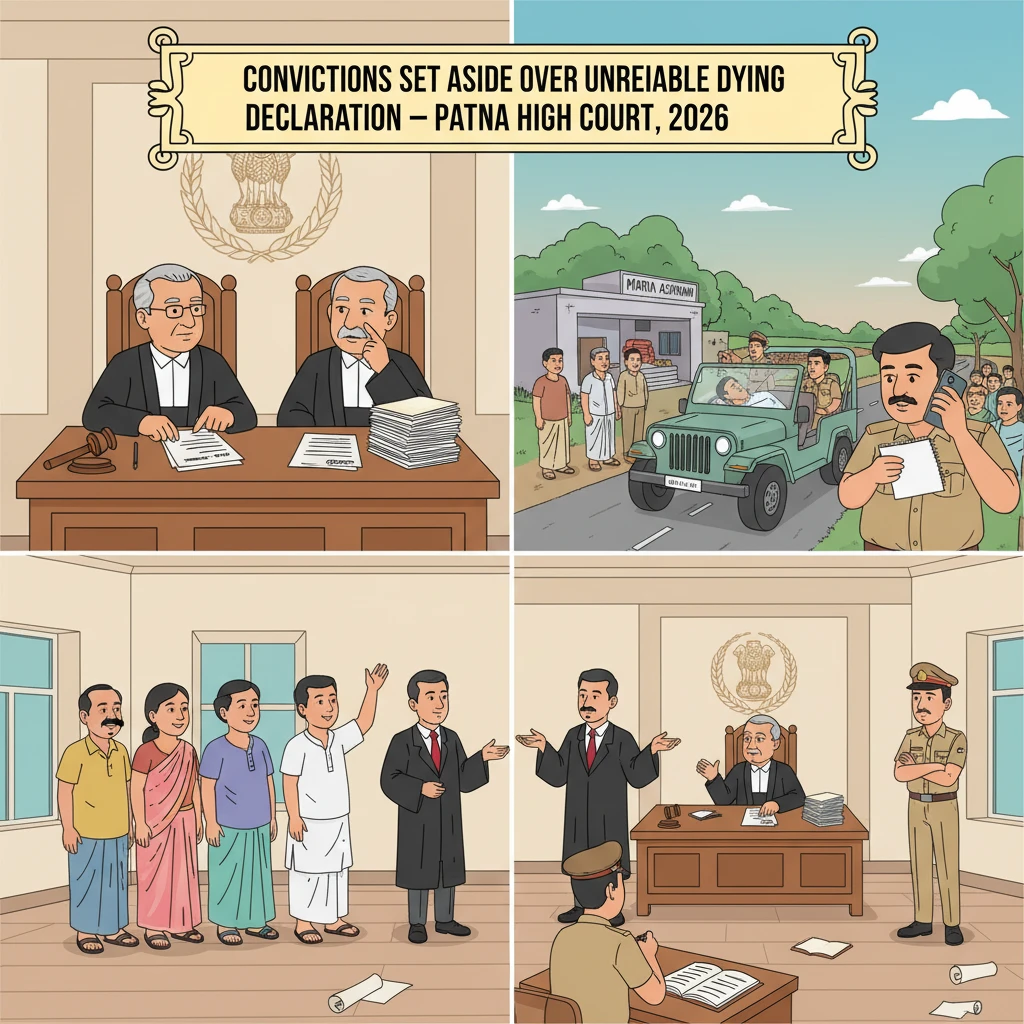
The case arises from Sheikhpura P.S. Case No. 16 of 2017. The prosecution story began on 17 January 2017, when Santosh Kumar Singh, then Station House Officer (SHO) of Sheikhpura police station, recorded a suo motu statement at about 7:30 p.m. in Sheikhpura District Hospital.
According to him, earlier that evening he and other police personnel were on patrol at Teen Muhani More. Around 6:10 p.m., he received a phone call on his official mobile number from a caller identifying himself as Ujjwal Raj, Junior Engineer (MNREGA), Sheikhpura Block. The caller allegedly said he had taken shelter in Maria Ashram and that one Sunil Kumar, P.R.S., Karya Panchayat, was calling him outside to make false entries in his Measurement Book.
The SHO claimed that, acting on this information, he and his team went to Maria Ashram. There, they allegedly found one person lying injured near the gate and another person running away, who escaped by scaling the boundary wall. The injured person identified himself as Ujjwal Raj and had gunshot injuries.
The SHO stated that he took the injured engineer in a police jeep towards the hospital. On the way, the victim allegedly disclosed that he had been threatened by the Mukhiya of Karya Panchayat, Balmukund Yadav @ Ravi Kant, and P.R.S. Sunil Kumar to manipulate MNREGA records, which he refused to do.
On the day of the incident, Sunil Kumar allegedly called him near the gate of Maria Ashram. When he refused, three persons, Nandan Yadav, Raju Kumar @ Narendra Kumar Raju and Dharmendra Paswan, allegedly entered the Ashram and forcibly brought him to the gate. There, he allegedly saw Balmukund Yadav holding a pistol, with Sunil Kumar present. According to the SHO, Balmukund instructed Nandan to fire, and Nandan shot him in the chest. Balmukund and Sunil allegedly fled towards the station on a motorcycle and the other three towards Maria Ashram.
The SHO also recorded that the victim died during medical treatment in hospital due to gunshot injury. On this basis, Sheikhpura P.S. Case No. 16 of 2017 was registered at 9:00 p.m. the same day under Section 302/34 of the Indian Penal Code and Section 27 of the Arms Act, and investigation commenced.
After investigation, a charge-sheet was filed against all five accused: Sunil Kumar, Balmukund Yadav @ Ravikant, Raju Kumar @ Narendra Kumar Raju, Dharmendra Paswan and Nandan Yadav. The case was committed to the Court of Session and tried as Sessions Trial No. 20 of 2018 before the Additional Sessions Judge, 1st Court, Sheikhpura.
On 22 July 2019, the trial court convicted all the accused under Section 302/34 IPC and Section 27 of the Arms Act, sentencing them to life imprisonment with fine for murder, and rigorous imprisonment for five years with fine for the Arms Act offence. These convictions and sentences were challenged before the Patna High Court in Criminal Appeal (DB) Nos. 953, 1061, 1067, 1112 and 1137 of 2019.
What the Court Examined and Decided
The Division Bench of Hon’ble Mr. Justice Bibek Chaudhuri and Hon’ble Mr. Justice Chandra Shekhar Jha examined the entire trial record, particularly the reliability of the alleged dying declaration and the admissibility of certain evidence relied upon by the trial court.
During trial, the prosecution examined eight witnesses. Two claimed eyewitnesses, PW-2 Nitish Kumar and PW-5 Dharmendra Kumar Pandit, did not support the prosecution and were declared hostile. They said they had no idea how the deceased received gunshot injury or how he died.
The remaining material witnesses were police personnel and the doctor. PW-1, Ram Bhajan Singh, was an Inspector of Police who accompanied the SHO and was present when the injured was taken to hospital. PW-3, Ravi Nandan Kumar, was the driver of the police vehicle. PW-6, Santosh Kumar Singh, was the SHO and informant. PW-7 was a Technical Assistant who obtained Call Detail Records (CDR) and Customer Application Forms (CAF). PW-8, Amit Sharan, was the SDPO who investigated and filed the charge-sheet. PW-4, Dr. Ravi Shankar Sharma, conducted the post-mortem.
The core of the prosecution case was the alleged oral dying declaration made by the victim to the SHO in the police jeep, later reproduced in the SHO’s fard beyan. The defence strongly attacked this.
Counsel for the appellants pointed out that no independent civilian witness supported the occurrence, despite the alleged shooting taking place in the evening in front of a Christian Ashram in the heart of Sheikhpura. Only police witnesses supported the prosecution version.
More importantly, they argued that the so-called dying declaration was neither properly recorded nor corroborated. PW-1 stated in chief that, on the way to the hospital, the SHO asked the victim about the incident, and the victim said three persons, Nandan, Raj Kumar and Dharmendra, forcibly brought him towards the gate and Nandan fired at him.
However, in cross-examination, PW-1 admitted that the SHO “tried to record the statement of the injured person” and that “the injured stated something to him” which the SHO wrote in his diary. PW-1 could not say whether the SHO obtained the victim’s signature or thumb impression on this alleged statement. The original diary entry, which would be the primary record of the dying declaration, was never produced in court.
The High Court noted that what appeared in the fard beyan was only what the SHO later wrote based on his diary. Since the original record of the alleged dying declaration was not placed before the court, it held that the prosecution had not produced the original dying declaration at all. Treating the fard beyan itself as a dying declaration, without the underlying diary, was held to be a serious error.
The Bench then considered the medical evidence. PW-4, the autopsy surgeon, found one entry wound between the fifth and sixth intercostal spaces on the left chest with charred skin margins, and a corresponding exit wound between the seventh and eighth intercostal spaces. On dissection, he found rupture of the lung, pleura, pericardium and heart on the left side.
In cross-examination, PW-4 clearly opined that if both lungs and heart are ruptured simultaneously, the injured would die within a few seconds. He further stated that the nature of the injury was such that the victim could not speak any word to anybody and that death would occur at the earliest. He also saw no evidence of medical treatment in or around the wound or elsewhere on the body.
The Court emphasised that this medical opinion seriously undermined the prosecution theory that the injured man remained conscious, narrated a detailed story to the SHO while being taken to hospital, and died only during treatment. If the medical opinion was accepted, the victim would have died before police could record any detailed statement.
The Court also found that the investigation was deficient. PW-4 observed charring around the entry wound, suggesting a shot fired from very close range. In such a case, seizure and production of the deceased’s bloodstained clothes would be important. Yet, the Investigating Officer did not seize the wearing apparel, weakening the forensic basis of the case.
From PW-8’s evidence, the Court further noted that the deceased’s wife, Monika Kumari, had lodged a written complaint in the police station. That complaint was not produced during trial and she was not examined as a witness. There was also no clear evidence whether her complaint preceded or followed the SHO’s fard beyan. The Bench observed that if her complaint had been lodged first, the SHO’s statement could not legally be treated as a First Information Report under Section 154 CrPC.
Regarding the CDR and CAF evidence, PW-7 and PW-8 showed that various mobile numbers were in the names of the deceased, one Banarasi Yadav, one Priyanka Devi and one Sunil Kumar. But there was no evidence that the “Sunil Kumar” in the subscriber records was the accused. Thus, the electronic records did not firmly connect any appellant to the crime.
A crucial criticism from the Bench was directed at the way the trial court had used alleged confessional statements. PW-8 admitted recording confessional statements of the accused. The trial judge treated these as admissible, marked them as exhibits, and relied on them to convict. The High Court noted with concern that a police officer is barred by Sections 25 and 26 of the Indian Evidence Act (corresponding to Sections 23(1) and 23(2) of the Bharatiya Sakshya Adhiniyam) from proving confessions made to him or while an accused is in police custody. Such confessions are legally inadmissible.
The Bench observed that it was “astonished” that a senior officer (the SDPO) did not know this basic rule and equally shocked that an Additional Sessions Judge relied on such confessions. The Court held that the trial judge had adopted “not only a wrong process but an illegal procedure” in convicting the accused on inadmissible evidence.
On the law of dying declarations, the Bench discussed Section 32(1) of the Evidence Act and noted that while a dying declaration can, in some cases, be the sole basis of conviction, certain safeguards must be satisfied. The statement must be made when the maker is on the verge of death, mentally fit, and speaking truthfully, and ideally should be recorded in question-and-answer form by a competent person, preferably in the presence of a doctor certifying fitness.
The Court referred to earlier Supreme Court decisions, including Munna Raj v. State of Madhya Pradesh, recognising that an FIR given by an injured person can function as a dying declaration. However, in this case, the fard beyan was not recorded from the deceased but from the SHO, who merely reported what he claimed to have heard. Moreover, the original diary containing the alleged statement was not produced, and the medical evidence suggested that the deceased could not have spoken.
Considering all this, the Bench held that it could not safely rely on the uncorroborated, indirectly reported and medically doubtful dying declaration. Without it, and with no independent eyewitnesses or solid forensic corroboration, the prosecution had failed to establish guilt beyond reasonable doubt.
Accordingly, the Patna High Court allowed all the appeals, set aside the judgment and order of conviction and sentence dated 22 July 2019, and acquitted all appellants of the charges. It directed their immediate release if not required in any other case.
The Court went further and, in strong language, expressed that the trial judge appeared to lack understanding of evidentiary rules in criminal trials. It recommended that the Additional Sessions Judge, 1st Court, Sheikhpura, be divested of criminal trial work and be given special training on the new criminal laws (Bharatiya Nyaya Sanhita, Bharatiya Nagarik Suraksha Sanhita and Bharatiya Sakshya Adhiniyam), subject to the administrative decision of the Hon’ble Chief Justice. It ordered that a copy of the relevant portion of its order be sent to the Chief Justice.
Why This Judgment Matters
This judgment is significant for several reasons that directly affect people facing serious criminal allegations.
First, it shows that the Patna High Court will not uphold a conviction for murder merely on a doubtful dying declaration, especially where medical evidence suggests the victim could not have spoken. Families of both victims and accused can understand that courts look closely at whether the deceased was physically and mentally capable of making such a statement.
Second, the decision reinforces an important protection in criminal law: a confession made to a police officer or in police custody is generally not admissible as evidence. If a trial court relies on such confessions, that conviction is at serious risk. This matters for any accused person who may have been pressured to admit guilt before the police.
Third, the judgment highlights the importance of proper investigation and production of documents. The non-production of the wife’s written complaint, the failure to seize the clothes of the deceased, and the unclear link between mobile numbers and the accused all counted against the prosecution.
Fourth, the Court’s criticism of the trial judge and the suggestion for training underline that wrongful convictions can result from ignorance of basic evidence law. The judges linked this directly to the right to life and personal liberty under Article 21 of the Constitution, noting that the accused had suffered years of imprisonment on the basis of illegal evidence.
For laypersons, especially in Bihar, the message is that higher courts can and do correct wrongful convictions, particularly where basic legal safeguards are ignored. For lawyers and junior judges, it is a clear reminder to strictly follow evidentiary rules, especially concerning dying declarations and police confessions.
Legal Issues and Answers
- Issue: Could the alleged oral statement of the deceased, as narrated by the SHO in his fard beyan, be treated as a valid dying declaration sufficient for conviction?
Answer: No. The High Court held that the original alleged statement in the SHO’s diary was not produced, the fard beyan was only a secondary account, and medical evidence showed the deceased could not have spoken; therefore the dying declaration was unreliable and could not be the sole basis of conviction. - Issue: Were the confessional statements recorded by the Investigating Officer admissible and capable of supporting the conviction?
Answer: No. The Court held that Sections 25 and 26 of the Evidence Act bar the use of confessions made to a police officer or in police custody. The trial court committed a serious legal error by treating such statements as admissible and relying on them. - Issue: In the absence of a reliable dying declaration, independent eyewitnesses, or strong corroborative evidence, was the prosecution able to prove the charges beyond reasonable doubt?
Answer: No. With hostile civilian witnesses, missing primary documents, lack of forensic support and inadmissible confessions, the prosecution failed to establish guilt. The appellants were entitled to acquittal.
Cases Cited by the Court
- Irfan v. State of U.P., 2023 SCC OnLine SC 1060 (paras 62–69 referred).
- Jitendra Kumar Mishra v. State of M.P., (2024) 2 SCC 666 (paras 14–18 referred).
- Arjun Panditrao Khotkar v. Kailash Kushanrao Gorantyal, (2020) 7 SCC 1 (paras 61, 73.1, 73.2 and 84 referred).
- Anvar P.V. v. P.K. Basheer, (2014) 10 SCC 473 (paras 14–18 referred).
- Takhaji Hiraji v. Thakore Kubersing Chamansing, (2001) 6 SCC 145 (referred).
- Munna Raj v. State of Madhya Pradesh, (1976) 3 SCC 104 (relied on regarding FIR as dying declaration).
- Uka Ram v. State of Rajasthan, (2001) 5 SCC 254 (criteria for accepting dying declaration).
- Pakala Narain Swami v. Emperor (principle on proximity of circumstances to death).
Case Details
Case Numbers: Criminal Appeal (DB) No. 953 of 2019; Criminal Appeal (DB) No. 1061 of 2019; Criminal Appeal (DB) No. 1067 of 2019; Criminal Appeal (DB) No. 1112 of 2019; Criminal Appeal (DB) No. 1137 of 2019; arising out of Sheikhpura P.S. Case No. 16 of 2017.
Case Title: Sunil Kumar v. The State of Bihar; Balmukund Yadav @ Ravikant v. The State of Bihar; Raju Kumar @ Narendra Kumar Raju v. The State of Bihar; Dharmendra Paswan v. The State of Bihar; Nandan Yadav v. The State of Bihar.
Citation: 2026 (3) PLJR 218.
Court: High Court of Judicature at Patna.
Coram: Hon’ble Mr. Justice Bibek Chaudhuri; Hon’ble Mr. Justice Chandra Shekhar Jha.
Date of Judgment: 30 March 2026.
Advocates for Appellants: Mr. Rajesh Kumar Singh, Sr. Advocate (in Cr. App. (DB) No. 953 of 2019); Mr. Pratik Mishra, Mr. Arun Kumar, Mr. Raghubir Chandrayan, Mr. Satyam Kumar (in Cr. App. (DB) No. 1061 of 2019); Mr. Rabindra Prasad Singh, Mr. Anil Kumar Singh (in Cr. App. (DB) Nos. 1067 and 1112 of 2019); Mr. Manish Kumar No. 2, Mr. Nilendu Kumar Choudhary (in Cr. App. (DB) No. 1137 of 2019).
Advocates for State: Mr. Sujit Kumar Singh, APP; Mr. Ajay Mishra, APP; Ms. Shashi Bala Verma, APP; Mr. Abhimanyu Sharma, APP (as recorded for respective appeals).
Nature of Case: Criminal appeals (Division Bench) against conviction and sentence for offences under Section 302/34 of the Indian Penal Code and Section 27 of the Arms Act arising from Sessions Trial No. 20 of 2018.
Link to Judgment: Full text of Patna High Court judgment
If you found this explanation helpful and wish to stay informed about
how legal developments may affect your rights in Bihar,
you may consider following Samvida Law Associates for more updates.







