

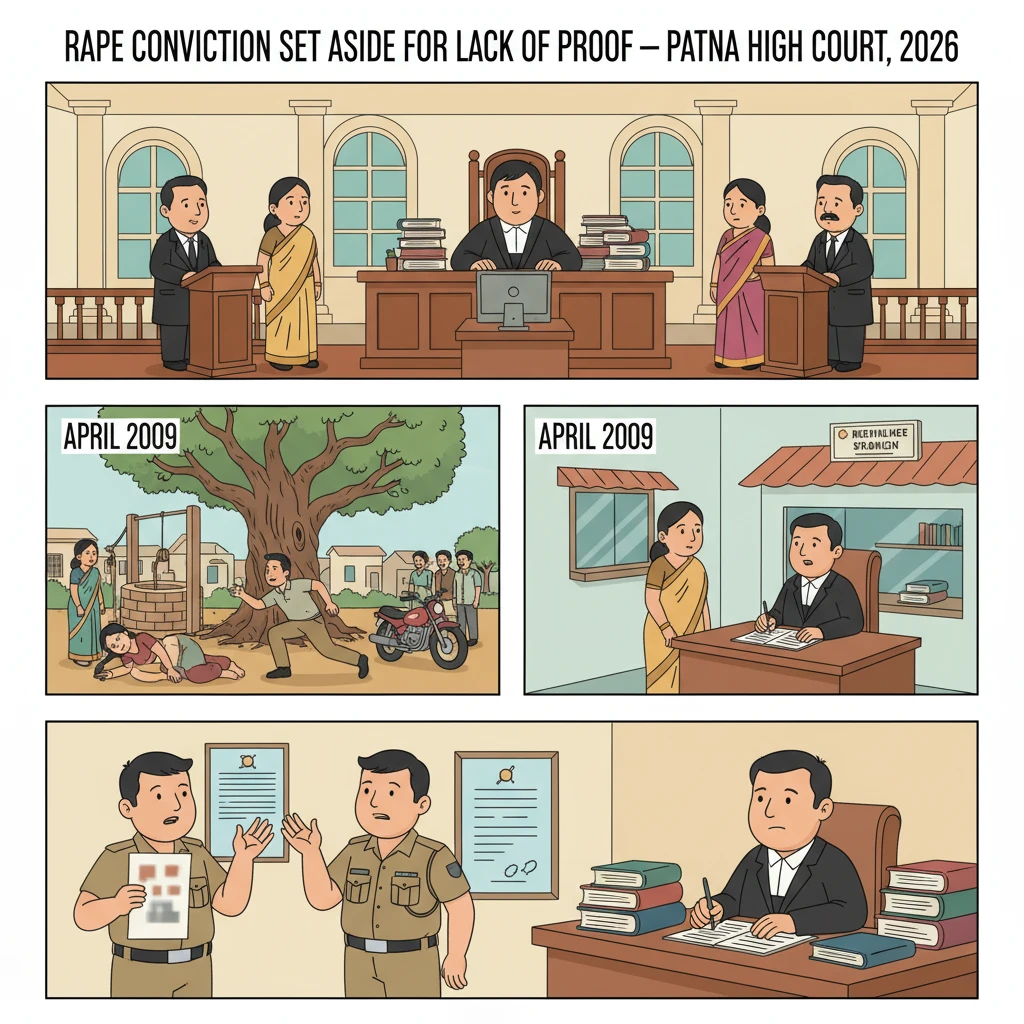
Case Background
This criminal appeal arose from a judgment of conviction dated 16.12.2013 and order of sentence dated 23.12.2013 passed by the Adhoc Additional District & Sessions Judge, Naugachia, District Bhagalpur in Sessions Trial No. 923 of 2010, arising out of Gopalpur P.S. Case No. 123 of 2009.
The sole accused had been convicted under Section 376 of the Indian Penal Code and sentenced to 10 years of rigorous imprisonment with a fine of Rs. 10,000/-, and six months’ further rigorous imprisonment in default of payment of fine.
According to the prosecution, the informant, a woman aged about 30 years, lodged her fardbeyan on 09.04.2009 at around 4:00 PM before the Station House Officer of Gopalpur Police Station. She alleged that on 07.04.2009, around 7:00 PM, the accused took her near an Imli tree at village Lattipakar, led her into a mango orchard near a well, overpowered her, tore her blouse and raped her. She claimed that after the incident she raised alarm, was taken by villagers to the house of one person in village Lattipakar where she stayed that night, and then went to her matrimonial home the next morning before approaching court and police.
On the basis of this fardbeyan, Gopalpur P.S. Case No. 123 of 2009 was registered under Section 376 IPC. The police investigated and, on 10.11.2009, submitted a final form declaring the case to be false. However, by order dated 16.01.2010, the learned A.C.J.M., Naugachia, took cognizance under Section 376 IPC. On 26.07.2010, the case was committed to the Court of Sessions for trial.
After trial, the sessions court convicted the accused. Aggrieved, he filed the present appeal before the Patna High Court under Sections 374(2) and 389(1) of the Code of Criminal Procedure.
What the Court Examined and Decided
Before the Patna High Court, the appellant’s counsel argued that the conviction was illegal, perverse and unsustainable. He stressed that there was an unexplained delay between the alleged occurrence on 07.04.2009 and the recording of the fardbeyan on 09.04.2009. He also highlighted that the medical evidence did not support the allegation of rape, no injury or sign of recent sexual assault was found, and many prosecution witnesses had turned hostile.
The defence further pointed out that the Investigating Officer had, after full investigation, submitted a final report declaring the case to be false, and that there was an alleged land dispute between the appellant and another person named Rustam, suggesting motive for false implication. It was argued that the prosecution had failed to prove the charge beyond reasonable doubt.
The State’s counsel, on the other hand, supported the trial court judgment and submitted that the sessions court had considered the materials and rightly convicted the appellant, given the seriousness and cognizable nature of the offence alleged.
Justice Purnendu Singh heard both sides and carefully went through the lower court records. The High Court noted that the prosecution had examined 16 witnesses, including the informant (PW-13), the Investigating Officer (PW-11) and the Medical Officer (PW-14). It also took note of the three main documentary exhibits: the medical report (Exhibit-1), FIR (Exhibit-2) and chargesheet (Exhibit-3).
A detailed review of witness testimonies showed that most of the prosecution witnesses did not support the prosecution story. PW-1, PW-15 and PW-16 were declared hostile. PWs 2, 8 and 9 were tendered and offered no material support. PW-3 and PW-4 clearly stated that no rape was committed by the accused. PW-6 and PW-12 also admitted that no such occurrence took place.
PW-5, a resident of village Lattipakar, said that the victim had told him she had been raped by the accused, but he was not an eye-witness and had only heard about it from her. The Court treated his evidence as hearsay.
PW-10 deposed that there existed prior litigation between Rustam and the accused, and that the informant, being Rustam’s sister-in-law, had falsely implicated the accused. This evidence supported the defence claim of false implication due to land dispute.
PW-11, the Investigating Officer, deposed that he inspected the place of occurrence and found no signs of violence. He recorded witnesses’ statements and initially found the case to be untrue, leading to a final form declaring the case false. Despite this, the Magistrate later took cognizance.
PW-14, Dr. Anita Kumari, examined the victim on 10.04.2009. She found no external injury on the body and no signs of violence on the private parts. No foreign hair or semen was detected in the vaginal swab and there was no evidence of recent sexual intercourse. She also noted that abortion of two months’ pregnancy had been done on 02.04.2009 at village Sanhaula by medical staff. She opined that the victim was above 18 years of age.
Thus, the medical report did not support the allegation of forcible sexual assault. The Court observed that when a medical expert clearly states there is no clinical indication suggestive of rape, the testimony of the prosecutrix must be scrutinised with greater caution.
The prosecution case, in the end, rested mainly on the solitary testimony of PW-13, the informant herself. She repeated her allegation that the accused took her near an Imli tree on a motorcycle, led her into a mango orchard, caught her near a well, tore her blouse and raped her. She also stated that she went to village Lattipakar, informed villagers and thereafter lodged the FIR.
In cross-examination, however, she admitted certain facts such as the absence of prior acquaintance with villagers of Lattipakar and lack of physical evidence at the spot. The High Court noted material inconsistencies between her versions and the overall lack of support for her statement from other evidence.
Justice Purnendu Singh then referred to the settled legal principle that a conviction for rape can be based on the sole testimony of the prosecutrix, but only if that testimony is trustworthy, reliable and of “sterling” quality.
The Court relied on several Supreme Court decisions:
In Krishan Kumar Malik v. State of Haryana, the Supreme Court held that though solitary evidence of the prosecutrix can be enough, where her testimony shows several lacunae and does not inspire confidence, conviction cannot be maintained without corroboration.
In Rai Sandeep v. State (NCT of Delhi), the Supreme Court explained what constitutes a “sterling witness”—a witness whose version is unassailable, consistent from the beginning to the end, and matches other evidence without missing links.
In Ganesan v. State, the Supreme Court reiterated that if the victim’s statement is reliable and trustworthy, it may not need corroboration, but that reliability and consistency are key.
The High Court further referred to Sadashiv Ramrao Hadbe v. State of Maharashtra. In that case, the Supreme Court held that when the prosecutrix’s version is not of sterling quality and is inconsistent with medical evidence and surrounding circumstances, the accused is entitled to benefit of doubt, and conviction cannot stand.
Applying these principles, the Patna High Court observed that in the present case:
- most prosecution witnesses either turned hostile, were tendered, or did not support the prosecution story,
- the Investigating Officer found no sign of violence and had declared the case false in the final form,
- the medical evidence did not show injuries, semen, or any sign of recent sexual intercourse, and also recorded a prior abortion,
- there was evidence of previous litigation between the accused and Rustam, with PW-10 alleging that the informant had falsely implicated the accused due to this dispute, and
- the prosecutrix’s testimony, standing alone, suffered from contradictions and was not backed by independent or scientific evidence.
In these circumstances, the Court found that the testimony of PW-13 did not reach the standard of a “sterling witness” required to sustain a conviction solely on her word. The inconsistencies between her statement and the medical and other evidence created serious doubt about the prosecution version.
Since criminal law requires proof beyond reasonable doubt, the benefit of that doubt had to go to the accused. The Court held that the prosecution had “miserably failed” to establish the charge under Section 376 IPC.
Accordingly, the appeal was allowed. The judgment of conviction dated 16.12.2013 and order of sentence dated 23.12.2013 were set aside. The appellant was acquitted of all charges. As he was on bail, he was discharged from the liability of his bail bond, and any fine deposited was ordered to be refunded.
The Court also directed that the Patna High Court Legal Services Committee pay Rs. 5,000/- as consolidated fee to the learned Amicus Curiae, Mr. Rudra Pratap Singh, for his professional assistance in the appeal, and that the lower court records be sent back with a copy of the judgment.
Why This Judgment Matters
This judgment of the Patna High Court shows how closely higher courts scrutinise evidence in serious criminal cases like rape. It underlines that even in offences of this nature, where the victim’s statement is very important, conviction cannot be based on suspicion or weak evidence.
For accused persons, it reinforces that if medical evidence, investigation records and witness testimonies do not support the allegation, the court will give benefit of doubt. For complainants, it highlights the need to report promptly, cooperate with medical examination, and ensure that their statements remain consistent.
The decision also clarifies that when the investigating agency finds a case to be false and there is strong medical and eyewitness material against the prosecution story, a conviction reached without addressing those contradictions is likely to be overturned on appeal.
Legal Issues and Answers
- Issue: Whether the conviction of the appellant under Section 376 IPC could be sustained when most prosecution witnesses turned hostile and medical evidence did not support the allegation of rape.
Answer: No. The Patna High Court held that the prosecution failed to prove the charge beyond reasonable doubt, as the testimony of the prosecutrix was not of sterling quality and was not corroborated by medical or independent evidence. The conviction and sentence were set aside and the appellant was acquitted. - Issue: Can a conviction for rape rest solely on the statement of the prosecutrix in the absence of supporting medical and other evidence?
Answer: Yes in law, but only if the prosecutrix is a wholly reliable “sterling witness.” In this case, due to inconsistencies and lack of corroboration, her solitary testimony was found insufficient, and benefit of doubt was given to the appellant.
Cases Cited by the Court
- Krishan Kumar Malik v. State of Haryana, (2011) 7 SCC 130
- Rai Sandeep v. State (NCT of Delhi), (2012) 8 SCC 21
- Ganesan v. State, (2020) 10 SCC 573
- Sadashiv Ramrao Hadbe v. State of Maharashtra, (2006) 10 SCC 92
Case Details
Case Number: Criminal Appeal (SJ) No. 73 of 2014; arising out of Gopalpur P.S. Case No. 123 of 2009; Sessions Trial No. 923 of 2010
Case Title: Sikandar Sah @ Mohammad Sikandar Sah v. The State of Bihar
Citation: 2026(3) PLJR 257
Coram: Hon’ble Mr. Justice Purnendu Singh
Advocates:
- For the Appellant: Mr. Ramanand Poddar, Advocate; Mr. Rudra Pratap Singh, Amicus Curiae
- For the State: Mr. Abhay Kumar, APP
Nature of the Case: Criminal appeal against conviction and sentence under Section 376 IPC
Date of High Court Judgment: 09.04.2026 (CAV; CAV date 24.03.2026)
Result: Appeal allowed; conviction and sentence set aside; appellant acquitted and discharged from bail bond; fine, if deposited, to be refunded.
Link to Judgment: Click here to read the full Patna High Court judgment
If you found this explanation helpful and wish to stay informed about how legal developments may affect your rights in Bihar, you may consider following Samvida Law Associates for more updates.







