

Case Background
The petitioner was a Range Officer in the Forest and Environment Department of the Government of Bihar. He was selected through the Bihar Public Service Commission and appointed as a Gazetted Officer. He claims to have served in different forest divisions with sincerity.
Serious allegations later arose regarding irregularities and misappropriation connected with timber and cooperative society dealings. On this basis, a complaint was lodged against him and other Range Officers. This led to registration of Gumla P.S. Case No. 225 of 1994 and also G.R. Case No. 620 of 1995.
While still in service, the petitioner was placed under suspension by Memo No. 2419 dated 10.07.1995. A departmental charge-sheet followed on 21.07.1995. He challenged the suspension in CWJC No. 1905 of 1996 before the Patna High Court. That writ was disposed of with a direction to the authorities to conclude the departmental proceedings within four months.
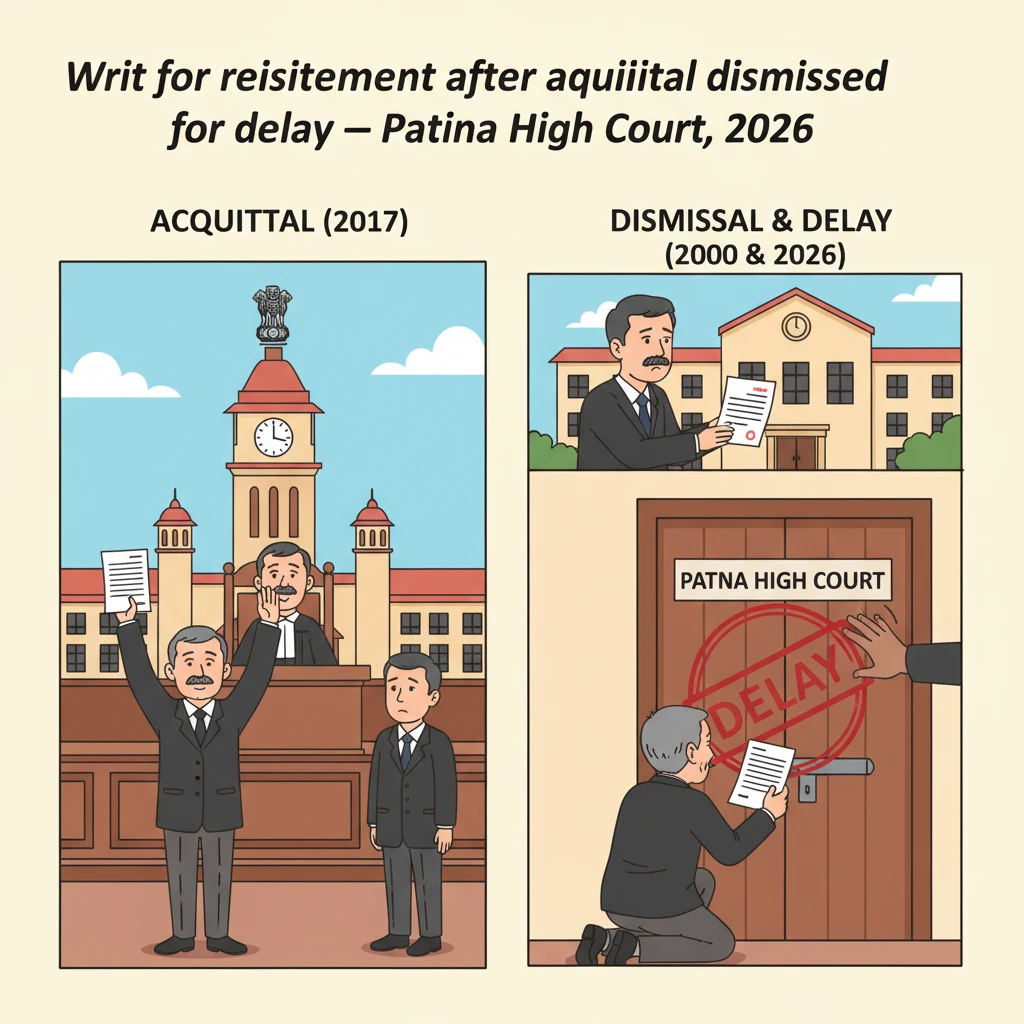
After the departmental enquiry concluded, the Additional Chief Secretary, Environment, Forest and Climate Change Department, Government of Bihar, passed Order No. 3302 dated 07.11.2000 dismissing the petitioner from service. The petitioner then filed CWJC No. 3207 of 2001 before the Patna High Court questioning the dismissal.
CWJC No. 3207 of 2001 was disposed of on 20.07.2007. The Court did not set aside the dismissal at that time. Instead, it recorded that if the petitioner was acquitted on merits in the criminal case, he would be at liberty to invite the State Government’s attention to such acquittal. The State Government could then consider recalling the dismissal order.
Meanwhile, the criminal cases progressed. Gumla P.S. Case No. 225 of 1994 was registered as Special (Vigilance) Case No. 22(B) of 1996 under various sections of the Indian Penal Code and the Prevention of Corruption Act, 1988. In G.R. Case No. 620 of 1995 (T.R. No. 22 of 2004), the allegation related to misappropriation of timber/wood from Dokapat Cooperative Society for personal gain.
In G.R. Case No. 620 of 1995, the Sub-Divisional Judicial Magistrate, Gumla, convicted the petitioner under Section 409 of the Indian Penal Code and sentenced him to three years’ rigorous imprisonment with a fine of Rs. 1,000/-. His Criminal Appeal No. 29 of 2004 was dismissed by the 2nd Additional District and Sessions Judge, Gumla, on 02.09.2005, affirming the conviction and sentence.
Against that decision, the petitioner filed Criminal Revision No. 3 of 2006 before the High Court of Jharkhand. The revision was allowed on 06.11.2017. The Jharkhand High Court set aside the conviction and sentence and discharged the petitioner from his bail bonds.
In the vigilance case (Special (Vigilance) Case No. 22(B) of 1996 arising out of Gumla P.S. Case No. 225 of 1994), the petitioner was also acquitted on 30.08.2017 of all charges under the Indian Penal Code and the Prevention of Corruption Act, 1988.
Despite these outcomes, the petitioner did not immediately move the State Government as indicated in the 2007 order. Only on 16.01.2026 did he submit a detailed representation to the Principal Chief Conservator of Forests (HoFF), Bihar, and the Additional Chief Secretary, seeking recall of the dismissal order in light of his acquittals and asking for reinstatement, back wages, and full retiral benefits.
According to the petitioner, no decision was taken on this representation. He therefore approached the Patna High Court once again in Civil Writ Jurisdiction Case No. 4812 of 2026, challenging the dismissal order dated 07.11.2000 and asking for service and monetary benefits.
What the Court Examined and Decided
The Patna High Court, through Hon’ble Mr. Justice Dr. Anshuman, heard arguments from both sides. The core questions were whether the dismissal order could now be interfered with, and whether the petitioner was entitled to reinstatement and financial benefits after his later acquittals.
The petitioner’s side argued that he had been wrongly branded a corrupt officer and removed from service. They pointed out that:
- He had been duly selected through the Bihar Public Service Commission and served as a Gazetted Officer.
- He faced two criminal cases, but in both matters he ultimately secured acquittal in 2017.
- In Special (Vigilance) Case No. 22(B) of 1996, he was acquitted of all charges under Sections 409/120B, 467/120B, 468/120B, 471/120B of the Indian Penal Code and Section 13(2) read with Section 13(1)(d) of the Prevention of Corruption Act, 1988.
- In Criminal Revision No. 3 of 2006, the Jharkhand High Court set aside his conviction in G.R. Case No. 620 of 1995 and discharged him from his bail bonds.
On this basis, counsel argued that he stood cleared of the criminal allegations and that, under the liberty given in CWJC No. 3207 of 2001, the State Government ought to recall the dismissal order. His representation of January 2026 was said to be in line with that liberty.
The petitioner also stressed that he was now around 73 years old. He said his age and personal circumstances made it difficult for him to pursue the matter earlier. According to him, the delay was neither intentional nor deliberate but due to bona fide reasons beyond his control.
On the other hand, the State’s counsel raised a preliminary objection on delay and laches. They submitted that the petitioner got acquitted in 2017 and any right to seek reconsideration of his dismissal arose at that time. However, he chose to remain silent for about nine years and approached the authorities only in 2026.
The State argued that, after such an inordinate and unexplained delay, the petitioner could not seek to reopen old disputes through a simple representation. It was highlighted that the 2007 order only gave a liberty, not a direction, and even that liberty had to be exercised within a reasonable time.
The Court first carefully traced the two criminal cases against the petitioner and noted the dates of acquittal. It accepted that in the vigilance case he was acquitted because the prosecution failed to establish the charges.
However, the Court gave special attention to the language used by the Jharkhand High Court while allowing Criminal Revision No. 3 of 2006. The operative portion quoted in the Patna judgment shows that the Jharkhand High Court did not give a clean chit to the petitioner.
The Jharkhand court held that the alleged misappropriation of Rs. 1,06,000/- stood disproved by the evidence of a prosecution witness. It also observed that, even if statistics were not mentioned in the vouchers, this could not automatically lead to a presumption of criminal misappropriation. The prosecution had failed to prove many of its allegations, and the investigating officer had not been examined, which prejudiced the defence.
Yet, in the same passage, the Jharkhand High Court clearly stated that “at best it can be termed to be dereliction of duty” on the part of the petitioner, who was the in-charge Forest Range Officer during the relevant period and held a supervisory post.
The Patna High Court treated this observation as important. It concluded that the petitioner was not “completely exonerated”. Although the criminal conviction was set aside and benefit of doubt was given, the finding that his conduct amounted to dereliction of duty meant that a stigma still attached to his service record.
Thus, even on merits, the Court was not inclined to fully accept the petitioner’s claim that his service should be treated as “unblemished”.
The Court then turned to the issue of delay and laches. It found that the cause of action to seek recall of the dismissal order arose in 2017, when the petitioner was acquitted and the conviction was set aside. Nevertheless, the petitioner waited until 16.01.2026 to submit his representation.
The Court examined whether this delay of about nine years was explained in any satisfactory way. It noted that apart from the petitioner’s age and general statement that he could not pursue the matter earlier, there was no concrete or plausible explanation in the writ petition. The Court held that these reasons were not sufficient.
To support its approach, the Court relied on the Supreme Court decision in Chennai Metropolitan Water Supply and Sewerage Board & Others vs. T.T. Murali Babu, (2014) 4 SCC 108. It quoted paragraphs 16 and 17 of that judgment, where the Supreme Court emphasised that:
- Delay and laches cannot be lightly brushed aside in writ jurisdiction.
- Courts exercise extraordinary and equitable powers and must see whether a person has slept over his rights.
- Inordinate delay often causes injustice, affects others’ rights, and may drag others into unnecessary litigation.
- Courts should not encourage indolent litigants who wake up after long periods without justification.
The Patna High Court also referred to its own Coordinate Bench judgment in Gyasuddin @ Gyasuddin Khan vs. State of Bihar & Others, CWJC No. 13306 of 2023, decided on 11.03.2024. In that case, a writ filed after 26 years was dismissed on grounds of res judicata and delay and laches. The Court there reiterated the maxim “equity aids the vigilant and not those who slumber on their rights”.
Applying these principles, the Court held that the petitioner in the present case had approached the authorities and the Court much too late. The delay of about nine years after his acquittals, without convincing justification, was inordinate.
The Court concluded that, considering both factors — the continuing stigma of dereliction of duty and the serious delay and laches — the writ petition was devoid of merit. It therefore dismissed Civil Writ Jurisdiction Case No. 4812 of 2026. Any interlocutory applications filed in the case were also dismissed.
Why This Judgment Matters
This judgment is significant for government employees and retirees who face dismissal following criminal cases. It shows that even if a criminal court later sets aside a conviction, it does not automatically wipe the service record clean, especially when the criminal court itself records that there was dereliction of duty.
The case also underlines that a person must act within a reasonable time after an acquittal. Here, the petitioner waited about nine years before invoking the liberty earlier granted to him by the Court. The Patna High Court treated this as an inexcusable delay and declined to exercise its writ powers.
For employees who have been removed from service and later acquitted, the judgment highlights two practical lessons. First, they should promptly inform the department and seek reconsideration of their dismissal. Second, they should not assume that an acquittal based on benefit of doubt or evidentiary gaps will always lead to reinstatement, especially if there are findings of poor supervision or dereliction of duty.
Legal Issues and Answers
- Issue: Whether the petitioner, a dismissed Range Officer, was entitled to reinstatement, continuity of service, and full back wages and retiral benefits on the basis of his acquittals in related criminal cases.
Answer: No. The Court held that his conduct was still described as dereliction of duty by the Jharkhand High Court, and therefore he could not be treated as completely exonerated or as having an unblemished service record. - Issue: Whether the Patna High Court should exercise its writ jurisdiction when the petitioner approached the authorities and the Court nearly nine years after his acquittals.
Answer: No. The Court found the writ petition barred by delay and laches, relying on Supreme Court and Patna High Court precedents that require aggrieved persons to act diligently and within a reasonable time.
Cases Cited by the Court
- Chennai Metropolitan Water Supply and Sewerage Board & Others vs. T.T. Murali Babu, (2014) 4 SCC 108.
- Gyasuddin @ Gyasuddin Khan vs. The State of Bihar & Others, CWJC No. 13306 of 2023, Patna High Court, judgment dated 11.03.2024.
- Criminal Revision No. 3 of 2006, High Court of Jharkhand, judgment dated 06.11.2017 (quoted for its findings on dereliction of duty).
Case Details
Case Number: Civil Writ Jurisdiction Case No. 4812 of 2026
Case Title: Shri Ramesh Prasad Bhagat vs. The State of Bihar & Others
Citation: 2026 (3) PLJR 151
Court: High Court of Judicature at Patna
Coram: Hon’ble Mr. Justice Dr. Anshuman
Date of Judgment: 31.03.2026
Advocates:
- For the petitioner: Mr. Maurya Vijay Chandra, Advocate; Mr. Gaurav Govinda, Advocate; Ms. Preety Ranjan, Advocate
- For the respondents (State): Mr. Government Pleader (26)
Nature of the Case: Writ petition under civil writ jurisdiction challenging dismissal from service and seeking reinstatement with consequential monetary and retiral benefits.
Impugned Order Challenged: Order No. 3302 dated 07.11.2000 issued by the Additional Chief Secretary, Environment, Forest and Climate Change Department, Government of Bihar, dismissing the petitioner from service.
Link to Judgment: Click here to read the full judgment on the Patna High Court website
If you found this explanation helpful and wish to stay informed about
how legal developments may affect your rights in Bihar,
you may consider following Samvida Law Associates for more updates.







