
Case Background
The Department of Mines and Geology, Government of Bihar, issued a tender notice for settlement of various sand ghats in Aurangabad district, including Aurangabad Sone 14-A. The process was to be conducted through an online e-auction portal managed by BELTRON at proc2.bihar.gov.in.
The petitioner, who was eligible, chose to participate in the auction for Aurangabad Sone 14-A. He deposited an Earnest Money Deposit (EMD) of Rs. 2,34,22,500/-, along with bid security amounts of Rs. 5,000/- and Rs. 5,900/- and other necessary documents. After scrutiny, he was found technically qualified and was permitted to take part in the financial bidding stage.
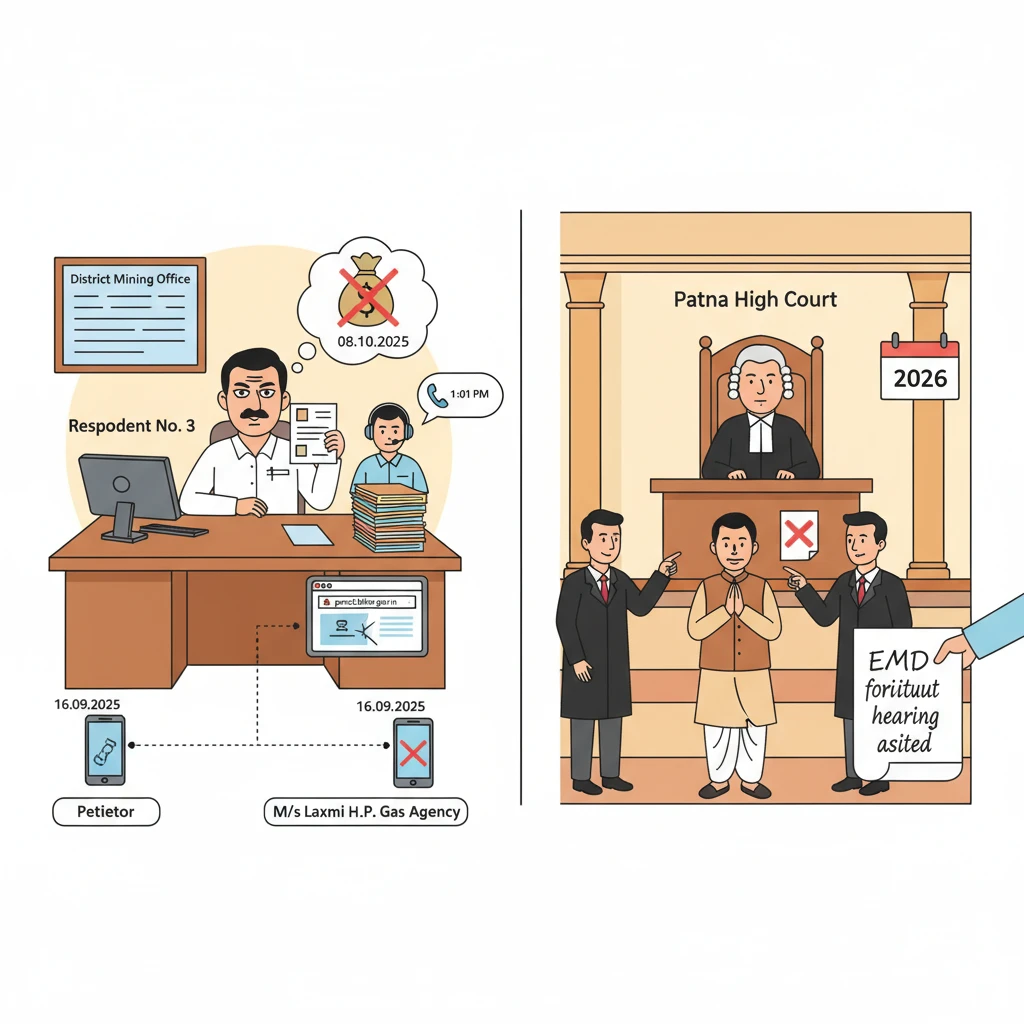
As per the tender notice, the financial e-auction for the relevant sand ghat was scheduled on 16.09.2025 between 11:00 a.m. and 1:00 p.m. On that day, the petitioner could not place his bid on the portal. According to him, he was blocked by a technical glitch in the system.
The same day, on 16.09.2025, he submitted a representation to the authorities, complaining that due to a technical error on the e-auction portal he could not participate in the bidding and requesting that the financial bid be conducted afresh.
On this representation, the authorities sought a report from BELTRON, the agency managing the portal, about any technical problem during the auction time. Meanwhile, on 08.10.2025, Respondent No. 3, the District Magistrate-cum-Collector, Aurangabad-cum-District Mining Officer, passed an order bearing Memo No. 1396.
By this order, the EMD of Rs. 2,34,22,500/- deposited by the petitioner was forfeited under Clause 19(v) of the tender notice, on the ground that the petitioner had deliberately not participated in the financial bidding process.
Aggrieved, the petitioner approached the Patna High Court under its civil writ jurisdiction, seeking quashing of the forfeiture order, refund or adjustment of the EMD, and directions in respect of subsequent tender proceedings relating to the same sand ghat.
What the Court Examined and Decided
Justice Sandeep Kumar first set out the reliefs sought. The petitioner asked the Court to quash Memo No. 1396 dated 08.10.2025 by which his EMD was forfeited. He also sought directions to refund the EMD or treat it as EMD for a fresh tender issued on 20.10.2025 for, among others, Aurangabad Sone 14-A. He further requested that the fresh tender process be stayed, that the sand ghat be settled in his favour, and that it be held that Clause 19(v) could not be invoked in the admitted presence of a technical glitch.
The Court then recorded the petitioner’s version. The petitioner claimed that on 16.09.2025 he attempted to log into the portal during the financial bidding window but was unable to do so due to a “technical error/glitch” which was beyond his control.
He said he immediately contacted BELTRON for assistance and bona fide tried to participate in the auction. He alleged that despite this, his EMD was forfeited on 08.10.2025 for alleged deliberate non-participation.
The petitioner’s counsel argued that the forfeiture was wholly illegal because he had made genuine efforts to participate but could not do so due to reasons not attributable to him. He further submitted that, after his representation dated 16.09.2025, the authorities sought a report from BELTRON, and BELTRON’s e-mail dated 24.09.2025 supposedly admitted a technical error existing till 1:01 p.m. on the auction date.
On this basis, counsel submitted that when the auction time was only till 1:00 p.m., the petitioner was effectively shut out from bidding. He referred to Clauses 14 and 19(v) of the tender notice, arguing that while bidders had to keep their IT systems in order, they could not be punished for a glitch in the portal itself, especially when the department had accepted the presence of such a glitch.
He also complained that no show-cause notice or opportunity of hearing was given before forfeiting the EMD, which, he argued, was a serious violation of the principles of natural justice.
Another limb of the petitioner’s case related to the structure of the bidding. For Aurangabad Sone 14-A, three bidders, including the petitioner, had filed tender documents. In the technical bid, the petitioner and M/s Laxmi H.P. Gas Agency were found technically qualified. However, according to counsel, M/s Laxmi H.P. Gas Agency had already been allotted Sand Ghat No. 16-A in the same district and so was automatically restrained from participating in this auction.
On these facts, he argued that the petitioner had, in effect, remained the sole bidder. Therefore Clause 19(vi) of the tender documents, dealing with single-bid situations, ought to have been applied. Under that clause, the authorities were required to issue a fresh auction notice and, if even then there was only a single bidder, the District Magistrate was to make a recommendation to the department on whether to accept that sole bid. Instead of following this route, the District Magistrate forfeited the EMD under Clause 19(v), which the petitioner termed punitive, arbitrary and illegal.
During the writ proceedings, a fresh tender was issued for the same sand ghat. By order dated 04.11.2025, the Patna High Court permitted the petitioner to participate in the fresh tender process without depositing a fresh EMD, subject to the final result of the writ petition. A supplementary affidavit was later filed, stating that though he participated in the fresh bid, he did not succeed.
On behalf of respondent nos. 3 and 4, the State’s counsel took a different stand. They asserted that there was no technical glitch in the e-auction portal. They relied on BELTRON’s e-mail dated 24.09.2025, which, according to them, clearly showed that the portal was functioning properly and that the problem lay with the petitioner using invalid login credentials.
The e-mail, produced and quoted in the judgment, stated that the petitioner had called BELTRON at 12:57 p.m. on 16.09.2025, just three minutes before the close of the auction window, complaining of a “login issue”. BELTRON’s team assisted him and resolved the issue around 1:01 p.m., by which time the bidding period was over.
Importantly, BELTRON reported that the login problem was due to invalid credentials — wrong login ID or password — entered by the petitioner. BELTRON also confirmed that there was no issue in the e-proc2 application, as a total of 287 tenders had been successfully closed on the same day with multiple bids. BELTRON further noted that there were calls from the same mobile number on behalf of both the petitioner and another bidder, M/s Laxmi H.P. Gas Agency, and reminded that, as per the pre-defined process, bidders should not share auction details during live auction to prevent cartelisation.
On this basis, the State argued that the failure to participate in the auction was attributable solely to the petitioner, who had entered wrong credentials and waited until the last few minutes before contacting BELTRON. Clause 16 of the tender notice, they pointed out, required every intending bidder to verify their IT resources and equipment for the e-auction process. Hence, the petitioner’s own negligence could not be visited on the department.
The State’s counsel further submitted that Clause 19(v) of the Notice Inviting Tender made forfeiture of the EMD mandatory whenever a technically qualified bidder failed to participate in the financial bid. According to them, the Collector had no discretion in the matter, and once non-participation occurred, forfeiture followed automatically.
They also rejected the petitioner’s reliance on Clause 19(vi). That clause, they said, applied only when there was a “single bid” in the auction. In this case another bidder, M/s Laxmi H.P. Gas Agency, had submitted a bid and was found technically qualified. Therefore, the auction could not be treated as a single-bid situation only because of any later restriction on that bidder.
After examining these rival positions, the Court focused on one central point: whether the District Magistrate could forfeit such a large EMD amount without giving the petitioner an opportunity of hearing.
The Court carefully perused BELTRON’s e-mail and accepted that the portal itself had no malfunction and that the error arose from incorrect login credentials. The Court also noted that the petitioner had contacted BELTRON only at 12:57 p.m., very near the close of bidding.
However, Justice Sandeep Kumar did not rest the matter there. He observed that the EMD had been forfeited under Clause 19(v), and the State argued that this forfeiture was automatic and left no discretion to the Collector. The Court found this position “not appealing”.
The Court pointed out that the petitioner had neither been issued notice nor heard before his EMD was forfeited. This, in the Court’s view, clearly violated the principles of natural justice, particularly the rule of audi alteram partem, which requires that no one should be condemned unheard.
To underline the importance of this principle, the Court relied on the recent Supreme Court judgment in Krishnadatt Awasthy v. State of M.P. & Ors., (2025) 7 SCC 545. It quoted extensively from that decision, where the Supreme Court held that an opportunity of hearing is fundamental to a civilised legal system and that non-observance of natural justice is itself a form of prejudice. The Supreme Court had also clarified that an administrative authority cannot bypass the requirement of hearing by presuming that no useful purpose would be served by it.
The Patna High Court summarised that the doctrine of audi alteram partem has three basic elements: the person affected must be given an opportunity of being heard; the authority must follow a fair and transparent procedure; and the authority must apply its mind and pass a reasoned or speaking order.
Applying these principles, the Court held that in the present case the earnest money was forfeited without any opportunity of hearing. This was a serious procedural defect. Given the size of the amount and the civil consequences involved, adherence to natural justice was mandatory.
Therefore, the Court concluded that the proper course was to set aside the forfeiture order and remit the matter back to the District Magistrate-cum-District Mining Officer, Aurangabad. That authority was directed to pass a fresh, reasoned and speaking order after giving the petitioner an opportunity of hearing in accordance with the principles of natural justice.
Accordingly, Memo No. 1396 dated 08.10.2025 was quashed and set aside. The writ petition was allowed to this extent, with no final pronouncement on whether the forfeiture was substantively correct or not. That question is now to be re-examined by the District Magistrate in the remanded proceedings.
Why This Judgment Matters
This decision is significant for anyone participating in government tenders and e-auctions in Bihar, especially in the mining and sand ghat sector where EMD amounts are very high. It shows that authorities cannot simply rely on tender clauses and take harsh steps like forfeiting crores of rupees without hearing the affected bidder.
Even if the department believes that the bidder is at fault, the Patna High Court has made it clear that basic fairness demands a prior notice and a chance to explain. The Court relied on strong Supreme Court authority to emphasise that natural justice is not a mere formality; it is a legal requirement.
For contractors and businesspersons, this means that if their EMD is forfeited without any show-cause notice or opportunity of reply, they may have a valid ground to challenge such orders. For government officers, it is a reminder that contract clauses cannot override constitutional fairness and that they must pass reasoned, speaking orders after hearing all sides.
Legal Issues and Answers
- Issue: Can the District Magistrate-cum-District Mining Officer forfeit a bidder’s EMD under Clause 19(v) of the tender documents without giving the bidder an opportunity of hearing?
Answer: No. The Patna High Court held that forfeiture of the EMD without prior notice and hearing violates the principles of natural justice. The forfeiture order was quashed and the matter remanded for a fresh, reasoned decision after hearing the petitioner. - Issue: Does the alleged absence of discretion under Clause 19(v) remove the need to follow natural justice before forfeiting EMD?
Answer: No. The Court rejected the contention that the Collector’s lack of discretion under Clause 19(v) allowed automatic forfeiture. Even where a clause appears mandatory, authorities must still observe audi alteram partem before passing an adverse order with civil consequences. - Issue: What is the proper course when an EMD is forfeited in breach of natural justice?
Answer: The Court held that the appropriate remedy is to set aside the forfeiture order and remit the matter to the competent authority to pass a fresh, reasoned and speaking order after giving the bidder a full opportunity of hearing.
Cases Cited by the Court
- Krishnadatt Awasthy v. State of M.P. & Ors., (2025) 7 SCC 545 (relied upon for principles of natural justice and audi alteram partem).
- The judgment also quotes and refers to earlier Supreme Court decisions, including Olga Tellis v. Bombay Municipal Corpn., S.L. Kapoor v. Jagmohan, Swadeshi Cotton Mills v. Union of India, Aligarh Muslim University v. Mansoor Ali Khan, State Bank of Patiala v. S.K. Sharma, Dharampal Satyapal Ltd. v. CCE, Board of High School & Intermediate Education, U.P. v. Chitra Srivastava, and State of U.P. v. Sudhir Kumar Singh, as discussed within Krishnadatt Awasthy’s case.
Case Details
Case Number: Civil Writ Jurisdiction Case No. 17615 of 2025
Case Title: Shailendra Prasad Singh v. The State of Bihar & Ors.
Court: High Court of Judicature at Patna
Coram: Hon’ble Mr. Justice Sandeep Kumar
Date of Judgment: 03.04.2026
Citation: 2026 (3) PLJR 144
Nature of the Case: Writ petition under Article 226 challenging forfeiture of Earnest Money Deposit in sand ghat e-auction and related tender actions.
Impugned Order: Memo No. 1396 dated 08.10.2025 issued by the District Magistrate-cum-District Mining Officer, Aurangabad, forfeiting EMD of Rs. 2,34,22,500/-.
Advocates:
For the Petitioner: Mr. Gautam Kumar Kejriwal, Advocate; Mr. Alok Kumar Jha, Advocate
For the State: Ms. Babita Kumari, A.C. to S.C.-1
For the Mines Department: Mr. Naresh Dikshit, Advocate
Link to Full Judgment: Click here to read the Patna High Court judgment
If you found this explanation helpful and wish to stay informed about
how legal developments may affect your rights in Bihar,
you may consider following Samvida Law Associates for more updates.







