

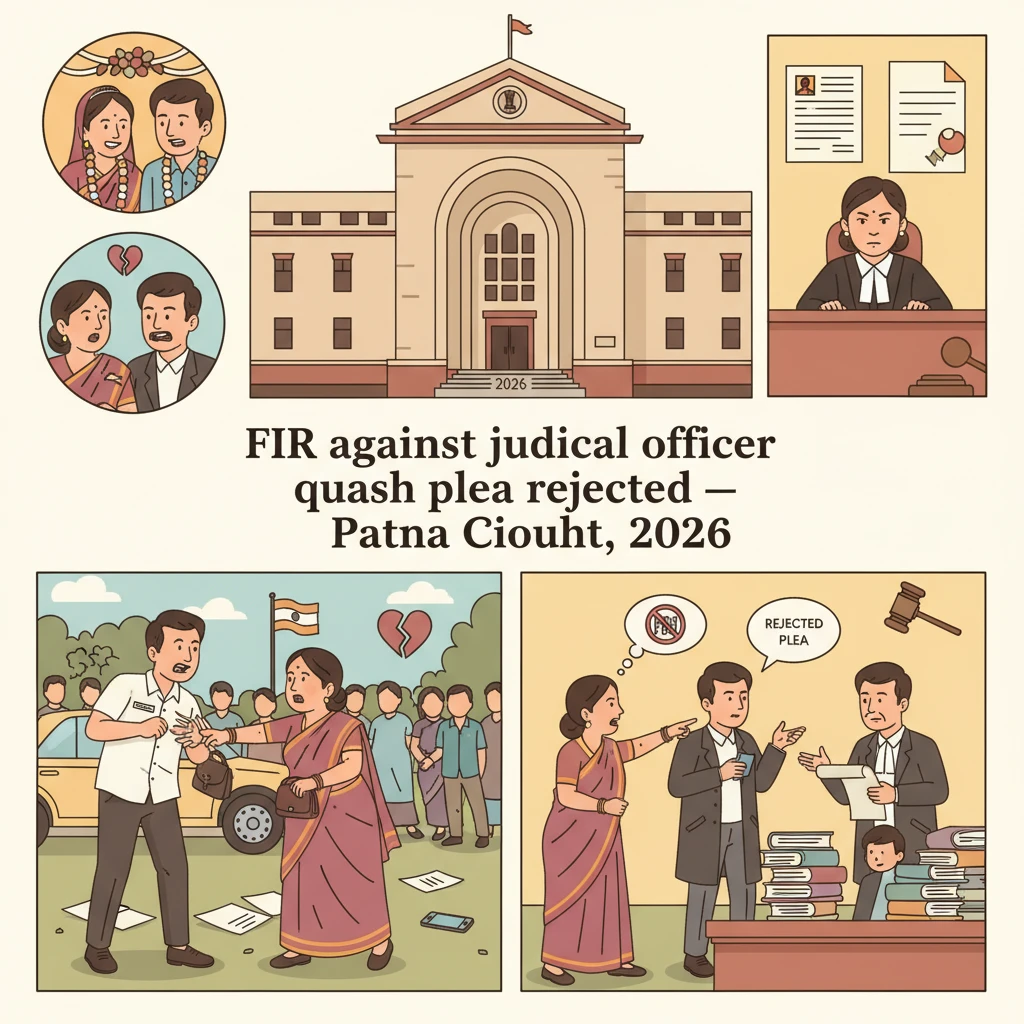
Case Background
The petitioner is a Senior Deputy Collector who had married opposite party no.2, a judicial officer, on 15.02.2021. According to him, there were serious matrimonial disputes after marriage, leading him to file a divorce petition before the Principal Judge, Family Court, Patna on 21.05.2022.
After this, multiple criminal and civil proceedings started between the parties in different courts. The father of opposite party no.2 lodged a dowry harassment case at Aliganj Police Station, Lucknow, on 15.06.2022. The opposite party no.2 also lodged a rape case and a domestic violence case against the petitioner in Uttar Pradesh, and an ex parte order of monthly maintenance of Rs.10,000/- was passed against him.
The petitioner, on his side, filed complaint cases in Muzaffarpur alleging violence and defamation by opposite party no.2 and her family members. These complaint cases were dismissed, including on grounds such as territorial jurisdiction or under Section 203 of the Code of Criminal Procedure (Cr.P.C.), and one dismissal order is under revision.
The present matter arises from an incident dated 26.03.2023 at the District Guest House, Muzaffarpur, where the petitioner was on duty in connection with the visit of the Hon’ble Governor of Bihar. This incident became the basis of Kazi Mohammadpur P.S. Case No.122 of 2024, which is central to this Patna High Court decision.
What the Court Examined and Decided
The petitioner alleged in his FIR that on 26.03.2023 at about 10:15 a.m., while he was engaged in maintaining law and order at the District Guest House, Muzaffarpur, his wife (opposite party no.2) suddenly reached there. He claimed that she started shouting at him using vulgar language, slapped him a couple of times, hit him on the head and back, caught him by the collar and dragged him, tearing his shirt.
According to the FIR, she demanded that he take her in his official car for some work, accused him of lying, misbehaved with him when he expressed his helplessness, and obstructed him from discharging his official duties. She was also alleged to have snatched his purse and key and to have remained at the guest house thereafter. The petitioner stated that after this incident he felt uncomfortable and stopped living with his wife from 28.03.2023.
The petitioner further alleged that he had earlier complained to Kazi Mohammadpur Police Station on 16.05.2023 and again on 27.05.2023, even producing statements of five eyewitnesses on oath, but no FIR was registered. According to him, the Senior Superintendent of Police, Muzaffarpur, informed him, after consulting the Government Advocate, that in view of a Patna High Court judgment in Cr.W.J.C. No.1391 of 2021, permission of the Hon’ble Chief Justice of the Patna High Court was required to register an FIR against a serving judicial officer.
On this understanding, the petitioner wrote to the Hon’ble Chief Justice on 22.09.2023 seeking permission to register an FIR against opposite party no.2. He claimed he received no response. He then filed an RTI application and, on 20.03.2024, received information stating that after consideration of the judicial officer’s explanation and the report of the District Judge, Muzaffarpur, no further action was required and the matter had been consigned.
Still uncertain, the petitioner sought legal clarification from the District Prosecution Officer, Muzaffarpur. As per the petitioner, the District Prosecution Officer replied that for acts done by a judicial officer in personal capacity, permission of the Chief Justice of the Patna High Court is not required for lodging an FIR.
Based on this opinion, Kazi Mohammadpur P.S. Case No.122 of 2024 was finally registered on 10.04.2024 against opposite party no.2 for offences under Sections 341, 323, 353 and 204 of the Indian Penal Code. The petitioner, fearing that the investigation might be influenced, also filed a protest petition before the Additional Chief Judicial Magistrate-I, East, Muzaffarpur.
After investigation, the police submitted a final form opining that the case was an “error of law”, apparently because the FIR had been registered without the required permission. By order dated 13.05.2024, the Additional Chief Judicial Magistrate-I, East, Muzaffarpur, accepted the final form and closed the case.
The petitioner approached the Patna High Court under its inherent jurisdiction, seeking quashing of this Magistrate’s order and effectively asking that his FIR be allowed to proceed.
Before the High Court, the petitioner’s counsel argued that the incident at the guest house was an act of personal violence by opposite party no.2, unrelated to her judicial duties. They therefore contended that no prior permission of the Chief Justice was needed to register an FIR.
They relied on the Supreme Court judgment in K. Veeraswami v. Union of India, (1991) 3 SCC 622. In that case, the Supreme Court had held that no criminal case shall be registered under Section 154 Cr.P.C. against a High Court judge, Chief Justice of a High Court or a Supreme Court judge without consultation with the Chief Justice of India. According to the petitioner, opposite party no.2, being a lower judicial officer, did not fall within the parameters of this judgment.
The petitioner’s counsel also relied upon U.P. Judicial Officer’s Association v. Union of India, (2002) 8 JT 133, and on Ramila Thapar v. Union of India, (2018) 10 SCC 723, where the Supreme Court emphasized a victim’s right to fair investigation and trial. Using these authorities, they submitted that the investigation into his complaint should not be stopped at the threshold, and that he should be assured a fair investigation.
Opposite party no.2, through her Senior Counsel, gave a different picture. Without going into all personal details, he argued that the petitioner himself had been assaulting her and that she had to file domestic violence and other criminal cases against him. It was submitted that when they had tried to reconcile through mediation at the Lucknow Bench of the High Court, the petitioner had secretly installed two spy audio recorders in her bedroom and that, when she confronted him on 28.03.2023, he abused and threatened her.
Opposite party no.2 claimed to have complained about these incidents, including by application dated 07.04.2023 to the Organizing Secretary, Mediation and Conciliation Centre, High Court, Lucknow. She also filed Town P.S. Case No.295 of 2023 at Muzaffarpur on 15.04.2023 for offences under Sections 498A, 341, 323, 504 and 506 of the Indian Penal Code, alleging assaults while living with the petitioner pursuant to court directions.
Her counsel argued that, seen in this context, the petitioner’s FIR at Kazi Mohammadpur was retaliatory. More importantly, they contended that, in law, no FIR could be lodged against a judicial officer in respect of alleged criminal conduct in discharge, or purported discharge, of duties without prior permission of the Hon’ble Chief Justice of the High Court concerned.
Reliance was placed on U.P. Judicial Officers’ Association v. Union of India & Ors., (1994) 4 SCC 687, where the Supreme Court directed that when criminal conduct is attributed to a judicial officer in discharge or purported discharge of duties, no crime should be registered for investigation pursuant to an FIR without the Chief Justice’s permission. Reference was also made to additional guidelines contained in Delhi Judicial Service Association v. State of Gujarat, 1991 (4) SCC 406.
After hearing both sides and examining the pleadings, Justice Sourendra Pandey of the Patna High Court held that the legal position is “well settled” that, when a criminal case is to be instituted against a judicial officer, permission of the Hon’ble Chief Justice of the concerned High Court must first be obtained. Only thereafter should an FIR be instituted.
The Court specifically rejected the petitioner’s argument that no permission is required if the alleged act is a cognizable offence. Referring to U.P. Judicial Officers’ Association (supra) and the additional guidelines in Delhi Judicial Service Association (supra), the Court reiterated that “no crime for investigation should be registered pursuant to any FIR without the permission of the Chief Justice of the High Court concerned.”
On this basis, the Court concluded that there was no legal infirmity in the police treating the case as an error of law and submitting the final form, and in the Magistrate accepting that final form. The High Court held that the impugned order dated 13.05.2024 of the Additional Chief Judicial Magistrate-I, East, Muzaffarpur, did not call for interference.
Accordingly, the criminal miscellaneous application was dismissed. The FIR in Kazi Mohammadpur P.S. Case No.122 of 2024, having been treated as an error of law and closed by the Magistrate, remains closed.
Why This Judgment Matters
This judgment is significant for anyone thinking of filing a criminal case against a judicial officer in Bihar or elsewhere. The Patna High Court has clearly reaffirmed that prior permission of the Hon’ble Chief Justice of the concerned High Court is a mandatory safeguard before any FIR is registered against a judicial officer.
This requirement applies even when the complainant believes a serious cognizable offence has been committed. Without such permission, the police cannot lawfully register a case and start investigation. If they still do, the case can be treated as a legal error and closed at an early stage, as happened here.
Practically, victims or complainants must first approach the Chief Justice of the High Court with their grievance against a judicial officer and seek approval for registration of an FIR. The judgment also shows that opinions of local officers, such as a District Prosecution Officer, cannot override this settled legal position.
For judicial officers, the decision reaffirms protection meant to secure their independence from frivolous or retaliatory complaints arising out of their official role. For litigants and government officers who interact with judges in their official capacity, the ruling is a reminder to follow the proper route through the High Court before expecting police action.
Legal Issues and Answers
- Issue: Can the police register an FIR against a serving judicial officer without prior permission of the Hon’ble Chief Justice of the concerned High Court, where the complaint alleges cognizable offences?
- Answer: No. Relying on U.P. Judicial Officers’ Association and Delhi Judicial Service Association, the Patna High Court held that “no crime for investigation should be registered pursuant to any FIR without the permission of the Chief Justice of the High Court concerned,” and therefore the FIR in this case, lodged without such permission, was an error of law.
- Issue: Was the Magistrate’s order dated 13.05.2024 accepting the final form and closing Kazi Mohammadpur P.S. Case No.122 of 2024 liable to be quashed in exercise of inherent jurisdiction?
- Answer: No. Since the FIR itself was registered contrary to the settled requirement of prior permission, the Court found no legal infirmity in the police treating the case as an error of law and in the Additional Chief Judicial Magistrate-I, East, Muzaffarpur, accepting the final form. The application for quashing that order was dismissed.
Cases Cited by the Court
- K. Veeraswami v. Union of India, (1991) 3 SCC 622 (relied on by the petitioner).
- U.P. Judicial Officer’s Association v. Union of India & Ors., (2002) 8 JT 133 (discussed by the petitioner).
- Ramila Thapar v. Union of India, (2018) 10 SCC 723 (cited for fair investigation and fair trial).
- U.P. Judicial Officers’ Association v. Union of India & Ors., (1994) 4 SCC 687 (relied on for the permission requirement).
- Delhi Judicial Service Association v. State of Gujarat, 1991 (4) SCC 406 (guidelines referred to in the judgment).
Case Details
Case Number: Criminal Miscellaneous No.70170 of 2024, arising out of Kazi Mohammadpur P.S. Case No.122 of 2024, District Muzaffarpur.
Case Title: Saurav Raj v. The State of Bihar & Anr.
Citation: 2026 (2) PLJR 667
Coram: Hon’ble Mr. Justice Sourendra Pandey
Date of Judgment: 26.02.2026
Advocates:
- For the Petitioner: Mr. Madhukar Mohan, Advocate
- For the State (Opposite Party no.1): Ms. Nirmala Kumari, APP
- For Opposite Party no.2: Mr. Raju Giri, Senior Counsel; assisted by Mr. Harsh Vardhan, Advocate; Mr. Harsh Raj, Advocate; and Mr. Chetan Anand, Advocate
Nature of the Case: Criminal miscellaneous application seeking quashing of order of the Additional Chief Judicial Magistrate-I, East, Muzaffarpur, accepting the final form and treating the FIR as an error of law.
Link to Judgment: Patna High Court Judgment in Cr. Misc. No.70170 of 2024
If you found this explanation helpful and wish to stay informed about how legal developments may affect your rights in Bihar, you may consider following Samvida Law Associates for more updates.







