

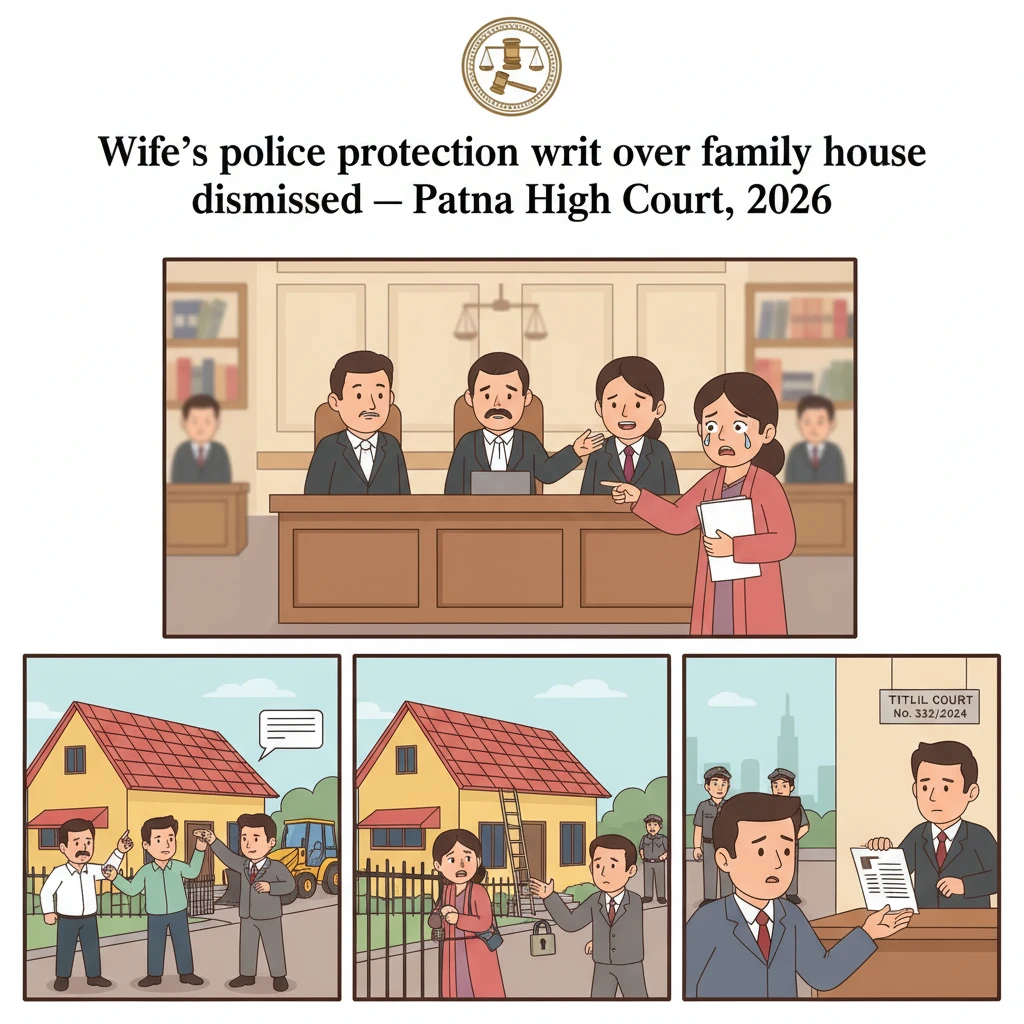
Case Background
The petitioner is the wife of one of four sons of late Arjun Pandey. According to her, Arjun Pandey purchased land in Patna (Khesra No. 329, Khata No. 85, Thana No. 7/29, Mauza Jakkanpur) in 1989 through a registered sale deed and built a pucca house on it. She says she has been living in that Patna house with her family since then.
The other three sons of Arjun Pandey (arrayed as respondent nos. 7, 8 and 9) are stated to be residing in their paternal village Mahatpur, P.S. Chandradip Dhanar, District Jamui. The petitioner claims there was an oral family arrangement under which her husband would live in the Patna house, and in return he would give up his share in the ancestral village property.
Her grievance started when respondent nos. 7, 8 and 9 allegedly sold their three-fourth share in the Patna property to a stranger (respondent no. 10) by a registered sale deed dated 28.06.2024. She asserts that this transfer was done clandestinely, against the provisions of the Transfer of Property Act, and that there had been no family partition, though the sale deed mentioned family partition and described the land as vacant.
The petitioner states that she first came to know of the sale when respondent no. 10 called and asked her to vacate the house. According to her, respondent no. 10 later came with others and threatened her and her family to vacate. She alleges that despite making a complaint to the police, no protective action was taken.
On 30.07.2024, a person allegedly identifying himself on phone as the SHO of Gardanibagh Police Station called the petitioner’s son and asked the petitioner to come to the police station. She says that when she went there, the police officer told her to vacate the house and threatened that the house would be demolished with a JCB if she did not comply.
Because of this, the petitioner submitted written applications to the Deputy Superintendent of Police, Sachiwalaya on 31.07.2024 and to the Senior Superintendent of Police, Patna on 02.08.2024. She complains that no effective help followed.
On 03.08.2024, as per her version, respondent no. 9 and others tried to forcibly enter the house and, when stopped, scuffled with her, abused her and threatened to kill her and her family. She called emergency number 112 and the police came but did nothing. She then filed a written information before Gardanibagh Police Station the same day.
She further alleges that on 05.08.2024, respondent no. 9 (described as co‑sharer Sudhir Pandey), one Aditya Pandey, respondent no. 10, his son and some unknown persons came again, abused and threatened her, tried to break the gate and then locked the gate from outside when they failed to enter. She says that later they returned with Gardanibagh police.
The petitioner claims that, out of fear, she used a ladder to come out of the house and then left the place. She alleges that the police tried to call her back so that they could facilitate the entry of the private respondents into the house. Afraid for her life and safety, she says she started living elsewhere. She also asserts that the private respondents and the police thereafter put locks on the main gate.
In the meantime, the petitioner’s husband instituted Title Suit No. 332 of 2024 before the civil court at Patna seeking, among other things, declaration that the suit property is joint and undivided, cancellation of the sale deed dated 28.06.2024, and an injunction restraining the purchaser and others from altering the property or interfering with his possession.
While this title suit was pending, the petitioner filed the present criminal writ petition (Criminal Writ Jurisdiction Case No. 1839 of 2024) before the Patna High Court seeking directions to the State authorities to protect her life and property and to protect her possession over the Patna house from respondent nos. 7 to 10.
What the Court Examined and Decided
The matter came before Hon’ble Mr. Justice Arun Kumar Jha. The central question was whether, in these circumstances, the High Court should issue directions in writ jurisdiction to the police to protect the petitioner’s life and possession in relation to the disputed house.
On behalf of the petitioner, her counsel argued that she and her family had been residing in the Patna house constructed by her father-in-law. Under a family arrangement, her husband was allowed to reside there in exchange for relinquishing his share in the Jamui village property. Therefore, according to her, the other brothers were not entitled to sell the dwelling house where she was living.
She alleged that respondents 7, 8 and 9, in collusion with the police, wanted to forcibly remove her from the only place she could call home. Counsel emphasized that the sale deed wrongly described the land as vacant even though there was a building on it, which showed mala fide intention. It was also argued that the three brothers could not sell this dwelling house to a stranger when she and her family were in possession.
Her counsel added that her husband was mentally not sound and could not effectively protect the family’s interests, which is why she had filed the writ petition herself. It was claimed that the police had failed in their duty to protect her possession despite repeated complaints, and were instead acting in favour of the private respondents.
On the other side, the State, through its counsel, relied on an earlier order of a co‑ordinate Bench dated 29.10.2024. In that order, the Senior Superintendent of Police, Patna, had been asked to inquire into the allegation that respondent no. 10 had put his lock on the house. After inquiry, it was found that two locks were on the main gate and that no one was residing there. The report was submitted to the Sub‑Divisional Police Officer, Sadar, Patna, and further inquiry reports were submitted on 30.10.2024 and 06.11.2024.
During the inquiry, the other three brothers told the police that there had been a partition in presence of panchas on 17.07.2017, though the petitioner and her husband were not accepting that partition. According to them, disputes arose within the family after this, and ultimately they sold only their respective shares, leaving intact the share of the petitioner’s husband.
To prevent any breach of peace, the police initiated preventive proceedings and registered non‑FIR Case No. 62 of 2024 under Section 126 of the Bharatiya Nagarik Suraksha Sanhita (BNSS). The State asserted that status quo was being maintained on the property and that the house was under police vigil.
The State counsel denied any collusion with the private respondents. They said the investigating officer had found that the petitioner had first put a lock on the main door and left. Thereafter, the second party put another lock over the first one. Thus, by the time of the inquiry no one was living in the house. The State, therefore, requested dismissal of the writ petition with costs, terming it a purely private land dispute.
Counsel for respondent nos. 7 to 10 went further and argued that the writ petition itself was an abuse of process. They questioned the petitioner’s locus standi, pointing out that her husband, not she, was the co‑sharer and had already filed Title Partition Suit No. 332 of 2024 in respect of the same property and similar reliefs. They also highlighted that the alleged oral family arrangement mentioned in the writ petition was not pleaded in the civil suit.
They submitted that the dispute involved rights of joint owners and raised complicated questions of fact, which could not be decided in writ proceedings. Since this was a property dispute between private parties, the High Court under Article 226 of the Constitution should not entertain it. They also argued that if the petitioner was aggrieved by the locks on the house, her remedy was to move the civil court, not to seek writ relief.
According to the private respondents, they had sold only their respective shares, and the sale deed itself mentioned residential land and valued the RCC structure separately, so there was no concealment. They denied that the petitioner was residing in the house at the relevant time, and claimed she had herself left the premises and put a lock. They further pointed out that both sides had filed criminal cases against each other, including Gardanibagh P.S. Case No. 386 of 2024 lodged by the petitioner’s sister‑in‑law against the petitioner, her husband and her son.
After considering the rival submissions and the record, the Court noted that all parties treated the property as joint family property of the four brothers, inherited from their father. The Court emphasised a “general principle” that the writ court does not enter into purely private title disputes involving contested property rights between private persons. Such disputes, especially where complex facts and evidence are involved, must be resolved by civil courts.
The Court relied on several Supreme Court authorities to underline this principle. In Roshina T. v. Abdul Azeez K.T., (2019) 2 SCC 329, the Supreme Court had held that disputes over property rights between private persons should normally be agitated through regular civil suits, and writ jurisdiction under Article 226 is not meant to replace ordinary civil or criminal remedies. The High Court’s extraordinary jurisdiction should not be used casually, and a writ claiming such relief should be rejected where an adequate alternative remedy such as a civil suit is available.
Similarly, in Sohan Lal v. Union of India, AIR 1957 SC 529, the Supreme Court had discouraged the use of writ jurisdiction to adjudicate rival claims of title to property, noting that questions of fact and law concerning ownership and possession must be decided in properly instituted civil suits. In that decision, the High Court’s order under Article 226 was set aside.
The Court also referred to P.R. Murlidharan v. Swami Dharmananda Theertha Padar, (2006) 4 SCC 501. There, the Supreme Court cautioned that a writ for “police protection” should not become a means to settle still‑disputed civil rights. Protection can be asked for to enforce an existing decree or injunction, but not as a shortcut where civil rights and possession remain to be adjudicated. Approaching the High Court under Article 226 in such circumstances was described as an abuse of process.
Applying these principles, the Patna High Court found that the petitioner’s case revolved around contested claims of title and possession among co‑sharers. Her own pleadings acknowledged that her husband had already filed Title Suit No. 332 of 2024 seeking, among other things, a declaration that the property is joint and undivided, cancellation of the sale deed dated 28.06.2024, and an injunction restraining the purchaser from altering the property or interfering with possession.
The Court reproduced the prayers in the civil suit, particularly relief (iv), which asked that the purchaser be restrained from alienating or changing the physical features of the suit property and from interfering in the plaintiff’s peaceful possession until disposal of the suit. The Court observed that this relief was “squarely covered” by the relief sought in the writ petition, which also sought protection of possession and prevention of interference.
The Court noted that, by the petitioner’s own stand in the writ petition, she was not in possession of the house at the time; she had left it and was staying elsewhere out of fear. The husband’s title suit was already pending before the competent civil court when the petition was filed. The rights of all parties to the property were yet to be adjudicated there.
In these circumstances, the Court held that disputed questions of fact regarding possession, right and title over the house could not be decided in writ jurisdiction. It would amount to the High Court usurping the role of the civil court and allowing forum hunting, especially when the petitioner’s husband had already chosen the civil remedy.
The Court acknowledged that in some cases, where a person is clearly in possession and that possession is undisputed or protected by an existing order, a writ for police protection may be maintainable. But here, where possession itself was seriously contested and the matter was sub judice in a title suit, that principle did not apply.
Ultimately, the Court concluded that the writ petition was not maintainable in view of the pending title suit and the nature of the dispute as a private property conflict among co‑sharers. On that basis, the Court dismissed the writ petition.
Why This Judgment Matters
This judgment is important for families in Bihar and elsewhere who face disputes over ancestral or joint family houses. It clarifies that when there is a serious dispute over who owns or possesses property, the proper forum is the civil court, not the High Court through a writ petition.
Even when a person fears eviction or claims threat to life from relatives over a house, the High Court will not decide the ownership or possession in writ jurisdiction if complex facts are in dispute and a civil suit is possible or already pending. Writ jurisdiction cannot be used as a shortcut to avoid the slower civil process.
The judgment also shows that asking for “police protection” cannot be used to indirectly claim a right over land or a house that has not yet been recognised by a civil court. Police can be directed to enforce an existing decree or clear right. But where the right itself is under challenge, one must first obtain appropriate orders from the civil court.
For lawyers and litigants, the ruling reinforces that filing parallel writ petitions while a title suit is pending may be treated as forum shopping and is likely to fail. It also indicates that the Patna High Court will follow Supreme Court guidance strictly in property disputes between private parties.
Legal Issues and Answers
- Issue: Can the Patna High Court, in writ jurisdiction, direct the police to protect the petitioner’s life and possession in a house when there is a contested property dispute between co‑sharers and a title suit regarding the same property and reliefs is already pending?
Answer: No. The Court held the writ petition was not maintainable because the dispute is a private property conflict involving disputed questions of title and possession, which must be decided by the civil court where the title suit is pending.
Cases Cited by the Court
- Roshina T. v. Abdul Azeez K.T., (2019) 2 SCC 329
- Sohan Lal v. Union of India, 1957 SCC OnLine SC 39 : AIR 1957 SC 529
- P.R. Murlidharan v. Swami Dharmananda Theertha Padar, (2006) 4 SCC 501
Case Details
Case Number: Criminal Writ Jurisdiction Case No. 1839 of 2024
Case Title: Aruna Devi v. The State of Bihar & Ors.
Citation: 2024(2) PLJR 549
Court: High Court of Judicature at Patna
Coram: Hon’ble Mr. Justice Arun Kumar Jha
Date of Judgment: 22-01-2026
Advocates:
For the petitioner: Mr. Ashok Kumar Pathak, Advocate
For the State: Mr. Raj Kishore, GP-18
For respondent nos. 7 to 10: Mr. Ranaj Kumar Dubey, Advocate; Mr. Kumar Gaurav, Advocate; Mr. Shashank Kashyap, Advocate; Ms. Sheshadri Kumari, Advocate; Ms. Ishiqua Raj, Advocate
Nature of the Case: Criminal writ petition seeking police protection and protection of life and property in the context of a family property dispute.
Link to the Judgment: Click here to access the official Patna High Court judgment
If you found this explanation helpful and wish to stay informed about
how legal developments may affect your rights in Bihar,
you may consider following Samvida Law Associates for more updates.







