

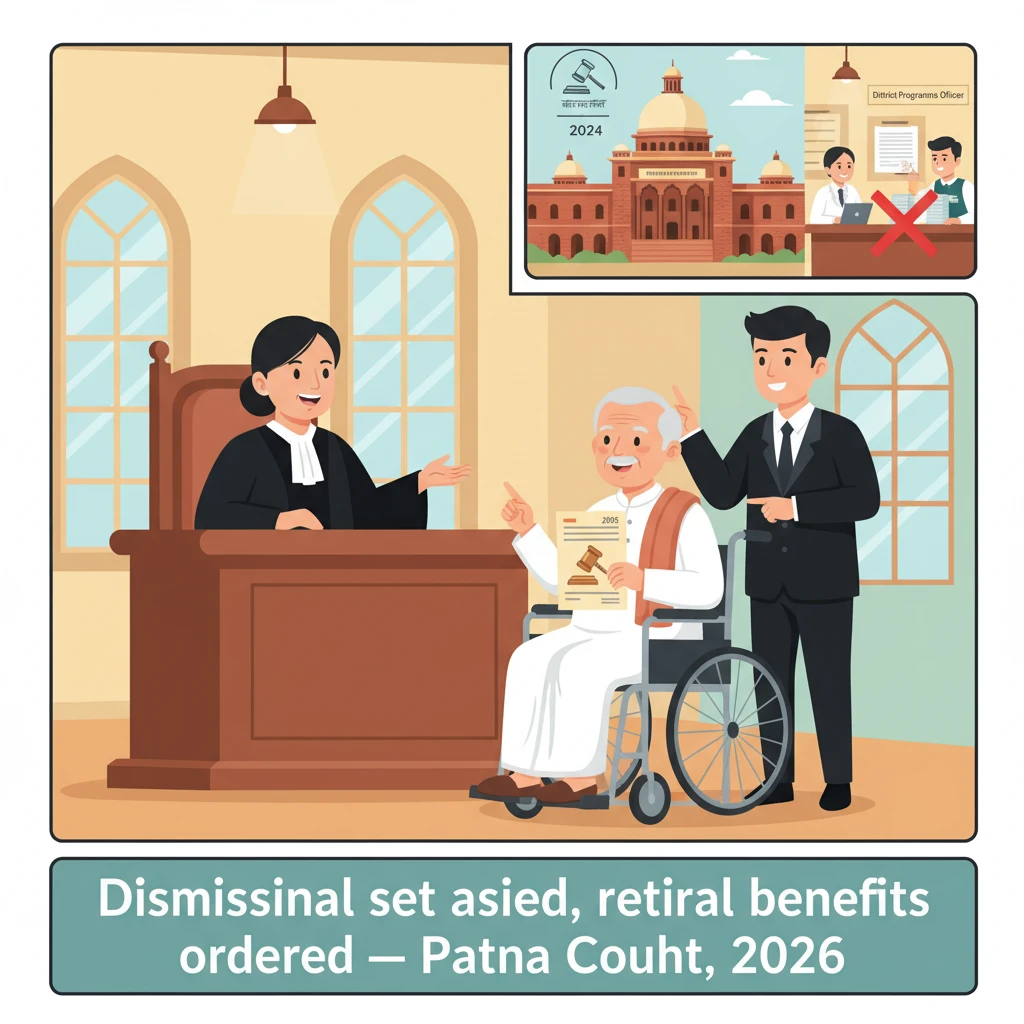
The Court cancelled the 2010 dismissal order and granted him notional continuity of service for pension, gratuity and leave encashment.
However, it refused back wages and salary for the years he remained out of service.
The authorities must now recalculate and release his post‑retirement dues under the applicable rules.
Case Background
The petitioner was appointed as an Assistant Teacher in a Government Middle School on 06.04.1982. He served without any adverse entries for many years.
In 2002, a criminal case, Maranchi P.S. Case No. 17 of 2002, was registered against him for offences punishable under Sections 302/34 of the Indian Penal Code. After trial, the criminal court convicted him on 21.12.2009, and he was taken into custody following this conviction.
The petitioner challenged this conviction by filing Criminal Appeal (DB) No. 232 of 2010 before the Patna High Court. During the pendency of that appeal, the Appellate Court stayed his sentence and fine and released him on bail.
Once enlarged on bail, the petitioner applied on 13.03.2010 for permission to rejoin his duties as a teacher. The District Superintendent of Education, Patna, called for a report and also issued a show‑cause notice vide letter no. 1669 dated 18.03.2010.
The petitioner replied on 29.03.2010, stating clearly that his sentence had been stayed and he was on bail. Despite this, the District Superintendent of Education issued Memo No. 4093 dated 16.09.2010, dismissing him from service under Rule 20(1) of the Bihar Government Servant (Classification, Control and Appeal) Rules, 2005.
The petitioner challenged this dismissal in C.W.J.C. No. 13280 of 2011. That earlier writ petition was disposed of on 07.03.2012, granting him liberty to seek reinstatement if he was exonerated by the Appellate Court.
Later, on 20.08.2024, the Division Bench of the Patna High Court allowed his criminal appeal. The prosecution was found to have failed to prove the charges beyond reasonable doubt, and the petitioner was acquitted and discharged.
Armed with the acquittal, the petitioner submitted a representation on 14.10.2024 before the District Programme Officer (Establishment), Patna, requesting review of the 16.09.2010 dismissal order. No action was taken.
In the meantime, the petitioner reached the age of superannuation in 2016. He received amounts towards General Provident Fund (GPF) and Group Life Insurance (GLI), but his claims for pension, gratuity and leave encashment were not accepted. It was also brought to the Court’s notice that he is physically challenged and undergoing treatment at Tata Memorial Hospital, Mumbai.
In these circumstances, he filed the present writ petition (C.W.J.C. No. 6777 of 2025) challenging the dismissal order and seeking all consequential benefits, including salary, pension, gratuity, leave encashment and arrears of pension with interest.
What the Court Examined and Decided
The Patna High Court, through Hon’ble Mr. Justice Harish Kumar, heard the petitioner’s counsel, the State’s counsel and an amicus curiae, Mr. Siddhartha Prasad, appointed by the Court because of the importance of the legal issue involved.
The central question was: what happens to a government servant’s dismissal from service, and to his service benefits, when his criminal conviction — which was the sole basis of dismissal — is later set aside in appeal?
The petitioner argued that once his conviction was overturned and he was acquitted by the Division Bench on 20.08.2024, the very foundation of the dismissal order disappeared. Therefore, the dismissal could not stand, and he must be given all service benefits, including pension and other retiral dues calculated on the basis of his last pay.
The State, however, opposed the writ petition. It admitted that the dismissal order was based on the trial court’s conviction. But it pointed out that the acquittal in appeal was on “benefit of doubt”, and contended that this was not a “clean” or “honourable” acquittal.
According to the State, the dismissal order had also taken into account the petitioner’s response to the show‑cause notice. On that basis, they argued that he was entitled only to the provident fund and group insurance amounts for the period he had actually worked, and nothing more. In the State’s view, since he had not been “honourably acquitted”, he could not claim monetary benefits like arrears of salary and pension.
To answer this dispute, the Court requested the amicus curiae to assist on the specific legal issue: whether an employee convicted of a heinous offence and dismissed from service during his service period can, after acquittal in appeal, claim consequential service benefits upon reconsideration of the dismissal order.
The amicus curiae took the Court through several Supreme Court judgments on similar situations, including Ranchhodji Chaturji Thakore v. Superintendent Engineer, Gujarat Electricity Board; Union of India v. Jaipal Singh; Baldev Singh v. Union of India; Banshi Dhar v. State of Rajasthan; and State Bank of India v. Mohammed Abdul Rahim.
Across these decisions, the Supreme Court has consistently held that:
First, where an employee is dismissed solely due to criminal conviction, and that conviction is later set aside, reinstatement or restoration of service may follow, because the dismissal was only a consequence of the conviction.
Second, however, the employee is not automatically entitled to back wages or arrears of salary for the period between conviction and acquittal. The Court stressed the principle of “no work, no pay” and stated that an employee who could not render service because of his own criminal case and incarceration cannot claim wages for that period.
Third, grant of back wages is never automatic. It depends on the facts of each case, including whether the prosecution was initiated by the employer, whether there was an independent departmental proceeding, and the nature and seriousness of the charges.
In one of the cited cases, the Supreme Court also clarified that an acquittal in a criminal case does not retrospectively erase the legal consequences that flowed from the conviction while it existed. It may justify restoration of service, but does not by itself create a right to wages for the period the conviction was in force.
The amicus further cited a Division Bench judgment of the Patna High Court in Bhagwan Ram v. State of Bihar & Ors. (L.P.A. No. 322 of 2020). In that case too, an employee had been dismissed solely on the basis of a criminal conviction, without a separate departmental inquiry. His conviction was later set aside and he was acquitted on benefit of doubt by the Supreme Court.
The Division Bench held that where dismissal is exclusively based on conviction and that conviction is later set aside, the dismissal order must be quashed. The employee would then be entitled to retiral or post‑retiral benefits, though back wages for the period when he did not work could legitimately be denied, especially where he had already attained superannuation before acquittal.
Turning to the present case, the Court first examined the legality of the 2010 dismissal. It noted that the dismissal had been ordered under Rule 20(1) of the Rules, 2005. This rule permits the disciplinary authority to impose any penalty, including dismissal, once a government servant is convicted on a criminal charge, without holding a separate departmental inquiry.
The Court held that this provision is in line with clause (a) of the second proviso to Article 311(2) of the Constitution of India. Under that clause, when a government servant is dismissed, removed or reduced in rank on the ground of conduct which has led to his conviction on a criminal charge, the usual requirement of holding a departmental inquiry is dispensed with.
Therefore, once the petitioner was convicted by the criminal court, the authorities were constitutionally and statutorily empowered to terminate his services without further inquiry. The Court held that, at that time, the dismissal order was a “natural consequence” of the conviction and was in consonance with Rule 20(1) and Article 311(2).
The Court then addressed the State’s argument that the acquittal was only on “benefit of doubt” and so the petitioner should not get monetary benefits. Referring to Ram Lal v. State of Rajasthan & Ors., (2024) 1 SCC 175, the Court explained that expressions like “benefit of doubt” and “honourably acquitted” are not magical formulas.
The real test is whether the appellate court, after fully considering the prosecution evidence, found that the prosecution had failed to prove the charges. Courts must look at the substance of the entire judgment, not just words or labels used in it.
On reading the Division Bench judgment dated 20.08.2024 in the petitioner’s criminal appeal, the Court found that the acquittal was granted after full consideration of evidence and because the prosecution failed to prove the case beyond reasonable doubt.
Importantly, the Court noted that the petitioner’s dismissal was not based on any independent departmental proceedings or evidence of misconduct. It was based solely on the criminal conviction and the automatic operation of Rule 20(1). Therefore, the State’s argument about the acquittal being based on “benefit of doubt” lost much of its force in this context.
The Court concluded that once the conviction was set aside and the petitioner was acquitted, the foundation of the dismissal disappeared. Since no independent departmental inquiry had been held, the dismissal order based purely on conviction “lost its effect”.
Accordingly, the Court set aside the impugned dismissal order contained in Memo No. 4093 dated 16.09.2010 issued by the District Superintendent of Education, Patna.
However, by the time of the judgment, the petitioner had already crossed the age of superannuation in 2016. Therefore, reinstatement into service was not possible. The question was limited to retiral and post‑retiral benefits.
Applying the Supreme Court’s rulings, the Court held that the petitioner was entitled to notional continuity of service for the limited purpose of computing pension, gratuity, leave encashment and other admissible dues under the rules. This means that for calculating these benefits, his service would be treated as if it had continued uninterrupted.
At the same time, in line with the principle of “no work, no pay” and the precedents discussed, the Court clearly held that the petitioner would not be entitled to back wages, salary, arrears or other monetary benefits for the period he remained out of service following his conviction.
Thus, the writ petition was allowed only to this extent: cancellation of dismissal, grant of notional continuity of service, and direction to compute and pay pensionary and other retiral dues, without back wages.
Why This Judgment Matters
This judgment is important for government employees in Bihar who are dismissed only because of a criminal conviction, and later acquitted in appeal.
The Patna High Court makes it clear that when dismissal is purely a result of conviction under Rule 20(1) of the Rules, 2005, and the conviction is later set aside, the dismissal cannot continue. The employee’s service record must be restored for pension and other retirement benefits.
At the same time, the Court has followed Supreme Court law that such employees cannot automatically claim salary for the years they did not work. The rule of “no work, no pay” still applies.
For teachers and other government servants, this judgment shows that an acquittal can protect their pension and gratuity, even if they have already retired. But it also warns that back wages for the period of dismissal will usually not be paid, unless there was an independent wrongful departmental action.
Legal Issues and Answers
- Issue: Can a government servant, dismissed solely on the basis of a criminal conviction under Rule 20(1) of the Rules, 2005, claim restoration of service benefits after being acquitted in appeal?
Answer: Yes. Once the conviction is set aside and there was no independent departmental inquiry, the dismissal order loses its basis and must be quashed. The employee is entitled to notional continuity of service for computation of pension, gratuity, leave encashment and other admissible dues. - Issue: Is such an employee entitled to back wages and salary for the period between dismissal and acquittal?
Answer: No. Following Supreme Court precedents and the principle of “no work, no pay”, the Court held that the employee is not entitled to back wages, salary, arrears or other monetary benefits for the period he remained out of service. - Issue: Does it matter that the acquittal was said to be on “benefit of doubt” rather than described as “honourable”?
Answer: No in this context. The Court held that such expressions are not decisive; what matters is that the appellate court, after fully examining the evidence, found that the prosecution failed to prove the charges. Since the dismissal was only based on conviction, the acquittal was sufficient to undo it.
Cases Cited by the Court
- Ranchhodji Chaturji Thakore v. Superintendent Engineer, Gujarat Electricity Board, (1996) 11 SCC 603
- Union of India & Others v. Jaipal Singh, (2004) 1 SCC 121
- Baldev Singh v. Union of India, (2005) 8 SCC 747
- Banshi Dhar v. State of Rajasthan, (2007) 1 SCC 324
- State Bank of India v. Mohammed Abdul Rahim, (2013) 11 SCC 67
- Ram Lal v. State of Rajasthan & Ors., (2024) 1 SCC 175
- Bhagwan Ram v. State of Bihar & Ors., L.P.A. No. 322 of 2020 (Patna High Court)
Case Details
Case Number: Civil Writ Jurisdiction Case No. 6777 of 2025
Case Title: Janardan Singh v. The State of Bihar & Ors.
Coram: Hon’ble Mr. Justice Harish Kumar
Date of Judgment: 12.01.2026
Citation: 2024(2) PLJR 529
Advocates: For the petitioner – Mr. Binod Kumar, Advocate; Mr. Sanjay Kumar, Advocate. For the State – Ms. Sunita Kumar, AC to AAG‑13. Amicus Curiae – Mr. Siddhartha Prasad, Advocate.
Nature of the Case: Writ petition under Article 226 of the Constitution challenging dismissal from service and seeking consequential service and retiral benefits.
Link to Judgment: Click here to read the full Patna High Court judgment
If you found this explanation helpful and wish to stay informed about
how legal developments may affect your rights in Bihar,
you may consider following Samvida Law Associates for more updates.







