

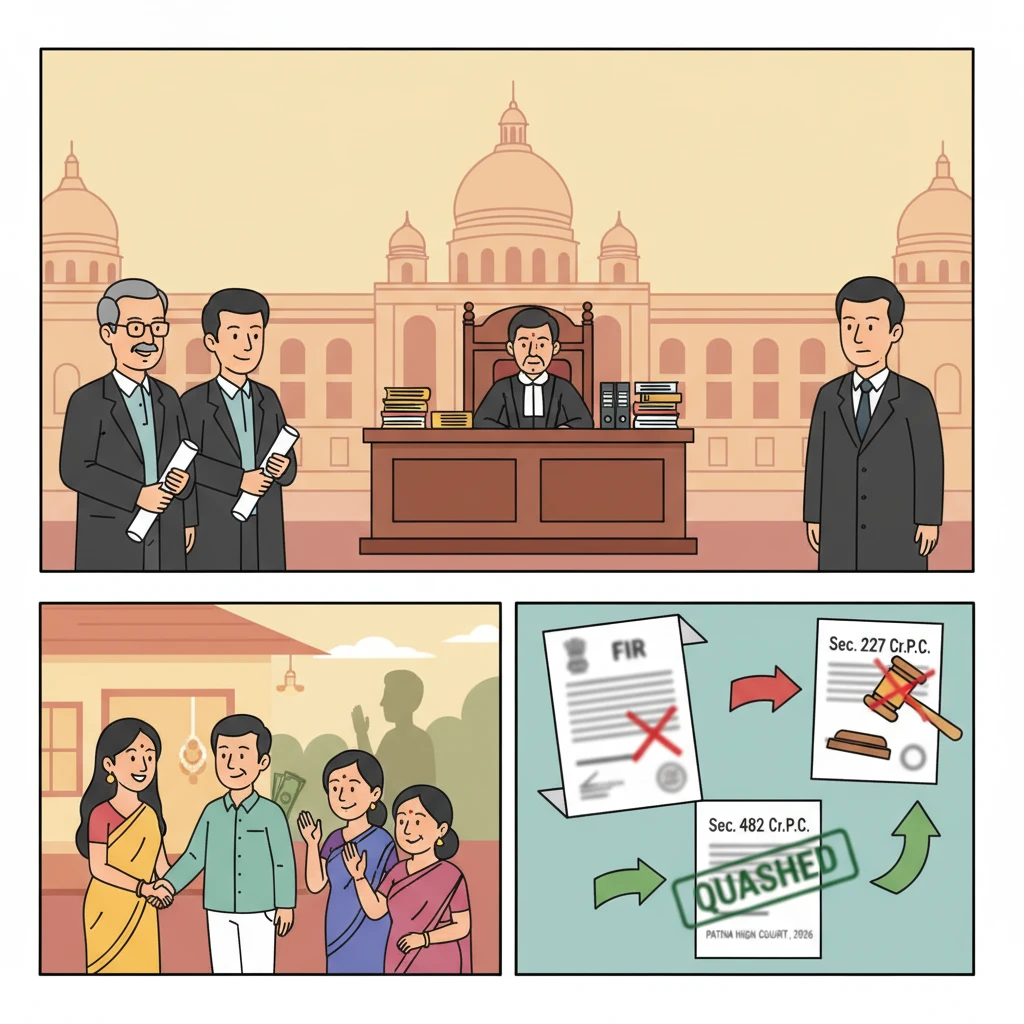
Case Background
The case arose from Jagdishpur P.S. Case No. 121 of 2019, District Bhagalpur. The FIR was lodged on 26.04.2019 by a 25‑year‑old woman alleging offences under Sections 341, 376, 379/34 of the Indian Penal Code.
She alleged that for about one year the petitioner had been having physical relations with her on the allurement and pretext of marriage. According to the FIR, on 22.04.2019 the petitioner asked her to come with him for marriage. She left her home with cash and jewellery, went with him to his maternal uncle’s house and stayed in a room there.
The FIR states that the petitioner’s father came there and assured that the marriage would take place. After this, she and the petitioner returned to her village. There, the petitioner’s mother allegedly assured the informant’s parents that the marriage would happen. However, no marriage took place, and the informant alleged that other family members of the petitioner were preventing it.
On this basis, the FIR for rape, wrongful restraint and theft was registered. After investigation, the police submitted charge‑sheet against the petitioner and others. The Magistrate took cognizance under Sections 376 and 341 read with Section 34 IPC, and the case was committed to the Court of Sessions as S.Tr. No. 161 of 2021.
Before the Sessions Court, the petitioner filed an application dated 26.10.2021 under Section 227 Cr.P.C. seeking discharge from the charge under Section 376 IPC. On 17.11.2021, the learned Additional Sessions Judge‑I, Bhagalpur rejected the discharge petition. Charges had not yet been framed when the matter came to the High Court.
Aggrieved, the petitioner approached the Patna High Court in Criminal Miscellaneous No. 3303 of 2022 seeking quashing of the order dated 17.11.2021 and the criminal prosecution so far as it concerned the rape allegation.
What the Court Examined and Decided
Hon’ble Justice Smt. Soni Shrivastava heard the matter. The State of Bihar was represented by the Additional Public Prosecutor. Despite valid service of notice, the informant did not appear before the High Court.
The key question framed by the Court was whether there was sufficient material on record to proceed against the petitioner for the offence under Section 376 IPC.
Arguments by the Petitioner
Senior counsel for the petitioner argued that even if the FIR is read as it is, no offence of rape is made out. The main points urged were:
First, the informant herself described her age as 25 years. She was thus an adult capable of taking her own decisions. The relationship between the petitioner and the informant had been going on for one year, showing it was not a one‑time incident.
Second, there was no allegation in the FIR of any threat, force or coercion. According to the petitioner, the informant had entered into the physical relationship with open eyes as a consenting adult.
Third, the statement of the informant recorded under Section 164 Cr.P.C. was highlighted. Counsel pointed out that in this statement she did not say a single word about any sexual assault by the petitioner. Instead, she mainly referred to assurances given by the petitioner’s parents, especially his mother, that she would be married to the petitioner.
This, counsel argued, indicated that there was a bona fide intention of marriage earlier, not a false promise given only to obtain sexual favours.
Fourth, the defence relied on the medical examination of the informant. The report showed that she was an adult and that no spermatozoa was found on vaginal swab examination. Counsel submitted that this medical evidence did not support the allegation of rape mentioned in the FIR.
To support the legal submission that consensual relationships between adults cannot be converted into rape cases merely because marriage does not happen later, learned senior counsel relied on recent Supreme Court decisions in:
(a) Jaspal Singh Kaural v. State (NCT of Delhi) & Anr., (2025) 5 SCC 756,
(b) Surendra Khawse v. State of Madhya Pradesh & Anr., 2025 INSC 1143, and
(c) Prashant v. State (NCT of Delhi), (2025) 5 SCC 764.
Arguments by the State
The learned APP opposed the application. He contended that the FIR and materials collected during investigation showed that the informant had been sexually exploited on a false promise of marriage.
According to the State, this meant that the informant had consented to the physical relationship under a “misconception of fact”. In such a situation, under criminal law, the consent is treated as no consent. Therefore, sufficient grounds existed to proceed against the petitioner for rape, and the Sessions Court was right in rejecting the discharge petition.
High Court’s Analysis of Consent and Promise of Marriage
The Patna High Court went through the FIR, the Section 164 statement and other materials. The Court noted that the prosecutrix was a 25‑year‑old adult who had been in a relationship with the petitioner for about a year.
From this, the Court inferred that the relationship was consensual between two adults. The Court recognised that there was an allegation that the sexual relationship was on the pretext of marriage, but stressed that there can be several reasons for two consenting partners to develop physical intimacy.
The Court said that for a case of rape based on “false promise to marry” to stand, the prosecution must bring specific assertions and material to show:
(i) that the woman entered into the relationship only because of a promise of marriage; and
(ii) that at the very beginning the accused never intended to marry her and used the promise only to obtain sexual relations.
On the facts, the Court found no such material. In fact, the prosecutrix herself stated that marriage could not take place because of interference by the petitioner’s parents and other family members. This suggested that there was at least some genuine intention to marry at the initial stage, which later faced obstacles.
The Court drew a clear distinction between a “false promise” to marry and a “breach of promise”. A false promise exists when, from the start, the man never intends to marry and only cheats the woman. A breach of promise occurs when circumstances later arise which prevent fulfilment of an earlier genuine promise.
For this distinction, the Court relied on the Supreme Court’s decision in Naim Ahmed v. State (NCT of Delhi), (2023) 15 SCC 385. Paragraph 21 of that judgment, which explains the difference between false promise and breach of promise and warns that every breach cannot be treated as false promise for rape, was quoted at length.
The Court also relied on Pramod Suryabhan Pawar v. State of Maharashtra, (2019) 9 SCC 608, where the Supreme Court summarised the law on consent and misconception of fact when sex occurs on a promise of marriage. The Patna High Court reproduced paragraph 18 of that decision, which says that:
(a) consent must involve active, reasoned deliberation; and
(b) to say consent was under misconception of fact, it must be shown that the promise of marriage was false, given in bad faith without intention to fulfil it, and that the promise had a direct link with the woman’s decision to engage in sex.
Applying these principles, the Court held that nothing in the record indicated that the informant engaged in physical relations only because of a false promise to marry. There was no material to show that any such promise had a direct nexus with her decision to have sexual relations.
Emphasis on Adult Agency and Voluntary Choice
The Court also stressed that the informant, by reason of her age and maturity, was capable of taking independent decisions. Entering into a sexual relationship with the petitioner was a conscious and informed choice, made without any allegation of force or coercion.
Such a voluntary and willing relationship, the Court observed, cannot be turned into a criminal case of rape simply because the relationship later does not end in marriage.
To reinforce this, the Court relied on the Supreme Court decision in Prashant v. State (NCT of Delhi), (2025) 5 SCC 764. Paragraph 19 of that judgment, quoted by the Court, states that where the relationship between the parties is cordial and consensual and there is no clear indication that sex was solely on account of a promise of marriage, criminal proceedings for rape cannot be initiated merely because the relationship breaks down.
The Court further cited Samadhan v. State of Maharashtra & Anr., 2025 SCC OnLine SC 2528. There, the Supreme Court held that continuing prosecution in a case of a voluntary, consensual relationship without coercion, fraud or misrepresentation would amount to an abuse of court machinery.
Power to Discharge and Prevent Vexatious Prosecution
The Patna High Court found that the Sessions Court had erred in refusing to discharge the petitioner. Referring to Kanchan Kumar v. State of Bihar, (2022) 9 SCC 577, the Court noted that at the stage of framing charge, a court is not a mere “post office”.
Though the Court should not conduct a detailed trial at that stage, it must look at the materials to see if there is enough ground to proceed. It has a duty to protect individuals from vexatious and unwanted prosecution.
In exercise of its inherent power under Section 482 Cr.P.C., the High Court drew support from the well‑known guidelines laid down in State of Haryana & Ors. v. Bhajan Lal & Ors., 1992 Supp (1) SCC 335. The Court quoted the relevant categories, especially:
(1) where even if the allegations are taken at face value they do not prima facie constitute any offence, and
(7) where a criminal proceeding is manifestly attended with mala fide or is maliciously instituted to wreak vengeance.
Final Decision
After considering the factual matrix and legal position, the Patna High Court concluded that the prosecution against the petitioner was frivolous and vexatious. The necessary ingredients of the offence of rape under Section 375 IPC, particularly for proceeding under Section 376 IPC, were clearly not made out.
Continuing the case would amount to abuse of the process of the Court. Therefore, the High Court quashed the order dated 17.11.2021 passed by the learned Additional Sessions Judge‑I, Bhagalpur in S.Tr. No. 161 of 2021 (arising out of Jagdishpur P.S. Case No. 121 of 2019). The criminal miscellaneous application was allowed, effectively ending the rape prosecution against the petitioner based on this FIR.
Why This Judgment Matters
This judgment is significant for people in Bihar and elsewhere who are involved in relationships that later break down. It clarifies that every failed love affair or broken engagement cannot automatically become a criminal case of rape.
Where two adults voluntarily enter into a long‑term physical relationship, and there is no clear proof that the man never intended to marry from the beginning, the criminal law on rape will not apply. The decision reinforces that adult women also have agency and responsibility in such relationships.
For criminal courts, the judgment underlines their duty at the stage of discharge and framing of charges. Courts must carefully look at FIR, statements and investigation materials to see whether the legal ingredients of rape are present. If not, they should prevent unnecessary trials that cause hardship to both sides and waste judicial time.
For lawyers and laypersons, the ruling provides guidance on when accusations of rape on the basis of promise to marry may be treated as misuse of criminal law, and when they may still be valid, depending entirely on the evidence about intention and consent.
Legal Issues and Answers
- Issue: Did the FIR and investigation materials disclose a prima facie case of rape under Section 376 IPC based on alleged sexual relations on the promise of marriage?
Answer: No. The Patna High Court held that the relationship was consensual between two adults, there was no material to show a false promise of marriage given in bad faith at the outset, and therefore the basic ingredients of rape were not made out. - Issue: Was the Sessions Court justified in rejecting the petitioner’s discharge application under Section 227 Cr.P.C.?
Answer: No. The High Court found that the Sessions Court failed to properly sift and weigh the material to see if there was sufficient ground to proceed. Its refusal to discharge was illegal, and the order was quashed under Section 482 Cr.P.C.
Cases Cited by the Court
- Naim Ahmed v. State (NCT of Delhi), (2023) 15 SCC 385 – distinction between false promise to marry and breach of promise.
- Pramod Suryabhan Pawar v. State of Maharashtra, (2019) 9 SCC 608 – legal test for consent and misconception of fact based on promise of marriage.
- Prashant v. State (NCT of Delhi), (2025) 5 SCC 764 – consensual relationship not to be criminalised merely because it does not lead to marriage.
- Samadhan v. State of Maharashtra & Anr., 2025 SCC OnLine SC 2528 – continuation of prosecution in voluntary consensual relationships amounts to abuse of court machinery.
- Kanchan Kumar v. State of Bihar, (2022) 9 SCC 577 – role of court at stage of discharge; not a mere post office.
- State of Haryana & Ors. v. Bhajan Lal & Ors., 1992 Supp (1) SCC 335 – categories where inherent powers under Section 482 Cr.P.C. can be exercised to quash criminal proceedings.
- The petitioner also relied on: Jaspal Singh Kaural v. State (NCT of Delhi) & Anr., (2025) 5 SCC 756; Surendra Khawse v. State of Madhya Pradesh & Anr., 2025 INSC 1143; and Prashant v. State (NCT of Delhi), (2025) 5 SCC 764.
Case Details
Case Number: Criminal Miscellaneous No. 3303 of 2022; arising out of Jagdishpur P.S. Case No. 121 of 2019; Sessions Trial No. 161 of 2021.
Case Title: Md. Saif Ali Ansari v. The State of Bihar & Anr.
Citation: 2024(2) PLJR 535.
Court and Bench: High Court of Judicature at Patna; Hon’ble Justice Smt. Soni Shrivastava.
Date of Judgment: 12.01.2026.
Advocates: For the petitioner – Mr. Syed Masleh Uddin Ashraf, Senior Advocate; Mr. Shehan Ashraf, Advocate. For the State – Mr. Bhanu Pratap Singh, APP. Appearance of the informant/opposite party no. 2 – none, despite valid service of notice.
Nature of the Case: Criminal miscellaneous application under Section 482 Cr.P.C. challenging rejection of discharge under Section 227 Cr.P.C. in a rape case based on alleged sexual relations on promise of marriage.
Result: Application allowed; order dated 17.11.2021 rejecting discharge set aside; continuation of prosecution under Section 376 IPC quashed as abuse of process of court.
Link to Judgment: Read the full judgment on the Patna High Court website
If you found this explanation helpful and wish to stay informed about
how legal developments may affect your rights in Bihar,
you may consider following Samvida Law Associates for more updates.







