

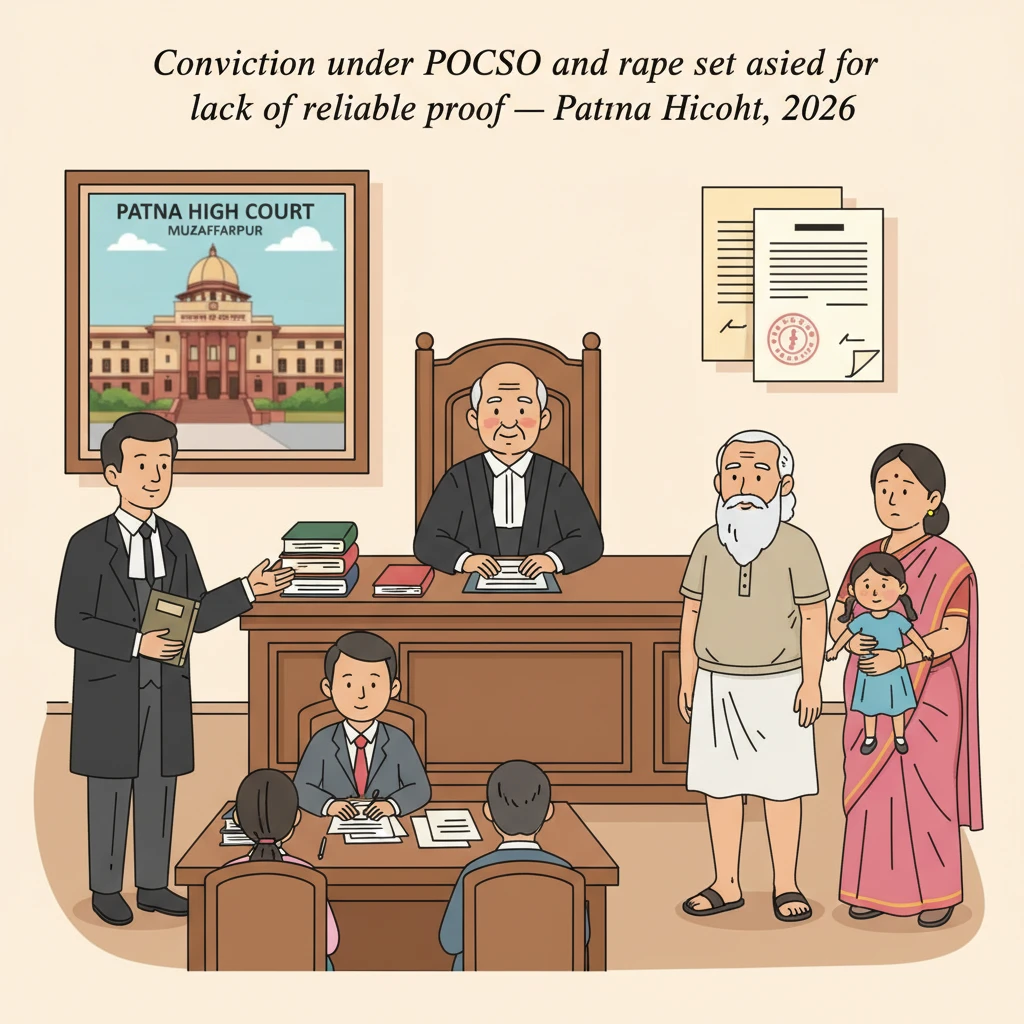
The Court found serious gaps in the investigation and evidence, especially around the child’s statement and medical proof.
It held that it was unsafe to uphold the conviction only on this untested testimony.
The conviction and 20‑year sentence were set aside, and the appellant was ordered to be released.
Case Background
The criminal appeal arose from Ahiyapur P.S. Case No. 636 of 2018, Muzaffarpur. The informant was the mother of a minor girl aged about 11 years. The appellant was a co-villager, locally known as a “Baba”.
According to the mother’s fardbeyan recorded on 13.06.2018 at 15:00 hours in the Gynaec Ward of SKMCH, Muzaffarpur, she had first taken her daughter to the appellant on 10.06.2018 at around 10:00 PM for treatment of stomach pain by way of “totama/jhadphuk”. The appellant allegedly gave five flowers, performed jhadphuk, and asked them to come again on 12.06.2018.
On 12.06.2018 at about 9:00 PM, the appellant allegedly came to the informant’s house, saying he had come to perform “totama” and asking that the minor girl be allowed to go with him alone. The mother stated that she agreed, and the girl left with him. About an hour later, the girl returned home weeping and made allegations of sexual assault, which the mother and other family members later narrated.
On the basis of the mother’s fardbeyan dated 13.06.2018, Ahiyapur P.S. Case No. 636 of 2018 was registered under Section 376 IPC, Sections 3/4 of the Prevention of Witch (Daain) Practices Act, and Sections 8/10 of the POCSO Act against the appellant.
After investigation, the police submitted Chargesheet No. 649 of 2018 dated 31.08.2018 under Section 376 IPC, Sections 3/4 of the Daain Practices Act, and Section 4 of the POCSO Act. Cognizance was taken on 12.09.2018. On 03.10.2018, charges were framed by the Special POCSO Court under Section 376 IPC and Section 6 of the POCSO Act.
The trial court examined seven prosecution witnesses, including the victim, her family members, the investigating officer, and the doctor, and marked documentary exhibits such as the FIR, endorsement, and medical report. The defence did not lead any evidence. The trial court convicted the appellant under Section 376(2) IPC and Section 6 POCSO and imposed 20 years’ rigorous imprisonment with a fine of Rs. 50,000/- under Section 6 POCSO, with default sentence.
The appellant, aged about 68 years at the time of the alleged occurrence and about 72 years at the time of recording of his Section 313 CrPC statement, challenged this conviction before the Patna High Court in Criminal Appeal (DB) No. 407 of 2023.
What the Court Examined and Decided
The Division Bench of Hon’ble Mr. Justice Rajeev Ranjan Prasad and Hon’ble Justice Smt. Soni Shrivastava heard the appeal. An Amicus Curiae argued for the appellant; the State was represented by the Additional Public Prosecutor. Despite service, no one appeared for the informant.
The Court first recounted the prosecution story based on the mother’s fardbeyan: the taking of the child to the Baba on 10.06.2018, the alleged second visit initiated by the Baba on 12.06.2018 at 9:00 PM, and the narration of sexual assault in a litchi orchard, where the appellant was said to have removed the girl’s leggings and frock, laid her on a gamchha, committed a “wrong act” with her, gave her Rs. 50, and warned her not to disclose it.
The prosecution case rested heavily on the statements of the child (PW‑1), her parents and relatives (PW‑2, PW‑3, PW‑4, PW‑5), the investigating officer (PW‑6), and the doctor (PW‑7), alongside the medical examination report (Exhibit 4) and other procedural documents.
The Amicus Curiae attacked the conviction on several grounds: delay and inconsistency in lodging the FIR, suppression of the earliest version, lack of proper proof of the victim’s age, non-seizure of clothes and gamchha, failure to conduct the mandatory medical examination of the accused under Section 53A CrPC, inconsistencies between ocular testimony and medical findings, and non-compliance with legal requirements for recording and relying on a child witness’s statement under Section 164 CrPC and at trial. He also argued that the trial court wrongly applied the amended Section 6 of the POCSO Act, which came into force only on 16.08.2019.
The State defended the conviction by pointing to the consistent and corroborative statements of the mother (PW‑5) and other family witnesses (PW‑2, PW‑3, PW‑4). It was contended that their depositions supported the victim’s version and justified the trial court’s reliance on the testimony.
When the High Court examined the evidence, it found several troubling aspects.
First, the Court noted that, according to prosecution witnesses, the girl had returned home with blood on her clothes and on the gamchha, but neither the clothes nor the gamchha were seized by the investigating officer. The Court considered this a serious omission, especially when the case involved an allegation of rape in an open orchard, where soil and tearing of clothes might be expected. PW‑3, the grandmother, admitted that there was no tearing of clothes and no soil marks, and no injuries on the face or nose.
Second, the Court considered the conduct of the parents in allowing an 11‑year‑old girl to go alone with the Baba at 9:00 PM to an undisclosed place. The Bench described this as “quite unnatural conduct” and observed that the story “does not inspire confidence”.
Third, the Court highlighted the failure to conduct a medical examination of the accused, despite his arrest on the same day as FIR registration (13.06.2018). This was seen as clear non‑compliance with Section 53A CrPC, which mandates medical examination of persons accused of rape-type offences. The Bench observed that such an examination could have yielded vital evidence and that the omission seriously prejudiced the defence, particularly given the accused’s advanced age (about 68 at the time of occurrence).
Fourth, the Court carefully examined the medical evidence. The doctor (PW‑7) had examined the victim on 12.06.2018 at 11:30 PM in the Emergency Ward, as per Exhibit 4. No external injury was found. Pelvic examination showed normal labia and an old partially torn hymen. No spermatozoa were detected. The doctor testified that the victim herself had told her that the accused, known to her, had taken her to a lonely place, removed her clothes, and tried to penetrate, but she managed to escape by physical effort and informed her parents.
From this, the Court held that the medical evidence suggested an attempt to penetrate rather than an actual penetrative sexual act. This was in contrast to the prosecution’s allegation of completed rape, and reduced the strength of the prosecution case.
Fifth, the Court found substantial force in the defence argument that the earliest version had been suppressed. PW‑1, PW‑4, and PW‑5 had stated that the victim’s fardbeyan was recorded by the police on 12.06.2018 itself and signed by her. However, the formal FIR (Exhibit 3) only annexed the mother’s fardbeyan dated 13.06.2018 at 15:00 hours as the basis for registration, and recorded receipt of information at 15:30 hours on 13.06.2018, though the police station was only 6 km away.
PW‑4 specifically stated that the girl first narrated the incident to “Darogaji”, who wrote it down and obtained her signature, and only thereafter questioned the mother and others. Yet this initial statement of the victim was not brought on record. The Court concluded that there had been suppression of the first version of the prosecution case, creating serious doubt about later embellishment or fabrication.
Sixth, the High Court criticised the handling of the child witness’s evidence. The girl was produced before the Magistrate for recording her statement under Section 164 CrPC after an 11‑day delay. She disclosed her age as 11 years. The Bench noted that the Magistrate did not test or record her competence to understand questions and speak the truth, as required under Section 118 of the Evidence Act and as explained by the Supreme Court in P. Ramesh v. State represented by Inspector of Police.
The Magistrate did not step into the witness box to prove the Section 164 statement; only the victim’s signature was proved as Exhibit 1. When the child deposed later in court, the trial judge again failed to put any questions to test her understanding or capacity, despite her being a child witness. The High Court cited detailed passages from P. Ramesh, restating that child witnesses must be assessed for intelligence and understanding, and that their testimony is admissible only if the court is satisfied that they can give rational answers and distinguish truth from falsehood.
Seventh, the Court also recorded the appellant’s defence in his Section 313 CrPC statement, where he claimed false implication due to outstanding money he was allegedly demanding from the victim’s family while selling vegetables. While the High Court did not base its decision on this version alone, it took note that the gaps in the prosecution case meant his plea could not be brushed aside lightly.
Finally, the Court observed that the trial court had applied the amended Section 6 of the POCSO Act, which enhanced the minimum sentence to 20 years’ rigorous imprisonment, although this amendment came into force only on 16.08.2019, more than a year after the occurrence dated 12.06.2018. This was a legal error in sentencing, as the law in force on the date of the offence should have been applied.
Taking all these factors together — unnatural conduct, non‑seizure of material evidence, non‑examination of the accused, medical findings inconsistent with full penetration, suppression of the earliest statement, and absence of proper competency test for the child witness — the High Court concluded that it would be unsafe to uphold the conviction solely on the uncorroborated testimony of the child witness.
The Bench therefore set aside the judgment of conviction dated 22.04.2022 and the sentence order dated 28.04.2022 passed by the Special POCSO Court, Muzaffarpur. The appellant was acquitted of all charges by giving him benefit of doubt and directed to be released forthwith if not required in any other case.
Why This Judgment Matters
This Patna High Court decision is important for both victims and accused persons in sexual offence cases, especially those involving children.
First, it underscores that even in sensitive POCSO matters, courts cannot dispense with basic safeguards. The testimony of a child can be relied upon, but only after the court tests and records the child’s capacity to speak the truth. Failure to do so can make a conviction unsafe.
Second, the judgment highlights how crucial timely and proper investigation is. Non‑seizure of clothes or relevant materials, ignoring mandatory medical examination of the accused under Section 53A CrPC, and suppressing an early statement create deep doubt. Where such gaps exist, the prosecution may fail, even if the allegations are serious.
Third, it clarifies that sentencing courts must apply the law as it stood on the date of the alleged crime. Later amendments enhancing punishment, including under the POCSO Act, cannot be applied retrospectively.
For families and complainants, the case shows the importance of immediately recording a truthful, complete first statement and preserving physical and medical evidence. For accused persons, it reaffirms that convictions cannot stand on shaky evidence and defective procedure.
Legal Issues and Answers
- Issue: Could the conviction for rape and aggravated penetrative sexual assault under Section 376(2) IPC and Section 6 POCSO be sustained mainly on the testimony of an 11‑year‑old child witness in the face of investigation and procedural lapses?
Answer: No. The Patna High Court held that, due to non‑seizure of material evidence, lack of medical examination of the accused, medical findings not supporting penetration, suppression of the earliest version, and absence of competence testing of the child witness, it was unsafe to base conviction solely on her testimony; the appellant was given benefit of doubt and acquitted. - Issue: Was the trial court justified in applying the amended Section 6 of the POCSO Act (minimum 20 years’ imprisonment) to an offence alleged to have occurred on 12.06.2018?
Answer: No. The High Court noted that the amendment enhancing the minimum sentence came into force only on 16.08.2019. Applying the enhanced punishment to a prior occurrence was legally erroneous. - Issue: What is the effect of failure to follow the legal requirements regarding child witnesses under Section 118 Evidence Act and recording of statements under Section 164 CrPC?
Answer: The Court, relying on P. Ramesh and other Supreme Court precedents, held that absence of any recorded satisfaction about the child’s competence to depose and the lack of testing questions made sole reliance on such untested testimony unsafe for sustaining conviction.
Cases Cited by the Court
- P. Ramesh v. State represented by Inspector of Police, (2019) 20 SCC 593.
- The judgment also notes that the Amicus Curiae relied on State of Karnataka v. Shivanna, (2014) 8 SCC 913; Allarakha Habib Memon v. State of Gujarat, (2024) 9 SCC 546; Babu Sahebagouda Rudragoudar v. State of Karnataka, (2024) 8 SCC 149; Krishan Kumar Malik v. State of Haryana, (2011) 7 SCC 130; Krishnegowda v. State of Karnataka, (2017) 13 SCC 98; and Sunil Kumar Sambhudayal Gupta v. State of Maharashtra, (2010) 13 SCC 657, though the High Court’s core reasoning turns mainly on factual appreciation and P. Ramesh.
Case Details
Case Number: Criminal Appeal (DB) No. 407 of 2023; arising out of Ahiyapur P.S. Case No. 636 of 2018; POCSO (G.R. No.) 84 of 2018.
Case Title: Birju Ram @ Birju Baba v. The State of Bihar & Anr.
Coram: Hon’ble Mr. Justice Rajeev Ranjan Prasad; Hon’ble Justice Smt. Soni Shrivastava.
Date of High Court Judgment: 10.03.2026 (Uploading Date 13.03.2026).
Citation: 2024(2) PLJR 593.
Advocates: Mr. Prashant Kumar, Amicus Curiae for the appellant; Mr. Abhimanyu Sharma, APP for the State; None appeared for the informant.
Nature of Case: Criminal appeal (Division Bench) against judgment of conviction and order of sentence passed by the Additional District & Sessions Judge‑VI‑cum‑Special Judge, POCSO Act, Muzaffarpur.
Trial Court Conviction: Section 376(2) IPC; Section 6 POCSO Act; sentence of 20 years’ rigorous imprisonment and fine of Rs. 50,000/- under Section 6 POCSO, with default sentence.
High Court Outcome: Conviction and sentence set aside; appellant acquitted of all charges with benefit of doubt; release directed if not wanted in any other case.
Link to Judgment: View full judgment on Patna High Court website
If you found this explanation helpful and wish to stay informed about
how legal developments may affect your rights in Bihar,
you may consider following Samvida Law Associates for more updates.







