

Case Background
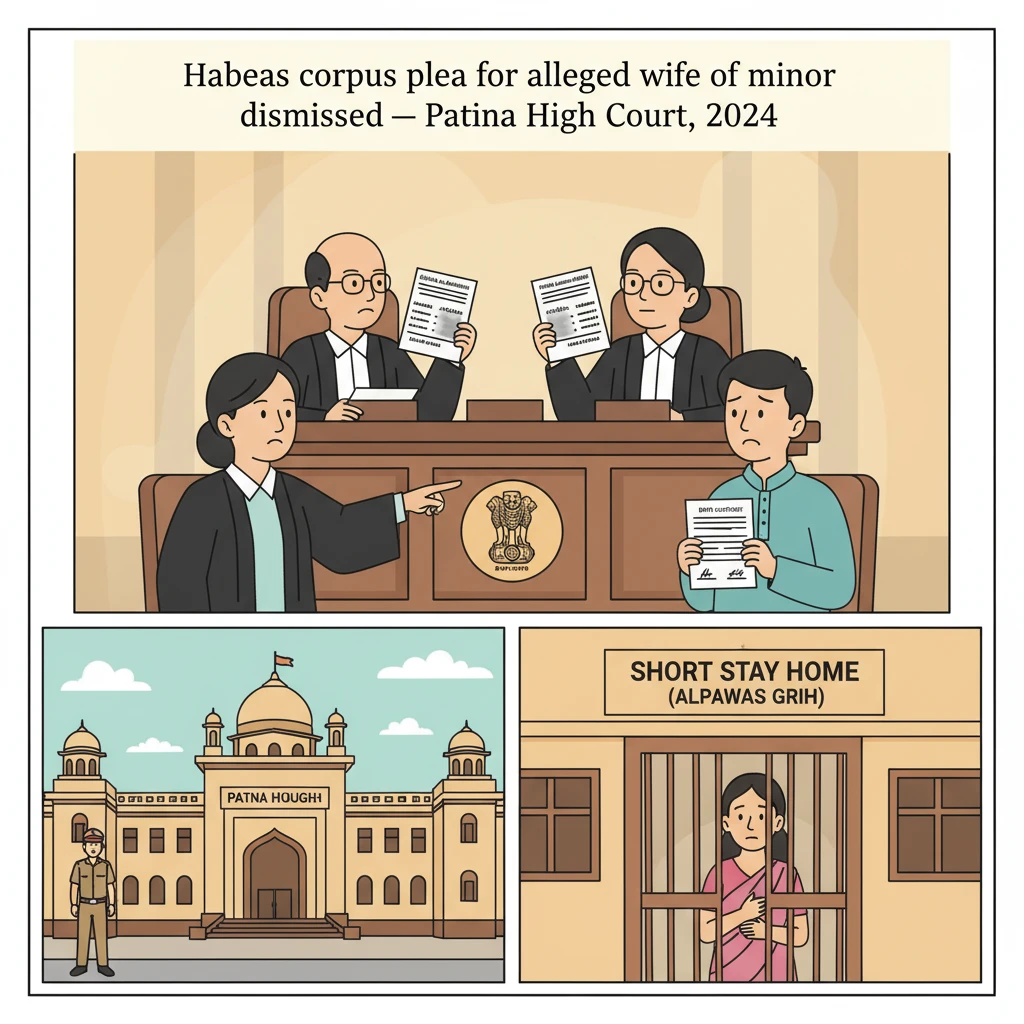
The case arose from a criminal proceeding registered as P.S. Case No. 21 of 2023 at Kako Police Station in Jehanabad district. During the course of events, a young girl, referred to in the judgment only as the “victim”, came under the protection of the authorities. Her name and that of her relative were not disclosed by the Patna High Court to protect her identity and prestige, as required by law.
The petitioner, a resident of Nawada village under Kako Police Station, Jehanabad, claimed that the victim was his legally wedded wife and that she was a major. He approached the Patna High Court under its criminal writ jurisdiction by filing Criminal Writ Jurisdiction Case No. 724 of 2024. His core grievance was that the authorities were illegally confining his alleged wife in a Short Stay Home (Alpawas Grih).
The petitioner sought a writ of habeas corpus, which is a constitutional remedy where a court can order that a person unlawfully detained be produced before it and released. He requested the Court to direct that the victim be produced and released from what he described as “illegal confinement” on the ground that she was a married major girl entitled to live with him.
Along with this main relief, the petitioner also prayed for any other appropriate writ, order, or direction that the Court deemed fit on the facts of the case.
What the Court Examined and Decided
The Division Bench of the Patna High Court, comprising Hon’ble Mr. Justice P. B. Bajanthri and Hon’ble Mr. Justice Alok Kumar Pandey, heard the matter. The CAV judgment was authored by Hon’ble Mr. Justice Alok Kumar Pandey and delivered on 06.05.2024.
The central point for the Court was simple but crucial: whether the victim was a minor or a major. The answer to this question would decide if she could legally be in a relationship or marriage with the petitioner and whether her stay in the Short Stay Home could be called “illegal confinement”.
Counsel for the petitioner argued that the victim was an adult. He relied on a birth certificate issued by the Registrar (Birth and Death), Nagar Parishad, Jehanabad. This certificate recorded the victim’s date of birth as 14.08.2004. On this basis, the petitioner claimed that she was more than 18 years old at the relevant time and therefore competent to marry and live with him by her own choice.
The petitioner’s counsel submitted that the marriage between the petitioner and the victim had been solemnised, that she was his wife, and that being a major she was entitled to live with him. According to the petitioner, her continued stay in the Short Stay Home was against her will and amounted to illegal detention by the authorities.
On the other hand, the State, represented by the learned Advocate General, contested the petitioner’s claim regarding the victim’s age. The State relied on two different official records connected with the victim’s education. First, it referred to the School Admission Register, which recorded the victim’s date of birth as 04.08.2007. Secondly, it relied on the mark sheet issued by the Bihar School Examination Board, Patna, which also showed her date of birth as 04.08.2007.
The State argued that these educational records were clear and consistent. Based on the date of birth 04.08.2007, the victim’s age was less than 18 years at the time of the proceedings. Therefore, the State contended, she was a minor, and any claim of valid marriage with the petitioner, as well as any insistence that she be allowed to live with him, could not be legally sustained.
The Court examined the materials placed on record from both sides. Though the petitioner produced a birth certificate giving a different date of birth, the Court placed emphasis on the school and examination records produced by the State. The judgment records that:
“As per School Admission Register, date of birth of victim is 04.08.2007. … mark sheet of victim issued by Bihar School Examination Board, Patna clearly indicates that date of birth of the victim is 04.08.2007 and on the basis of said certificate age of the victim is less than 18 years. In this way, victim is minor.”
After assessing the documents, the Court concluded that the victim was indeed still a minor. This factual finding was fundamental to the outcome of the case.
The Court also considered the circumstances of the victim’s custody. Earlier, by order dated 24.04.2024, the Court had directed that the victim’s mother appear before it. In compliance, the mother came to court and made a statement. She expressed that she was afraid of keeping her daughter with her.
The judgment notes that the petitioner has criminal antecedent. Although the details of those antecedents are not recorded in the judgment, this factor appears as part of the Court’s appraisal of the overall situation. In the Court’s view, the combination of the victim’s minority, the mother’s unwillingness to keep her due to fear, and the petitioner’s antecedents required that the victim continue to remain in protective custody.
The Court recorded that the victim was presently staying in a Short Stay Home (Alpawas Grih). Given that she was a minor and that her mother did not wish, or perhaps did not feel safe, to take her back, the Court treated her stay at the Short Stay Home as lawful protective custody rather than illegal confinement.
The Court concluded:
“From perusal of the material available on record, it is evident that victim is minor and her mother is not ready to keep the victim with her. Presently, victim has been kept in Short Stay Home (Alpawas Grih). Hence, petitioner has not made out a case as there is no illegal confinement of the victim.”
Having reached this conclusion, the Court examined the maintainability of the habeas corpus petition. A writ of habeas corpus is meant to challenge unlawful detention. Once the Court held that the victim’s custody in the Short Stay Home was legal and justified because she was a minor requiring protection, there was no basis to issue such a writ.
Accordingly, in paragraph 7 of the judgment, the Court stated that, considering the facts, circumstances and material on record, the criminal writ petition was not maintainable and therefore stood dismissed. No further directions were passed, and the existing arrangement of the victim’s stay in the Short Stay Home continued.
Why This Judgment Matters
This decision is important for families, young couples, and lawyers dealing with similar situations involving alleged love marriages with girls whose age is disputed. The Patna High Court made it clear that when there is a conflict about age, school and examination records can carry significant weight in deciding whether someone is a minor.
If a girl is found to be a minor, her stay in a government-run shelter home, such as a Short Stay Home or Alpawas Grih, will not be treated as illegal confinement. Instead, it is seen as protective custody, especially where her parents or guardians are unwilling or unable to keep her safely at home.
For people thinking of filing habeas corpus petitions in similar circumstances, this judgment shows that the Court will first look closely at the age of the girl and the lawfulness of her custody. Where the custody is lawful and intended for her protection as a minor, the Court is unlikely to interfere or permit her to go with a person claiming to be her spouse.
Legal Issues and Answers
- Issue: Whether the young girl, claimed by the petitioner as his wife, was a major or a minor at the relevant time.
Answer: Based on the School Admission Register and the Bihar School Examination Board mark sheet, the Court held that her date of birth was 04.08.2007 and that she was a minor. - Issue: Whether her stay in the Short Stay Home (Alpawas Grih) amounted to illegal confinement justifying issuance of a writ of habeas corpus.
Answer: The Court held that, since she was a minor and her mother was not ready to keep her, her stay in the Short Stay Home was lawful protective custody and not illegal confinement; hence the habeas corpus petition was not maintainable and was dismissed.
Cases Cited by the Court
- No prior judgments or case law have been cited or relied upon in the text of this decision.
Case Details
Case Number: Criminal Writ Jurisdiction Case No. 724 of 2024, arising out of P.S. Case No. 21 of 2023, Kako Police Station, District Jehanabad.
Case Title: Manish Raj @ Mani Kumar @ Manish Kumar v. The State of Bihar & Ors.
Coram: Hon’ble Mr. Justice P. B. Bajanthri and Hon’ble Mr. Justice Alok Kumar Pandey.
Citation: 2024(2) PLJR 769.
Advocates: For the petitioner – Ms. Kumari Anjani Sinha. For the respondents – Mr. Advocate General.
Nature of the Case: Criminal writ petition seeking a writ of habeas corpus.
Date of Judgment: 06.05.2024. CAV date: 01.05.2024.
Link to the Judgment: Patna High Court Judgment – Cr. WJC No. 724 of 2024
If you found this explanation helpful and wish to stay informed about
how legal developments may affect your rights in Bihar,
you may consider following Samvida Law Associates for more updates.







