

Case Background
This case arose out of an externment order passed by the District Magistrate, Khagaria, under the Bihar Control of Crimes Act, 1981.
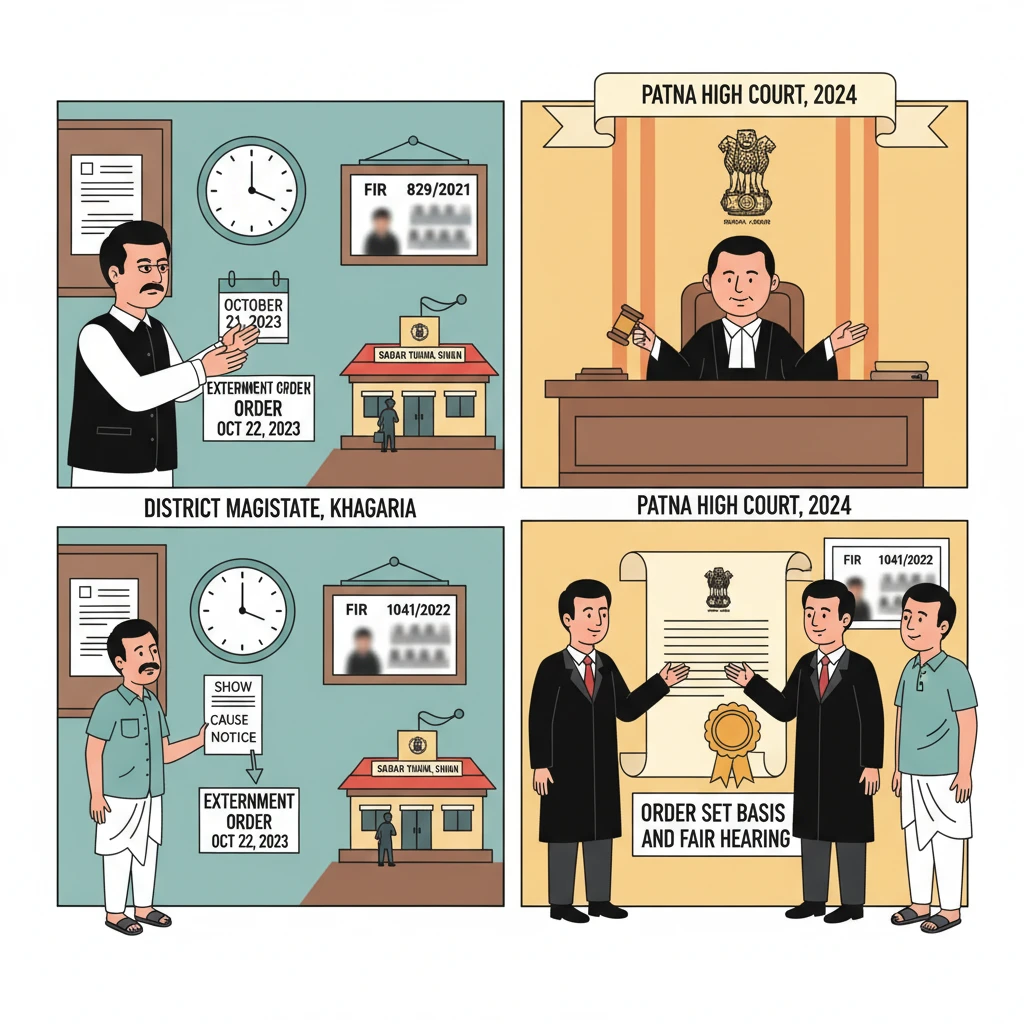
On 21.10.2023, the District Magistrate issued a notice to the petitioner under Section 3(3) of the Act in B.C.C.A. Case No. 33 of 2023. The notice called upon him to show cause why he should not be externed from Khagaria district as an “anti-social element”.
The petitioner submitted his reply. Despite this, on 22.10.2023, the District Magistrate passed an order declaring him an anti-social element and directing his externment for one month from Khagaria district. He was also directed to report every day to Sadar Thana, Siwan, between 9–11 a.m. and 5–8 p.m.
Aggrieved, the petitioner approached the Patna High Court in Criminal Writ Jurisdiction Case No. 635 of 2024. He challenged the legality of the externment order and the manner in which the proceedings were conducted.
What the Court Examined and Decided
The petitioner’s main challenge was to the externment order dated 22.10.2023 passed by the District Magistrate, Khagaria, under the Bihar Control of Crimes Act, 1981.
He sought quashing of the order of externment, a direction to the authorities to explain the haste in conducting the proceedings, and an explanation on what basis proceedings were initiated under the Act. He also sought compensation for harassment and humiliation caused by the externment order. The Court finally confined itself to examining the legality of the externment order and the procedure adopted.
The petitioner argued that the externment proceedings violated the principles of natural justice. The notice was issued on 21.10.2023, asking him to reply by 22.10.2023. The time gap was less than 24 hours. According to him, this made the right to be heard an empty formality, especially when such a serious consequence as externment was involved.
He also argued that there was no live connection between the alleged offences and the externment order. Two FIRs had been lodged against him, one in 2021 and another in 2022. The externment order came only in October 2023, with no explanation as to why past cases of 2021 and 2022 suddenly justified an externment in 2023.
The petitioner further submitted that, from the FIRs themselves, the only offence touching Chapter XVI or Chapter XVII of the Indian Penal Code (which deal with offences against the human body and against property) that could arguably apply was Section 353 IPC. On this basis, he argued he could not be treated as a person “habitually” committing offences under those Chapters.
He relied upon Section 3(1) of the Bihar Control of Crimes Act, 1981. Under this provision, an externment order can be passed only if the person is an “anti-social element” as defined in Section 2(d) of the Act. According to him, his alleged conduct did not fit the strict definition of “anti-social element”.
The State, on the other hand, justified the externment order. It submitted that the order was based on reports from the Superintendent of Police, Khagaria, the Sub-Divisional Police Officer, Sadar, Khagaria, and the Station House Officer, Chitraguptanagar, Khagaria. The State argued that the petitioner had committed serious offences and associated with several criminals. On the basis of the two registered cases, the District Magistrate’s order was said to be sound and not requiring interference.
The Patna High Court, speaking through Hon’ble Mr. Justice Alok Kumar Pandey, with Hon’ble Mr. Justice P. B. Bajanthri concurring, first reproduced and analysed the statutory scheme.
Section 2(d) of the Bihar Control of Crimes Act, 1981 defines “anti-social element”. It covers, among others, a person who habitually commits or attempts or abets offences under Chapters XVI and XVII of the IPC, and a person convicted of specified offences under the Arms Act, 1959. Section 3 of the Act allows externment of such “anti-social elements” when their acts or movements cause alarm or when they are engaged or about to engage in such offences. The District Magistrate must issue a written notice informing the person of the general nature of allegations and give a reasonable opportunity to explain.
The Court emphasised that, from the language of Section 3(1), a person must first qualify as an “anti-social element” under Section 2(d). Only then does the District Magistrate get jurisdiction to consider externment. If a person does not fall within this definition, Section 3 cannot be invoked at all.
The Court then examined whether the petitioner could be treated as an “anti-social element” on the strength of two FIRs relied upon by the District Magistrate. These were:
(i) Khagaria P.S. Case No. 1041 of 2022 dated 06.10.2022 under Sections 147, 341, 323, 188, 290, 353, 504, 506, 120B of the IPC and Section 37 of the Bihar Prohibition and Excise (Amendment) Act, 2022.
(ii) Khagaria (Chitraguptanagar) P.S. Case No. 829 of 2021 dated 16.10.2021 under Sections 188, 353, 290, 34 of the IPC.
The Court noted that none of these cases were under the Arms Act. Hence, sub-clause (v) of Section 2(d) (which relates to conviction under certain Arms Act provisions) did not apply.
The Court then turned to sub-clause (i) of Section 2(d), which requires that the person “habitually” commits, attempts, or abets offences under Chapter XVI or XVII of the IPC. Here, the key word was “habitually”.
For understanding “habitually”, the Court relied on the Supreme Court’s judgment in Vijay Narain Singh v. State of Bihar, (1984) 3 SCC 14, and also referred to Ayub alias Pappukhan Nawabkhan Pathan v. S.N. Sinha, (1990) 4 SCC 552. In those cases, the Supreme Court held that “habitually” means repeatedly or persistently and requires a thread of continuity connecting similar acts. Isolated or dissimilar acts do not make a person a habitual offender.
The Court observed that, under Section 2(d), for sub-clauses (i), (ii) and (iv), repeated acts of the same kind are needed to prove a “habit”. In contrast, for sub-clauses (iii) and (v), even a single act may sometimes be enough. Thus, in a case like the petitioner’s, governed by sub-clause (i), the State had to show repeated, similar offences under Chapters XVI or XVII to justify calling him an anti-social element.
In this background, the Court held that merely two cases in two different years are not enough to brand the petitioner as a “habitual” offender. There was nothing to show persistent or continuous criminal conduct of the type contemplated by the Act. Therefore, he did not fall within the definition of “anti-social element”.
The Court further noted that the District Magistrate relied only on the 2021 and 2022 cases but gave no explanation why those cases suddenly justified an externment order in October 2023. This lack of “live link” between past cases and the externment decision weakened the basis of the order.
On the issue of natural justice, the Court considered several Supreme Court judgments, including Mohinder Singh Gill v. Chief Election Commissioner, AIR 1978 SC 851; D.K. Yadav v. J.M.A. Industries Ltd., (1993) 3 SCC 258; Oryx Fisheries Pvt. Ltd. v. Union of India, (2010) 13 SCC 427; Kranti Associates Pvt. Ltd. v. Masood Ahmed Khan, (2010) 9 SCC 496; Divisional Personnel Officer, Southern Railway v. T.R. Challappan, 1975 AIR 2216; and Rahmat Khan @ Rammu Bismillah Khan v. Deputy Commissioner of Police, Criminal Appeal No. 912 of 2021.
Relying on these cases, the Court stressed that natural justice is part of Article 14 of the Constitution. Even administrative or quasi-judicial actions must be fair, reasonable, and must give a real opportunity to be heard. Authorities must consider the person’s reply with an active mind, record reasons, and avoid making the hearing a mere ritual.
In this case, the notice was served just one day before the externment order. The Court found that such a short interval made it practically impossible for the petitioner to prepare a meaningful defence. This reduced the right to be heard to a hollow formality and showed a biased and hasty approach by the authority.
Taking all these factors together, the Court concluded that the conditions precedent for invoking Section 3 of the Bihar Control of Crimes Act, 1981 were not satisfied. The petitioner did not qualify as an “anti-social element”, there was no clear live link between the cases and the externment order, and the principles of natural justice had been violated.
The High Court therefore held that the externment order dated 22.10.2023 passed by the District Magistrate, Khagaria, in B.C.C.A. Case No. 33 of 2023, was unsustainable in law. It set aside the order and allowed the criminal writ petition.
Why This Judgment Matters
This judgment is significant for anyone facing externment proceedings under the Bihar Control of Crimes Act, 1981.
First, it clarifies that a person cannot be branded an “anti-social element” merely because one or two criminal cases are registered against him. The authorities must show that he habitually and repeatedly commits the sort of offences described in the Act. Without this, the District Magistrate has no power to pass an externment order.
Second, the judgment reinforces that notice and hearing in externment matters must be real, not illusory. Giving less than 24 hours between notice and decision, especially in serious matters affecting liberty and movement, violates natural justice.
Third, the Court’s insistence on a clear “live link” between past conduct and current externment action is important. Old cases cannot mechanically be used to justify a fresh externment order without demonstrating how they create a present danger.
For residents of Bihar, especially those against whom old FIRs exist, this decision of the Patna High Court offers protection against arbitrary externment and emphasises that the law must be used carefully and fairly, not as a tool of harassment.
Legal Issues and Answers
- Issue: Can the District Magistrate extern a person under Section 3 of the Bihar Control of Crimes Act, 1981 on the basis of two FIRs from 2021 and 2022 and treat him as an “anti-social element” under Section 2(d)?
Answer: No. The Court held that two cases in different years, without more, do not establish that the person “habitually” commits offences under Chapters XVI or XVII of the IPC. Therefore, the petitioner did not fall within the definition of “anti-social element” and the District Magistrate lacked jurisdiction to pass the externment order. - Issue: Does giving less than 24 hours between issuing show cause notice and passing an externment order satisfy the principles of natural justice?
Answer: No. The Court held that serving notice just one day prior to the externment order made it impracticable for the petitioner to respond effectively and reduced natural justice to a mere formality. This procedural unfairness contributed to quashing the order. - Issue: Must there be a live connection between past criminal cases and the timing of an externment order?
Answer: Yes. The Court observed that the District Magistrate failed to explain how the 2021 and 2022 cases became relevant for ordering externment in 2023. In the absence of such explanation, the basis of externment was unsatisfactory.
Cases Cited by the Court
- Vijay Narain Singh v. State of Bihar, (1984) 3 SCC 14
- Ayub alias Pappukhan Nawabkhan Pathan v. S.N. Sinha, (1990) 4 SCC 552
- Mohinder Singh Gill & Anr. v. Chief Election Commissioner, New Delhi & Ors., AIR 1978 SC 851
- D.K. Yadav v. J.M.A. Industries Ltd., (1993) 3 SCC 258
- Oryx Fisheries Private Limited v. Union of India and Others, (2010) 13 SCC 427
- Kranti Associates Pvt. Ltd. v. Masood Ahmed Khan, (2010) 9 SCC 496
- Divisional Personnel Officer, Southern Railway & Anr. v. T.R. Challappan, 1975 AIR 2216
- Rahmat Khan @ Rammu Bismillah Khan v. Deputy Commissioner of Police, Criminal Appeal No. 912 of 2021 (SLP (Crl.) No. 1676 of 2021), referring to Gazi Saduddin v. State of Maharashtra, (2003) 7 SCC 330
Case Details
Case Number: Criminal Writ Jurisdiction Case No. 635 of 2024
Case Title: Harshvardhan Singh @ Harsh Vardhan v. The State of Bihar & Ors.
Citation: 2024(2) PLJR 761
Coram: Hon’ble Mr. Justice P. B. Bajanthri and Hon’ble Mr. Justice Alok Kumar Pandey
Advocates:
- For the petitioner: Ms. Mayuri Mishra, Advocate
- For the respondents (State): Mr. G.P. 12
Nature of the Case: Criminal writ petition challenging an externment order under Section 3 of the Bihar Control of Crimes Act, 1981 passed by the District Magistrate, Khagaria.
Impugned Order: Externment order dated 22.10.2023 in B.C.C.A. Case No. 33 of 2023 passed by the District Magistrate, Khagaria.
Final Outcome: Writ petition allowed; externment order dated 22.10.2023 set aside.
Link to Judgment: Patna High Court Judgment
If you found this explanation helpful and wish to stay informed about how legal developments may affect your rights in Bihar, you may consider following Samvida Law Associates for more updates.







