

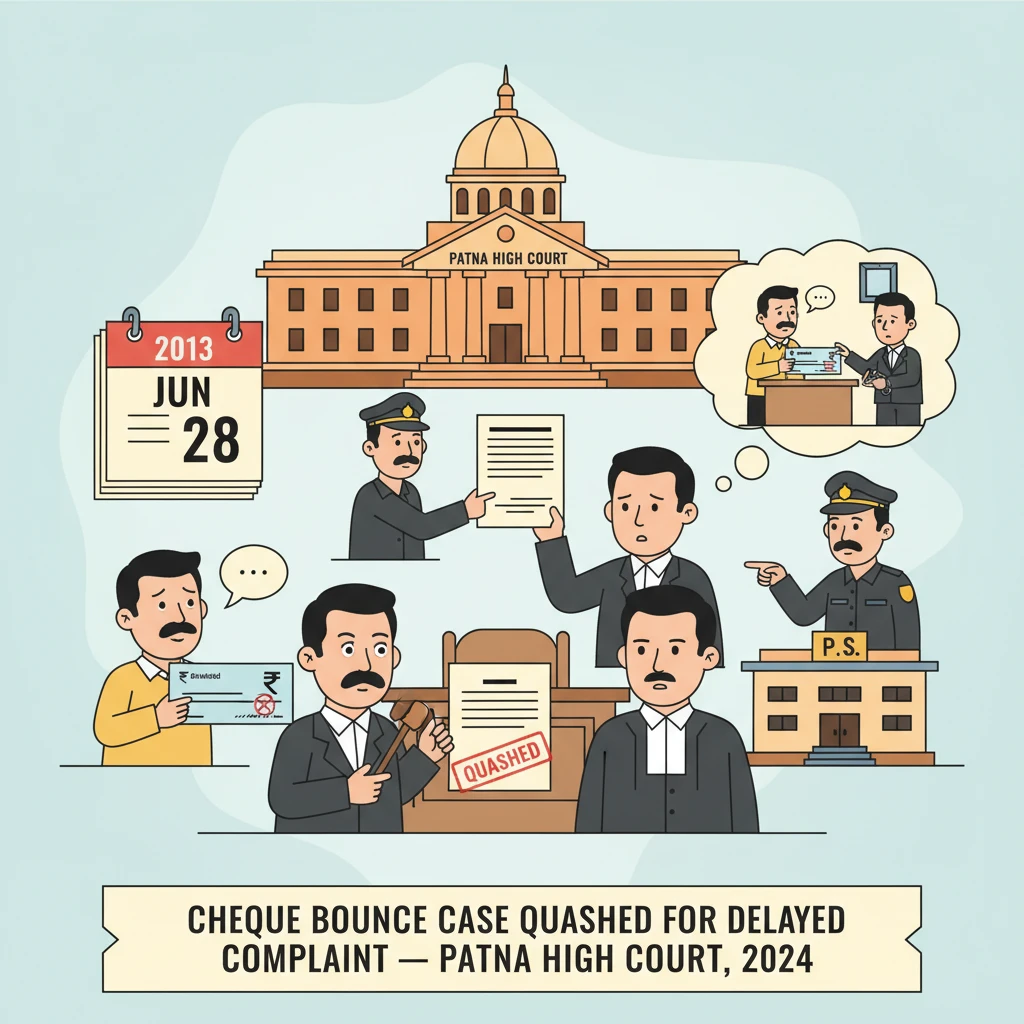
Case Background
This case arose from a private complaint filed in Muzaffarpur alleging cheque dishonour under Section 138 of the Negotiable Instruments Act, 1881 (N.I. Act).
According to the complainant (opposite party no. 2), the accused (petitioner) visited his house on 10.03.2013 and requested a friendly loan of Rs. 8 lakhs. On the basis of their prior acquaintance, the complainant claimed to have paid Rs. 8 lakhs on 15.03.2013, with an assurance that the amount would be returned by 15.06.2013.
When the alleged loan was not repaid, the complainant said he demanded payment on 26.06.2013. On that date, the petitioner is said to have issued Cheque No. 233717 dated 26.06.2013 drawn on Bank of Maharaja, Muzaffarpur, for Rs. 8 lakhs.
The cheque was presented to the bank but was returned unpaid for insufficiency of funds. The complainant received information of dishonour from the bank on 28.06.2013. A legal notice demanding payment was then sent to the petitioner on 26.07.2013. When no payment or reply came, the complainant filed Complaint Case No. 2549 of 2013.
After inquiry under Section 202 of the Code of Criminal Procedure, the Judicial Magistrate 1st Class, Muzaffarpur took cognizance of an offence under Section 138 of the N.I. Act on 08.09.2014 in Trial No. 4870 of 2015.
The accused challenged this cognizance order by filing Criminal Miscellaneous No. 27813 of 2015 before the Patna High Court, seeking quashing of the proceedings.
What the Court Examined and Decided
The Patna High Court, through Hon’ble Mr. Justice Rajiv Roy, focused mainly on the dates and statutory time limits under the N.I. Act to decide whether the Magistrate could legally take cognizance.
The petitioner did not dispute the sequence of dates relied upon by the complainant, and his counsel herself summarised them as follows:
(i) The cheque was issued on 26.06.2013.
(ii) Information of dishonour due to insufficient funds was received by the complainant from the bank on 28.06.2013.
(iii) Legal notice was sent by the complainant to the petitioner on 26.07.2013.
(iv) The complaint was filed on 17.09.2013.
Apart from the timing issue, the petitioner took a serious defence on facts. He alleged that the cheque in question was never issued towards any loan liability. Instead, according to him, opposite party no. 2 used to visit his house and stole a signed or blank cheque from his home. He said that after he came to know about misuse of the cheque, he lodged Muzaffarpur Sadar P.S. Case No. 287 of 2013 on 11.08.2013 under Sections 406, 420 and 379 of the Indian Penal Code against the complainant.
It was brought on record that in this police case, a charge-sheet (No. 295 of 2016 dated 14.04.2016) was submitted under Section 380 of the IPC and cognizance had been taken; the complainant was facing trial in that case.
The petitioner’s counsel argued that once the alleged theft FIR was lodged on 11.08.2013, the present cheque bounce complaint, filed later on 17.09.2013, was only a counterblast to “save his skin”. However, the High Court ultimately decided the matter on a narrower legal ground of limitation under Section 142 of the N.I. Act.
The Court reproduced Section 142 of the N.I. Act, which governs cognizance of offences under Section 138. Under Section 142(1)(b), a complaint must be filed within one month from the date on which the cause of action arises under clause (c) of the proviso to Section 138. That clause refers to failure of the drawer to make payment within 15 days of receipt of the statutory notice.
The Court then examined Section 138 itself, particularly its proviso, which lays down three mandatory steps:
(a) The cheque must be presented within six months of the date on which it is drawn or the period of its validity, whichever is earlier.
(b) The payee must make a demand for payment by giving written notice to the drawer within thirty days of receiving information from the bank regarding return of the cheque as unpaid.
(c) The drawer must fail to make payment within fifteen days of receiving the notice, after which the cause of action to file a complaint arises, and the complaint must be filed within one month under Section 142.
Applying these statutory steps to the admitted dates, the Court noted that the notice was dispatched on 26.07.2013, while the complaint came to be filed on 17.09.2013. This was “much beyond the period prescribed under ‘the Act’.”
The High Court stressed that Section 142 does create a narrow relaxation by adding a proviso which allows the court to take cognizance even beyond the prescribed period if the complainant satisfies the court that he had sufficient cause for not filing the complaint in time. However, two conditions must be fulfilled:
First, the complainant must explain the delay and state reasons in the complaint or otherwise. Second, the Magistrate must record his satisfaction, showing why he is accepting the delayed complaint and condoning the delay.
In this case, the High Court found that neither condition was met. The complaint filed by opposite party no. 2 contained “no explanation whatsoever” for the delay. There was no statement that the complaint was being filed late, nor any assertion of circumstances that prevented a timely filing.
More importantly, the Magistrate’s order taking cognizance did not record any satisfaction regarding delay. It did not show that he had consciously considered the limitation bar under Section 142 or that he was condoning any delay for sufficient cause. Without such satisfaction, the benefit of the proviso could not be invoked.
The Court held that in such circumstances, the Magistrate had “certainly exceeded its jurisdiction in taking cognizance in the matter.” The bar under Section 142 was clear: without a complaint filed within one month of cause of action, or without condonation upon sufficient cause, the court cannot validly take cognizance of an offence under Section 138.
The High Court also referred to its earlier decision in Jairam Sharma son of late Devi Singh & Anr. v. The State of Bihar & Anr., reported in 2010 (2) PLJR 646. In that case, the Court had discussed the nature of the N.I. Act as a separate code dealing with offences relating to promissory notes, bills of exchange and cheques. It noted that before the 2002 amendment, there was no provision for condoning delay in filing a complaint under Section 138, and the non-obstante clause barred cognizance if filed beyond time.
The insertion of the proviso to Section 142, as that judgment explained, gave the court power to consider reasons for delay and condone it. However, the use of the term “satisfies” means that the court can proceed only after sufficient reasons are made out and duly recorded.
Relying on this interpretation, the Patna High Court in the present case concluded that, in absence of any explanation by the complainant and any recorded satisfaction by the Magistrate, cognizance could not lawfully be taken.
The Court also noted the pending theft case regarding the same cheque. Though the final decision was not based solely on this aspect, the High Court observed that it “cannot ignore” the allegation that the cheque was stolen from the petitioner’s home, and that in that FIR, cognizance had been taken under Section 380 IPC and opposite party no. 2 was facing trial.
Ultimately, having found the cognizance order to be beyond jurisdiction due to limitation, the Court quashed the order dated 08.09.2014 passed by the Judicial Magistrate 1st Class, Muzaffarpur in Trial No. 4870 of 2015 (arising out of Complaint Case No. 2549 of 2013).
As a result, Criminal Miscellaneous No. 27813 of 2015 was allowed, and the cheque bounce proceedings against the petitioner in that trial stood quashed.
Why This Judgment Matters
This judgment is important for anyone involved in cheque bounce disputes in Bihar and beyond. It reinforces that Section 138 and Section 142 of the N.I. Act are strict about time limits.
If a cheque is dishonoured, the payee must act promptly—send notice in time, wait for 15 days, and then file the complaint within one month from the end of those 15 days. If this time window is missed, the complaint is not automatically acceptable.
The case shows that even if the accused did not appear at the cognizance stage, higher courts can later examine whether the Magistrate had the power to take cognizance at all. If there is delay, the complainant must clearly explain why, and the Magistrate must record reasons for condoning that delay.
For borrowers and accused persons, the decision also shows that limitation is a real defence. If the complaint is filed late without explanation, proceedings can be quashed even before trial.
Legal Issues and Answers
- Issue: Can a Magistrate take cognizance of an offence under Section 138 of the N.I. Act when the complaint is filed beyond the one-month limitation period without any explanation from the complainant and without recording satisfaction for condoning delay?
Answer: No. The Patna High Court held that in such a situation the Magistrate exceeds his jurisdiction, as Section 142 requires the complaint to be filed within one month of cause of action, and delayed complaints can be entertained only if sufficient cause is shown and the Magistrate records his satisfaction. - Issue: What is the effect of non-compliance with the mandatory time frame under Sections 138 and 142 of the N.I. Act on cheque bounce proceedings?
Answer: Non-compliance renders the cognizance order invalid. If limitation is not followed and delay is neither explained nor condoned on record, the complaint cannot proceed, and the High Court can quash the cognizance order and the related trial.
Cases Cited by the Court
- Jairam Sharma son of late Devi Singh & Anr. v. The State of Bihar & Anr., 2010 (2) PLJR 646.
- The judgment in Jairam Sharma in turn referred to Chandra Deo Singh v. Prakash Chandra Bose @ Chabi Bose & Another, AIR 1963 SC 1430, while distinguishing its factual context.
Case Details
Case Number: Criminal Miscellaneous No. 27813 of 2015; arising out of Complaint Case No. 2549 of 2013, Trial No. 4870 of 2015.
Case Title: Krishna Mohan Kumar v. State of Bihar & Vivek Kumar.
Citation: 2024 (2) PLJR 698.
Coram: Hon’ble Mr. Justice Rajiv Roy.
Advocates:
For the petitioner: Mrs. Bela Singh, Advocate; Mr. Avinash Kumar Pandey, Advocate.
For the State: Mr. Nawal Kishore Pd., APP.
For the opposite party no. 2 (complainant): Mr. Ravindra Kumar Shukla, Advocate; Mr. R.R. Shukla, Advocate.
Nature of the case: Petition under Section 482 Cr.P.C. (criminal miscellaneous) seeking quashing of cognizance order in a complaint case under Section 138 of the Negotiable Instruments Act.
Date of High Court Judgment: 28.03.2024 (C.A.V.; CAV date 20.03.2024).
Link to the Judgment: Patna High Court Judgment
If you found this explanation helpful and wish to stay informed about
how legal developments may affect your rights in Bihar,
you may consider following Samvida Law Associates for more updates.







