

Case Background
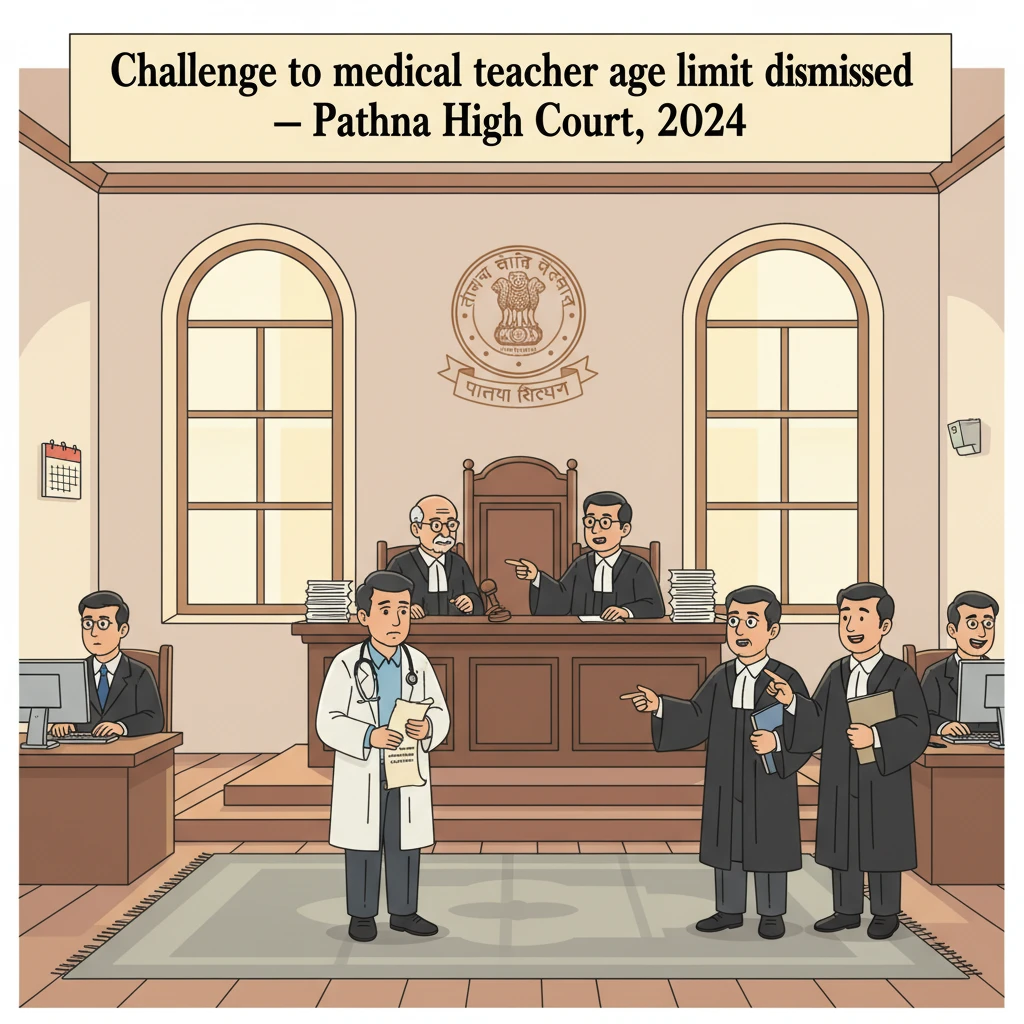
The case was filed as a writ petition before the Patna High Court, registered as Civil Writ Jurisdiction Case No.6780 of 2024.
The petitioner is a doctor who challenged a specific provision in the “Senior Resident/Tutor and Bihar Medical Education Service Recruitment, Appointment and Promotion Rules, 2008”.
The challenge was directed against Rule 7(iii)(d) of Chapter 4 of those 2008 Rules. This rule fixes the maximum age for appointment to the post of Assistant Professor in government medical colleges in Bihar.
Under this rule, the maximum age is 45 years for candidates from the unreserved category, 50 years for candidates from Scheduled Castes and Scheduled Tribes, and 48 years for other reserved categories.
The petitioner argued that this age scheme is inconsistent with the “Minimum Qualifications for Teachers in Medical Institutions Regulations, 1998” framed by the National Medical Commission (earlier Medical Council of India), as amended under Section 57 of the National Medical Commission Act, 2019.
The petitioner placed reliance on Schedule 1 of these Regulations, which mentions that persons can be appointed as teachers in medical institutions up to the age of 70 years. On this basis, the petitioner asked the Court to strike down the Bihar rule that sets much lower age limits.
The matter was heard by a Division Bench of the Patna High Court comprising Hon’ble the Chief Justice and Hon’ble Mr. Justice Harish Kumar. The judgment was delivered on 29.04.2024 by the Chief Justice speaking for the Bench.
What the Court Examined and Decided
The Court began by clearly identifying the core relief sought: the striking down of Rule 7(iii)(d) of the 2008 Bihar Rules governing recruitment, appointment and promotion in the Bihar Medical Education Service, particularly in relation to the post of Assistant Professor.
The petitioner’s main contention was that Bihar’s fixation of a lower maximum age limit directly conflicts with the National Medical Commission’s Regulations, which, through Schedule 1, allow appointment of teachers in medical institutions up to 70 years of age.
According to the petitioner, once the National Medical Commission, exercising its power under Section 57 of the National Medical Commission Act, 2019, has laid down that teachers in medical colleges may be appointed up to the age of 70, the State of Bihar must adopt that same upper age limit. The argument was that State Rules must be brought “in consonance” with the central Regulations and that any lesser maximum age would be invalid.
In support of this argument, learned counsel for the petitioner relied on the Supreme Court decision in Dr. Professor Rajendra Chaudhary v. State of Uttar Pradesh, (2020) 13 SCC 278. That case concerned recruitment of Professors in medical colleges in Uttar Pradesh.
The Patna High Court therefore had to examine two connected questions:
First, what exactly is the legal effect of Schedule 1 of the Minimum Qualifications Regulations that mentions the upper age of 70 years? Is it a mandatory age that every State must adopt?
Second, what guidance does the Supreme Court’s decision in Dr. Professor Rajendra Chaudhary provide about the relationship between the National Medical Commission’s (earlier MCI’s) Regulations and State service rules on age limits?
The Court closely read Schedule 1 of the Regulations, which the petitioner had produced as Annexure P5. This Schedule, as noted by the Court, specifically provides “the maximum age limit up to which a person can be appointed” as 70 years.
The Bench highlighted the words “up to”. It stressed that the Regulations say that appointment can be made up to 70 years; they do not say that the State must appoint every candidate up to that age or that every State must fix 70 years as the mandatory maximum age in their service rules.
In other words, the Court read the Regulations as setting an outside ceiling, not a compulsory standard that every State government must copy exactly.
To test the petitioner’s reading further, the Court turned to the Supreme Court judgment in Dr. Professor Rajendra Chaudhary. In that case, the relevant State Service Rules in Uttar Pradesh had earlier prescribed a maximum age of 45 years for direct recruitment to the post of Professor in medical colleges.
Later, an advertisement was issued enhancing the upper age limit from 45 years to 65 years, which some candidates challenged on the ground that it violated the Medical Colleges Teachers Services Rules, 2005, that formally still mentioned 45 years.
The High Court of that State had upheld the enhancement, and the Supreme Court approved this view. The Supreme Court held that the Government Order dated 06.02.2015 that permitted enhancement of the upper age limit to 65 years only supplemented the Rules and did not “supplant” them. It accepted that the Regulations framed by the medical regulator prevailed over conflicting service rules.
The Patna High Court also took note of a key observation in that earlier High Court decision, which the Supreme Court had affirmed. That observation was that the enhancement of the upper age limit in Uttar Pradesh had been driven by a shortage of qualified teachers in medical institutions for appointment as Professors. The relaxation was made department-specific and applied only where 25 per cent or more of the posts were vacant.
The important point for the Patna High Court was that, even though the medical regulator’s Regulations permitted appointment up to 70 years, the age in Uttar Pradesh was enhanced only to 65 years, and the Supreme Court accepted this. This showed, in the view of the Patna Bench, that the Regulations merely allow States to relax their upper age limits “up to” a maximum of 70 years; they do not require that every State must fix the maximum age at 70.
The Court emphasised the phrase “up to” in the Regulations and explained its understanding: the National Medical Commission sets 70 years as the outer boundary. States are free to move their own upper age limits higher, but cannot go beyond 70. However, it does not follow that States cannot keep a lower upper age limit if they consider it appropriate.
Turning back to Bihar, the Court noted that the 2008 Rules already prescribe upper age limits of 45/48/50 years for different categories for appointment as Assistant Professor. The State Government had not chosen to use the relaxation allowed by the National Medical Commission Regulations to raise these limits.
The Bench stated that such a choice by the Government cannot be seen as illegal or unconstitutional on the basis of the Regulations alone. It described the Regulations framed by the medical regulator as laying down “minimum standards”. According to the Court, States are not permitted to dilute these minimum standards, but they can certainly impose stricter conditions (“a rigor can definitely be applied”).
In age terms, the Court clarified that the State would be prohibited from providing any maximum age beyond 70 years, because that would violate the outer limit fixed by the Regulations. But it is not prohibited from providing a lesser maximum age, such as 45/48/50, if it thinks that is suitable for its service.
Thus, so long as the State does not cross the 70-year limit, it can make its own policy choices about the upper age for recruitment, even if the result is a stricter regime than what the Regulations might allow.
On this reasoning, the Court concluded that Rule 7(iii)(d) of the 2008 Bihar Rules is “perfectly in order”. The regulation of the National Medical Commission does not make it mandatory to adopt 70 years as the maximum age. It only allows a State to go up to 70 years, if it so chooses, and Bihar has opted not to exercise that relaxation.
Finding no conflict between the Bihar Rules and the Regulations, and no legal basis to strike down the Rule, the Court held that there was no reason to entertain the writ petition. The petition was accordingly dismissed.
Why This Judgment Matters
This judgment is important for doctors and other aspirants seeking faculty posts in government medical colleges in Bihar.
It makes clear that the State’s existing upper age limits of 45, 48 and 50 years for Assistant Professor posts remain valid and enforceable.
The Patna High Court has clarified that the National Medical Commission Regulations, which speak of appointment up to 70 years, do not give an automatic right to candidates above the State’s age bar to demand consideration.
For policymakers, the ruling confirms that Bihar is not legally bound to raise its maximum age for medical teachers to 70 years, though it may choose to do so in future as a matter of policy.
The decision also sends a wider message: central regulatory standards that set an outer limit, such as an upper age “up to” a certain number of years, may act as a ceiling that States cannot cross, but they do not always operate as a compulsory floor that States must match.
Legal Issues and Answers
- Issue: Is Rule 7(iii)(d) of the 2008 Bihar Rules, which fixes the maximum age at 45/48/50 years for appointment as Assistant Professor, invalid because the National Medical Commission Regulations allow appointment of medical teachers up to 70 years?
Answer: No. The Patna High Court held that the Regulations only permit States to relax the upper age limit up to a maximum of 70 years but do not mandate 70 years as the compulsory upper age. Bihar is free to prescribe a lower maximum age, provided it does not exceed 70. - Issue: Do the National Medical Commission Regulations override the State’s decision not to enhance the age limit for medical teachers?
Answer: No. The Court held that the Regulations prescribe minimum standards and set an outer ceiling. They prevent States from going beyond 70 years but do not prevent States from maintaining stricter age limits below that threshold.
Cases Cited by the Court
- Dr. Professor Rajendra Chaudhary v. State of Uttar Pradesh; (2020) 13 SCC 278.
Case Details
Case Number: Civil Writ Jurisdiction Case No.6780 of 2024
Case Title: Dr. Nishant v. The State of Bihar & Others
Citation: 2024(2) PLJR 670
Coram: Hon’ble the Chief Justice; Hon’ble Mr. Justice Harish Kumar
Advocates:
- For the petitioner: Mr. Kumar Kaushik, Advocate
- For the State: Mr. P.K. Shahi, Advocate General; Mr. Amish Kumar, AC to AG
- For National Medical Commission: Mr. Kumar Priya Ranjan, Sr. Standing Counsel; Mr. Sandeep Kumar, Advocate; Mr. Vibhuti Kumar, Advocate
Nature of the case: Writ petition under civil writ jurisdiction challenging the validity of a recruitment rule relating to maximum age for appointment as Assistant Professor in Bihar Medical Education Service.
Link to full judgment: Patna High Court Judgment CWJC No.6780 of 2024
If you found this explanation helpful and wish to stay informed about
how legal developments may affect your rights in Bihar,
you may consider following Samvida Law Associates for more updates.







