

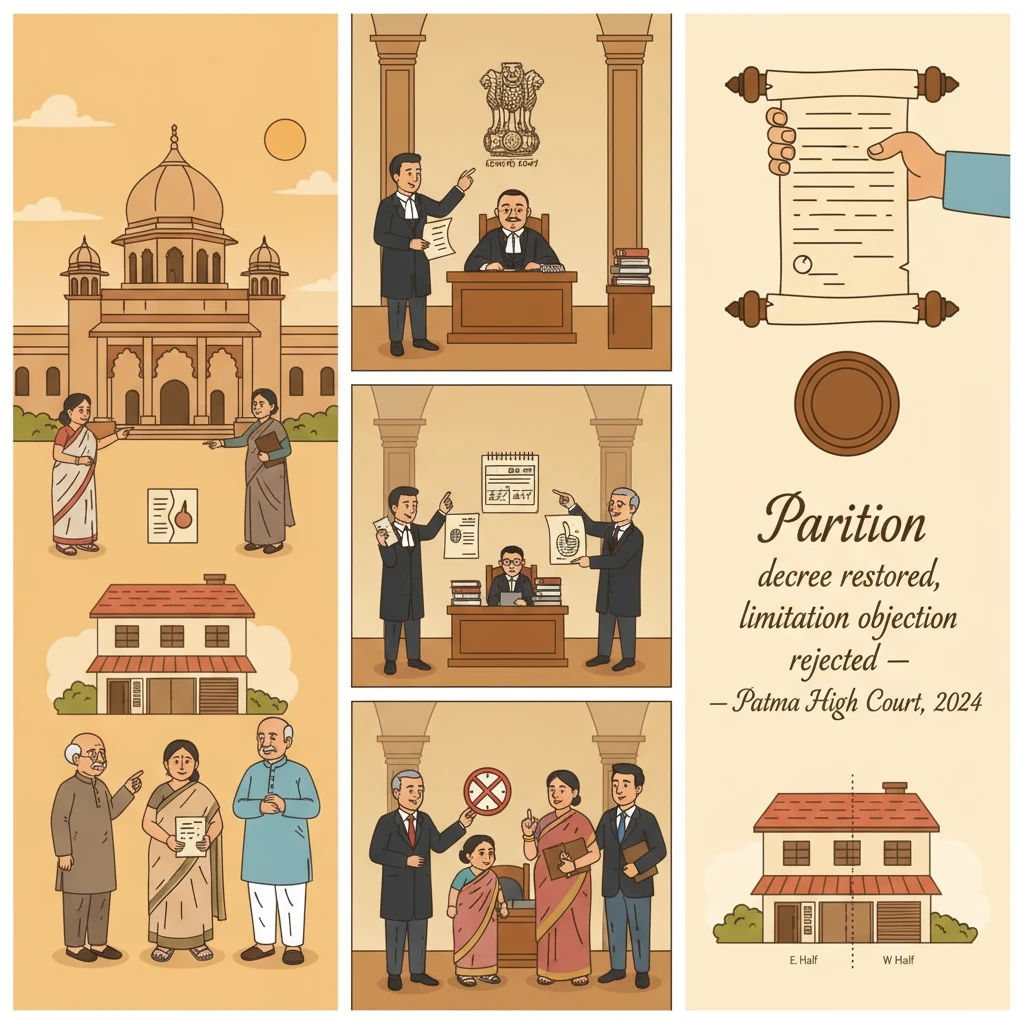
Case Background
The dispute relates to a residential house with five shops in Mohalla Alamganj, Biharsharif, Nalanda. The property stands on municipal Holding Nos. 419 and 420 (old) and later 549, 550 and 551 (new), in Ward No. 28.
The common ancestor was Ram Kishun Ram @ Fateh Ram. He had four sons, including plaintiff no. 1 Rajendra Ram and defendant no. 1 Ramji Ram, and two daughters. According to the plaintiffs, the house was bought from joint family funds and remained joint family property.
After the death of Ram Kishun Ram, defendant no. 1 Ramji Ram became karta of the joint family. The extended family lived in the suit house. The shops were let out to tenants and rent was collected by Ramji Ram.
Over time, the plaintiffs demanded their share in the rent and sought repairs and separate mess. This led to friction. A proceeding under Section 107 of the Code of Criminal Procedure, 1973, was started between the brothers but later dropped.
The plaintiffs claimed that Rajendra Ram was illiterate and had full faith in his elder brother, who used to take his left thumb impression on blank and other papers. They feared that such papers had been misused to create documents against their interest.
In 2002, the plaintiffs filed Title Suit No. 162 of 2002 before the Subordinate Judge-I, Biharsharif. They sought declaration of their title, partition of half share in the house, and a declaration that a sale deed dated 27.09.1967 was forged and fabricated and should be set aside.
The trial court decreed the suit in favour of the plaintiffs, holding that the property was joint and that the sale deed was not proved.
The defendants filed Title Appeal No. 53 of 2005 before the Additional District and Sessions Judge, Fast Track Court No. 1, Nalanda. The first appellate court reversed the trial court, held that there had been a partition, that the plaintiffs were not in joint possession, and that the suit was barred by limitation though it also found the sale deed to be forged and void.
Against this reversal, the plaintiffs filed Second Appeal No. 237 of 2008 before the Patna High Court under Section 100 of the Code of Civil Procedure, 1908.
What the Court Examined and Decided
The Patna High Court, through Hon’ble Mr. Justice Arun Kumar Jha, focused on two substantial questions of law. First, whether, after holding the sale deed dated 27.09.1967 (Exhibit F/1) to be forged, fabricated, void and inoperative, the first appellate court could still deny relief on the ground of limitation. Second, whether non-consideration of the plaintiffs’ oral evidence by the appellate court vitiated its judgment of reversal.
The plaintiffs’ story was that the house always remained joint. They said no partition ever took place and that the 1967 sale deed in favour of defendant no. 1 was not a genuine transaction. They described plaintiff no. 1 as illiterate and dependent on defendant no. 1 for all paperwork, including thumb impressions on blank sheets.
They pleaded that they came to know of the alleged sale deed only when the defendants mentioned it in their written statement in the partition suit. By an amendment, they specifically attacked the sale deed as forged, fabricated, without consideration, and void.
The defendants made a very different claim. They traced title to a common ancestor Sanichar Tanti and then to Ram Kishun Ram, who allegedly became full owner in 1933. They said that after Ram Kishun’s death, plaintiff Rajendra Ram and defendant Ramji Ram first remained joint and then partitioned the house in 1961, with a “Yadast” document dated 26.05.1961 recording this. According to them, eastern half went to Ramji, western half to Rajendra. They relied on an unregistered Yadast as Exhibit K.
The defendants further alleged that Rajendra Ram, needing money, sold his western half to Ramji Ram by a registered sale deed dated 27.09.1967 (Exhibit F/1) for Rs. 2,000. After this, Ramji Ram claimed to be absolute owner of the entire house, got mutation done, paid municipal taxes, and let out the premises to tenants through registered tenancy deeds.
They also claimed that later, considering Rajendra’s poor financial condition, Ramji Ram gave a portion of the house back to him in March 1998 on rent at Rs. 400 per month. When Rajendra allegedly stopped paying rent in April 2000, Ramji Ram filed Eviction Suit No. 09 of 2003.
The trial court examined both oral and documentary evidence. It found unity of title and possession and held that both sides had half share. It disbelieved the partition story and held that the defendants had not proved the sale deed of 1967.
The first appellate court relied mainly on documents filed by the defendants, especially:
- Exhibit F/1 – original sale deed dated 27.09.1967.
- Exhibits H and H/1 – order sheets in a municipal proceeding regarding mutation.
- Exhibit H/3 – order sheet dated 11.07.1990 in Mutation Case No. 66/67/90-91 filed by the plaintiff’s wife.
On this basis it concluded that partition had taken place in 1961 and that the parties were in separate possession thereafter. It also held that the plaintiffs had knowledge of the sale deed at least from 11.07.1990 and, as they filed the suit in 2002, it was beyond three years and barred by limitation.
However, the appellate court simultaneously held that Exhibit F/1 was forged, fabricated, void and inoperative and that the defendants failed to prove its execution.
The Patna High Court found this reasoning legally unsound. Once a court concludes that a sale deed is forged and void, there is in substance no valid transfer. In such a situation, making limitation the basis to refuse relief about that very deed is problematic, especially when the deed’s existence itself stands disbelieved on evidence.
The High Court closely examined Exhibits H, H/1 and H/3, which the appellate court had used to infer the plaintiffs’ knowledge of the sale deed:
• Exhibits H and H/1 showed that notice in a municipal proceeding regarding Holding Nos. 419 and 420 was initially returned unserved with a report that Rajendra was “not found” or had gone somewhere outside. There was no further service report or clear material to show that he later appeared after proper notice. Yet the municipal order sheet recorded an appearance and “no objection” by Rajendra regarding mutation in favour of Ramji Ram.
The High Court held that when the tamila (service report) itself recorded non-service, the sudden alleged appearance of Rajendra and giving of consent for mutation became doubtful. There was no material on record about how his identity was verified before the municipal authority. In such circumstances, these documents could not safely be used to hold that Rajendra had clear knowledge of the contents of Exhibit F/1.
• Exhibit H/3 showed that the plaintiff’s wife, Balkeshiya Devi, later filed Mutation Case No. 66/67/90-91 seeking mutation of the same holdings in her name. The municipal authority refused, noting that a sale deed no. 11293/1967 existed in favour of Ramji Ram and that unless it was set aside by a competent court, mutation could not be done in her favour.
The first appellate court treated this order as proof that the family knew of the sale deed by 11.07.1990. The High Court took a more cautious approach. It accepted that, in normal circumstances, notice to spouse could amount to knowledge to the other. But here the execution of the sale deed itself was doubtful and tainted by the way thumb impressions were allegedly taken. In such a context, identity and participation of Balkeshiya Devi in the mutation case had to be proved very clearly, which the defendants had not done.
The Court also noted another important fact appearing from Exhibits H and H/1. Two persons had intervened in those municipal proceedings claiming that Holding Nos. 419 and 420 had been mortgaged to them after the date of the alleged sale deed. The municipal authority recorded that the mortgage was “subsequent” to the sale.
The High Court reasoned that if Rajendra had already sold the property to Ramji Ram in 1967, there was no occasion for him to mortgage the same property later to anyone else. This circumstance cast further doubt on the genuineness of the sale deed and the defendants’ story.
The High Court also found it strange that, during Rajendra’s lifetime, his wife would file for mutation in her own name instead of his, which again raised questions about the correctness of the narrative suggested by the defendants.
On consideration of the oral evidence, the High Court found significant gaps in the appellate court’s approach. Defendant no. 1 himself, examined as DW-6, had stated that his father died in 1946 and that partition between the brothers took place one and a half years thereafter. This was inconsistent with the defendants’ own pleading that partition occurred in 1961 evidenced by the Yadast.
DW-6 further stated that after that early partition, the brothers were not even on speaking terms, making it difficult to believe that Rajendra later calmly accepted a Yadast Batwara in 1961. The Yadast itself (Exhibit K) was unregistered and did not inspire confidence.
On the other hand, plaintiff Rajendra, examined as PW-5, denied any partition in 1961 and denied selling Holding Nos. 419 and 420 or handing over possession to Ramji.
The High Court held that none of the defence witnesses, apart from DW-6, could clearly support the claimed 1961 partition. There was no reliable documentary evidence of such partition beyond the doubtful Yadast. Thus, the first appellate court’s finding that partition had taken place on 25.06.1961 was contrary to the oral evidence and unsupported by convincing documents.
The Court concluded that the appellate court had failed to properly consider the plaintiffs’ oral evidence and had placed undue reliance on doubtful documents. This failure vitiated its judgment.
Answering the substantial questions of law, the Patna High Court held that:
- The plaintiffs could not be denied relief against Exhibit F/1 on limitation grounds when knowledge of the deed could not be safely imputed to them and when the deed had already been found forged, fabricated, void and inoperative.
- The non-consideration and mis-appreciation of oral evidence by the first appellate court did vitiate its judgment of reversal.
Accordingly, the High Court set aside the judgment and decree of the first appellate court and restored the trial court’s decree in favour of the plaintiffs. The second appeal was allowed.
Why This Judgment Matters
This judgment is important for families in Bihar and elsewhere who face disputes over old family houses and shops, especially where one member is illiterate or dependent on another for paperwork.
The Patna High Court shows that a registered document is not automatically accepted if its execution is doubtful and the person said to have signed it is illiterate and alleges misuse of thumb impressions.
The Court also makes clear that limitation (time bar) cannot be used mechanically to shut out a claim when the very existence and knowledge of the disputed document is under serious doubt. Authorities’ mutation orders and municipal records must be carefully examined, especially where initial notices were not served or identity of the appearing person is unclear.
For poor and less-educated people, the case underlines the importance of challenging suspicious documents but also offers reassurance that courts will look beyond technicalities if there is a serious question of fraud or misuse of trust within the family.
Legal Issues and Answers
- Issue: Could the plaintiffs be denied relief against the 1967 sale deed as time-barred when the courts had already held the deed to be forged, fabricated, void and inoperative?
Answer: No. The Patna High Court held that limitation did not run against the plaintiffs in the absence of clear proof that they knew of the sale deed earlier, and once the deed was found forged and void, refusing relief on limitation was legally unsustainable. - Issue: Did the first appellate court’s failure to properly consider oral evidence, especially on the alleged 1961 partition, vitiate its reversal of the trial court judgment?
Answer: Yes. The High Court found that the appellate court ignored crucial oral evidence, including contradictory statements of DW-6 and denials by PW-5, and wrongly relied on a doubtful unregistered Yadast. This non-consideration of oral evidence vitiated its findings. - Issue: Was there proof of an earlier partition and separate possession that could defeat the plaintiffs’ claim for partition?
Answer: No. The Court held that the alleged 1961 partition was not established by reliable evidence. Therefore, unity of title and possession between the co-sharers continued, entitling the plaintiffs to seek partition.
Cases Cited by the Court
- The judgment records several decisions cited in arguments, including S.V.R. Mudaliar v. Rajabu F. Buhari, AIR 1995 SC 1607; Ram Charitra Mahto v. Satya Narain Sahu, (2001) 4 PLJR 627; Ram Charittar Sahu v. Sadrul Hassan, (1997) 1 PLJR 880; Dilbagrai Punjabi v. Sharad Chandra, AIR 1988 SC 1858; C. S. Ramaswamy v. V. K. Senthil, 2023 (1) PLJR (SC) 44; Suraj Lamp & Industries (P) Ltd v. State of Haryana, AIR 2009 SC 3077; Devji Shivji v. Karsandas Ramji, AIR 1954 Pat 280; Harbans Singh v. Tekamani Devi, AIR 1990 Pat 26; Kaliaperumal v. Rajagopal, AIR 2009 SC 2122; Uma Shankar Rai v. Kishun Rai, (2010) 3 PLJR 46; Bharat Singh v. State of Haryana, (1988) 4 SCC 534; and M/S Trinity Infraventures Ltd. & Ors. v. M.S. Murthy & Ors., Civil Appeal arising out of SLP (C) Nos. 2373-2377 of 2020.
Case Details
Case Number: Second Appeal No. 237 of 2008
Case Title: Meena Devi & Ors v. Sushila Devi & Ors
Court: High Court of Judicature at Patna
Bench / Coram: Hon’ble Mr. Justice Arun Kumar Jha
Date of Judgment: 29.02.2024
Citation: 2024(2) PLJR 254
Nature of Case: Second appeal under Section 100 of the Code of Civil Procedure, 1908, arising out of a title/partition suit challenging a sale deed and seeking declaration of title and partition.
Trial Court: Subordinate Judge-I, Biharsharif (Nalanda), in Title Suit No. 162 of 2002.
First Appellate Court: Additional District & Sessions Judge, Fast Track Court No. 1, Nalanda, in Title Appeal No. 53 of 2005.
Advocates:
- For the appellants in the High Court (plaintiffs): Mr. Suman Kumar, Advocate; Mr. Amar Nath Singh, Advocate; Mr. Satya Prakash, Advocate.
- For the respondents in the High Court (defendants): Mr. Anil Kumar Jha, Senior Advocate; Mr. Binoy Kumar, Advocate.
Link to Judgment: Full text of Patna High Court judgment
If you found this explanation helpful and wish to stay informed about
how legal developments may affect your rights in Bihar,
you may consider following Samvida Law Associates for more updates.







